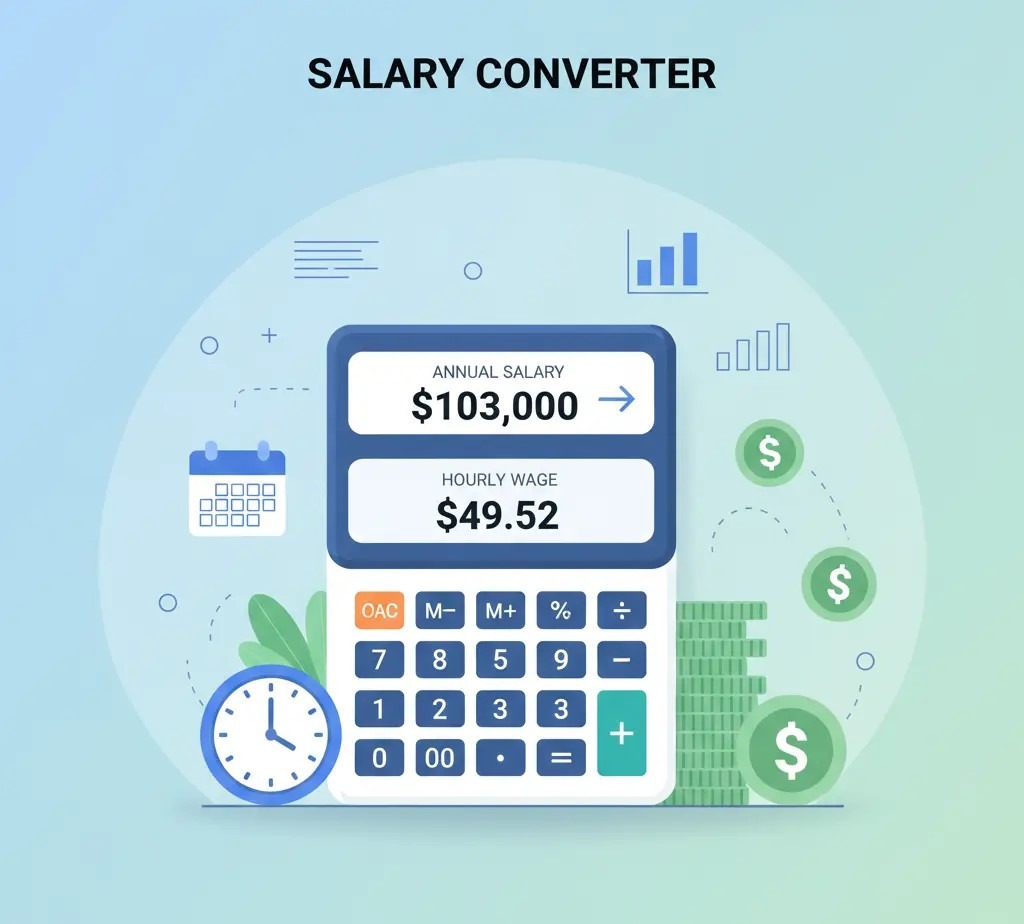
$103,000 a year equals $49.52 per hour if you work 40 hours a week.
Here’s the calculation:
$103,000 ÷ 2,080 hours (52 weeks × 40 hours) = $49.52/hour
Your exact hourly rate varies based on actual hours worked:
| Annual Salary | Weekly Hours | Hourly Rate |
| $103,000 | 35 | $56.59/hour |
| $103,000 | 37.5 | $52.82/hour |
| $103,000 | 40 | $49.52/hour |
| $103,000 | 45 | $44.02/hour |
| $103,000 | 50 | $39.62/hour |
| $103,000 | 60 | $33.01/hour |
Why Hours Worked Determines Your Real Hourly Wage
Most salaried professionals assume $103,000 annually always means the same hourly rate. This assumption costs people money.
If your actual work schedule involves 50 hours weekly including emails, meetings, and projects after hours, your true hourly rate drops to $39.62 instead of $49.52. That represents a 20% pay reduction for the extra time invested.
This calculation matters when 1000 a week is how much an hour deciding whether to accept overtime assignments, comparing salaried positions against hourly contracts, evaluating promotion offers that increase responsibilities and hours, or setting freelance consulting rates based on your current value.
Many employers present attractive annual salary figures to obscure lower effective hourly compensation. Calculate your real hourly wage using actual working hours, not just scheduled hours. Include time spent on work emails outside office hours, weekend projects, and commute time if required for job duties.
$103,000 Salary: Complete Time Period Breakdown
Understanding income across multiple timeframes enables better financial planning and budgeting:
| Time Period | Amount | Calculation Method |
| Hourly | $49.52 | $103,000 ÷ 2,080 hours |
| Daily (8 hrs) | $396.15 | $103,000 ÷ 260 workdays |
| Weekly | $1,980.77 | $103,000 ÷ 52 weeks |
| Bi-weekly | $3,961.54 | $103,000 ÷ 26 pay periods |
| Monthly | $8,583.33 | $103,000 ÷ 12 months |
| Quarterly | $25,750 | $103,000 ÷ 4 quarters |
| Semi-annually | $51,500 | $103,000 ÷ 2 |
| Annually | $103,000 | Base salary |
Practical Applications of These Figures
Bi-weekly income of $3,961.54 aligns with the most common American pay schedule, helping you manage cash flow between paychecks. Monthly gross of $8,583.33 forms the foundation for rent, utilities, insurance, and recurring subscription budgeting.
Daily earnings of $396.15 provide perspective on purchase decisions by framing costs in terms of work days required. An $800 expense equals roughly two days of gross pay, while a $4,000 vacation represents about 10 working days.
Hourly rate of $49.52 serves as your baseline for evaluating consulting opportunities, side projects, or freelance work. Any additional income opportunities paying less than this rate effectively reduce your total earnings per hour invested.
$103,000 After Taxes: Your Actual Take-Home Pay
Reality check: Your $49.52/hour becomes approximately $37-39/hour after taxes.
Gross salary differs significantly from spendable income. Here’s what various governments extract from your $103,000:
Federal Tax Calculation (Single Filer, Standard Deduction)
Federal Income Tax Breakdown:
- First $11,600: 10% = $1,160
- $11,601 to $47,150: 12% = $4,266
- $47,151 to $103,000: 22% = $12,287
- Total Federal Income Tax: approximately $17,713
FICA Deductions:
- Social Security: 6.2% = $6,386
- Medicare: 1.45% = $1,494
- Total FICA: $7,880
Combined Federal Deductions: $25,593 (24.8%)
Take-Home Pay Comparison Across States
State income taxes create substantial differences in actual purchasing power:
| State | State Tax | Total Tax | Annual Net | Monthly Net | Effective Hourly |
| Texas | $0 | 24.8% | $77,407 | $6,451 | $37.22 |
| Florida | $0 | 24.8% | $77,407 | $6,451 | $37.22 |
| Nevada | $0 | 24.8% | $77,407 | $6,451 | $37.22 |
| Washington | $0 | 24.8% | $77,407 | $6,451 | $37.22 |
| Tennessee | $0 | 24.8% | $77,407 | $6,451 | $37.22 |
| Arizona | $2,575 | 27.3% | $74,832 | $6,236 | $35.98 |
| Pennsylvania | $3,162 | 27.9% | $74,245 | $6,187 | $35.69 |
| Illinois | $5,098 | 29.7% | $72,309 | $6,026 | $34.76 |
| New York | $6,557 | 31.2% | $70,850 | $5,904 | $34.06 |
| California | $6,330 | 31.0% | $71,077 | $5,923 | $34.17 |
| Oregon | $9,218 | 33.7% | $68,189 | $5,682 | $32.78 |
Critical Financial Insights
Choosing to live in a no-income-tax state saves $6,330-9,218 annually compared to high-tax states like California or Oregon. This difference equals $527-768 monthly, enough to cover a car payment, significantly boost retirement savings, or accelerate mortgage principal payments.
The hourly wage gap between Texas and Oregon reaches $4.44 per hour for identical gross salaries. Over a full year, this state tax difference costs Oregon residents 234 additional working hours of after-tax income.
In Texas, you retain 75.1% of gross income with an effective net hourly rate of $37.22. In Oregon, you keep only 66.2% with an effective rate of $32.78. Same job title, same gross pay, vastly different financial reality.
Is $103,000 Annually a Good Salary?
Direct answer: Yes, for most Americans in most locations. However, three variables determine actual financial comfort: geographic cost of living, household size, and existing debt obligations.
National Income Comparisons
$103,000 positions you well above typical American earners:
- US median household income: $74,580. Your salary exceeds this by 38%.
- US median individual income: $40,480. You earn 154% more than this benchmark.
- Comfortable living threshold for singles: $43,200. You surpass this by 238%.
- Middle-class range: $45,800-$137,400. You occupy the upper-middle segment.
- Top income percentile: You rank in approximately the 75th-80th percentile nationally.
Single Person Lifestyle Assessment
In moderate cost-of-living cities like Atlanta, Phoenix, Houston, Charlotte, Indianapolis, or Columbus:
You can comfortably afford a 2-bedroom apartment or small house without stretching your budget. Savings of 25-30% of gross income are achievable, accumulating $25,750-30,900 annually. Maximizing retirement accounts becomes feasible with $23,000 in 401k contributions plus $7,000 in IRA contributions yearly.
International travel 2-3 times per year fits within your discretionary budget. Building a 6-month emergency fund of approximately $38,700 takes 18-24 months with disciplined saving. Car payments, comprehensive insurance, regular dining out, entertainment, and hobbies all fit without causing financial stress.
In expensive coastal metropolitan areas like San Francisco, New York City, Los Angeles, Boston, Seattle, or San Diego:
Housing costs will consume 45-55% of net income for a decent one-bedroom apartment. Savings capacity drops to 10-15% of gross income, limiting wealth accumulation. Roommates or living in outer suburbs become necessary for meaningful retirement contributions.
Transportation costs run higher due to parking fees, tolls, and higher vehicle insurance rates. Retirement account maximization becomes difficult without sacrificing other quality-of-life expenses. However, basic needs remain covered without requiring public assistance programs.
Family Financial Picture
For a household of 3-4 people, $103,000 provides a functional but tight budget requiring careful money management:
Manageable expenses:
- Modest 3-bedroom house or apartment in suburban or lower-cost urban areas
- Two reliable used vehicles or one newer family vehicle
- Public school education without additional tutoring expenses
- Employer-sponsored family health insurance with moderate deductibles
- Domestic vacations 1-2 times yearly focused on budget-friendly destinations
- Basic savings for minor emergencies
Financially stressful items:
- Private school tuition ranging $12,000-35,000 annually per child
- Childcare costs for multiple young children at $1,500-3,000 monthly
- College savings accounts for multiple children requiring $300-500 monthly per child
- Large unexpected expenses like major home repairs or medical bills
- Building substantial wealth beyond basic retirement savings
- Regular extracurricular activities and sports for multiple children
Financial planners typically recommend $125,000-160,000 minimum household income for comfortable family living with children in most American markets.
Monthly Budget Breakdown for $103,000 Salary
Realistic monthly budget using Texas as baseline with $6,451 net monthly income:
50/30/20 Budget Framework Applied
NEEDS CATEGORY (50% = $3,226 monthly)
- Housing costs: $1,700 (rent/mortgage, property tax, insurance)
- Utilities: $260 (electricity, water, gas, internet, trash)
- Groceries and household items: $520
- Transportation: $465 (car payment, fuel, maintenance, insurance)
- Health insurance premiums: $205 (employee portion after employer contribution)
- Cell phone service: $76
WANTS CATEGORY (30% = $1,935 monthly)
- Restaurant dining and takeout: $520
- Entertainment and recreation: $310
- Hobbies and personal interests: $260
- Shopping for clothing and personal care: $310
- Travel and vacation fund: $415
- Gym membership or fitness: $120
SAVINGS AND INVESTMENTS (20% = $1,290 monthly)
- 401k retirement contribution: $835 (enough to maximize employer match)
- Emergency fund building: $260
- Roth IRA contribution: $195 (toward $7,000 annual limit)
Annual Savings Potential
This budget produces $15,480 in direct savings annually through the 20% allocation. Adding typical employer 401k matching of 3-6% of salary contributes another $3,090-6,180, bringing total annual savings to $18,570-21,660.
This savings rate enables building a full 6-month emergency fund of approximately $19,350 within 15-18 months while simultaneously funding retirement accounts. After establishing emergency reserves, you can redirect those funds toward additional investment accounts, down payments for property, or accelerated debt elimination.
Careers That Pay $103,000 Annually
Six-figure salaries appear across diverse industries and roles. These professions commonly reach or exceed $103,000:
Technology Sector
- Software Engineer (mid-level): $95,000-145,000
- Data Scientist: $100,000-155,000
- Cloud Solutions Architect: $108,000-165,000
- DevOps Engineer: $98,000-148,000
- Cybersecurity Analyst (senior): $95,000-140,000
- IT Systems Engineer: $92,000-135,000
- Product Manager: $100,000-160,000
- UX/UI Designer (senior): $95,000-135,000
Healthcare Professions
- Registered Nurse (experienced or specialized): $85,000-120,000
- Nurse Practitioner: $105,000-140,000
- Physician Assistant: $105,000-140,000
- Physical Therapist (established practice): $85,000-110,000
- Occupational Therapist (specialized): $80,000-108,000
- Pharmacist: $115,000-150,000
- Medical Laboratory Scientist (supervisor): $75,000-105,000
Business and Finance
- Financial Analyst (senior level): $88,000-125,000
- Certified Public Accountant (5+ years): $85,000-115,000
- Management Consultant: $92,000-145,000
- Sales Manager: $88,000-140,000
- Marketing Manager: $88,000-130,000
- Human Resources Manager: $88,000-125,000
- Operations Manager: $85,000-120,000
- Business Analyst (senior): $85,000-120,000
Engineering Fields
- Mechanical Engineer (experienced): $85,000-120,000
- Electrical Engineer: $88,000-125,000
- Civil Engineer (project manager): $85,000-118,000
- Chemical Engineer: $90,000-130,000
- Industrial Engineer: $82,000-115,000
Skilled Trades and Specialized Roles
- Master Electrician (business owner): $80,000-130,000
- HVAC Business Owner/Master Technician: $75,000-120,000
- Construction Project Manager: $88,000-130,000
- Commercial Plumber (master level): $75,000-115,000
- Real Estate Agent (top performers): $85,000-250,000+
- Insurance Broker (established): $80,000-150,000
Education and Public Service
- School Principal: $88,000-130,000
- College Professor (tenured): $85,000-135,000
- Instructional Coordinator: $75,000-110,000
- Education Administrator: $85,000-125,000
Other Professional Positions
- Commercial Airline Pilot: $95,000-250,000+
- Air Traffic Controller: $100,000-185,000
- Attorney (3-7 years experience): $90,000-160,000
- Actuary: $105,000-160,000
- Urban Planner (senior): $75,000-110,000
Most positions require bachelor’s degrees in relevant fields, professional certifications, or 5-10 years of progressive experience. Some high-earning trades bypass traditional degrees but demand apprenticeships, licensure, and business acumen.
Path to Earning $103,000 Annually
Traditional Career Progression
The standard route involves completing a bachelor’s degree in a high-demand discipline such as engineering, computer science, healthcare, business, or finance. Entry positions typically start at $55,000-75,000 with natural progression to $103,000+ within 5-8 years through promotions and experience accumulation.
Career advancement speed depends on industry growth rate, company size, individual performance, and market demand for specific skills. Technology and healthcare sectors often reach six figures faster than education or nonprofit fields.
Accelerated Paths
Several careers offer faster timelines to $103,000+ compensation. Sales roles with aggressive commission structures can reach six figures within 2-4 years for top performers. Technology bootcamp graduates occasionally land $90,000-110,000 positions within 12-18 months of completion when they possess transferable skills and strong portfolios.
Skilled trades through apprenticeship programs reach high earnings by starting independent businesses after 6-8 years of training and journeyman work. Master electricians and plumbers who establish their own companies often exceed $103,000 within 7-10 years total from starting apprenticeships.
Consulting and contract work in specialized fields can hit $103,000+ quickly. Professionals with niche expertise command premium hourly rates of $75-150, reaching six-figure annual income through 30-35 billable hours weekly.
Required Education and Credentials
Healthcare positions demand specific degrees and licensing. Nurse Practitioners and Physician Assistants require master’s degrees plus clinical hours and board certification. Pharmacists need Doctor of Pharmacy degrees. Registered Nurses need either associate or bachelor’s degrees plus NCLEX licensure.
Technology roles increasingly accept alternative credentials. Relevant certifications like AWS Solutions Architect, CISSP for cybersecurity, or PMP for project management often carry more weight than traditional degrees. Strong GitHub portfolios and demonstrated skills can substitute for formal education in software engineering.
Finance and accounting positions value professional designations. CPA certification requires passing a comprehensive exam and completing experience requirements. CFA designation demands years of study and exam passage. These credentials significantly boost earning potential beyond base degrees.
Timeline Expectations
Most professionals starting from entry-level positions reach $103,000 within 7-12 years. High-growth technology and healthcare fields can achieve this in 4-7 years. Traditional corporate environments or slower-growing industries may require 10-15 years.
Career switchers who leverage existing skills and networks often reach six figures faster than fresh graduates. A marketing manager transitioning to product management might achieve $103,000 within 3-5 years rather than starting from zero.
What Lifestyle Does $103,000 Support?
Housing Affordability
Applying the 28% rule where housing costs should not exceed 28% of gross monthly income:
- Maximum affordable monthly housing: $2,403
- This supports purchasing a $480,000-600,000 home with 20% down payment in moderate markets
- Rental budget allows $2,100-2,400 monthly for quality 2-bedroom apartments in mid-tier cities
In affordable regions like Texas, Ohio, or North Carolina, this budget purchases 3-4 bedroom houses with yards in good school districts. In expensive markets like California or Massachusetts, the same budget covers 1-2 bedroom apartments or requires longer commutes to afford single-family homes.
Transportation Budget
Vehicle affordability extends to $35,000-45,000 purchases with conventional financing. Monthly payments of $450-650 fit comfortably within budget constraints. Leasing premium brands becomes financially feasible, though not necessarily optimal for wealth building.
Insurance, fuel, maintenance, and registration costs add $250-400 monthly depending on vehicle choice and driving habits. Total transportation allocation of $700-1,000 monthly accommodates comfortable, reliable vehicles without financial strain.
Discretionary Spending Capacity
After covering necessities and savings, approximately $1,900-2,100 monthly remains for discretionary purchases and experiences. This enables dining out 2-4 times weekly, regular entertainment like concerts or sporting events, active hobby participation, and shopping without constant budget monitoring.
Vacation and Travel
Dedicating $400-500 monthly toward travel accumulates $4,800-6,000 annually for vacations. This budget supports two international trips to nearby destinations like Mexico or Caribbean islands, or three domestic vacations including airfare, hotels, and activities. Premium accommodation and first-class flights remain largely out of reach without reducing other expenses.
Family Considerations
Single individuals enjoy comfortable, financially secure lifestyles at $103,000 in most American cities. Stress-free living includes robust savings, quality housing, reliable transportation, regular entertainment, and vacation travel without constant money concerns.
Couples without children find $103,000 enables significant savings toward future goals like home down payments, starting families, or early retirement. Quality of life remains high with room for both partners to pursue interests and hobbies.
Families with children face tighter constraints requiring more deliberate budgeting and trade-offs. Quality of life remains good but demands prioritization between savings, housing size, activities, and lifestyle choices. Daycare costs particularly strain budgets, often consuming $1,000-2,500 monthly for multiple children.
Common Questions About $103,000 Salary
How much is $103,000 biweekly before taxes?
$103,000 annually equals $3,961.54 per biweekly paycheck before any deductions. After federal taxes, FICA, and state taxes where applicable, expect $2,775-2,975 per biweekly paycheck depending on your state and tax filing status.
What is 103k salary after taxes?
Federal taxes reduce $103,000 to approximately $77,407 in no-tax states. High-tax states like California or Oregon leave $68,189-71,077 after all deductions. Your filing status, deductions, and state of residence determine exact take-home amounts.
How much is $103,000 a year monthly?
Gross monthly income equals $8,583.33 before taxes. Net monthly income ranges from $5,682 in high-tax states to $6,451 in no-tax states after federal and state tax withholdings.
Is $49.52 an hour good pay?
Yes, $49.52 hourly represents strong compensation placing you in the upper-middle income bracket nationally. This rate substantially exceeds the US median hourly wage of approximately $24 and provides financial stability for most households.
How much is 103 thousand a year hourly?
$103,000 annually converts to $49.52 per hour based on standard 2,080 working hours yearly. If you work fewer hours, your effective hourly rate increases proportionally. Working more hours decreases your real hourly compensation.
What percentage of Americans earn over $103,000?
Approximately 22-25% of individual earners in the United States make $103,000 or more annually. For households, roughly 33-36% reach or exceed this income threshold, making it an upper-middle-class salary.
Can you live comfortably on $103,000 a year?
Yes, singles live very comfortably on $103,000 in virtually all American cities except the most expensive like San Francisco or Manhattan. Families can live well but with tighter budgets requiring more financial planning and fewer luxuries.
Is $103,000 considered wealthy?
No, $103,000 represents upper-middle class income, not wealth. While above median, it still requires budgeting and does not provide luxury lifestyle. True wealth typically involves assets and passive income, not just salary.
How much is $103k after taxes monthly?
After-tax monthly income ranges from $5,682 in high-tax states like Oregon to $6,451 in no-tax states like Texas or Florida. This assumes single filer status with standard deductions.
Quick Reference: Salary Conversion Table
For mental math and quick comparisons:
Annual to Hourly Conversions (40-hour week):
- $95,000 = $45.67/hour
- $98,000 = $47.12/hour
- $100,000 = $48.08/hour
- $103,000 = $49.52/hour
- $105,000 = $50.48/hour
- $108,000 = $51.92/hour
- $110,000 = $52.88/hour
- $115,000 = $55.29/hour
Simple Approximation Formula: Divide annual salary by 2,000 for quick estimates. Example: $103,000 ÷ 2,000 = $51.50/hour. This slightly overestimates by assuming 50 weeks of work, but provides useful ballpark figures for rapid calculations.
Reverse Calculation Method: Multiply hourly rate by 2,080 to determine annual equivalent. Example: $49.52 × 2,080 = $102,961.60, approximately $103,000 annually.
Maximizing Your $103,000 Income
Tax Optimization Strategies
Maximize contributions to tax-advantaged retirement accounts. Contributing the full $23,000 to your 401k reduces taxable income to $80,000, saving $5,060 in federal taxes. Adding $7,000 to a Roth IRA doesn’t reduce current taxes but provides tax-free growth and retirement withdrawals.
Utilize Health Savings Accounts if you have qualifying high-deductible health insurance. Family HSA contribution limits of $8,300 provide triple tax benefits: deductible contributions, tax-free growth, and tax-free medical withdrawals. This saves an additional $1,826 in federal taxes annually.
These strategies combined reduce federal tax burden by approximately $6,886 yearly while simultaneously building retirement wealth and healthcare reserves.
Geographic Arbitrage Opportunities
Consider whether your position allows remote work from lower cost-of-living areas or states without income tax. Relocating from California to Texas while maintaining the same $103,000 salary increases take-home pay by $6,330 annually, equivalent to a $6,330 raise requiring no additional work.
Housing cost differences compound these savings. Identical $2,000 monthly rent in Dallas might buy 1,400 square feet while barely covering 600 square feet in San Francisco. Lower property taxes, insurance, and utilities in moderate cost states can save another $3,000-6,000 annually.
Combined geographic arbitrage can increase effective purchasing power by 15-25% without changing jobs or earning more income.
Career Advancement Focus
At $103,000, target reaching $125,000-150,000 within 3-5 years through strategic career moves. The jump from $103,000 to $135,000 often proves easier than the climb from $70,000 to $103,000 because you’ve already demonstrated value and capability at senior levels.
Pursue specialized certifications relevant to your field. AWS certifications for cloud roles, PMP for project managers, or CPA for accountants can justify $10,000-25,000 salary increases within 12-24 months of completion.
Develop skills in emerging technologies or methodologies your industry needs. Becoming the expert in areas like AI implementation, automation, or data analytics positions you for rapid advancement and compensation increases.
Additional Income Development
Your $103,000 base provides stability to build supplementary income streams. Consulting 5-10 hours weekly in your professional field at $80-120/hour adds $20,800-62,400 annually. This requires no additional education, leverages existing expertise, and can grow into full-time business if desired.
Create information products like online courses, templates, or guides related to your professional expertise. Initial creation requires time investment but generates ongoing passive income once established.
Invest in dividend-paying stocks or real estate that generates monthly cash flow. Your strong income enables building investment portfolios that eventually provide significant passive income supplementing salary.
Final Analysis of $103,000 Annual Compensation
A $103,000 annual salary ($49.52 hourly, $8,583 monthly) positions you solidly in America’s upper-middle class. This income level provides genuine financial security, enables meaningful wealth accumulation, and supports comfortable living standards in most markets.
However, the value of $103,000 fluctuates dramatically based on geographic location, with no-state-income-tax jurisdictions providing $6,000-9,000 more annual spending power than high-tax states. Family size critically impacts lifestyle quality, with single individuals thriving while families of four must budget more carefully.
The path to maximizing this income involves understanding true take-home pay after all deductions, strategically selecting lower cost-of-living areas when possible, maintaining disciplined savings and investment habits, and avoiding lifestyle inflation that consumes raises before they build wealth.
Whether you currently earn $103,000 or work toward this target, remember that total compensation extends beyond salary alone. Evaluate health insurance premiums, retirement matching, paid time off, professional development budgets, and other benefits when comparing opportunities. A $103,000 position with excellent benefits often exceeds the value of a $110,000 position with minimal additional compensation.