Whether you just received a new job offer, are switching from hourly to salaried work, or simply want to understand what your paycheck Salary to Hourly Calculator means over a full year, you need more than a basic math formula. You need a calculator built for British Columbia — one that accounts for BC tax brackets, Canada Pension Plan (CPP) contributions, Employment Insurance (EI) premiums, BC statutory holidays, and your actual take-home pay, not just a gross number.
This guide walks you through every layer of wage conversion in BC so you know exactly what you earn, what gets deducted, and what lands in your bank account.
How the Hourly to Salary Calculator BC Works
The core formula behind any wage conversion is simple: multiply your hourly wage by the number of hours you work per week, then multiply that by the number of weeks you work per year.
Annual Gross Salary = Hourly Rate × Hours per Week × Weeks per Year
For a standard full-time worker in BC: $25/hr × 40 hours × 52 weeks = $52,000 gross annual salary.
However, this basic formula misses a critical BC-specific reality. British Columbia recognizes 11 statutory holidays in 2026 (including the National Day for Truth and Reconciliation). If you work a standard 8-hour day, those holidays remove 88 paid hours from your year, bringing your effective working hours down from 2,080 to approximately 1,992 hours annually.
This matters when you compare an hourly offer to a salaried offer. A salaried worker earning $52,000 who regularly works unpaid overtime effectively earns far less per hour than the number suggests. The BC Employment Standards Act (ESA), enforced by the Employment Standards Branch, sets the minimum floor for these protections — but salaried workers often sit outside overtime rules depending on their role.
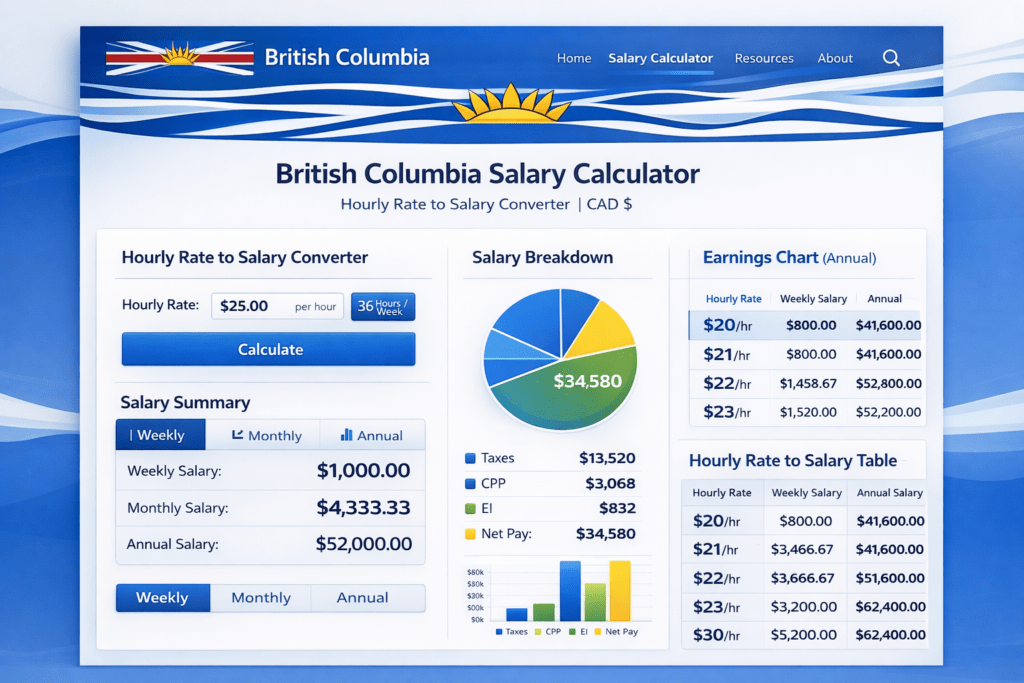
When you use our hourly to salary calculator BC, the output shows both your gross annual income and your estimated net take-home pay after all mandatory BC and federal deductions. That second number is the one that actually matters for rent, mortgage applications, and monthly budgeting.
Gross vs. Net Salary in British Columbia: What You Actually Take Home
Most online calculators stop at gross income. That number looks good on paper but it does not reflect reality. In BC, multiple mandatory deductions reduce every paycheque before it reaches you.
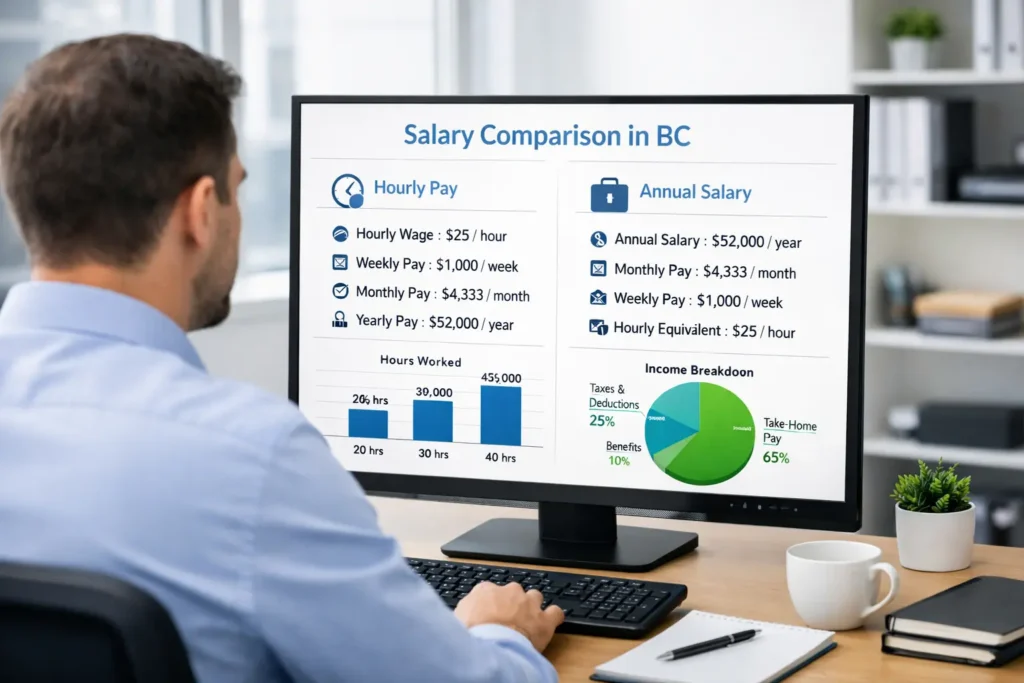
Federal income tax for 2026 starts at 14% on the first bracket of income — down from 15% in prior years, following federal legislation passed in May 2025 (Canada Revenue Agency, T4032-BC, January 2026). BC provincial income tax follows a seven-bracket system. The lowest provincial rate increased from 5.06% to 5.60% following the BC Budget 2026 announced February 17, 2026, and applies to income up to $50,363. The top rate of 20.5% applies to income over $265,545, giving BC the highest top marginal provincial rate in Canada (BC Budget 2026, Ministry of Finance).
CPP contributions in 2026 sit at 5.95% of earnings between $3,500 and $68,500, with a maximum employee contribution of $3,867.50 per year. The CPP2 expansion adds a second tranche on earnings between $68,500 and $85,000 at an additional rate. EI premiums cost employees 1.66% of insurable earnings up to $63,200, capping at $1,049.12 annually (CRA, T4032-BC 2026).
Here is how those deductions play out at common BC wage levels:
| Hourly Wage | Annual Gross | Est. Net Take-Home | Effective Tax Rate |
|---|---|---|---|
| $17.85 (2025 min wage) | $37,128 | ~$29,800 | ~20% |
| $22.00 | $45,760 | ~$35,900 | ~22% |
| $25.00 | $52,000 | ~$39,900 | ~23% |
| $30.00 | $62,400 | ~$46,500 | ~25% |
| $35.00 | $72,800 | ~$52,900 | ~27% |
| $40.00 | $83,200 | ~$59,200 | ~29% |
Estimates based on standard claim code 1, no RRSP contributions. Use the calculator above for your exact figures.
The gap between gross and net grows as income rises because Canada Salary Calculator Utah uses a progressive tax system — higher income moves into higher marginal tax brackets. Your average tax rate (total tax divided by total income) will always be lower than your marginal rate (the rate on your last dollar of income). For most BC workers earning between $50,000 and $90,000, the combined federal and provincial marginal rate sits between 29.65% and 38.29% (TaxTips.ca, 2026).
To get the most accurate net figure, use the CRA’s Payroll Deductions Online Calculator (PDOC) at canada.ca/pdoc, which the CRA officially recommends for all payroll estimates.
BC Statutory Holidays and How They Change Your Real Hourly Rate
This is the calculation gap that almost every competitor calculator ignores. British Columbia recognizes 11 statutory holidays in 2026 under the BC Employment Standards Act:
New Year’s Day, Family Day, Good Friday, Victoria Day, Canada Day, BC Day, Labour Day, National Day for Truth and Reconciliation, Thanksgiving Day, Remembrance Day, and Christmas Day.
For eligible employees who do not work on a statutory holiday, the ESA requires employers to pay an average day’s wages — calculated by dividing total wages (excluding overtime) earned in the 30 calendar days before the holiday by the number of days worked in that period.
Any accurate hourly to annual salary calculator BC must subtract these hours from the 2,080-hour standard year. Those 11 days (88 hours at a standard 8-hour day) reduce your actual working year to 1,992 hours. This shifts the math meaningfully on both sides of the conversion.
Example: A salaried employee earning $60,000 per year at a standard 2,080-hour calculation appears to earn $28.85/hr. When you subtract statutory holiday hours, their effective working rate is $60,000 ÷ 1,992 = $30.12/hr. That difference matters when you negotiate a contract rate or compare a salaried role to an hourly one.
If your employer does not pay statutory holidays and does not provide a day off in lieu, they must pay 1.5x your regular wage for any stat holiday hours worked, in addition to your average day’s pay (BC Employment Standards Branch).
Converting Your Annual Salary Back to an Hourly Rate in BC
Not every conversion runs from hourly to annual. Many people receive a salary offer and need to work backwards to understand what hourly rate it represents — especially workers comparing a salaried role to a contract or hourly position.
The reverse formula is: Hourly Rate = Annual Salary ÷ (Hours per Week × Weeks per Year)
For standard full-time work: $70,000 ÷ (40 × 52) = $33.65/hr gross
But the salary to hourly calculator BC calculation gets more revealing when you factor in unpaid overtime. A salaried manager earning $70,000 who regularly works 50 hours per week actually earns the following: $70,000 ÷ (50 × 52) = $26.92/hr — nearly $7 less than the headline figure suggests. No competitor calculator currently shows this “true effective hourly rate” after unpaid overtime. It is one of the most important numbers for anyone considering a move from hourly to salaried work.
| Annual Salary | Standard Hourly (40 hrs) | Effective Hourly (50 hrs) |
|---|---|---|
| $50,000 | $24.04 | $19.23 |
| $60,000 | $28.85 | $23.08 |
| $70,000 | $33.65 | $26.92 |
| $80,000 | $38.46 | $30.77 |
| $100,000 | $48.08 | $38.46 |
If your job routinely demands extra hours without additional pay, you should treat that realistic effective rate as your true compensation benchmark when evaluating competing offers.

Hourly vs. Salaried Employment in BC: Which One Pays More?
The answer depends on your industry, role, and how your employer handles overtime. Here is a direct comparison of what each structure means under BC law.
Hourly employees in BC receive strong legal protections under the Employment Standards Act. Overtime triggers at 1.5x regular pay after 8 hours in a single day or 40 hours in a week, and at 2x regular pay after 12 hours in a single day (BC ESA, Connecteam Labour Law Guide 2026). Hourly workers also receive vacation pay at a minimum of 4% of gross wages (rising to 6% after 5 years of service), calculated on every cheque. They cannot be underpaid for statutory holidays.
Salaried employees often fall outside daily overtime rules depending on their job classification. Managers, certain professionals, and those with averaging agreements may have no overtime entitlement at all. The benefit is income stability — a consistent biweekly or semi-monthly cheque regardless of slower weeks.
Which earns more net? Consider this scenario: an hourly warehouse worker earning $28/hr who works 2 hours of overtime per day, 4 days a week earns approximately $8 in overtime premium daily. Over 48 working weeks (excluding vacation), that adds roughly $1,536 in overtime pay annually on top of their $58,240 base — a total of $59,776. A salaried supervisor at the same facility earning $58,000 flat, who works those same extra hours without OT pay, walks away with $1,776 less and none of the protections.
The hourly wage to salary calculator BC comparison is only accurate when overtime, vacation pay, and statutory holiday pay are all included in the picture.
Self-Employed and Contractors: How to Calculate Your Equivalent Salary in BC
This section covers a calculation gap that most competitor pages skip entirely. If you work as a contractor or freelancer in BC, your hourly rate needs to be significantly higher than an equivalent employee’s rate to yield the same net income.
Here is why. As a self-employed individual in BC, you pay both the employee and employer share of CPP — effectively double, at 5.95% each side, for a combined rate of 11.9% on eligible earnings. You receive no EI coverage unless you voluntarily opt in and pay both shares of the premium. You have no employer-funded paid statutory holidays, no vacation pay, no group health benefits, and no employer RRSP matching.
The standard compensation formula for contractors is: Employee equivalent ÷ 0.70 = Minimum contractor rate to break even
Example: A salaried employee earning $35/hr with a full benefits package in BC (employer covers extended health, dental, and 4% vacation pay, plus employer CPP match) receives approximately $42–$45/hr in total compensation. A contractor who wants to match that package needs to charge at least $60–$65/hr before they achieve the same net financial position after taxes, CPP, and no-benefit overhead.
| Employee Package (Total Value) | Equivalent Contractor Rate |
|---|---|
| $25/hr + benefits | $36–$38/hr |
| $35/hr + benefits | $50–$53/hr |
| $50/hr + benefits | $72–$75/hr |
For the annual to hourly salary calculator BC use case, contractors must also budget for RRSP contributions personally (the 2026 RRSP dollar limit is $33,810, per Alitis Investment Counsel), since they have no employer pension plan. Factor 10–15% of gross revenue aside for RRSP contributions to build retirement income on par with a salaried peer.
Pay Period Types in BC: Biweekly vs. Semi-Monthly
Many workers confuse these two pay structures and the confusion causes budgeting errors. The BC Employment Standards Act requires employers to pay employees at least twice per month, with pay periods not exceeding 16 days. Payment must arrive within 8 days of the end of each pay period (BC ESA, s. 17).
Biweekly pay means you receive 26 paycheques per year. Semi-monthly pay means 24 paycheques per year. Same annual salary, different per-cheque amounts.
| Annual Salary | Weekly | Biweekly (26) | Semi-Monthly (24) | Monthly |
|---|---|---|---|---|
| $50,000 | $961.54 | $1,923.08 | $2,083.33 | $4,166.67 |
| $65,000 | $1,250.00 | $2,500.00 | $2,708.33 | $5,416.67 |
| $80,000 | $1,538.46 | $3,076.92 | $3,333.33 | $6,666.67 |
| $100,000 | $1,923.08 | $3,846.15 | $4,166.67 | $8,333.33 |
The practical impact: biweekly workers receive two “extra” paycheques per year in the months where three pay periods fall. Many BC workers in skilled trades, healthcare, and retail receive biweekly pay. Professionals in finance, legal, and government typically see semi-monthly cycles. Know your cycle before you build a monthly budget.
Common BC Salary and Hourly Conversion Examples
Use these as quick reference benchmarks. All annual figures assume 40 hours per week and 52 weeks. Net figures are estimates under standard 2026 BC and federal tax rates with no RRSP deductions.
| Hourly Rate | Annual Gross | Monthly Gross | Net Annual (Est.) |
|---|---|---|---|
| $17.85 (min wage 2025) | $37,128 | $3,094 | ~$29,800 |
| $18.25 (min wage June 2026) | $37,960 | $3,163 | ~$30,400 |
| $20.00 | $41,600 | $3,467 | ~$33,100 |
| $25.00 | $52,000 | $4,333 | ~$39,900 |
| $30.00 | $62,400 | $5,200 | ~$46,500 |
| $40.00 | $83,200 | $6,933 | ~$59,200 |
| $50.00 | $104,000 | $8,667 | ~$71,400 |
Reverse lookup — annual salary to hourly equivalent:
| Annual Salary | Hourly (40 hrs/wk) |
|---|---|
| $45,000 | $21.63 |
| $60,000 | $28.85 |
| $75,000 | $36.06 |
| $90,000 | $43.27 |
| $100,000 | $48.08 |
| $120,000 | $57.69 |
Using the Hourly to Salary Calculator BC for Job Offer Comparisons
How to Use the Hourly to Salary Calculator BC When Evaluating Two Competing Offers
On paper, $30/hr × 2,080 hours = $62,400 annually — almost identical to $62,000 salary. But the real comparison requires five more data points.
Step 1 — Check overtime entitlement. The hourly role pays 1.5x after 8 hours daily. The salaried role may not. If either position regularly involves 9-hour days, the hourly worker earns $45/hr on that extra hour. The salaried worker earns nothing extra.
Step 2 — Calculate vacation pay. BC law mandates 4% vacation pay on all gross wages for hourly workers from day one. A salaried worker gets the same entitlement in weeks — but confirm whether the salary offer includes vacation pay inside or on top of the stated figure. Under the ESA, vacation pay is a separate obligation.
Step 3 — Value the benefits package. Extended health and dental coverage in BC typically costs an employer $3,000–$6,000 per employee annually. If one offer includes benefits and the other does not, add that dollar value to the salaried offer before comparing.
Step 4 — Account for CPP and EI. Both employee types pay these equally. This is not a differentiator in a direct hourly vs. salary comparison unless one role is contract-based.
Step 5 — Calculate total compensation. Add base pay, overtime potential, vacation value, and benefits value. The offer with the higher total compensation number is the better financial choice — regardless of which side the hourly rate appears to be on.
BC Minimum Wage and What It Means Annually
The BC minimum wage history shows consistent upward movement tied to the province’s All-Items Consumer Price Index (CPI). The ESA now mandates automatic annual adjustments every June 1, which means this rate will never decrease even if CPI falls.
| Effective Date | BC Minimum Wage | Annual Full-Time Gross |
|---|---|---|
| June 1, 2024 | $17.40/hr | $36,192 |
| June 1, 2025 | $17.85/hr | $37,128 |
| June 1, 2026 | $18.25/hr | $37,960 |
At $18.25/hr — BC’s minimum wage from June 2026 — a full-time worker earns approximately $37,960 gross per year and takes home roughly $30,400 after tax, CPP, and EI deductions. That net figure sits well below Metro Vancouver’s living wage of $27.85/hr (Living Wage for Families, 2025 calculation), illustrating the gap between legal minimum and actual cost-of-living requirements in BC’s most expensive urban markets.
App-based ride-hailing and delivery workers in BC have a separate minimum of $21.89/hr for engaged time as of June 2026, under gig-economy protections introduced through ESA amendments (Province of BC, gov.bc.ca/minimum-wage).
Note: BC does not maintain a lower server or tipped worker minimum wage. All employees — regardless of tips received — must receive at least the general minimum wage for every hour worked.
Conclusion
Converting between hourly and annual pay in BC is not a single calculation — it is a layered financial picture that involves gross income, net take-home pay, BC provincial tax, federal income tax, CPP, EI, overtime rules, statutory holidays, and pay period structure. Each layer changes the real number workers and employers need to make sound decisions. A $30/hr offer and a $62,000 salary may look equivalent on the surface but carry vastly different financial outcomes depending on overtime exposure, benefits value, and employment type.
Use the calculator at the top of this page to run your own numbers in seconds. For official payroll deduction tables and the most current BC and federal rates, refer to CRA’s T4032-BC payroll guide at canada.ca/payroll, BC’s Employment Standards Branch at gov.bc.ca/employment-standards, and TaxTips.ca for confirmed 2026 BC tax brackets. Those three sources give you everything you need to verify any calculation this page produces.