Calculate your North Salary Calculate Carolina annual salary from hourly wage instantly, including NC flat state income tax (3.99%), Social Security, Medicare, and federal taxes. Our free Hourly to Salary Calculator NC shows your exact take-home pay after all deductions.
Whether you earn North Carolina’s minimum wage of $7.25 per hour or $50+ per hour in Charlotte or Raleigh, this calculator provides accurate results based on North Carolina’s simple flat-tax structure-one of the lowest in the nation. You can also convert North Carolina annual salary to hourly rate using the reverse calculator.
North Carolina workers benefit from one of the lowest state income tax rates in the United States-a flat 3.99% (as of January 1, 2026) with ongoing reductions scheduled. Understanding your true earnings helps with budgeting, job comparisons, and financial planning across North Carolina’s diverse regions from Charlotte and Research Triangle to Greensboro, Winston-Salem, Asheville, and rural counties.
Hourly to Salary Calculator North Carolina
Calculate your North Carolina salary using our 2-in-1 salary to hourly calculator. Select your location by clicking the advanced option to apply NC’s minimum wage ($7.25/hour, federal minimum), add overtime hours, and see your exact take-home pay after North Carolina’s lowest-in-nation 3.99% flat tax.
How to Use This North Carolina Calculator
Step 1: Enter your North Carolina hourly wage Input your current or expected hourly rate. North Carolina’s minimum wage is $7.25/hour (matching federal minimum), unchanged since 2009. Proposals to raise it remain stalled in the Republican-led legislature.
Step 2: Input your working hours Enter hours per week (40 for full-time) and weeks per year (52 standard, or adjust for unpaid time off).
Step 3: Add overtime if applicable North Carolina follows federal overtime rules requiring time-and-a-half after 40 hours per week. Input your typical overtime hours for accurate calculations.
Step 4: Review your North Carolina results The calculator displays your gross salary plus all deductions including federal tax, North Carolina flat tax (3.99% – lowest rate since 2014 tax reform), FICA (Social Security 6.2% + Medicare 1.45%), and your net take-home pay.
Your Results Breakdown
Once you enter your information, the calculator shows:
Gross Income:
- Hourly rate
- Daily earnings (8-hour day)
- Weekly gross pay
- Bi-weekly gross pay (most common in NC)
- Monthly gross pay
- Annual salary
North Carolina State Deductions:
- NC flat income tax: 3.99% of taxable income (after standard deduction: $14,150 single / $28,300 married)
- No local income taxes anywhere in NC
- No city/county income taxes
Federal Deductions:
- Federal income tax withholding (10%, 12%, 22%, 24%, 32%, 35%, 37% progressive brackets)
- Social Security (6.2% up to $176,100 in 2025 / $184,500 projected 2026)
- Medicare (1.45% on all wages)
- Additional Medicare tax (0.9% over $200k single / $250k married)
Net Take-Home Pay:
- After all federal and NC deductions
- Monthly take-home amount
- Actual spending power in North Carolina dollars
North Carolina vs. Neighboring States:
- How your NC take-home compares to South Carolina (6.5% top rate), Virginia (5.75% progressive), or Tennessee (0% income tax)
- Effective tax rate in North Carolina
- True hourly rate after all taxes
HOW TO CALCULATE HOURLY TO SALARY IN NORTH CAROLINA
Understanding North Carolina salary calculations is extremely straightforward thanks to the state’s flat 3.99% tax—one of the simplest and lowest in the nation.
Hourly to Salary Calculator NC: Basic Formula
The core formula is simple, and North Carolina’s low flat 3.99% tax makes take-home pay calculations more favorable than most states:
Gross Annual Salary = Hourly Rate × Hours Per Week × Weeks Per Year
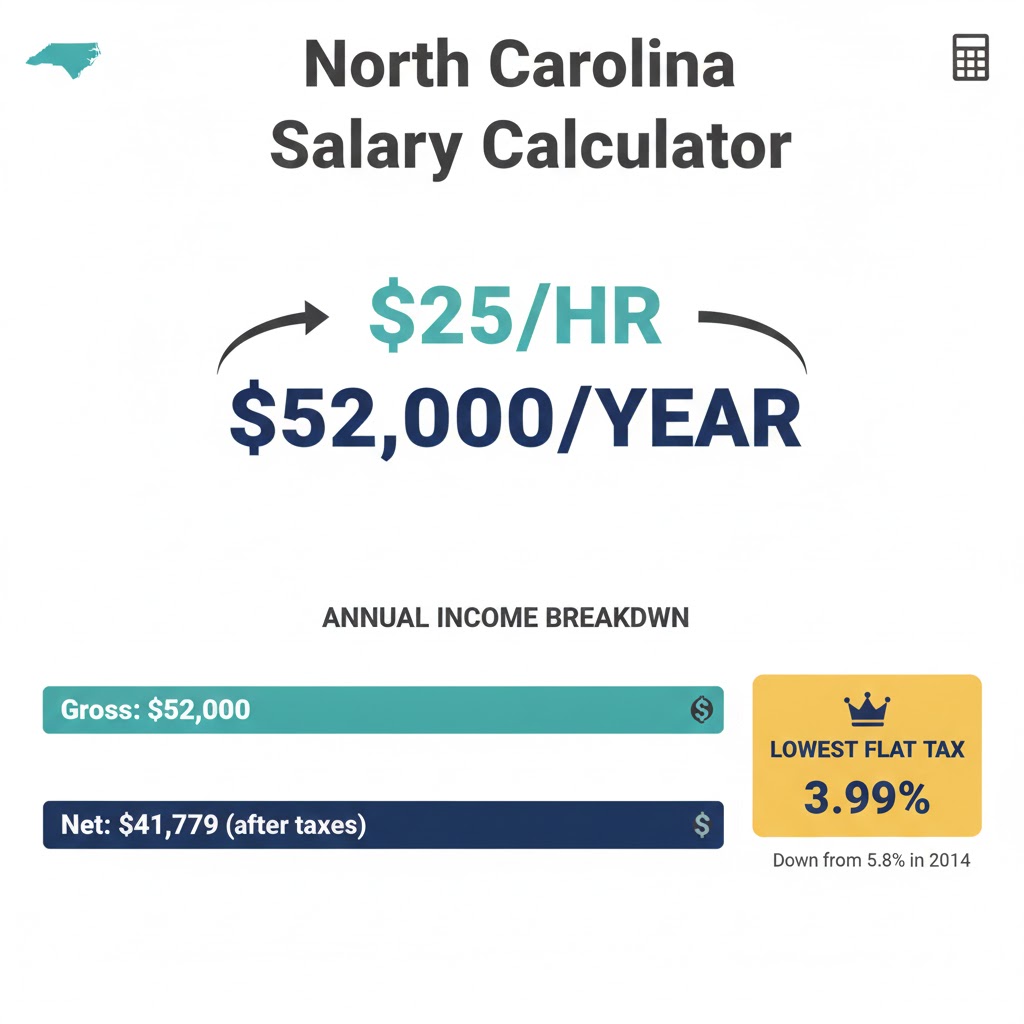
For North Carolina workers at $25/hour, 40 hours/week, 52 weeks/year: $25 × 40 × 52 = $52,000 gross annual salary
However, North Carolina net pay calculation requires subtracting:
- Federal income tax (~12% effective at $52k)
- North Carolina state income tax: ($52,000 – $14,150 standard deduction) × 3.99% = $1,509
- Social Security: $52,000 × 6.2% = $3,224
- Medicare: $52,000 × 1.45% = $754
Net annual pay: ~$39,200 (75% of gross)
In comparison, the same $52,000 salary in South Carolina (6.5% top rate) yields ~$38,400 net pay (74% of gross), giving North Carolina workers about $800 more annually or $67 per month thanks to NC’s lower state tax rate.
Step-by-Step Calculation for North Carolina Workers
Step 1: Calculate gross salary Multiply your North Carolina hourly rate by hours and weeks worked. Example: $20/hour × 40 hours × 52 weeks = $41,600
Step 2: Calculate North Carolina state income tax North Carolina uses a flat 3.99% tax on income after standard deduction:
- Gross income: $41,600
- Standard deduction (single 2026): $14,150
- Taxable income: $41,600 – $14,150 = $27,450
- NC tax: $27,450 × 3.99% = $1,095
Step 3: Calculate federal income tax For single filer earning $41,600 using 2026 federal brackets:
- Standard deduction: $16,100 (2026 projected)
- Taxable income: $41,600 – $16,100 = $25,500
- First $11,925 at 10% = $1,193
- Remaining $13,575 at 12% = $1,629
- Total federal tax: $2,822
Step 4: Calculate FICA (Social Security + Medicare)
- Social Security: $41,600 × 6.2% = $2,579
- Medicare: $41,600 × 1.45% = $603
- Total FICA: $3,182
Step 5: Calculate North Carolina net pay $41,600 – $1,095 (NC) – $2,822 (Fed) – $3,182 (FICA) = $34,501 net pay
Your North Carolina take-home pay is 83% of gross at this income level.
North Carolina-Specific Calculation Examples
Example 1: $20/hour in Charlotte
Gross Calculation:
- Hourly rate: $20.00
- Hours per week: 40
- Weeks per year: 52
- Annual gross salary: $41,600
North Carolina Deductions:
- NC state income tax: $1,095 (2.6% effective after deduction)
- Federal income tax: $2,822 (6.8% effective)
- FICA: $3,182 (7.65%)
- Total deductions: $7,099 (17.1%)
Net Pay:
- Annual net: $34,501
- Monthly net: $2,875
- Bi-weekly net: $1,327
- Take-home percentage: 83%
Charlotte Context: At $20/hour in Charlotte, you’re earning significantly above NC minimum wage ($7.25) but below Charlotte’s estimated living wage of $19-21/hour for single adults. Charlotte median 1-bedroom rent is $1,400-$1,700/month, consuming 49-59% of your take-home pay. Charlotte’s cost of living is moderate for a major city, and NC’s low 3.99% tax helps maximize take-home pay compared to higher-tax neighboring states.
Example 2: $30/hour in Raleigh-Durham (Research Triangle)
Gross Calculation:
- Hourly rate: $30.00
- Hours per week: 40
- Weeks per year: 52
- Annual gross salary: $62,400
North Carolina Deductions:
- NC state income tax: $1,925 (3.1% effective after deduction)
- Federal income tax: $6,336 (10.2% effective)
- FICA: $4,774 (7.65%)
- Total deductions: $13,035 (20.9%)
Net Pay:
- Annual net: $49,365
- Monthly net: $4,114
- Bi-weekly net: $1,899
- Take-home percentage: 79.1%
Research Triangle Context: At $30/hour in the Raleigh-Durham area, you’re earning a solid middle-class income in one of NC’s fastest-growing tech and research hubs. Research Triangle median 1-bedroom rent ranges from $1,200-$1,500/month, consuming 29-36% of your take-home pay—a comfortable ratio. NC’s low state tax (3.99%) means Research Triangle tech workers keep more of their income compared to Silicon Valley or Boston counterparts.
Example 3: $7.25/hour at North Carolina Minimum Wage
Gross Calculation:
- Hourly rate: $7.25 (NC minimum wage 2026, unchanged since 2009)
- Hours per week: 40
- Weeks per year: 52
- Annual gross salary: $15,080
North Carolina Deductions:
- NC state income tax: $36 (0.2% effective – below standard deduction threshold, minimal tax)
- Federal income tax: $0 (below taxable threshold after standard deduction)
- FICA: $1,154 (7.65%)
- Total deductions: $1,190 (7.9%)
Net Pay:
- Annual net: $13,890
- Monthly net: $1,158
- Bi-weekly net: $534
- Take-home percentage: 92.1%
North Carolina Minimum Wage Context: At NC’s $7.25 minimum wage (federal minimum, unchanged for 16 years), workers face minimal state tax due to the standard deduction covering most income, but $7.25/hour is insufficient even in North Carolina’s lowest-cost counties. Living wage estimates range from $15-16/hour in rural areas to $19-21/hour in Charlotte/Raleigh. Many minimum wage workers qualify for federal EITC (potentially $2,000-$7,000 refund at tax time), North Carolina EITC (5% of federal), and assistance programs.
Important: North Carolina has not raised its minimum wage above federal $7.25 since 2009. Democratic-sponsored bills to increase it to $10-$18/hour have repeatedly failed in the Republican-controlled legislature.
Example 4: $25/hour with Regular Overtime in North Carolina
Gross Calculation:
- Regular hourly rate: $25.00
- Regular hours: 40 per week
- Overtime hours: 5 per week (at time-and-a-half)
- Overtime rate: $37.50
Weekly Breakdown:
- Regular pay: $25 × 40 = $1,000
- Overtime pay: $37.50 × 5 = $187.50
- Total weekly: $1,187.50
- Annual gross: $61,750
North Carolina Deductions:
- NC state income tax: $1,899 (3.1% effective)
- Federal income tax: $6,234 (10.1% effective)
- FICA: $4,724 (7.65%)
- Total deductions: $12,857 (20.8%)
Net Pay:
- Annual net: $48,893
- Monthly net: $4,074
- Bi-weekly net: $1,881
- Take-home percentage: 79.2%
North Carolina Overtime Impact: The 5 hours of weekly overtime adds $9,750 to your annual gross income (regular 40 hours = $52,000). North Carolina’s flat 3.99% tax and federal taxes mean you keep about 78% of that overtime income after taxes, netting an additional $7,605 annually. North Carolina follows standard federal overtime rules (after 40 hours/week, time-and-a-half) with no daily overtime or double-time provisions.
North Carolina Tax Advantage Comparison
Same $50,000 Salary – State Tax Comparison:
| State | State Tax Rate | State Tax Amount | Total Deductions | Net Pay | vs NC |
|---|---|---|---|---|---|
| North Carolina | 3.99% flat | $1,430 | $9,795 | $40,205 | Baseline |
| South Carolina | 6.5% top rate | $2,425 | $10,790 | $39,210 | -$995 |
| Virginia | 5.75% top rate | $2,100 | $10,465 | $39,535 | -$670 |
| Georgia | 5.39% flat | $1,935 | $10,300 | $39,700 | -$505 |
| Tennessee | 0% | $0 | $8,365 | $41,635 | +$1,430 |
Key Insight: North Carolina’s 3.99% flat tax is among the lowest in the Southeast. Only Tennessee (0% income tax) and Florida (0% income tax) provide better take-home pay. NC beats Virginia, South Carolina, and Georgia on state tax burden, making it highly competitive for workers and businesses.
REVERSE CALCULATOR – NORTH CAROLINA ANNUAL SALARY TO HOURLY RATE
Converting North Carolina annual salaries to hourly rates helps you compare salaried positions with hourly jobs and understand your true per-hour earnings after North Carolina’s favorable 3.99% flat tax.
How to Convert North Carolina Salary to Hourly Wage
The reverse calculation divides annual salary by total hours worked, and North Carolina’s low flat tax means workers keep more of each hour’s earnings.
Basic Formula: Hourly Rate = Annual Salary ÷ 2,080 hours (40 hours × 52 weeks)
North Carolina Take-Home Hourly Rate: Effective Hourly Rate = (Annual Salary – NC tax – Federal tax – FICA) ÷ 2,080
This “effective hourly rate” shows what you actually earn per hour after North Carolina’s combined tax burden, which ranges from 13% to 28% depending on your income level—significantly lower than high-tax states.
Salary to Hourly Formula for North Carolina
Step 1: Divide annual salary by 2,080 This gives you gross hourly rate before any North Carolina or federal deductions.
Step 2: Calculate North Carolina flat tax impact NC tax is always 3.99% of taxable income (after standard deduction $14,150 single / $28,300 married):
- Approximate: ~3-3.8% of gross income for most earners
- Much lower than neighboring states
Step 3: Calculate federal tax impact Estimate 8-18% of annual salary for federal income tax (varies by bracket).
Step 4: Calculate FICA Always 7.65% (6.2% Social Security + 1.45% Medicare) up to Social Security wage cap.
Step 5: Determine effective hourly rate Subtract all taxes from annual salary, then divide by 2,080.
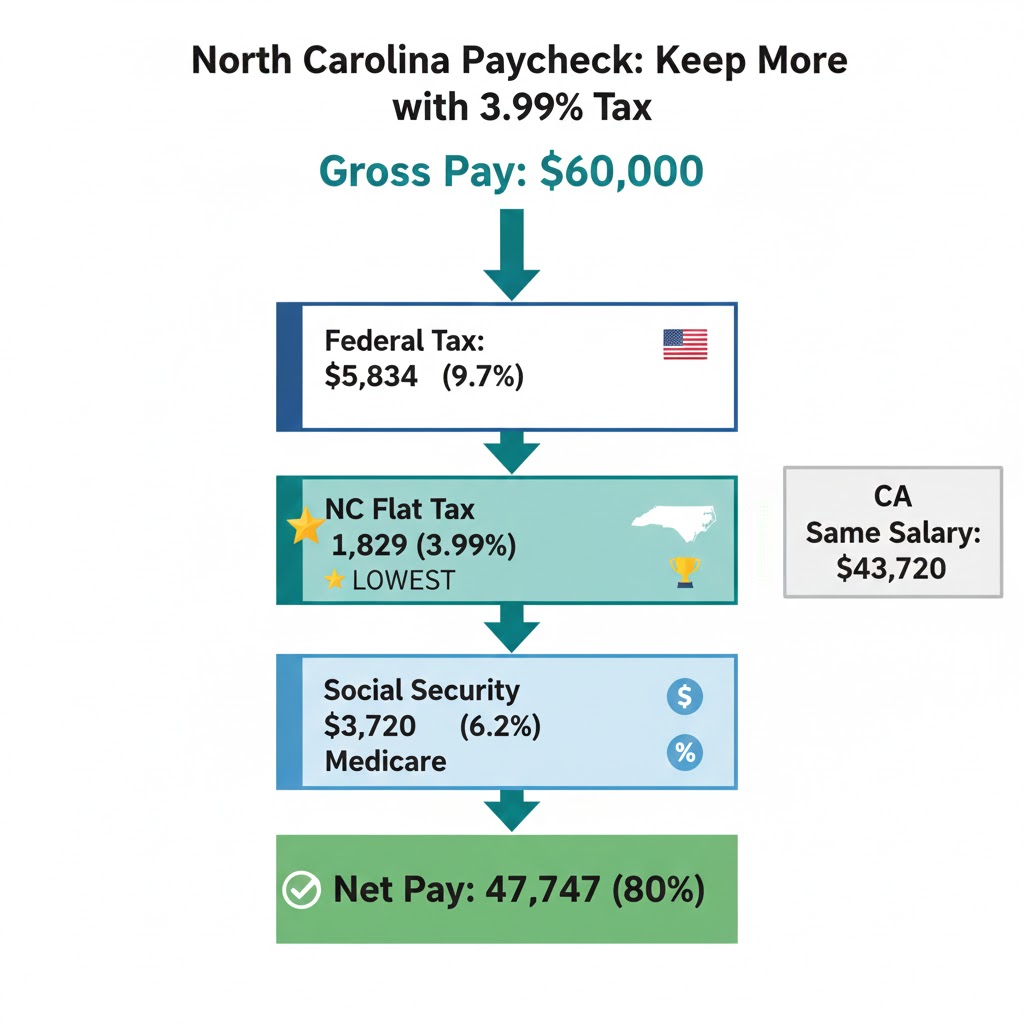
Example: $60,000 North Carolina salary:
- Gross hourly: $60,000 ÷ 2,080 = $28.85/hour
- NC tax (~$1,829): -$0.88/hour
- Federal tax (~$5,834): -$2.80/hour
- FICA ($4,590): -$2.21/hour
- Effective hourly: $22.96/hour
Your North Carolina take-home is $22.96/hour on a $60,000 salary, which is 80% of your gross hourly rate—higher than most states.
North Carolina Salary Conversion Examples
Example: $50,000 salary to hourly in North Carolina
Gross Calculation:
- Annual salary: $50,000
- Standard hours: 2,080 per year
- Gross hourly rate: $24.04/hour
North Carolina Tax Impact:
- NC state income tax: $1,430 (2.9% effective after deduction)
- Federal income tax: $4,034 (8.1% effective)
- FICA: $3,825 (7.65%)
- Total annual deductions: $9,289
Net North Carolina Earnings:
- Annual net: $40,711
- Effective hourly rate: $19.57/hour
- Take-home percentage: 81.4%
North Carolina vs. Neighbors Comparison: The same $50,000 salary in neighboring states:
- North Carolina: $40,711 net ($19.57/hour)
- South Carolina: $39,716 net ($19.09/hour) – NC wins by $0.48/hour
- Virginia: $39,986 net ($19.22/hour) – NC wins by $0.35/hour
- Tennessee: $41,635 net ($20.02/hour) – TN wins by $0.45/hour (no state tax)
North Carolina provides better take-home than SC and VA thanks to lower state tax, though Tennessee’s zero income tax still wins.
Example: $75,000 salary to hourly in North Carolina
Gross Calculation:
- Annual salary: $75,000
- Standard hours: 2,080 per year
- Gross hourly rate: $36.06/hour
North Carolina Tax Impact:
- NC state income tax: $2,428 (3.2% effective after deduction)
- Federal income tax: $9,534 (12.7% effective)
- FICA: $5,738 (7.65%)
- Total annual deductions: $17,700
Net North Carolina Earnings:
- Annual net: $57,300
- Effective hourly rate: $27.55/hour
- Take-home percentage: 76.4%
North Carolina Middle-Income Advantage: At $75,000 in North Carolina, you lose 23.6% to taxes compared to ~26% in Virginia or ~27% in South Carolina. NC’s flat 3.99% means all income (after standard deduction) is taxed equally, providing significant savings for middle-to-upper-middle-income earners compared to progressive-tax states.
Example: $100,000 salary to hourly in North Carolina
Gross Calculation:
- Annual salary: $100,000
- Standard hours: 2,080 per year
- Gross hourly rate: $48.08/hour
North Carolina Tax Impact:
- NC state income tax: $3,426 (3.4% effective after deduction)
- Federal income tax: $16,094 (16.1% effective)
- FICA: $7,650 (7.65%)
- Total annual deductions: $27,170
Net North Carolina Earnings:
- Annual net: $72,830
- Effective hourly rate: $35.01/hour
- Take-home percentage: 72.8%
Six-Figure North Carolina Reality: At $100,000 in North Carolina, you’re still paying the same low 3.99% state rate. This flat-tax structure means NC doesn’t have the progressive burden increase that states like California (9.3%) or New York (6.5%) have for six-figure earners. Combined federal-state-FICA burden reaches just 27.2%—highly competitive nationally.
High-Earner North Carolina Tax Comparison
Annual Take-Home Pay Comparison (NC vs. Neighboring States):
| Annual Salary | NC Net Pay (3.99%) | SC Net Pay (6.5%) | VA Net Pay (5.75%) | TN Net Pay (0%) | NC Advantage vs SC | NC Advantage vs VA |
|---|---|---|---|---|---|---|
| $50,000 | $40,711 | $39,716 | $39,986 | $41,635 | +$995 | +$725 |
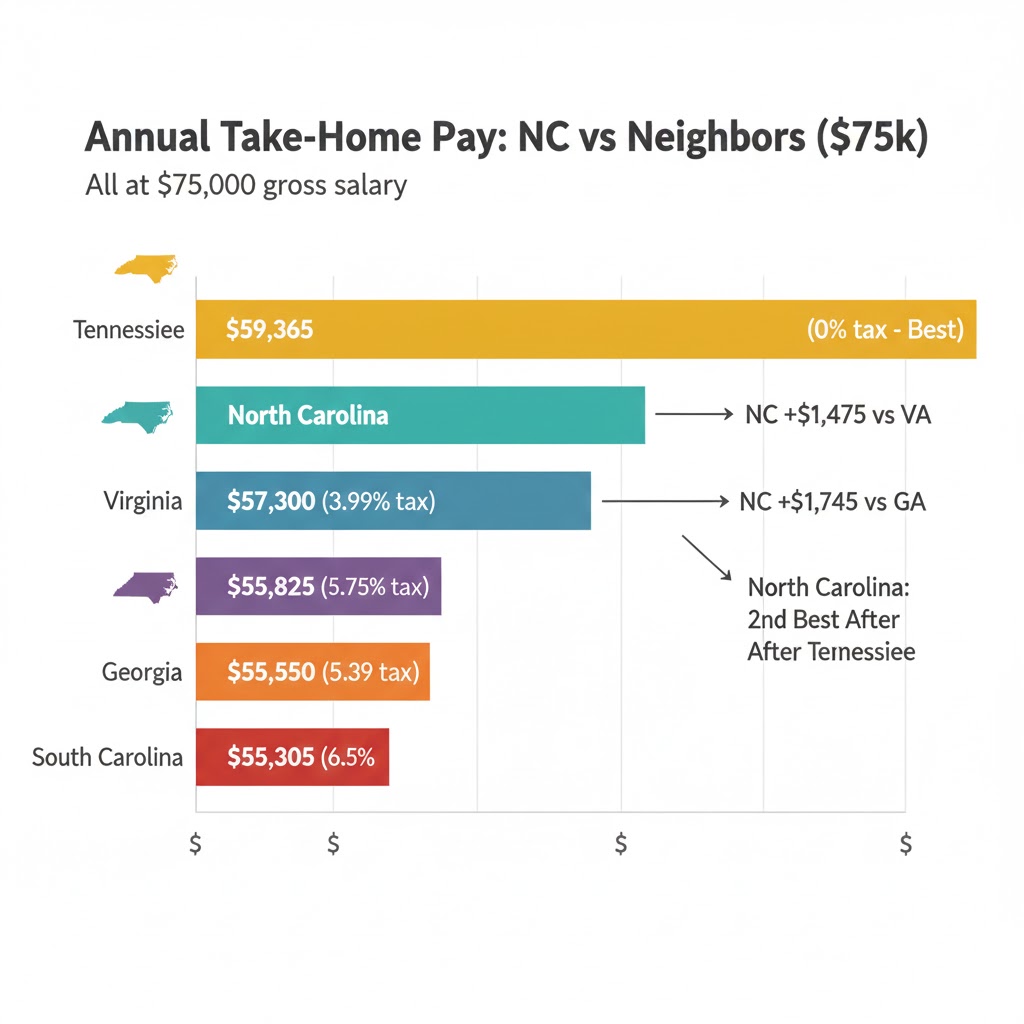
| $75,000 | $57,300 | $55,305 | $55,825 | $59,365 | +$1,995 | +$1,475 |
| $100,000 | $72,830 | $69,835 | $70,605 | $76,350 | +$2,995 | +$2,225 |
| $150,000 | $103,080 | $98,085 | $99,355 | $109,350 | +$4,995 | +$3,725 |
| $200,000 | $132,080 | $125,835 | $127,855 | $141,100 | +$6,245 | +$4,225 |
Key Insight: North Carolina’s flat 3.99% tax provides increasing dollar advantages as income rises when compared to South Carolina (6.5%) and Virginia (5.75%), though Tennessee (0% tax) still provides best take-home. The gap widens significantly for high earners—at $200k, NC workers keep $6,245 more annually than SC and $4,225 more than VA.
North Carolina Effective Tax Rates by Income
North Carolina’s flat tax means effective state rate varies only by the ratio of standard deduction to income:
| Annual Income | NC State Tax | Effective NC Rate | Combined Effective Rate (Fed+State+FICA) |
|---|---|---|---|
| $30,000 | $633 | 2.1% | 15.3% |
| $40,000 | $1,030 | 2.6% | 17.8% |
| $50,000 | $1,430 | 2.9% | 18.6% |
| $60,000 | $1,829 | 3.0% | 19.5% |
| $75,000 | $2,428 | 3.2% | 23.6% |
| $100,000 | $3,426 | 3.4% | 27.2% |
| $150,000 | $5,422 | 3.6% | 31.3% |
| $200,000 | $7,418 | 3.7% | 34.0% |
Observation: North Carolina’s effective state rate approaches the full 3.99% as income increases, since the $14,150 standard deduction becomes a smaller percentage of total income. Even at $200k, NC state tax is only 3.7% effective—extraordinarily competitive nationally.
North Carolina Tax Reform History and Future
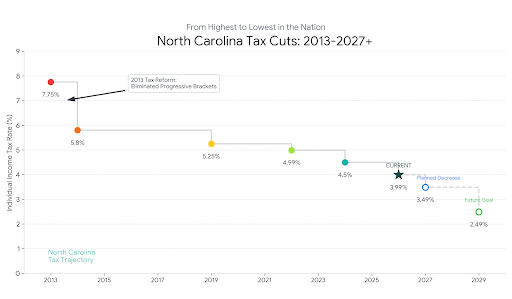
Historical NC Tax Rates:
- 2013 and earlier: Progressive brackets up to 7.75%
- 2014: 5.8% flat (major tax reform)
- 2015-2016: 5.75% flat
- 2017-2018: 5.499% flat
- 2019-2021: 5.25% flat
- 2022: 4.99% flat
- 2023: 4.75% flat
- 2024: 4.5% flat
- 2025: 4.25% flat
- 2026: 3.99% flat (current)
Future Reductions: North Carolina law includes triggers for further rate reductions if state revenue targets are met:
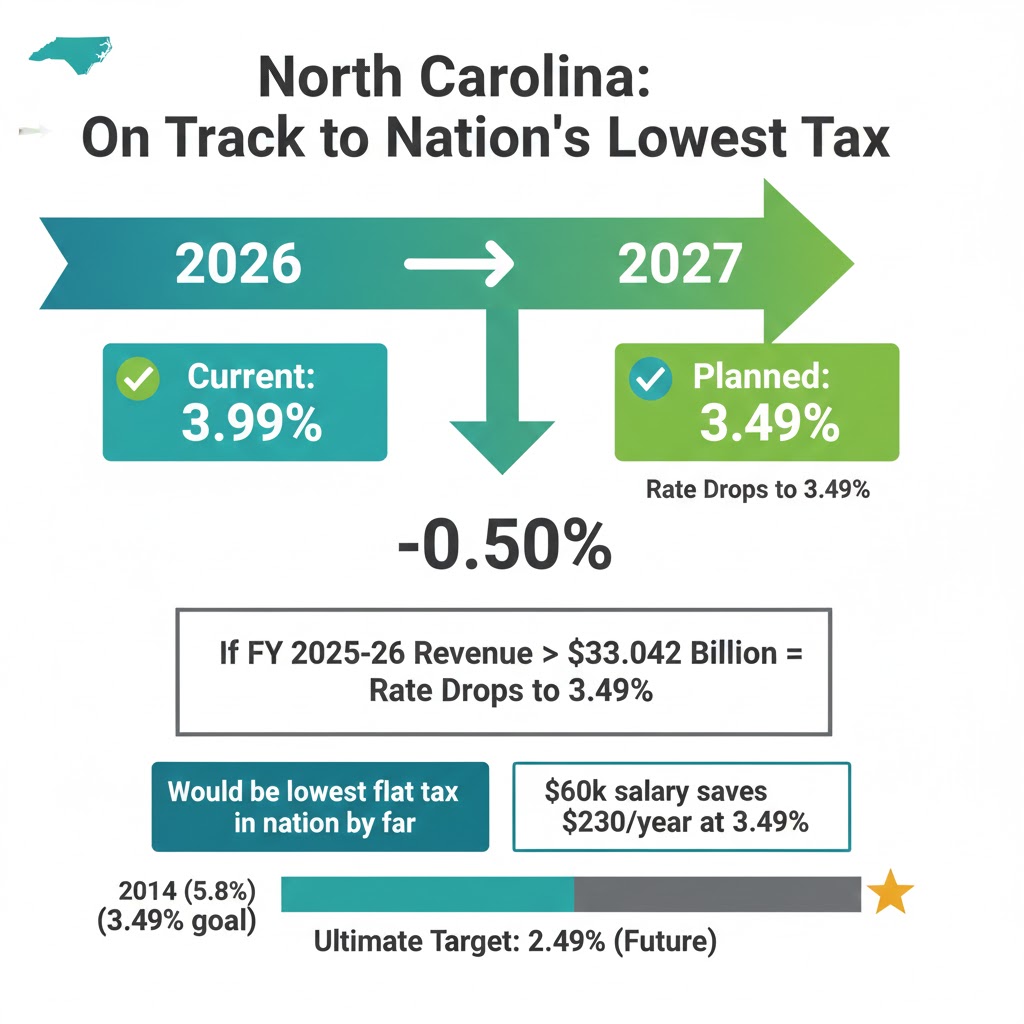
- 2027: Potential reduction to 3.49% if FY 2025-26 revenue exceeds $33.042 billion
- Ultimate goal: 2.49% flat rate
What This Means: North Carolina is on a path to having one of the lowest state income tax rates in the nation. The 2013 tax reform eliminated progressive brackets (which topped at 7.75%) in favor of a flat rate that has steadily declined from 5.8% to the current 3.99%, with further cuts planned.
Revenue Impact: Critics argue these cuts disproportionately benefit high earners and reduce state capacity to fund education, healthcare, and infrastructure. Supporters contend lower taxes attract businesses and residents from high-tax states, growing the tax base through economic expansion.
North Carolina Standard Deduction (2026)
North Carolina’s standard deduction reduces taxable income before applying the 3.99% rate:
2026 Standard Deduction Amounts:
- Single: $14,150
- Married Filing Jointly: $28,300
- Married Filing Separately: $14,150
- Head of Household: $21,225
Impact Example:
- Earning $50,000 (single)
- Standard deduction: $14,150
- Taxable NC income: $35,850
- NC tax: $35,850 × 3.99% = $1,430
- Effective rate: 2.9% of gross income
No Personal Exemptions: North Carolina eliminated personal exemptions as part of 2013 tax reform but increased the standard deduction to compensate.
Why North Carolina Has Such Low Taxes
2013 Tax Reform: North Carolina’s current tax structure resulted from comprehensive 2013 tax reform legislation that:
- Eliminated progressive brackets (1.2%-7.75%)
- Implemented flat tax starting at 5.8%
- Scheduled gradual rate reductions
- Eliminated most credits and deductions
- Increased standard deduction
- Lowered corporate tax from 6.9% to 2.5%
Goals:
- Simplify tax code
- Attract businesses and high-income residents
- Compete with zero-tax states (TN, FL)
- Improve state business climate ranking
Results:
- North Carolina’s state tax competitiveness ranking improved from 44th (2011) to 13th (2026) per Tax Foundation
- Charlotte and Raleigh-Durham became major business relocation destinations
- State population grew 10.5% (2010-2020), faster than national average
- Critics point to reduced education funding and increased class sizes
Popular North Carolina Hourly to Salary Conversions
Quick reference tables showing exact North Carolina take-home pay after all federal and state deductions.
Common North Carolina Hourly Rates to Annual Salary:
| Hourly Rate | Annual Gross | NC Tax (3.99%) | Federal Tax | FICA | Total Deductions | Annual Net | Monthly Net | % Take-Home |
|---|---|---|---|---|---|---|---|---|
| $7.25 (NC min) | $15,080 | $36 | $0 | $1,154 | $1,190 | $13,890 | $1,158 | 92.1% |
| $10/hour | $20,800 | $265 | $505 | $1,591 | $2,361 | $18,439 | $1,537 | 88.7% |
| $12/hour | $24,960 | $432 | $1,305 | $1,909 | $3,646 | $21,314 | $1,776 | 85.4% |
| $15/hour | $31,200 | $680 | $2,053 | $2,387 | $5,120 | $26,080 | $2,173 | 83.6% |
| $18/hour | $37,440 | $930 | $2,545 | $2,864 | $6,339 | $31,101 | $2,592 | 83.1% |
| $20/hour | $41,600 | $1,095 | $2,822 | $3,182 | $7,099 | $34,501 | $2,875 | 83.0% |
| $25/hour | $52,000 | $1,509 | $4,734 | $3,978 | $10,221 | $41,779 | $3,482 | 80.3% |
| $30/hour | $62,400 | $1,925 | $6,336 | $4,774 | $13,035 | $49,365 | $4,114 | 79.1% |
| $35/hour | $72,800 | $2,340 | $8,534 | $5,569 | $16,443 | $56,357 | $4,696 | 77.4% |
| $40/hour | $83,200 | $2,755 | $10,934 | $6,365 | $20,054 | $63,146 | $5,262 | 75.9% |
| $50/hour | $104,000 | $3,586 | $16,534 | $7,956 | $28,076 | $75,924 | $6,327 | 73.0% |
Key Insights:
- NC minimum wage workers keep 92.1% (lowest tax burden due to standard deduction)
- Middle earners ($20-30/hour) keep 79-83%
- Higher earners ($40-50/hour) keep 73-76%
- NC’s low 3.99% flat tax means state burden is minimal and consistent
- Federal progressive brackets cause most variation in take-home percentage
Common North Carolina Annual Salaries to Hourly Rate:
| Annual Salary | Gross Hourly | NC Tax | Federal Tax | FICA | Annual Net | Net Monthly | Effective Hourly |
|---|---|---|---|---|---|---|---|
| $35,000 | $16.83/hr | $830 | $2,282 | $2,678 | $29,210 | $2,434 | $14.04/hr |
| $40,000 | $19.23/hr | $1,030 | $2,634 | $3,060 | $33,276 | $2,773 | $15.99/hr |
| $45,000 | $21.63/hr | $1,230 | $3,234 | $3,443 | $37,093 | $3,091 | $17.83/hr |
| $50,000 | $24.04/hr | $1,430 | $4,034 | $3,825 | $40,711 | $3,393 | $19.57/hr |
| $60,000 | $28.85/hr | $1,829 | $5,834 | $4,590 | $47,747 | $3,979 | $22.96/hr |
| $75,000 | $36.06/hr | $2,428 | $9,534 | $5,738 | $57,300 | $4,775 | $27.55/hr |
| $100,000 | $48.08/hr | $3,426 | $16,094 | $7,650 | $72,830 | $6,069 | $35.01/hr |
| $125,000 | $60.10/hr | $4,423 | $23,594 | $9,388 | $87,595 | $7,300 | $42.11/hr |
| $150,000 | $72.12/hr | $5,422 | $32,094 | $10,948 | $101,536 | $8,461 | $48.82/hr |
Effective Hourly Rate Analysis: The “effective hourly rate” shows actual earning power after taxes:
- $50k salary: Lose $4.47/hour to taxes (18.6% reduction) – very competitive
- $75k salary: Lose $8.51/hour to taxes (23.6% reduction)
- $100k salary: Lose $13.07/hour to taxes (27.2% reduction)
- $150k salary: Lose $23.30/hour to taxes (32.3% reduction)
North Carolina’s low flat tax means effective hourly reduction is lower than most states at all income levels.
NORTH CAROLINA TAXES, MINIMUM WAGE, AND YOUR PAYCHECK
North Carolina Flat State Income Tax (2026)
North Carolina is one of nine states with a flat income tax rate, and has the lowest flat rate among them as of 2026.
North Carolina Flat Tax Rate: 3.99%
This rate applies to all taxable income after standard deduction, regardless of how much you earn—the same rate for someone earning $30,000 and someone earning $300,000.
Key Features:
- Lowest flat tax in the nation: At 3.99%, NC has the lowest flat tax rate among all flat-tax states
- No tax brackets: Unlike progressive states, NC has no graduated brackets
- Simple calculation: Multiply taxable income by 3.99%
- Continuing reductions: Rate has dropped from 5.8% (2014) to 3.99% (2026) with further cuts planned
North Carolina Flat Tax Rates – Historical Decline:
| Year | NC Flat Rate | Reduction from Previous Year |
|---|---|---|
| 2014 | 5.80% | New flat tax system |
| 2015 | 5.75% | -0.05% |
| 2017 | 5.499% | -0.251% |
| 2019 | 5.25% | -0.249% |
| 2022 | 4.99% | -0.26% |
| 2023 | 4.75% | -0.24% |
| 2024 | 4.50% | -0.25% |
| 2025 | 4.25% | -0.25% |
| 2026 | 3.99% | -0.26% (current) |
| 2027 | 3.49%* | -0.50% (if revenue triggers met) |
*Future rate depends on state revenue triggers
Why North Carolina Has the Lowest Flat Tax
2013 Tax Reform: North Carolina’s current system resulted from comprehensive 2013 tax reform that eliminated progressive brackets ranging from 6% to 7.75% and replaced them with a flat rate starting at 5.8%.
Legislative Goals:
- Compete with zero-tax states (Tennessee, Florida, Texas)
- Attract businesses relocating from high-tax states
- Simplify tax code
- Improve business climate rankings
Results:
- Tax Foundation ranks NC 13th for tax competitiveness (2026)
- Charlotte became major corporate relocation destination
- Research Triangle attracted tech companies from California/Northeast
- Population growth exceeded national average
Trade-offs: Critics note education funding per pupil has declined relative to inflation, class sizes have increased, and the cuts disproportionately benefit high earners. Supporters point to economic growth, job creation, and increased overall tax revenue despite lower rates.
North Carolina vs. Other Flat-Tax States (2026)
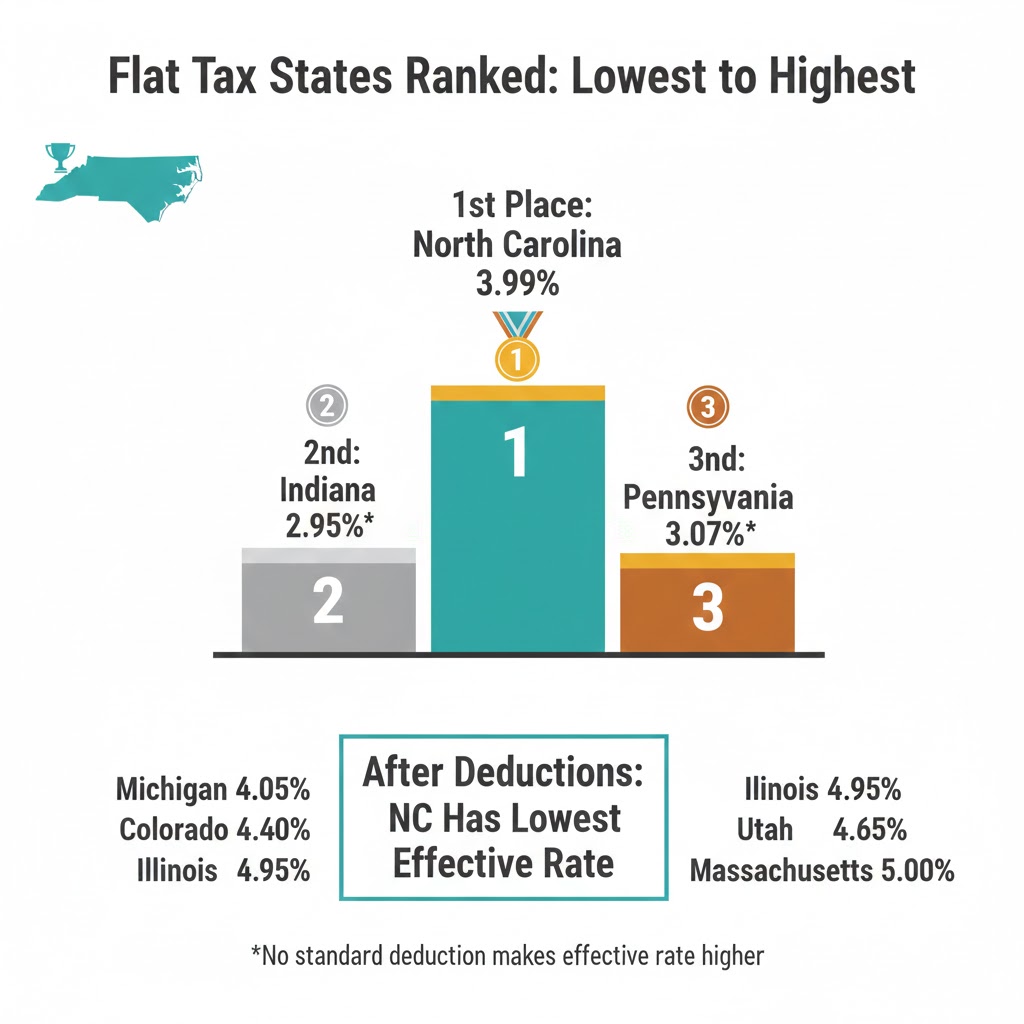
| State | Flat Tax Rate | Rank (Lowest to Highest) |
|---|---|---|
| North Carolina | 3.99% | 1st (Lowest) |
| Pennsylvania | 3.07%* | Actually lowest but no standard deduction |
| Indiana | 2.95% | Technically lowest rate |
| Illinois | 4.95% | 3rd |
| Michigan | 4.05% | 2nd (after NC with deduction) |
| Colorado | 4.40% | 4th |
| Utah | 4.65% | 5th |
| Massachusetts | 5.00% | 6th |
*Note: Pennsylvania’s 3.07% appears lower but has no standard deduction, making effective rate higher for most workers. Indiana’s 2.95% (2026) is technically lowest but NC’s larger standard deduction often results in lower effective burden for middle-income earners.
Effective Rate Comparison at $50,000 income:
- North Carolina: 2.9% effective (after $14,150 deduction)
- Indiana: 2.95% (minimal deduction)
- Pennsylvania: 3.07% (no standard deduction)
- Illinois: 4.66% effective (after $2,925 personal exemption)
North Carolina Minimum Wage (2026)
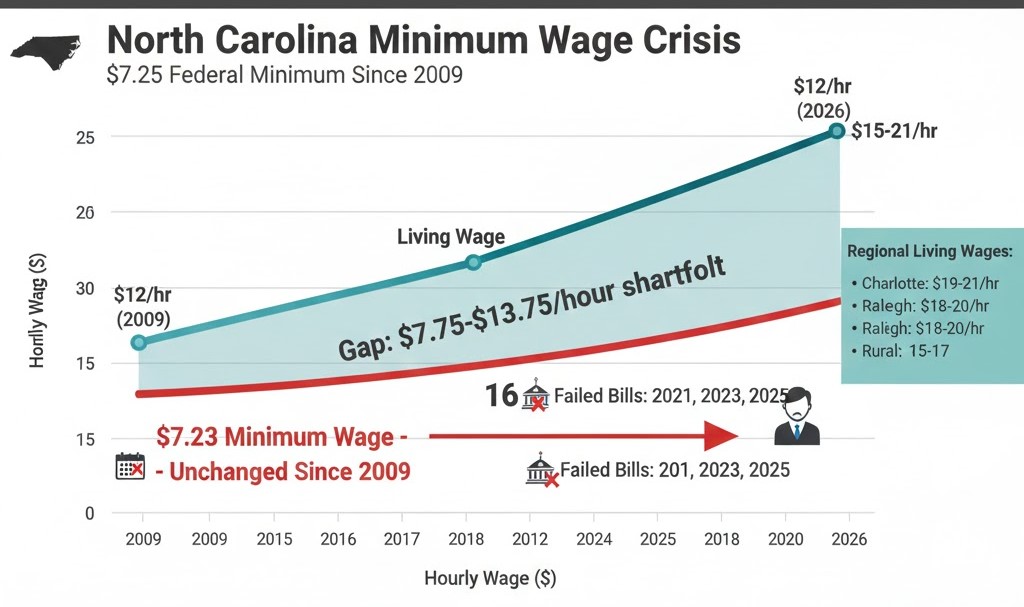
North Carolina’s minimum wage remains at the federal minimum, unchanged for 16 years.
Current North Carolina Minimum Wage:
- General minimum wage: $7.25/hour (matches federal minimum)
- Tipped workers: $2.13/hour (must reach $7.25 with tips)
- Youth workers: $7.25/hour (no sub-minimum)
- Last increase: July 24, 2009 (federal increase)
No State Increases Since 2009: North Carolina has not enacted a state minimum wage above the federal $7.25 since the federal increase in 2009. The state follows federal minimum wage law exclusively.
Why NC Minimum Wage Hasn’t Increased
Political Landscape:
- Republican-controlled legislature since 2011
- Multiple Democratic-sponsored bills to raise minimum wage have failed
- Most recent attempt: House Bill 353 (2025) – proposed $10/hour in 2026, increasing to $18 by 2030 – failed in committee
Legislative Opposition Reasons:
- Concerns about small business impact
- Preference for market-driven wages
- Belief that low state taxes compensate for lower minimum wage
- Fear of job losses in rural counties
Failed Minimum Wage Proposals (2020-2025):
- 2021: $15/hour by 2026 – Failed
- 2023: $12/hour by 2024 – Failed
- 2025: $10/hour by 2026, $18/hour by 2030 – Failed
North Carolina Minimum Wage vs. Neighboring States (2026)
| State | Minimum Wage | Above Federal? |
|---|---|---|
| North Carolina | $7.25/hour | No (matches federal) |
| South Carolina | $7.25/hour | No (matches federal) |
| Georgia | $5.15/hour* | State rate, but most follow federal $7.25 |
| Tennessee | $7.25/hour | No (matches federal) |
| Virginia | $12.41/hour | Yes (+$5.16 above federal) |
| West Virginia | $8.75/hour | Yes (+$1.50 above federal) |
*Georgia’s state minimum is $5.15 but federal law requires $7.25 for covered employers
Key Insight: Among NC’s neighbors, only Virginia has significantly raised minimum wage above federal level. Most Southern states maintain $7.25 federal minimum.
North Carolina Living Wage vs. Minimum Wage
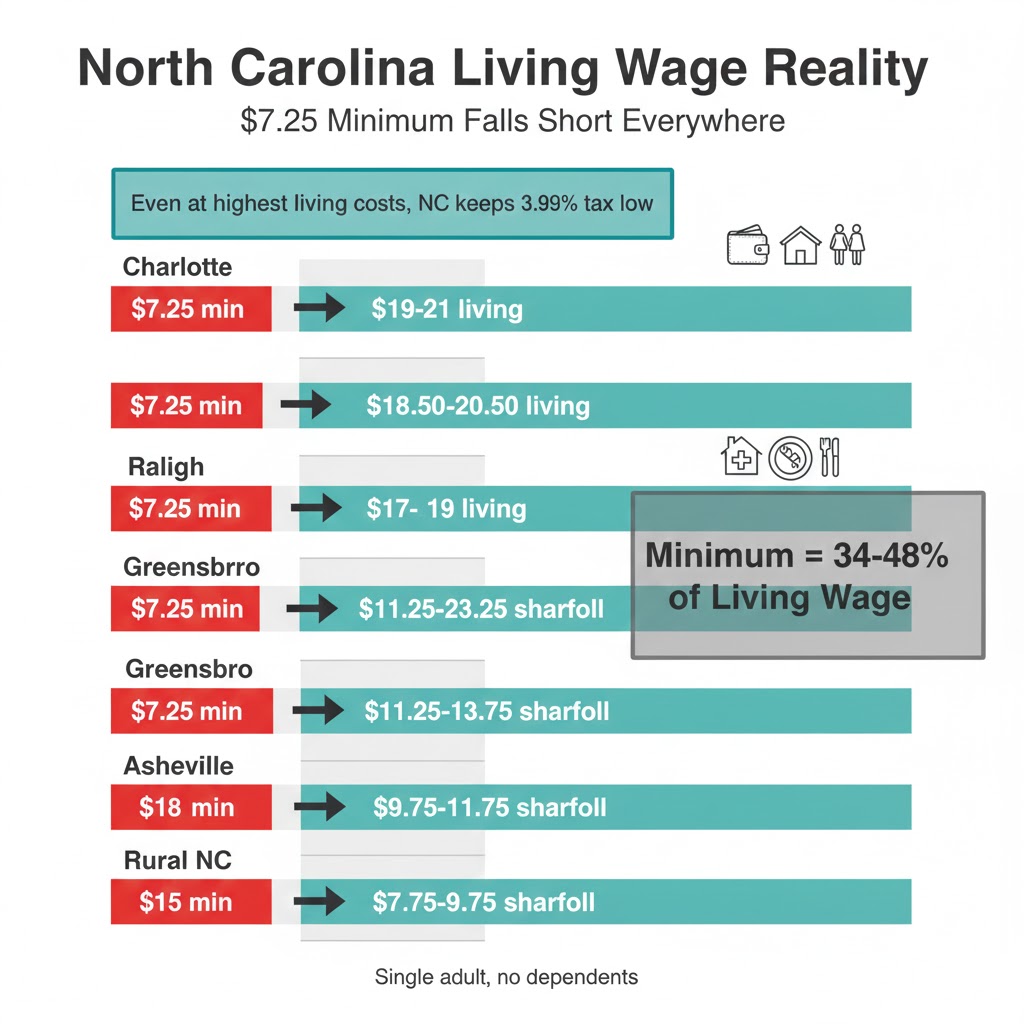
The “living wage” represents the hourly rate needed for basic necessities without government assistance. NC minimum wage falls far short across all regions.
Living Wage Estimates for North Carolina (2026):
| Region | Living Wage (Single Adult) | Annual Living Wage | Gap from $7.25 Min Wage |
|---|---|---|---|
| Charlotte Metro | $19.00-$21.00/hour | $39,520-$43,680 | -$11.75 to -$13.75/hour |
| Raleigh-Durham | $18.50-$20.50/hour | $38,480-$42,640 | -$11.25 to -$13.25/hour |
| Greensboro-Winston-Salem | $17.00-$19.00/hour | $35,360-$39,520 | -$9.75 to -$11.75/hour |
| Asheville | $18.00-$20.00/hour | $37,440-$41,600 | -$10.75 to -$12.75/hour |
| Wilmington | $17.50-$19.50/hour | $36,400-$40,560 | -$10.25 to -$12.25/hour |
| Rural NC (Eastern) | $15.00-$17.00/hour | $31,200-$35,360 | -$7.75 to -$9.75/hour |
| Rural NC (Western) | $15.50-$17.50/hour | $32,240-$36,400 | -$8.25 to -$10.25/hour |
Gap Analysis:
- Charlotte: Minimum wage covers only 34-38% of living wage
- Rural NC: Minimum wage covers only 43-48% of living wage
- Even in lowest-cost NC counties, $7.25 is insufficient for independent living
Annual Earnings at NC Minimum Wage
Full-Time at $7.25/hour:
- Hourly: $7.25
- Weekly (40 hours): $290
- Monthly: $1,257
- Annual: $15,080
- After taxes: ~$13,890 net ($1,158/month)
Poverty Level Comparison (2026):
- Federal poverty line (single): $15,200
- $7.25/hour full-time: $15,080
- Minimum wage is below poverty line for single adult
Family Impact:
- Federal poverty line (family of 4): $31,200
- Two adults at $7.25/hour full-time: $30,160
- Two minimum wage earners with two kids are below poverty line
North Carolina Overtime Pay Rules
North Carolina follows federal Fair Labor Standards Act (FLSA) overtime requirements with no state-specific enhancements.
North Carolina Overtime Rules:
- Overtime required after: 40 hours in a workweek
- Overtime rate: Time-and-a-half (1.5× regular hourly rate)
- No daily overtime: NC does not require overtime for long workdays
- No double-time: NC has no double-time provisions
- Weekly calculation: Based on 7-day workweek
Overtime Calculation Example:
Scenario: Work 50 hours at $18/hour in a week
- First 40 hours: $18 × 40 = $720 (regular time)
- Next 10 hours: $27 × 10 = $270 (overtime)
- Total weekly pay: $990
North Carolina Overtime Exemptions
Many NC workers are exempt from overtime requirements under federal FLSA rules.
Common FLSA Exemptions (apply in North Carolina):
- Executive employees: Manage 2+ employees, have hiring/firing authority
- Administrative employees: Office work requiring discretion/judgment
- Professional employees: Work requiring advanced knowledge/education
- Computer professionals: Earning at least $35.47/hour or $684/week salary
- Outside sales employees: Primary duty is external sales
Salary Threshold for Exemption: To qualify for executive, administrative, or professional exemptions:
- Federal minimum: $684/week ($35,568 annually)
- North Carolina has no higher state threshold
Important: Many employers misclassify employees as exempt to avoid overtime. If you’re paid salary but don’t meet duties test or earn under threshold, you may be entitled to back overtime pay.
North Carolina Cost of Living by Region
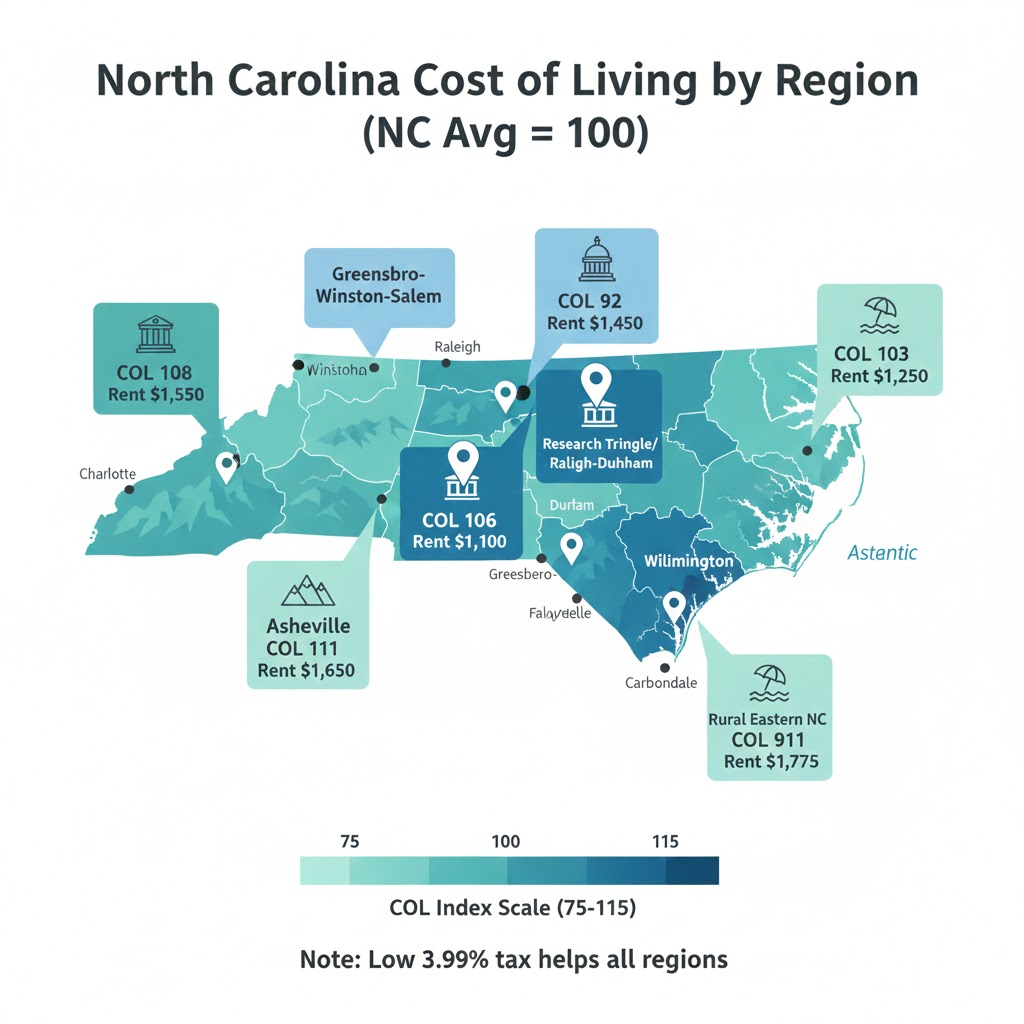
North Carolina offers significant cost-of-living variation from expensive metros to very affordable rural areas.
North Carolina Cost of Living Index (NC Average = 100):
| Region | Overall COL Index | Housing Index | Key Factor |
|---|---|---|---|
| Charlotte Metro | 108 | 120 | Financial center |
| Raleigh-Durham | 106 | 118 | Research Triangle |
| Asheville | 111 | 135 | Tourism, retirees |
| Chapel Hill | 115 | 145 | University town |
| Wilmington | 103 | 115 | Coastal city |
| Greensboro | 93 | 92 | Mid-sized, affordable |
| Winston-Salem | 91 | 88 | Affordable urban |
| Fayetteville | 90 | 85 | Military base |
| Rocky Mount | 84 | 75 | Eastern NC |
| Rural Western NC | 88 | 82 | Mountains |
| Rural Eastern NC | 80 | 70 | Most affordable |
Charlotte Cost of Living
Charlotte Details:
- Overall COL: 108% of NC average, 102% of national average
- Housing: 120% of NC average
- Median home price: $380,000-$420,000
- Median 1-BR rent: $1,400-$1,700/month
Charlotte Salary Equivalents: To match purchasing power of $50,000 in other NC cities:
- $54,000 in Charlotte (8% more)
- $57,500 in Asheville (15% more due to housing)
- $48,000 in Greensboro (4% less)
- $45,500 in Rocky Mount (9% less)
Research Triangle (Raleigh-Durham-Chapel Hill) Cost of Living
Research Triangle Details:
- Overall COL: 106-115% of NC average
- Housing: 118-145% of NC average (Chapel Hill highest)
- Raleigh median 1-BR rent: $1,300-$1,600/month
- Durham median 1-BR rent: $1,200-$1,500/month
- Chapel Hill median 1-BR rent: $1,500-$1,900/month
Research Triangle Advantages:
- High-paying tech, research, healthcare jobs
- Multiple universities (UNC, Duke, NC State)
- Lower cost than Silicon Valley or Boston for similar jobs
- NC’s 3.99% tax maximizes tech worker take-home
Rural North Carolina Affordability
Rural NC (Eastern counties) Details:
- Overall COL: 80-85% of NC average
- Housing: 70-75% of NC average
- Median home price: $150,000-$220,000
- Median 1-BR rent: $650-$900/month
Rural NC Challenges:
- Lower wages (median household income $35,000-$45,000)
- Fewer job opportunities
- Limited public transportation
- Longer commutes to major employment centers
Rural NC Advantages:
- Very affordable housing
- Low property taxes
- Lower sales tax in some counties
- Quality of life for retirees and remote workers
North Carolina Sales Tax Rates
North Carolina has moderate combined state and local sales taxes.
North Carolina Sales Tax (2026):
- State rate: 4.75%
- County rates: 2.00% to 2.75% additional
- Combined rates: 6.75% to 7.50% depending on county
Major NC Cities Combined Sales Tax:
- Charlotte (Mecklenburg): 7.50%
- Raleigh (Wake): 7.50%
- Durham: 7.50%
- Greensboro (Guilford): 7.00%
- Winston-Salem (Forsyth): 7.00%
- Asheville (Buncombe): 7.00%
- Wilmington (New Hanover): 7.00%
Sales Tax Exemptions:
- Prescription drugs: Exempt
- Groceries: Taxed at 2% (state only)
- Prepared food: Full rate (6.75-7.50%)
North Carolina Property Tax Rates
North Carolina has below-average property taxes compared to national averages.
NC Property Tax Facts:
- Average effective rate: 0.63% of home value (national average: 0.99%)
- Among lowest in the Southeast
- Locally assessed and collected by counties
County Property Tax Comparison:
| County | Effective Rate | $300k Home Annual Tax |
|---|---|---|
| Mecklenburg (Charlotte) | 0.91% | $2,730 |
| Wake (Raleigh) | 0.72% | $2,160 |
| Durham | 0.88% | $2,640 |
| Forsyth (Winston-Salem) | 0.71% | $2,130 |
| Guilford (Greensboro) | 0.85% | $2,550 |
| Buncombe (Asheville) | 0.54% | $1,620 |
| Rural counties | 0.40-0.60% | $1,200-$1,800 |
Trade-off: NC’s low income tax (3.99%) and moderate property tax (0.63%) create favorable overall tax burden despite moderate sales tax.
North Carolina Tax-Friendly Status
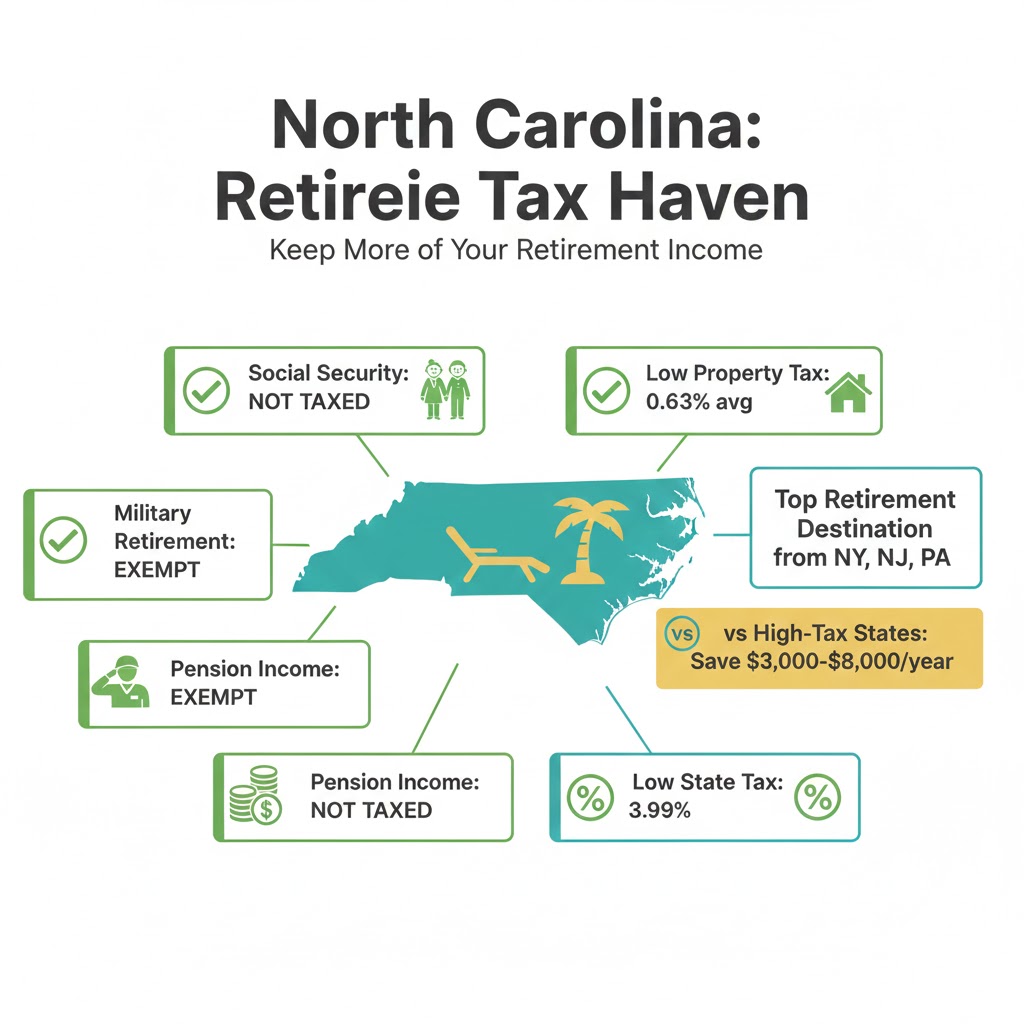
Tax Advantages:
- 3.99% flat income tax (one of lowest in nation)
- No tax on Social Security benefits
- No tax on military retirement pay
- Below-average property taxes
- No estate or inheritance tax
Retiree Benefits: NC is particularly tax-friendly for retirees:
- Social Security: Not taxed
- Pension income (public/private): Fully exempt up to certain limits
- IRA/401k distributions: Standard treatment
- Low property taxes
- Moderate sales taxes
Why Retirees Choose North Carolina:
- Low income tax on retirement income
- Affordable cost of living (especially outside metros)
- Mild climate
- Quality healthcare facilities
- No estate tax for inheritance planning
Summary: Hourly to Salary Calculator NC
Converting hourly wages to annual salary in North Carolina is straightforward thanks to the state’s flat 3.99% income tax—the lowest flat rate in the nation as of 2026.
Key Takeaways:
North Carolina’s 3.99% flat tax provides one of the lowest state income tax burdens in the United States, with further reductions to 3.49% (2027) and potentially 2.49% planned. The 2013 tax reform eliminated progressive brackets (up to 7.75%) and created a flat system that has steadily declined from 5.8% to today’s 3.99%, making NC highly competitive for attracting workers and businesses from high-tax states.
No local income taxes exist anywhere in North Carolina—unlike Ohio, Pennsylvania, or Indiana which allow municipal taxes. Combined with below-average property taxes (0.63%) and moderate sales taxes (6.75-7.50%), NC offers favorable overall tax burden despite low state income tax.
North Carolina’s $7.25 minimum wage (federal minimum) hasn’t increased since 2009 and remains far below living wage estimates ($15-21/hour depending on region). Multiple legislative attempts to raise it have failed in the Republican-controlled legislature, with latest proposal (HB 353) to reach $18 by 2030 dying in committee.
Charlotte and Research Triangle offer higher wages and job opportunities but cost 6-15% more than state average. Rural Eastern NC provides lowest costs (20% below average) but fewer job opportunities. NC’s low 3.99% tax helps maximize take-home pay across all regions.
North Carolina is exceptionally tax-friendly for retirees, exempting Social Security, military retirement, and most pension income from state tax. Combined with low property taxes and no estate tax, NC attracts retirees from high-tax Northern states seeking affordable Southern living.
Use this calculator for comparing NC job offers across regions, understanding true take-home pay in Charlotte vs. rural areas, negotiating salaries with NC’s low tax advantage, planning budgets based on 3.99% flat state tax, and evaluating NC opportunities versus neighboring states (Virginia, SC, Tennessee).