Calculate your Oregon annual salary from hourly wage instantly, including Oregon state income tax (4.75%-9.9%), Paid Leave Oregon contributions, and federal taxes. Our free hourly to salary calculator Oregon shows your exact take-home pay after all Oregon-specific deductions.
Whether you earn Oregon’s minimum wage of $15.05 per hour (standard rate) or $50+ per hour in Portland, this calculator provides accurate results based on Oregon’s unique tax structure and payroll deductions. You can also convert Oregon annual salary to hourly rate using the reverse calculator.
Oregon workers benefit from no sales tax but face progressive state income taxes that range from 4.75% to 9.9%. Understanding your true earnings helps with budgeting, job comparisons, and financial planning across Oregon’s diverse regions from Portland Metro to Eugene, Salem, and rural counties.
Hourly to Salary Calculator Oregon (Interactive Tool)
Calculate your Oregon salary using our 2-in-1 salary to hourly calculator with advanced location settings. Input your hourly rate (OR minimum: $14.70 standard, $15.95 Portland metro, $13.70 non-urban counties), add overtime, and instantly see your take-home pay after Oregon’s progressive state tax (4.75%-9.9%) and all federal deductions.
How to Use This Oregon Calculator
Step 1: Enter your Oregon hourly wage Input your current or expected hourly rate. Oregon’s minimum wage varies by location: $16.30 in Portland Metro (as of July 2025), $15.05 in standard counties, and $14.20 in non-urban counties.
Step 2: Select your Oregon work location Choose your county to apply the correct minimum wage tier. Oregon has three minimum wage zones based on cost of living.
Step 3: Input your working hours Enter hours per week (40 for full-time) and weeks per year (52 standard, or adjust for unpaid time off).
Step 4: Indicate Portland Metro residency If you live or work in the Portland Metro area or Multnomah County, check the appropriate boxes to calculate local income taxes (Metro SHS and/or Multnomah County PFA) that apply to high earners.
Step 5: Review your Oregon results The calculator displays your gross salary plus Oregon-specific deductions including state income tax, Paid Leave Oregon (0.6% employee contribution), federal taxes, FICA, and your net take-home pay.
Your Results Breakdown
Once you enter your information, the calculator shows:
Gross Income:
- Hourly rate
- Daily earnings (8-hour day)
- Weekly gross pay
- Bi-weekly gross pay (most common in Oregon)
- Monthly gross pay
- Annual salary
Oregon State Deductions:
- Oregon state income tax (4.75% to 9.9% progressive brackets)
- Paid Leave Oregon employee contribution (0.6% of wages up to $168,600)
- Statewide Transit Tax (0.1% – withheld from wages)
- Portland Metro taxes (if applicable):
- Metro Supportive Housing Services (1% over $125k/$200k)
- Multnomah County Preschool for All (1.5-3% over $125k/$200k)
- Portland Arts Tax ($35 flat for eligible residents)
Federal Deductions:
- Federal income tax withholding
- Social Security (6.2% up to $176,100)
- Medicare (1.45% on all wages)
- Additional Medicare tax (0.9% over $200k single / $250k married)
Net Take-Home Pay:
- After all Oregon and federal deductions
- Monthly take-home amount
- Actual spending power in Oregon dollars
Oregon vs. National Comparison:
- How your Oregon take-home compares to same salary in Washington (no state income tax)
- Effective tax rate in Oregon
- True hourly rate after all Oregon taxes
How to Calculate Hourly to Salary in Oregon
Understanding the Oregon salary calculation process helps you verify results and make quick conversions for job offers or salary negotiations in Oregon’s competitive job market.
Basic Oregon Salary Calculation Formula
The core formula applies across all states, but Oregon’s progressive tax system significantly impacts take-home pay:
Gross Annual Salary = Hourly Rate × Hours Per Week × Weeks Per Year
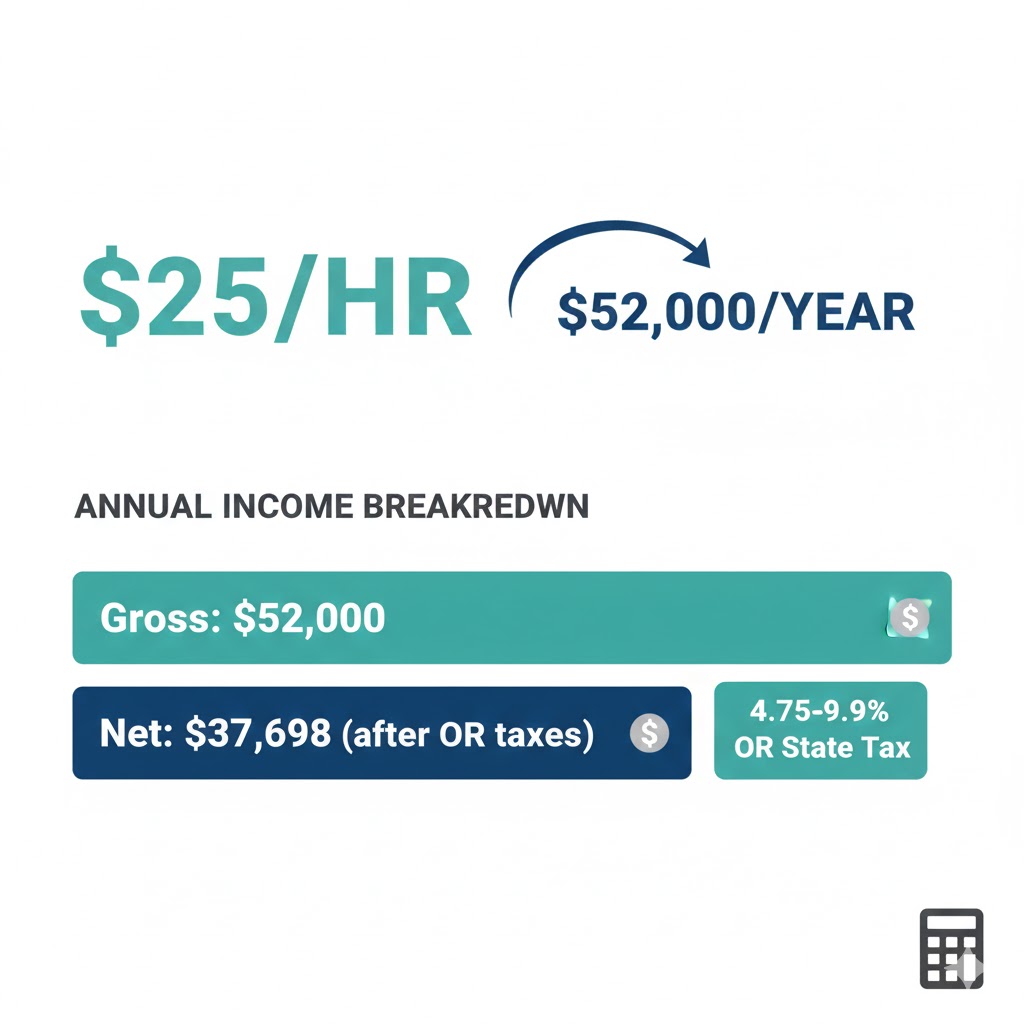
For Oregon workers at $25/hour, 40 hours/week, 52 weeks/year: $25 × 40 × 52 = $52,000 gross annual salary
However, Oregon net pay calculation requires subtracting:
- Oregon state income tax (~4.8% effective rate at $52k)
- Paid Leave Oregon (0.6%): $312
- Federal income tax (~12% effective): $6,240
- FICA taxes (7.65%): $3,978
- Statewide Transit Tax (0.1%): $52
Net annual pay: ~$38,900 (75% of gross)
In comparison, the same $52,000 salary in Washington (no state income tax) yields ~$40,800 net pay (78% of gross), a difference of $1,900 annually or $158 per month.
Step-by-Step Calculation for Oregon Workers
Step 1: Calculate gross salary Multiply your Oregon hourly rate by hours and weeks worked. Example: $20/hour × 40 hours × 52 weeks = $41,600
Step 2: Determine Oregon state tax bracket For single filer earning $41,600 in Oregon:
- First $4,300 taxed at 4.75% = $204
- Next $6,450 ($10,750 – $4,300) taxed at 6.75% = $435
- Next $16,900 ($27,650 – $10,750) taxed at 8.75% = $1,479
- Remaining $13,950 ($41,600 – $27,650) taxed at 9.9% = $1,381
Total Oregon state tax: $3,499 annually (~8.4% effective)
Step 3: Calculate Paid Leave Oregon Oregon Paid Leave employee contribution is 0.6% on wages up to $168,600: $41,600 × 0.6% = $250 annually
Step 4: Calculate Statewide Transit Tax All Oregon workers pay 0.1% for statewide transit: $41,600 × 0.1% = $42 annually
Step 5: Calculate federal taxes Federal income tax for single filer at $41,600:
- Using standard deduction of $14,600
- Taxable income: $27,000
- Federal tax: ~$3,100
Step 6: Calculate FICA
- Social Security: $41,600 × 6.2% = $2,579
- Medicare: $41,600 × 1.45% = $603
- Total FICA: $3,182
Step 7: Calculate Oregon net pay $41,600 – $3,499 (OR tax) – $250 (Paid Leave) – $42 (Transit) – $3,100 (Fed) – $3,182 (FICA) = $31,527 net pay
Your Oregon take-home pay is 76% of gross at this income level.
Oregon-Specific Calculation Examples
Example 1: $20/hour in Portland Metro
Gross Calculation:
- Hourly rate: $20.00
- Hours per week: 40
- Weeks per year: 52
- Annual gross salary: $41,600
Oregon Deductions:
- OR state income tax: $3,499 (8.4% effective rate)
- Paid Leave Oregon: $250 (0.6%)
- Statewide Transit Tax: $42 (0.1%)
- Federal income tax: $3,100 (7.45% effective rate)
- FICA: $3,182 (7.65%)
- Total deductions: $10,073
Net Pay:
- Annual net: $31,527
- Monthly net: $2,627
- Bi-weekly net: $1,213
- Take-home percentage: 76%
Portland Metro Context: At $20/hour in Portland, you’re earning above Oregon’s standard minimum wage ($15.05) and near the Portland Metro minimum ($16.30). Living wage estimates for Portland single adults range from $22-24/hour. Portland median 1-bedroom rent averages $1,500-$1,700 monthly, consuming 57-65% of your take-home pay.
Example 2: $30/hour in Eugene
Gross Calculation:
- Hourly rate: $30.00
- Hours per week: 40
- Weeks per year: 52
- Annual gross salary: $62,400
Oregon Deductions:
- OR state income tax: $5,544 (8.9% effective rate)
- Paid Leave Oregon: $374 (0.6%)
- Statewide Transit Tax: $62 (0.1%)
- Federal income tax: $6,850 (11% effective rate)
- FICA: $4,774 (7.65%)
- Total deductions: $17,604
Net Pay:
- Annual net: $44,796
- Monthly net: $3,733
- Bi-weekly net: $1,723
- Take-home percentage: 72%
Eugene Cost of Living Context: At $30/hour in Eugene, you’re earning well above minimum wage in Oregon’s second-largest metro. Eugene median 1-bedroom rent is $1,300-$1,500 monthly, consuming 35-40% of your take-home pay. Eugene’s living wage for single adults is estimated at $20-22/hour, making this salary comfortable for the area.
Example 3: $15.05/hour at Oregon Standard Minimum Wage
Gross Calculation:
- Hourly rate: $15.05 (Oregon standard minimum wage July 2025-June 2026)
- Hours per week: 40
- Weeks per year: 52
- Annual gross salary: $31,304
Oregon Deductions:
- OR state income tax: $2,085 (6.7% effective rate – lower bracket)
- Paid Leave Oregon: $188 (0.6%)
- Statewide Transit Tax: $31 (0.1%)
- Federal income tax: $2,000 (6.4% effective rate)
- FICA: $2,395 (7.65%)
- Total deductions: $6,699
Net Pay:
- Annual net: $24,605
- Monthly net: $2,050
- Bi-weekly net: $946
- Take-home percentage: 79%
Oregon Minimum Wage Context: At Oregon’s $15.05 standard minimum wage, workers face lower tax rates but still struggle with Oregon’s cost of living. Even in more affordable cities like Salem or Bend, living wage is $18-22/hour. Many minimum wage workers in Oregon qualify for earned income tax credits and state assistance programs.
Example 4: $25/hour with Regular Overtime in Oregon
Gross Calculation:
- Regular hourly rate: $25.00
- Regular hours: 40 per week
- Overtime hours: 5 per week
- Overtime rate: $37.50 (time-and-a-half)
Weekly Breakdown:
- Regular pay: $25 × 40 = $1,000
- Overtime pay: $37.50 × 5 = $187.50
- Total weekly: $1,187.50
- Annual gross: $61,750
Oregon Deductions:
- OR state income tax: $5,462 (8.8% effective rate)
- Paid Leave Oregon: $371 (0.6%)
- Statewide Transit Tax: $62 (0.1%)
- Federal income tax: $6,750 (10.93% effective rate)
- FICA: $4,724 (7.65%)
- Total deductions: $17,369
Net Pay:
- Annual net: $44,381
- Monthly net: $3,698
- Bi-weekly net: $1,707
- Take-home percentage: 72%
Oregon Overtime Impact: The 5 hours of weekly overtime adds $9,750 to your annual gross income (regular 40 hours = $52,000). Oregon’s progressive tax system and federal taxes mean you keep about 72% of that overtime income after taxes, netting an additional $7,000 annually. Oregon follows federal overtime rules (after 40 hours/week) without California’s daily overtime provisions.
Reverse Calculator: Oregon Annual Salary to Hourly Rate
Converting Oregon annual salaries to hourly rates helps you compare salaried positions with hourly jobs and understand your true per-hour earnings after considering Oregon’s tax burden.
How to Convert Oregon Salary to Hourly Wage
The reverse calculation divides annual salary by total hours worked, but understanding Oregon take-home requires factoring in the state’s progressive tax structure.
Basic Formula: Hourly Rate = Annual Salary ÷ 2,080 hours (40 hours × 52 weeks)
Oregon Take-Home Hourly Rate: Effective Hourly Rate = (Annual Salary – OR taxes – Federal taxes – FICA – Paid Leave) ÷ 2,080
This “effective hourly rate” shows what you actually earn per hour after Oregon’s combined tax burden, which ranges from 20-30% depending on your income level.
Salary to Hourly Formula for Oregon
Step 1: Divide annual salary by 2,080 This gives you gross hourly rate before any Oregon or federal deductions.
Step 2: Calculate Oregon state tax impact Estimate 5-9% of annual salary for Oregon state income tax (varies by income bracket).
Step 3: Calculate total tax burden Add Oregon state tax + federal tax + FICA + Paid Leave (typically 20-30% combined).
Step 4: Determine effective hourly rate Subtract total taxes from annual salary, then divide by 2,080.
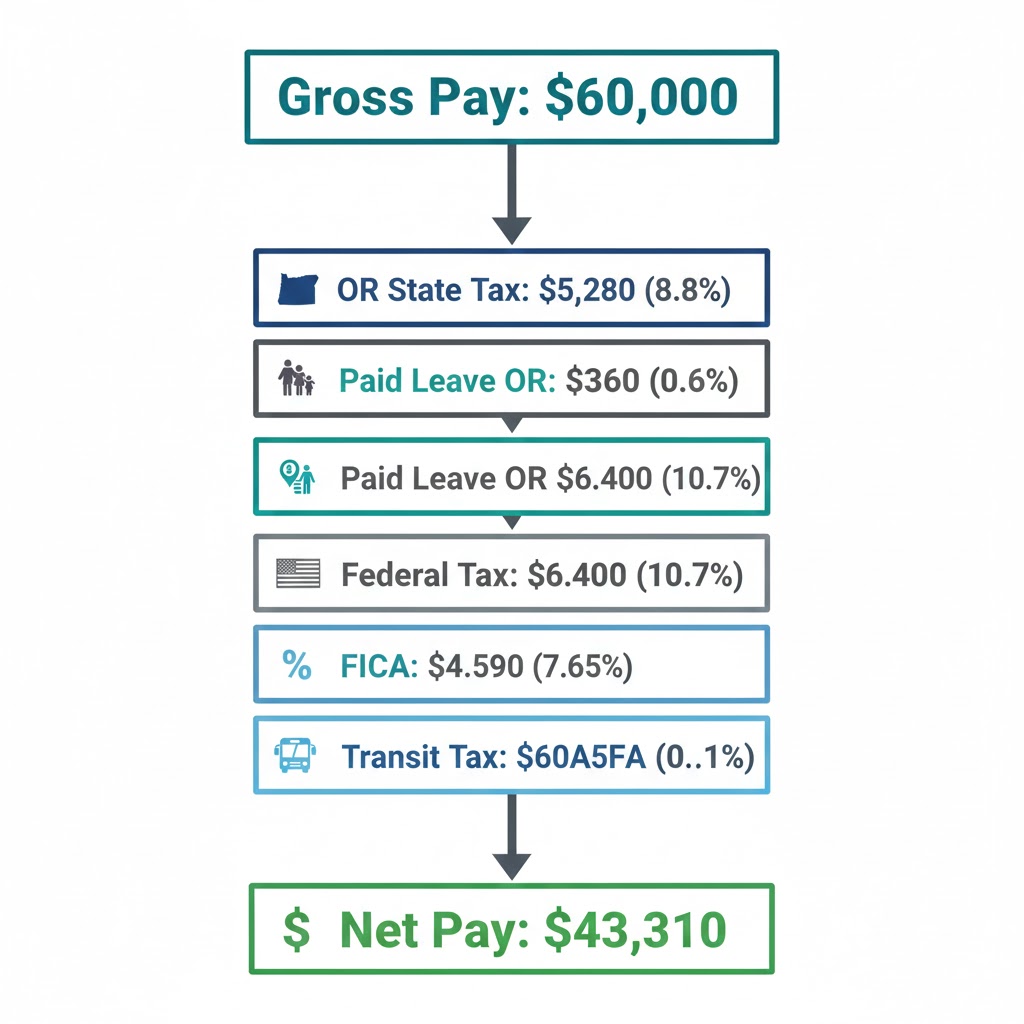
Example: $60,000 Oregon salary:
- Gross hourly: $60,000 ÷ 2,080 = $28.85/hour
- OR state tax (~$5,280): -$2.54/hour
- Federal + FICA (~$11,000): -$5.29/hour
- Paid Leave ($360): -$0.17/hour
- Effective hourly: $20.85/hour
Your Oregon take-home is $20.85/hour on a $60,000 salary, which is 72% of your gross hourly rate.
Oregon Salary Conversion Examples
Example: $50,000 salary to hourly in Oregon
Gross Calculation:
- Annual salary: $50,000
- Standard hours: 2,080 per year
- Gross hourly rate: $24.04/hour
Oregon Tax Impact:
- OR state income tax: $4,113 (8.2% effective)
- Paid Leave Oregon: $300 (0.6%)
- Statewide Transit Tax: $50 (0.1%)
- Federal income tax: $4,200 (8.4% effective)
- FICA: $3,825 (7.65%)
- Total annual deductions: $12,488
Net Oregon Earnings:
- Annual net: $37,512
- Effective hourly rate: $18.04/hour
- Take-home percentage: 75%
Oregon vs. Washington Comparison: The same $50,000 salary in Washington (no state income tax):
- Annual net: ~$41,000
- Effective hourly: $19.71/hour
- Difference: $1.67/hour more in Washington (about $3,475 annually)
Example: $75,000 salary to hourly in Oregon
Gross Calculation:
- Annual salary: $75,000
- Standard hours: 2,080 per year
- Gross hourly rate: $36.06/hour
Oregon Tax Impact:
- OR state income tax: $6,713 (9.0% effective)
- Paid Leave Oregon: $450 (0.6%)
- Statewide Transit Tax: $75 (0.1%)
- Federal income tax: $9,800 (13.1% effective)
- FICA: $5,738 (7.65%)
- Total annual deductions: $22,776
Net Oregon Earnings:
- Annual net: $52,224
- Effective hourly rate: $25.11/hour
- Take-home percentage: 70%
Oregon Tax Impact: At $75,000 in Oregon, you lose 30% to taxes compared to ~23% in a no-income-tax state. This higher earner pays $6,713 in Oregon state tax alone, reducing effective hourly rate by $3.23/hour compared to Washington.
Example: $100,000 salary to hourly in Oregon
Gross Calculation:
- Annual salary: $100,000
- Standard hours: 2,080 per year
- Gross hourly rate: $48.08/hour
Oregon Tax Impact:
- OR state income tax: $9,213 (9.2% effective)
- Paid Leave Oregon: $600 (0.6%)
- Statewide Transit Tax: $100 (0.1%)
- Federal income tax: $16,500 (16.5% effective)
- FICA: $7,650 (7.65%)
- Total annual deductions: $34,063
Net Oregon Earnings:
- Annual net: $65,937
- Effective hourly rate: $31.70/hour
- Take-home percentage: 66%
Six-Figure Oregon Reality: At $100,000 in Oregon, you’re in the 9.9% state tax bracket (marginal rate), though your effective rate is 9.2%. Combined with federal taxes, you lose 34% to taxes. In comparison, the same salary in Washington yields ~$73,000 net (73%), a difference of $7,063 annually or $3.40/hour.
High-Earner Oregon Tax Comparison
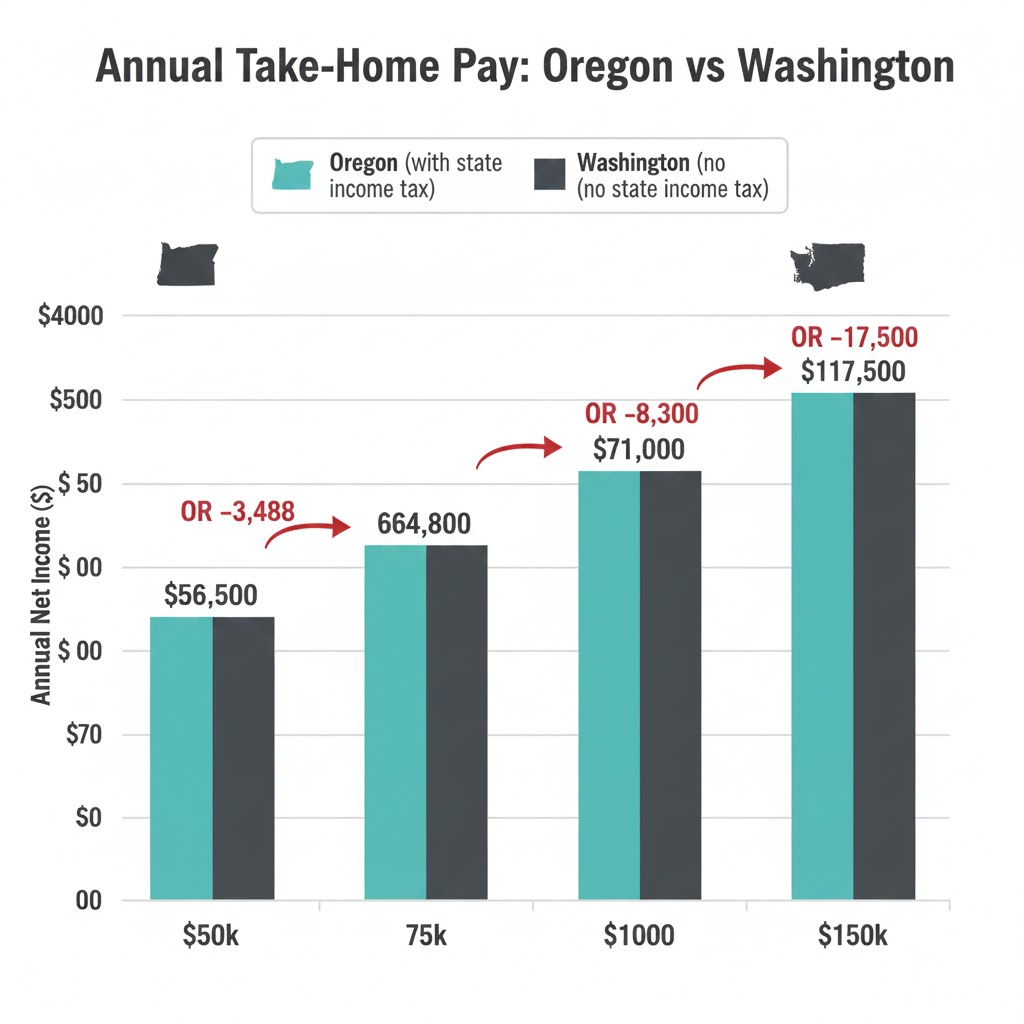
| Annual Salary | OR Net Pay | WA Net Pay | Annual Difference | Hourly Difference |
|---|---|---|---|---|
| $50,000 | $37,512 | $41,000 | -$3,488 | -$1.68/hour |
| $75,000 | $52,224 | $58,500 | -$6,276 | -$3.02/hour |
| $100,000 | $65,937 | $73,000 | -$7,063 | -$3.40/hour |
| $150,000 | $94,000 | $105,000 | -$11,000 | -$5.29/hour |
| $200,000 | $120,500 | $136,000 | -$15,500 | -$7.45/hour |
Oregon’s progressive tax system means higher earners pay proportionally more in state taxes, with those earning $100,000+ paying effective state rates of 9-10% compared to 5-7% for those earning $40,000.
Oregon State Taxes and Your Paycheck
Oregon has a progressive state income tax system with rates ranging from 4.75% to 9.9%. Understanding how Oregon taxes impact your paycheck is crucial for accurate salary planning.
Oregon State Income Tax Rates (2026)
Oregon uses a progressive tax system with four tax brackets. You pay different rates on different portions of your income, not one flat rate on all income.
Oregon Tax Brackets for Single Filers (2026)
| Tax Rate | Income Range | Tax Owed on Range | Cumulative Tax |
|---|---|---|---|
| 4.75% | $0 – $4,300 | Up to $204 | $204 |
| 6.75% | $4,301 – $10,750 | Up to $435 | $639 |
| 8.75% | $10,751 – $27,650 | Up to $1,479 | $2,118 |
| 9.9% | Over $27,650 | 9.9% of excess | $2,118 + 9.9% |
Key Insights:
- Oregon’s top rate of 9.9% starts at just $27,651 for single filers
- Most Oregon workers earning $40k-$100k pay effective rates of 7-9%
- First $4,300 is only taxed at 4.75%
- Oregon brackets are NOT adjusted for inflation (unlike federal)
Oregon Tax Brackets for Married Filing Jointly (2026)
| Tax Rate | Income Range | Tax Owed on Range | Cumulative Tax |
|---|---|---|---|
| 4.75% | $0 – $8,600 | Up to $409 | $409 |
| 6.75% | $8,601 – $21,500 | Up to $871 | $1,280 |
| 8.75% | $21,501 – $55,300 | Up to $2,958 | $4,238 |
| 9.9% | Over $55,300 | 9.9% of excess | $4,238 + 9.9% |
Married Filing Impact:
- Brackets are exactly double those for single filers
- Married couples benefit from doubled income thresholds
- A couple earning $100,000 combined pays less effective rate than two singles earning $50,000 each
How Oregon’s Progressive Tax System Works
Oregon’s progressive system means you pay different rates on different “chunks” of your income, not one rate on all of it.
Example: Single filer earning $60,000
Income is taxed in layers:
- First $4,300 at 4.75% = $204
- Next $6,450 ($4,301-$10,750) at 6.75% = $435
- Next $16,900 ($10,751-$27,650) at 8.75% = $1,479
- Remaining $32,350 ($27,651-$60,000) at 9.9% = $3,203
Total Oregon tax: $5,321 Effective tax rate: 8.9% (much lower than 9.9% marginal rate)
Common Misconception: Many people think earning $60,000 means paying 9.9% on all income. In reality, only the last $32,350 is taxed at 9.9%. Your effective rate is 8.9%, not 9.9%.
Oregon Effective Tax Rates by Income
| Annual Income | Marginal Rate | Effective Rate | Annual OR Tax |
|---|---|---|---|
| $30,000 | 8.75% | 6.4% | $1,920 |
| $40,000 | 9.9% | 7.5% | $3,000 |
| $50,000 | 9.9% | 8.2% | $4,100 |
| $60,000 | 9.9% | 8.9% | $5,340 |
| $75,000 | 9.9% | 9.0% | $6,750 |
| $100,000 | 9.9% | 9.2% | $9,200 |
| $150,000 | 9.9% | 9.5% | $14,250 |
| $200,000 | 9.9% | 9.6% | $19,200 |
The gap between marginal and effective rates shows why Oregon’s system is progressive. Someone earning $100,000 pays 9.2% effective rate, not the full 9.9% marginal rate on all income.
Oregon Paid Leave Oregon Program
Oregon Paid Leave is a state-run program providing paid time off for family, medical, and safe leave. The program is funded through payroll contributions split between employers and employees.
What is Paid Leave Oregon?
Paid Leave Oregon provides wage replacement benefits for:
- Family leave: Bonding with new child, caring for family member with serious health condition
- Medical leave: Your own serious health condition
- Safe leave: Domestic violence, harassment, sexual assault, or stalking situations
The program launched in 2023, making Oregon one of the few states with comprehensive paid family and medical leave.
Coverage Details:
- Up to 12 weeks of family or medical leave annually
- Up to 14 weeks for pregnancy-related medical leave
- Up to 2 additional weeks of safe leave
- Pays up to 100% of wages for lower earners, 50% for higher earners
- Maximum weekly benefit in 2026: $1,387
- Job protection for eligible workers
Paid Leave Oregon Contribution Rate (2026)
Total Contribution: 1% of gross wages up to $168,600
The 1% rate is split:
- Employee pays: 0.6%
- Employer pays: 0.4%
For employers with fewer than 25 employees, the employer may choose not to pay their portion, meaning employees pay the full 1%.
Employee Contribution Examples:
| Monthly Gross | Employee Contribution (0.6%) |
|---|---|
| $3,000 | $18.00 |
| $4,000 | $24.00 |
| $5,000 | $30.00 |
| $6,000 | $36.00 |
| $8,000 | $48.00 |
| $10,000 | $60.00 |
Paid Leave Wage Base Limit
2026 Wage Base: $168,600
Paid Leave contributions only apply to the first $168,600 of your annual wages. Any income above this amount is not subject to the 1% contribution.
Impact for high earners:
- Earning $168,600 or more: Maximum annual employee contribution = $1,012
- Earning $100,000: Annual employee contribution = $600
- Earning $60,000: Annual employee contribution = $360
Once your year-to-date wages reach $168,600, Paid Leave deductions stop for the remainder of the calendar year.
Paid Leave Oregon Benefits
When you need to take leave, Oregon Paid Leave provides:
Benefit Calculation:
- First $56,000 of annual wages: 100% wage replacement
- Wages between $56,000-$168,600: 50% wage replacement
- Maximum weekly benefit: $1,387
Example Benefit Calculations:
Scenario 1: Worker earning $40,000 annually ($769/week)
- Weekly benefit: $769 (100% replacement)
- 12 weeks of leave: $9,228 total benefit
Scenario 2: Worker earning $80,000 annually ($1,538/week)
- First $1,077/week (from $56k): 100% = $1,077
- Remaining $461/week: 50% = $231
- Total weekly benefit: $1,308
- 12 weeks of leave: $15,696 total benefit
Scenario 3: Worker earning $120,000 annually ($2,308/week)
- First $1,077/week: 100% = $1,077
- Next portion up to cap: 50% = $310
- Total weekly benefit: $1,387 (maximum)
- 12 weeks of leave: $16,644 total benefit
Eligibility for Paid Leave Oregon
To qualify for benefits:
- Worked in Oregon at least 1 of the last 5 calendar quarters
- Earned at least $1,000 during one of the last 4 quarters
Most Oregon workers who pay into the system will qualify for benefits when needed.
How Paid Leave Affects Your Paycheck
The 0.6% employee contribution appears on every paycheck as a line-item deduction, similar to Social Security or federal income tax withholding.
Value to employees: If you earn $5,000 monthly and use 12 weeks of Paid Leave:
- Your contribution: $30/month ($360 annually)
- Potential benefit: ~$6,000-$7,000 (12 weeks at benefit rate)
- Return on investment: 17-19x your annual contribution
- Job protection during leave (if eligible)
The small paycheck deduction provides access to substantial benefits if you need family, medical, or safe leave.
Oregon Minimum Wage by Region (2026)
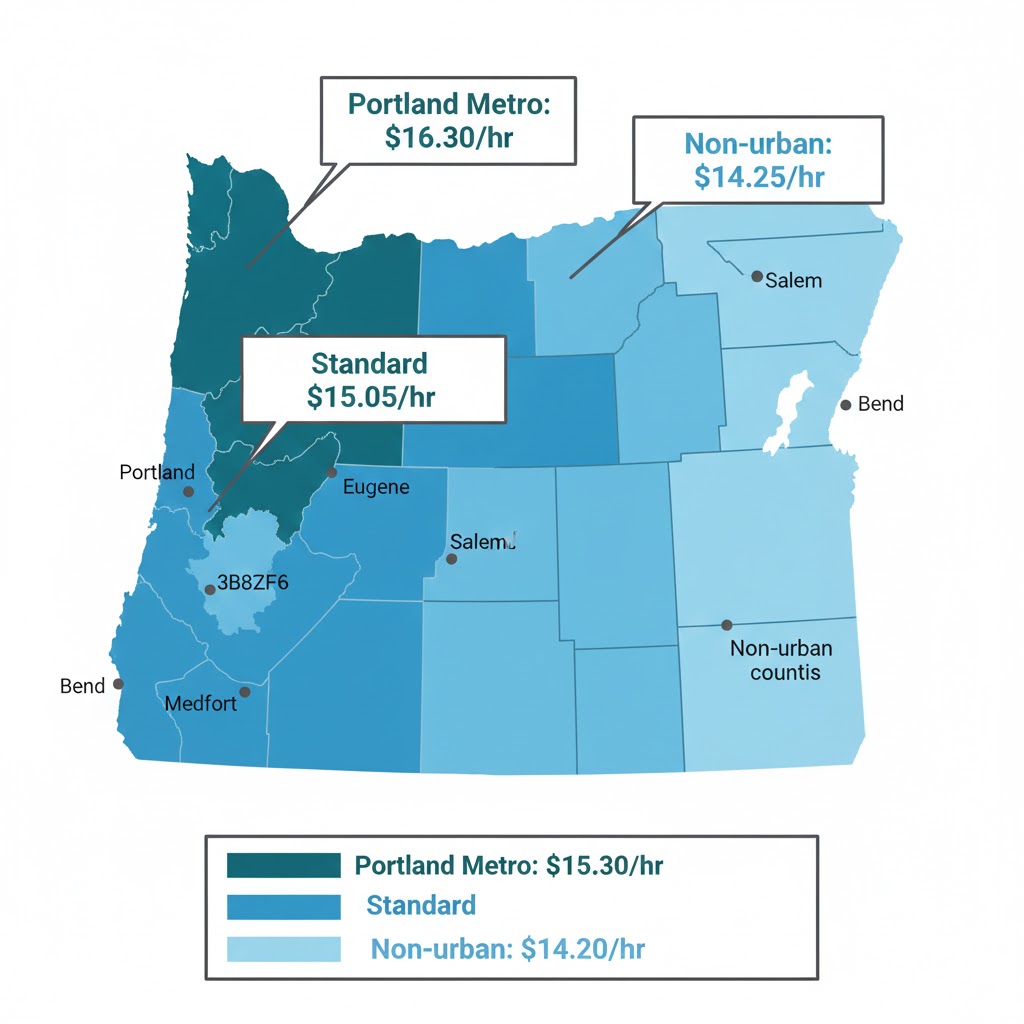
Oregon has one of the most unique minimum wage structures in the United States, with three different rates based on geographic location and cost of living.
Oregon’s Three-Tier Minimum Wage System
Oregon law divides the state into three minimum wage zones, adjusted annually for inflation each July 1st.
Current Oregon Minimum Wages (July 1, 2025 – June 30, 2026):
| Region | Minimum Wage | Annual Full-Time | Adjustment Date |
|---|---|---|---|
| Portland Metro | $16.30/hour | $33,904 | July 1, 2025 |
| Standard Counties | $15.05/hour | $31,304 | July 1, 2025 |
| Non-urban Counties | $14.20/hour | $29,536 | July 1, 2025 |
This three-tier system recognizes that cost of living varies dramatically across Oregon, from expensive Portland Metro to rural eastern Oregon.
Portland Metro Minimum Wage ($16.30/hour)
Applies to: Clackamas, Multnomah, and Washington counties (the Portland metropolitan area)
Portland Metro has the highest minimum wage in Oregon, reflecting the region’s higher housing costs and cost of living.
Portland Metro Minimum Wage Details:
- Rate: $16.30/hour (July 1, 2025 – June 30, 2026)
- Adjusted annually each July based on Consumer Price Index
- Covers approximately 40% of Oregon workers
- Includes suburbs like Beaverton, Hillsboro, Gresham, Lake Oswego
Annual earnings at Portland Metro minimum:
- Gross annual: $33,904 (40 hours × 52 weeks)
- After Oregon and federal taxes: ~$27,500 net
- Monthly net: ~$2,292
Portland Metro Context: Despite earning $16.30/hour, Portland Metro’s high housing costs mean minimum wage workers still face challenges:
- Portland median 1-BR rent: $1,500-$1,700/month
- Living wage for single adult: $22-24/hour
- Minimum wage covers only 68-74% of living wage
Historical Portland Metro Minimum Wage:
- 2023: $15.45/hour
- 2024: $15.95/hour
- 2025: $16.30/hour (current)
- 2026 projection: ~$16.65-$16.85/hour (based on inflation)
Standard Counties Minimum Wage ($15.05/hour)
Applies to: Most Oregon counties including Eugene, Salem, Bend, Corvallis, and Medford
The standard rate covers Oregon’s mid-sized cities and suburban areas with moderate costs of living.
Standard Counties Include:
- Lane County (Eugene, Springfield)
- Marion County (Salem)
- Deschutes County (Bend)
- Jackson County (Medford)
- Linn County (Albany)
- Douglas County (Roseburg)
- Benton County (Corvallis)
- Polk County
- Yamhill County
- And others (see full list below)
Standard Minimum Wage Details:
- Rate: $15.05/hour (July 1, 2025 – June 30, 2026)
- Adjusted annually for inflation
- Covers approximately 50% of Oregon workers
- $1.25/hour less than Portland Metro
Annual earnings at standard minimum:
- Gross annual: $31,304 (40 hours × 52 weeks)
- After Oregon and federal taxes: ~$24,600 net
- Monthly net: ~$2,050
Standard Counties Context: At $15.05/hour in cities like Eugene or Salem:
- Eugene median 1-BR rent: $1,300-$1,500/month
- Salem median 1-BR rent: $1,100-$1,300/month
- Living wage estimate: $19-21/hour
- Minimum wage covers 72-79% of living wage
Non-urban Counties Minimum Wage ($14.20/hour)
Applies to: Rural and frontier counties in eastern and southern Oregon
The non-urban rate recognizes significantly lower costs of living in Oregon’s rural areas.
Non-urban Counties Include:
- Baker County
- Coos County
- Crook County
- Curry County
- Douglas County (parts)
- Gilliam County
- Grant County
- Harney County
- Hood River County
- Jefferson County
- Klamath County
- Lake County
- Lincoln County
- Malheur County
- Morrow County
- Sherman County
- Tillamook County
- Umatilla County
- Union County
- Wallowa County
- Wasco County
- Wheeler County
Non-urban Minimum Wage Details:
- Rate: $14.20/hour (July 1, 2025 – June 30, 2026)
- Lowest of Oregon’s three tiers
- Adjusted annually for inflation
- Covers approximately 10% of Oregon workers
- $2.10/hour less than Portland Metro
Annual earnings at non-urban minimum:
- Gross annual: $29,536 (40 hours × 52 weeks)
- After Oregon and federal taxes: ~$23,400 net
- Monthly net: ~$1,950
Non-urban Counties Context: At $14.20/hour in rural Oregon:
- Rural Oregon 1-BR rent: $700-$1,000/month
- Living wage estimate: $16-18/hour
- More affordable than urban areas but wages also lower
- Many rural workers qualify for state assistance programs
Oregon Minimum Wage Comparison to Other States
Oregon’s tiered system and rates put it among the highest minimum wage states:
| State/Region | Minimum Wage | vs Federal ($7.25) |
|---|---|---|
| Federal | $7.25/hour | Baseline |
| Oregon Non-urban | $14.20/hour | +96% (+$6.95) |
| Oregon Standard | $15.05/hour | +108% (+$7.80) |
| Oregon Portland Metro | $16.30/hour | +125% (+$9.05) |
| Washington State | $16.66/hour | +130% (+$9.41) |
| California | $16.50/hour | +127% (+$9.25) |
| Seattle, WA | $19.97/hour | +175% (+$12.72) |
Key Comparisons:
- Oregon minimum wages are 96-125% higher than federal minimum
- Portland Metro rate slightly lower than Washington State
- Oregon’s rural rate ($14.20) still 96% above federal minimum
- Oregon adjusts annually; federal has been $7.25 since 2009
Oregon Minimum Wage History and Projections
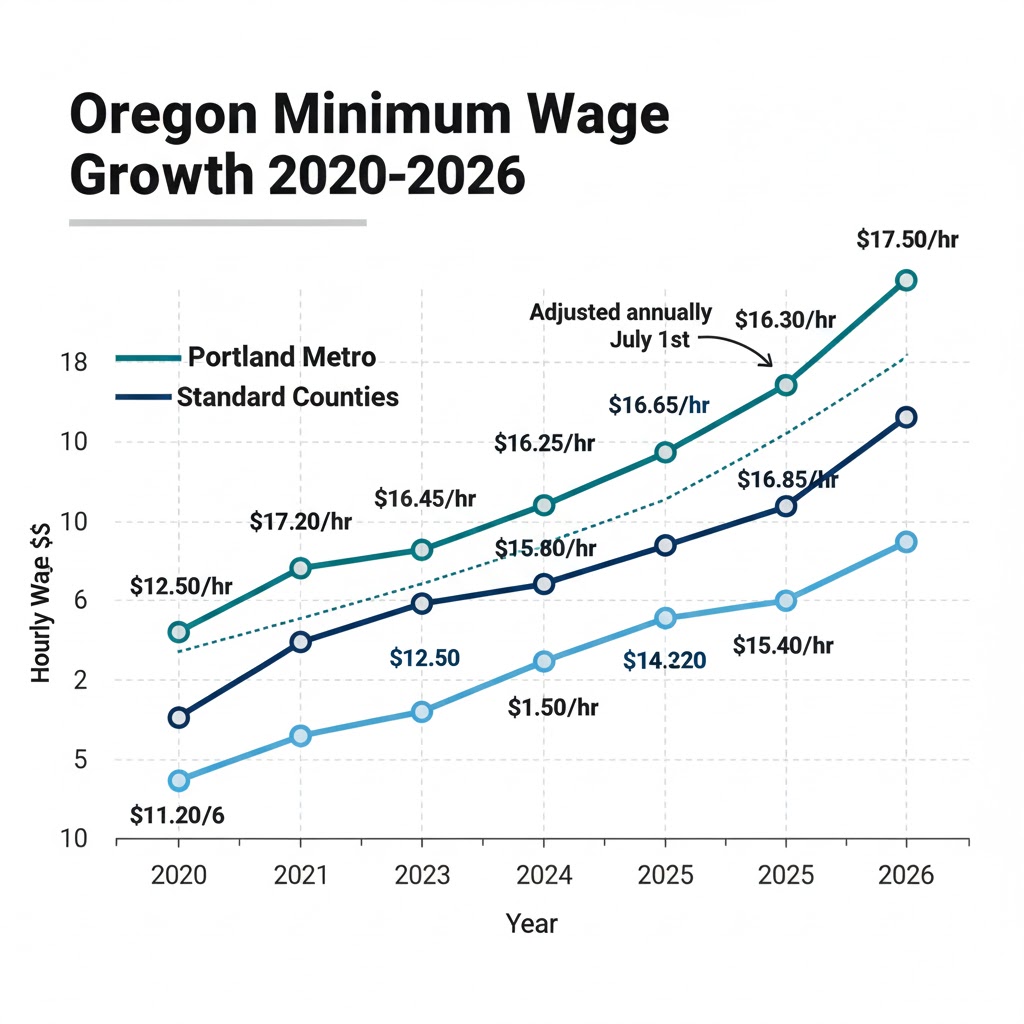
Oregon has consistently increased minimum wages over the past decade:
Historical Increases:
- 2016: $9.75 (statewide)
- 2017: Three-tier system begins
- Portland Metro: $11.25
- Standard: $10.25
- Non-urban: $10.00
- 2018: $11.25 / $10.75 / $10.50
- 2019: $12.00 / $11.00 / $11.00
- 2020: $13.25 / $12.00 / $11.50
- 2021: $14.00 / $12.75 / $12.00
- 2022: $14.75 / $13.50 / $12.50
- 2023: $15.45 / $14.20 / $13.20
- 2024: $15.95 / $14.70 / $13.70
- 2025: $16.30 / $15.05 / $14.20
2026 Projections (July 1, 2026 adjustment): Based on typical inflation rates, Oregon minimum wages in 2026 may be:
- Portland Metro: $16.65-$16.85/hour
- Standard: $15.40-$15.60/hour
- Non-urban: $14.50-$14.70/hour
Oregon law requires annual adjustments each July 1st tied to the Consumer Price Index for All Urban Consumers (CPI-U).
Which Oregon Minimum Wage Applies to You?
Determination factors:
- Work location, not residence: The minimum wage is based on where you physically work, not where you live
- County classification: Check your work county’s classification
- Entire shift rule: If you work in multiple counties during one shift, the higher rate applies to the entire shift
Examples:
- Live in Vancouver, WA, work in Portland, OR: Portland Metro rate ($16.30) applies
- Live in Portland, work in Salem: Standard rate ($15.05) applies
- Work shifts in both Multnomah County (Portland Metro) and Clackamas County (also Portland Metro): Portland Metro rate applies to all hours
- Mobile worker traveling between counties: Rate depends on where majority of work is performed.
Oregon Overtime Pay Rules
Oregon follows federal overtime standards under the Fair Labor Standards Act (FLSA), with some minor state-specific provisions.
Oregon Overtime Laws
Oregon requires overtime pay for non-exempt employees but does not have the enhanced overtime rules found in California or Alaska.
Key Oregon Overtime Requirements:
- Overtime after 40 hours in a workweek
- Time-and-a-half (1.5× regular rate) for overtime hours
- No daily overtime requirements (unlike California)
- No double-time requirements (unlike California)
- No seventh-day premiums (unlike California)
- Manufacturing workers have special daily overtime protections
Oregon follows federal standard: Most Oregon workers receive overtime the same way workers in most other states do—after 40 hours in a workweek.
Overtime After 40 Hours in a Workweek
Oregon Rule: Time-and-a-half required after 40 hours in a seven-day workweek
This is the standard federal rule applied in Oregon and most states.
Example: Monday-Friday: 9 hours each day (45 hours total)
- Regular time: 40 hours
- Overtime: 5 hours at time-and-a-half
- No additional overtime despite 9-hour days (Oregon has no daily overtime rule)
Calculation at $20/hour:
- Regular: $20 × 40 = $800
- Overtime: $30 × 5 = $150
- Total weekly: $950
Compare to California: The same schedule in California would trigger daily overtime:
- 5 hours of overtime (1 hour each day beyond 8)
- California worker earns same $950 in this example, but California’s rules provide more protection in other scenarios
Oregon Manufacturing Overtime Exception
Oregon has a special rule for manufacturing workers providing daily overtime protection.
Manufacturing Daily Overtime Rule: Workers in manufacturing establishments must receive overtime for:
- Hours over 10 in a single day (even if under 40 hours/week)
Example: Manufacturing worker schedule:
- Monday-Wednesday: 12 hours each day (36 hours total)
- Thursday-Friday: Off
Overtime calculation:
- 6 hours daily overtime (2 hours each day over 10)
- Weekly total under 40 hours, but daily overtime still applies
- Weekly pay: (30 regular hours × $20) + (6 OT hours × $30) = $600 + $180 = $780
Without this rule, the worker would earn just $720 (36 hours × $20).
What qualifies as manufacturing:
- Production of goods
- Assembly operations
- Processing of materials
- Food processing
- Not retail, office work, or service industries
Calculating Overtime Pay in Oregon
Time-and-a-Half Calculation: Formula: Regular hourly rate × 1.5
Calculation table:
| Regular Rate | Time-and-a-Half Rate | 10 Hours OT Pay |
|---|---|---|
| $15/hour | $22.50/hour | $225 |
| $18/hour | $27.00/hour | $270 |
| $20/hour | $30.00/hour | $300 |
| $25/hour | $37.50/hour | $375 |
| $30/hour | $45.00/hour | $450 |
| $35/hour | $52.50/hour | $525 |
| $40/hour | $60.00/hour | $600 |
Annual Salary with Regular Oregon Overtime
Example: $22/hour with consistent Oregon overtime
Weekly schedule:
- Monday-Friday: 9 hours each (45 hours total)
- Overtime hours: 5 per week
Weekly earnings:
- Regular time: $22 × 40 = $880
- Overtime: $33 × 5 = $165
- Total weekly: $1,045
Annual calculation:
- Annual gross: $54,340
- Oregon state tax: ~$4,700
- Paid Leave Oregon: ~$326
- Federal tax: ~$5,400
- FICA: ~$4,157
- Annual net: ~$39,757
- Monthly net: ~$3,313
Overtime impact: The 5 hours of weekly overtime adds $8,580 to annual gross income (40 hours/week at $22 = $45,760). After Oregon and federal taxes, the overtime nets approximately $6,250 extra annually, or about $520 per month.
Who is Exempt from Oregon Overtime?
Oregon uses both state and federal exemption criteria, with state minimum salary thresholds that often exceed federal requirements.
Oregon Salary Threshold for Exemption (2026)
Executive, Administrative, and Professional Exemptions:
- Oregon minimum: $1,382.40/week ($71,885 annually)
- Federal minimum: $684/week ($35,568 annually)
- Oregon requires 102% higher salary than federal minimum
Computer Professional Exemption:
- Oregon minimum: $58.88/hour OR $122,251 annually
- Federal minimum: $27.63/hour
- Oregon requires 113% higher hourly rate
Outside Sales Exemption:
- No minimum salary required (same as federal)
- Primary duty must be making sales outside employer’s place of business
Oregon’s higher thresholds mean many workers classified as exempt in other states are non-exempt (overtime-eligible) in Oregon.
Oregon Overtime Exemption Tests
To be exempt from Oregon overtime, employees must meet ALL tests:
1. Salary Basis Test:
- Guaranteed minimum salary of $1,382.40/week ($71,885 annually)
- Paid same amount regardless of hours worked
- Cannot be reduced for variations in work quality/quantity
2. Salary Level Test:
- Must earn at least $1,382.40/week
- Higher for computer professionals ($58.88/hour or $122,251 annually)
- No maximum income test
3. Duties Test:
- Executive: Manage enterprise or department, direct 2+ employees, authority to hire/fire
- Administrative: Office work related to management/general business operations, exercise discretion and independent judgment
- Professional: Work requiring advanced knowledge in field of science or learning, prolonged specialized intellectual instruction
- Must primarily perform exempt duties (generally >50% of work time)
Common Oregon Misclassifications:
- Assistant managers spending most time on non-management tasks
- Office workers following set procedures without discretion
- Computer workers earning under $58.88/hour
- Salaried workers earning $50,000-$71,000 performing non-exempt duties
Your Rights: If misclassified as exempt in Oregon, you may be entitled to:
- Back pay for all overtime worked (up to 2 years, or 3 if willful)
- Liquidated damages (equal to unpaid wages)
- Attorney fees and costs
- Civil penalties paid to state
Contact Oregon Bureau of Labor and Industries (BOLI) if you believe you’re misclassified.
Oregon Sick Leave Requirements
Oregon requires all employers to provide paid sick time to employees, one of the first states in the nation to mandate paid sick leave.
Oregon Sick Leave Law
Oregon’s sick leave law applies to all employers regardless of size, with requirements varying by employer size.
Basic Requirements:
- All Oregon employees accrue paid sick time
- Begins accruing on first day of employment
- Can be used after 90 days of employment
- Accrues at rate of 1 hour per 30 hours worked (or 1.33 hours per 40-hour week)
Minimum Oregon Sick Leave by Employer Size
Employers with 10+ employees:
- Minimum 40 hours paid sick leave per year
- Must allow unlimited accrual OR provide 40 hours up front
Employers with 6-9 employees (2024-2025):
- Minimum 40 hours paid sick leave per year
- Transition period, becoming same as larger employers
Employers with 1-5 employees (2024-2025):
- Minimum 40 hours sick leave per year
- May be unpaid (though most provide paid)
- Transitioning to paid requirement
As of 2026: All Oregon employers with 6+ employees must provide paid sick leave; employers with 1-5 employees must provide at least unpaid sick leave.
Sick Leave Accrual Methods
Option 1: Accrual Method
- Employee accrues 1 hour per 30 hours worked
- Accrual begins first day of employment
- Can be used after 90-day waiting period
- Can cap accrual at 80 hours
Example accrual:
- Full-time worker (40 hours/week): Accrues 1.33 hours per week
- After 30 weeks: 40 hours accrued (meets annual minimum)
- After 60 weeks: 80 hours accrued (cap reached if employer uses cap)
Option 2: Front-loading Method
- Employer provides all 40 hours at start of year
- No accrual tracking needed
- Simplifies administration
- Common for larger employers
Option 3: Unlimited PTO
- If employer provides unlimited PTO, satisfies sick leave requirement
- No tracking required
- Must be truly available (not just on paper)
What Oregon Sick Leave Covers
Employees can use Oregon sick time for:
Employee’s own health:
- Illness, injury, or health condition
- Medical diagnosis, treatment, or care
- Preventive medical care
Family member care:
- Child (biological, adopted, foster, stepchild, legal ward)
- Spouse or domestic partner
- Parent or parent-in-law
- Grandparent or grandchild
- Any person with whom employee has “family relationship”
Public health emergencies:
- Workplace or child’s school/care closed by public official for health reasons
Safe leave situations:
- Domestic violence
- Harassment
- Sexual assault
- Stalking
- Seeking medical attention, legal assistance, counseling, relocation, etc.
Oregon Sick Leave Pay Rate
Sick time must be paid at employee’s regular rate:
- Hourly workers: Regular hourly rate
- Salaried workers: Salary divided by hours in pay period
- Tipped workers: Regular wage (not reduced minimum wage)
- Commission workers: Base hourly rate or minimum wage, whichever is higher
Example calculations:
- $20/hour worker taking 8 hours sick leave: $160 sick pay
- $60,000 salary (2,080 hours/year) taking 8 hours: $230.77 sick pay
- $15/hour + tips worker: Receives $15/hour for sick time (not tipped wage)
Sick Leave and Your Oregon Paycheck
Oregon sick leave doesn’t appear as a deduction on your paycheck-it’s a benefit you accrue and use as needed.
Value to employees:
- 40 hours annually = one full week of paid time off
- For $20/hour worker: $800 annual value
- For $30/hour worker: $1,200 annual value
- For $50,000 salary: $962 annual value
When you use sick time, your paycheck shows regular wages for those hours, maintaining your income during illness.
Unused sick time:
- Employers not required to pay out unused sick time at termination
- Must allow carryover of up to 40 hours to next year (if using accrual method)
- Front-loading method eliminates carryover issues
Portland Metro Area Local Taxes
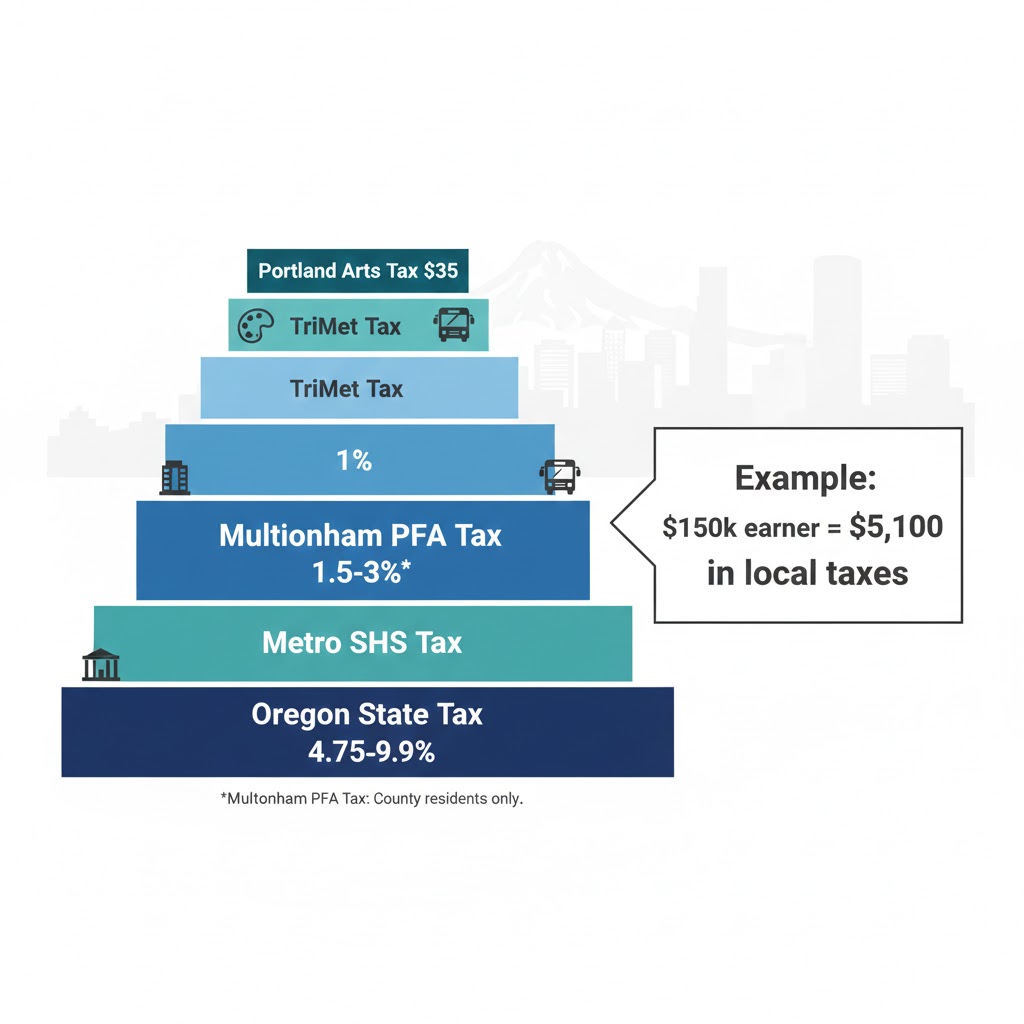
Workers living or earning income in the Portland Metro area face additional local income taxes beyond state and federal taxes.
Portland Metro Supportive Housing Services Tax
The Metro Supportive Housing Services (SHS) Tax is a 1% income tax on high earners in the three-county Portland Metro area.
Who pays Metro SHS Tax:
- Individuals with income over $125,000 (single filers)
- Joint filers with income over $200,000
- Married filing separately over $100,000
Where it applies:
- Clackamas County
- Multnomah County
- Washington County
Tax calculation:
- 1% of all income (not just amount over threshold)
- Applies to wages, self-employment, business income, capital gains
- Collected through paycheck withholding for wages
Example Metro SHS Tax:
Single filer earning $150,000:
- Income over threshold: Yes ($150k > $125k)
- Metro SHS Tax: $150,000 × 1% = $1,500 annually ($125/month)
Single filer earning $100,000:
- Income over threshold: No ($100k < $125k)
- Metro SHS Tax: $0
Married filing jointly earning $180,000:
- Income over threshold: No ($180k < $200k)
- Metro SHS Tax: $0
Married filing jointly earning $225,000:
- Income over threshold: Yes ($225k > $200k)
- Metro SHS Tax: $225,000 × 1% = $2,250 annually ($188/month)
Multnomah County Preschool for All Tax
Multnomah County residents (Portland and surrounding areas in the county) pay an additional personal income tax for universal preschool funding.
Who pays PFA Tax:
- Residents of Multnomah County only (not Clackamas or Washington)
- Income over $125,000 (single) or $200,000 (joint)
Tax rates:
- 1.5% on income $125,000-$250,000 (single) or $200,000-$400,000 (joint)
- 3.0% on income over $250,000 (single) or $400,000 (joint)
Example PFA Tax calculations:
Single Multnomah County resident earning $175,000:
- Income over $125k threshold: $50,000
- PFA Tax: $50,000 × 1.5% = $750 annually ($63/month)
- Total income tax: $175,000 × 1.5% (paid on all income over threshold)
Single Multnomah County resident earning $300,000:
- Income $125k-$250k: $125,000 × 1.5% = $1,875
- Income over $250k: $50,000 × 3.0% = $1,500
- Total PFA Tax: $3,375 annually ($281/month)
Important: PFA Tax is separate from and in addition to Metro SHS Tax.
Portland Arts Tax
Portland city residents face a unique flat tax to fund arts and music education in public schools.
Portland Arts Tax details:
- Flat fee: $35 annually (not based on income)
- Applies to Portland residents age 18+
- Due by April 15 each year
- Low-income exemption available (income under federal poverty level)
Who pays:
- Portland city residents only
- Must be 18 or older
- Household income over federal poverty level
- Not based on where you work, only residency
Example:
- Single adult living in Portland earning $40,000: Owes $35
- Single adult living in Portland earning $200,000: Owes $35 (same amount)
- Adult living in Beaverton (Washington County): Owes $0 (outside Portland city limits)
Penalties for non-payment:
- $35 late fee
- Accrued interest
- Collection agency referral
- Many Portland residents overlook this tax, resulting in penalties
Combined Portland Metro Tax Burden
High earners in Multnomah County face the highest combined income tax burden in Oregon.
Example: $150,000 earner living and working in Portland:
- Oregon state income tax: ~$13,900 (9.3% effective)
- Metro SHS Tax: $1,500 (1%)
- Multnomah PFA Tax: $375 (1.5% on $25k over threshold)
- Portland Arts Tax: $35
- Federal income tax: ~$24,000
- FICA: ~$10,900
- Paid Leave: $900
- Total taxes: ~$51,610 (34.4% of income)
- Take-home: ~$98,390
Compare same earner in Eugene (no local taxes):
- Total taxes: ~$49,700 (33.1%)
- Take-home: ~$100,300
- Portland premium: $1,910 less in take-home
Portland Metro high earner ($200,000) in Multnomah County:
- Oregon state tax: ~$19,200
- Metro SHS Tax: $2,000
- Multnomah PFA Tax: $1,125
- Portland Arts Tax: $35
- Federal + FICA: ~$44,000
- Paid Leave: $1,012
- Total: ~$67,372 (33.7%)
- Take-home: ~$132,628
Oregon Transit Taxes
Oregon workers contribute to transit systems through payroll taxes, with rates varying by region.
Statewide Transit Tax (0.1%)
All Oregon workers pay 0.1% Statewide Transit Tax
This payroll tax funds public transportation improvements across Oregon.
Details:
- Rate: 0.1% of all wages
- No wage cap
- Withheld from employee paychecks
- Applies statewide (all counties)
Annual tax amounts:
| Annual Wages | Statewide Transit Tax |
|---|---|
| $30,000 | $30 |
| $50,000 | $50 |
| $75,000 | $75 |
| $100,000 | $100 |
| $150,000 | $150 |
TriMet and Tri-County Transit Taxes
Workers in TriMet district pay additional 0.7537% payroll tax
The TriMet tax is one of the largest regional transit taxes in the nation.
TriMet district includes:
- Most of Multnomah County
- Most of Washington County
- Most of Clackamas County
- Essentially the Portland Metro area
TriMet Tax details:
- Employee portion: 0.7537% withheld from paycheck
- Employer portion: 0.7537% (not withheld from wages)
- Applies to wages earned in TriMet district
- No wage cap
Combined Portland Metro transit taxes:
- Statewide Transit: 0.1%
- TriMet: 0.7537%
- Total: 0.8537% of wages
Annual TriMet tax (employee portion):
| Annual Wages | TriMet Tax | Total Transit Tax (0.8537%) |
|---|---|---|
| $40,000 | $301 | $341 |
| $60,000 | $452 | $512 |
| $80,000 | $603 | $683 |
| $100,000 | $754 | $854 |
Lane Transit District Tax
Eugene-Springfield area workers pay 0.68% to Lane Transit District
This tax funds public transit in the Eugene-Springfield metropolitan area.
Lane Transit District includes:
- Most of Lane County
- Eugene, Springfield, and surrounding areas
Lane Transit Tax details:
- Employee portion: 0.68% withheld
- Employer portion: 0.68% (not withheld)
- No wage cap
Combined Eugene-area transit taxes:
- Statewide: 0.1%
- Lane Transit: 0.68%
- Total: 0.78% of wages
Annual Lane Transit tax (employee portion):
| Annual Wages | Lane Transit Tax | Total Transit Tax (0.78%) |
|---|---|---|
| $40,000 | $272 | $312 |
| $60,000 | $408 | $468 |
| $80,000 | $544 | $624 |
| $100,000 | $680 | $780 |
Oregon Transit Tax Summary by Location
| Location | Transit Taxes | $60,000 Annual Tax | $100,000 Annual Tax |
|---|---|---|---|
| Portland Metro (TriMet) | 0.8537% | $512 | $854 |
| Eugene-Springfield (LTD) | 0.78% | $468 | $780 |
| Salem, Bend, Medford, etc. | 0.1% | $60 | $100 |
| Rural Oregon | 0.1% | $60 | $100 |
Transit taxes are often overlooked when calculating Oregon take-home pay but can add several hundred dollars annually for urban workers.
Oregon Cost of Living by City
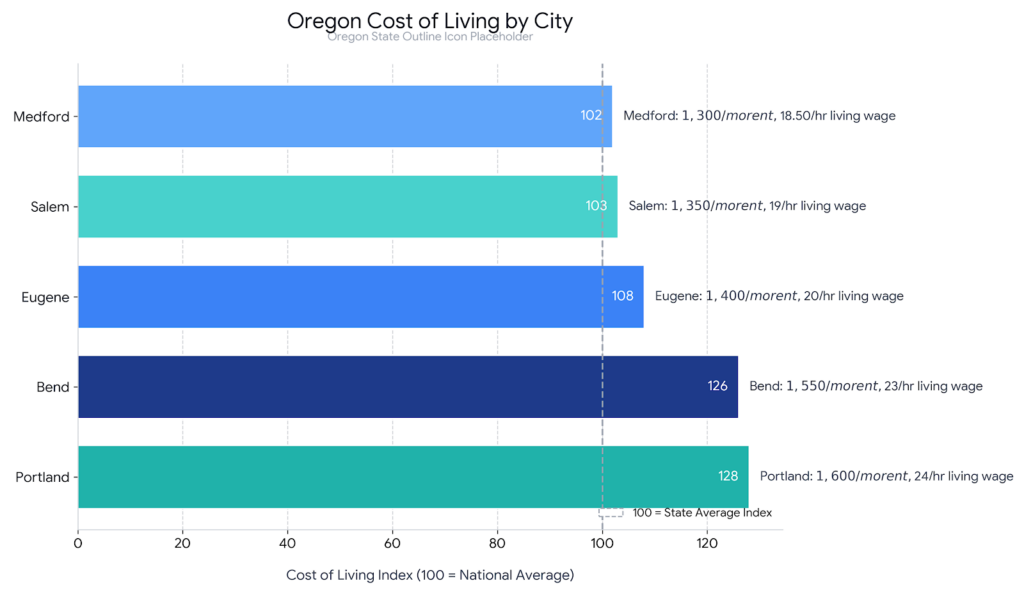
Oregon’s cost of living varies dramatically between the expensive Portland Metro area, mid-sized cities like Eugene and Bend, and more affordable rural communities.
Oregon Cost of Living Index by City
Regional Cost of Living Comparison (Oregon Average = 100):
| City/Region | Overall COL Index | Housing Index | Biggest Driver |
|---|---|---|---|
| Portland Metro | 128 | 165 | Housing costs |
| Bend | 126 | 162 | Housing costs |
| Hood River | 122 | 155 | Housing costs |
| Eugene | 108 | 125 | Moderate housing |
| Salem | 103 | 115 | Affordable |
| Medford | 102 | 112 | Affordable |
| Corvallis | 106 | 118 | College town |
| Klamath Falls | 91 | 85 | Rural/affordable |
| Pendleton | 88 | 80 | Eastern Oregon |
| Coos Bay | 94 | 88 | Coastal/moderate |
Portland Metro Cost of Living
Portland is Oregon’s most expensive region, with housing costs driving the high cost of living.
Portland Metro Details:
- Overall COL: 128% of Oregon average, 136% of national average
- Housing: 165% of Oregon average
- Median home price: $550,000-$600,000
- Median 1-BR rent: $1,500-$1,700/month
- Median 2-BR rent: $1,900-$2,200/month
Portland salary equivalencies: To match purchasing power of $50,000 in other Oregon cities, you need:
- $64,000 in Portland (28% more)
- $61,000 in Bend (22% more)
- $54,000 in Eugene (8% more)
- $51,500 in Salem (3% more)
Portland high earner considerations: Portland high earners face:
- Oregon state tax: 9.9% marginal rate
- Metro SHS Tax: 1% (over $125k)
- Multnomah County PFA Tax: 1.5-3% (county residents over $125k)
- TriMet payroll tax: 0.75%
- Portland Arts Tax: $35 annually
Combined marginal tax rate in Portland can reach 45-50% for six-figure earners when including federal taxes.
Eugene-Springfield Cost of Living
Eugene offers moderate costs with a college town atmosphere and outdoor recreation access.
Eugene Area Details:
- Overall COL: 108% of Oregon average, 115% of national average
- Housing: 125% of Oregon average
- Median home price: $450,000-$500,000
- Median 1-BR rent: $1,300-$1,500/month
- Median 2-BR rent: $1,600-$1,850/month
Eugene advantages:
- Lower cost than Portland (16% less overall)
- No local income taxes (beyond statewide)
- Strong job market for education, healthcare, tech
- University of Oregon presence
Eugene salary comparison: $60,000 in Eugene provides similar purchasing power to:
- $77,000 in Portland
- $75,000 in Bend
- $58,000 in Salem
- $55,000 in Medford
Bend Cost of Living
Bend has become one of Oregon’s most expensive cities due to its appeal as an outdoor recreation destination.
Bend Details:
- Overall COL: 126% of Oregon average, 134% of national average
- Housing: 162% of Oregon average
- Median home price: $650,000-$700,000
- Median 1-BR rent: $1,600-$1,850/month
- Median 2-BR rent: $2,000-$2,400/month
Bend challenges:
- High housing costs relative to local wages
- Limited rental inventory
- Rapid growth increasing costs
- Popular with remote workers driving up prices
Bend salary requirements: Living wage for single adult: $23-25/hour Family of 4 (one income): $75,000-$85,000/year Comfortable living (single): $65,000-$75,000/year
Salem Cost of Living
Oregon’s capital offers more affordable living than Portland while maintaining urban amenities.
Salem Details:
- Overall COL: 103% of Oregon average, 110% of national average
- Housing: 115% of Oregon average
- Median home price: $400,000-$450,000
- Median 1-BR rent: $1,100-$1,300/month
- Median 2-BR rent: $1,400-$1,650/month
Salem advantages:
- 20% lower cost than Portland
- Good job market (state government, healthcare, education)
- Standard Oregon minimum wage ($15.05)
- No local income taxes
Salem affordability: $50,000 salary in Salem provides purchasing power equivalent to:
- $64,000 in Portland
- $63,000 in Bend
- $54,000 in Eugene
Medford Cost of Living
Southern Oregon’s largest city offers some of the state’s most affordable living for a mid-sized metro area.
Medford Details:
- Overall COL: 102% of Oregon average, 108% of national average
- Housing: 112% of Oregon average
- Median home price: $425,000-$475,000
- Median 1-BR rent: $1,000-$1,200/month
- Median 2-BR rent: $1,300-$1,550/month
Medford advantages:
- More affordable than Willamette Valley cities
- Warmer, drier climate than western Oregon
- Growing healthcare and retail sectors
- Access to outdoor recreation
Rural Oregon Cost of Living
Eastern and coastal Oregon offer Oregon’s lowest living costs but with fewer job opportunities.
Rural Oregon (Klamath Falls, Pendleton, Ontario, Burns):
- Overall COL: 88-94% of Oregon average
- Housing: 80-90% of Oregon average
- Median home price: $250,000-$350,000
- Median 1-BR rent: $700-$950/month
- Median 2-BR rent: $900-$1,200/month
Rural Oregon considerations:
- Non-urban minimum wage: $14.20/hour
- Lower wages overall
- Limited job market
- Greater affordability for retirees and remote workers
- Longer distances to services
Oregon Living Wage by City
The “living wage” represents the hourly rate needed to cover basic necessities without government assistance. Oregon’s living wages vary significantly by region.
Living Wage Estimates for Oregon (2026)
Living Wage for Single Adults (no children):
| City/Region | Living Wage/Hour | Annual Living Wage | vs Min Wage Gap |
|---|---|---|---|
| Portland Metro | $24.00/hour | $49,920 | -$7.70/hour |
| Bend | $23.00/hour | $47,840 | -$8.80/hour |
| Eugene | $20.00/hour | $41,600 | -$4.95/hour |
| Salem | $19.00/hour | $39,520 | -$3.95/hour |
| Corvallis | $20.00/hour | $41,600 | -$4.95/hour |
| Medford | $18.00/hour | $37,440 | -$2.95/hour |
| Klamath Falls | $16.00/hour | $33,280 | -$1.80/hour |
| Rural Oregon | $15.00/hour | $31,200 | -$0.80/hour |
Key Insight: Even at Oregon’s relatively high minimum wages, workers earn only 59-95% of the living wage depending on location. The gap is most severe in high-cost areas like Portland and Bend.
Living Wage for Families (2026)
Oregon Living Wage by Household Type:
| Household | Portland | Eugene | Salem | Bend | Medford |
|---|---|---|---|---|---|
| Single Adult | $24/hr | $20/hr | $19/hr | $23/hr | $18/hr |
| 1 Adult + 1 Child | $40/hr | $34/hr | $32/hr | $38/hr | $30/hr |
| 2 Adults (both work) | $18/hr each | $15/hr each | $14/hr each | $17/hr each | $13/hr each |
| 2 Adults + 2 Children | $27/hr each | $23/hr each | $21/hr each | $25/hr each | $20/hr each |
Family wage gap:
- Single parent with one child needs 67-75% more than living wage for single adult
- Two working adults with two children need 12-13% more per person than two adults alone
- Childcare costs are the primary driver of increased need
Portland Metro Living Wage Breakdown
For a single adult in Portland Metro, the $24/hour living wage covers:
Monthly expenses at $24/hour ($49,920 annually):
- Take-home pay: ~$3,100/month (after taxes)
- Housing (1-BR): $1,500-$1,700 (48-55% of income)
- Food: $400 (13%)
- Transportation: $300 (10%)
- Healthcare: $250 (8%)
- Other necessities: $450 (15%)
- Savings/emergency: $200 (6%)
Reality at Portland minimum wage ($16.30/hour):
- Take-home: ~$2,100/month
- Shortfall: $1,000/month vs. living wage
- Must choose: cheaper housing (roommates), reduce food/transport, no savings
Eugene Living Wage Breakdown
For a single adult in Eugene, the $20/hour living wage covers:
Monthly expenses at $20/hour ($41,600 annually):
- Take-home pay: ~$2,600/month
- Housing (1-BR): $1,350 (52%)
- Food: $350 (13%)
- Transportation: $250 (10%)
- Healthcare: $225 (9%)
- Other necessities: $325 (13%)
- Savings: $100 (4%)
Reality at Oregon standard minimum wage ($15.05/hour):
- Take-home: ~$1,950/month
- Shortfall: $650/month vs. living wage
Salary Equivalencies Across Oregon
A $60,000 salary provides vastly different purchasing power depending on location:
| Location | Equivalent Living Standard | Required Hourly | vs $60k in Salem |
|---|---|---|---|
| Salem (baseline) | $60,000 | $28.85/hour | 100% |
| Medford | $59,200 | $28.46/hour | 99% |
| Eugene | $64,800 | $31.15/hour | 108% |
| Bend | $73,500 | $35.34/hour | 123% |
| Portland | $76,800 | $36.92/hour | 128% |
Example: A $60,000 job offer in Salem provides the same standard of living as a $76,800 job in Portland. A $70,000 offer in Portland is equivalent to just $54,700 in Salem after cost-of-living adjustments.
Oregon Employer Payroll Costs
Understanding the full cost of Oregon employees helps employers budget and helps employees understand their total compensation value.
Total Cost of Oregon Employee
Oregon employers face moderate payroll costs compared to other states-lower than California but higher than low-tax states.
Full Oregon Employee Cost Breakdown ($60,000 salary example):
| Cost Component | Annual Amount | % of Salary |
|---|---|---|
| Base Salary | $60,000 | 100.0% |
| Employer FICA (7.65%) | $4,590 | 7.7% |
| Federal Unemployment (FUTA 0.6%) | $42 | 0.1% |
| OR Unemployment Insurance (2.4% avg) | $1,440 | 2.4% |
| OR Paid Leave (0.4% employer share) | $240 | 0.4% |
| Workers’ Compensation (1.5% avg) | $900 | 1.5% |
| TriMet Tax (if applicable, 0.7537%) | $452 | 0.8% |
| Health Insurance (employer share) | $7,500 | 12.5% |
| 401(k) Match (3%) | $1,800 | 3.0% |
| Paid Time Off (15 days) | $3,462 | 5.8% |
| Other Benefits | $1,000 | 1.7% |
| Total Cost | $81,426 | 135.7% |
Oregon vs. Other States (same $60k employee):
- California: ~$83,500 (higher UI, SDI, WC costs)
- Washington: ~$79,000 (no income tax but higher UI wage base)
- Texas: ~$77,500 (lower unemployment costs)
- Oregon position: Moderate, competitive
Oregon Employer Taxes
Oregon employers pay several state-specific taxes beyond federal requirements.
Oregon Unemployment Insurance (UI)
Purpose: Funds unemployment benefits for laid-off workers
Rate Structure:
- New employers: 2.4% on first $52,800 of wages
- Experience-rated employers: 0.9% to 5.4% based on layoff history
- Additional factors: Reserve ratio, benefit charges
2026 Wage Base: $52,800 per employee Maximum UI tax per employee: $2,851 annually (at 5.4%)
Experience Rating: Employers with:
- Low layoff history: 1.0-1.8% rate
- Moderate layoffs: 1.8-3.0% rate
- High layoff history: 3.0-5.4% rate
Oregon vs. Other States:
- Oregon wage base: $52,800 (higher than many states)
- California wage base: $7,000 (much lower)
- Washington wage base: $68,500 (higher)
- Most states: $10,000-$15,000
Oregon’s higher wage base means more UI tax per employee but more stable unemployment fund.
Oregon Paid Leave Employer Share
Purpose: Funds Paid Leave Oregon benefits
Rate: 0.4% of first $168,600 of wages per employee Maximum per employee: $674 annually
Small employer exemption:
- Employers with fewer than 25 employees may opt out of paying employer share
- Employees still pay 0.6% regardless
- Most small employers choose to pay to offer competitive benefits
Oregon Workers’ Compensation
Purpose: Covers work-related injuries and illnesses
Rate: Varies by industry classification
- Low-risk (office): 0.5-1.0%
- Medium-risk (retail, hospitality): 1.5-2.5%
- High-risk (construction, manufacturing): 3.0-6.0%
- Very high-risk (logging, roofing): 8.0-15.0%
Average Oregon Rate: ~1.5-2.0% of payroll (2026)
Oregon WC Costs:
- Among middle tier nationally
- Lower than California (~2.5% average)
- Higher than Texas (~1.0% average)
- Rate depends heavily on safety record
Example Costs:
| Industry | $60k Employee WC Cost |
|---|---|
| Office/Professional | $600 (1%) |
| Retail | $1,200 (2%) |
| Restaurant | $1,500 (2.5%) |
| Manufacturing | $2,400 (4%) |
| Construction | $4,200 (7%) |
TriMet Employer Tax (Portland Metro)
Purpose: Funds TriMet public transportation
Rate: 0.7537% of wages (matches employee portion) Applies: Workers in TriMet district (Portland Metro area) No wage cap
Annual employer cost:
- $60,000 employee: $452
- $80,000 employee: $603
- $100,000 employee: $754
Employers pay this in addition to employee withholding, effectively doubling the TriMet tax burden to 1.5074% total.
Lane Transit Employer Tax (Eugene Area)
Purpose: Funds Lane Transit District
Rate: 0.68% of wages (matches employee portion) Applies: Workers in Lane County area No wage cap
Annual employer cost:
- $60,000 employee: $408
- $80,000 employee: $544
- $100,000 employee: $680
Oregon Labor Law Compliance Costs
Oregon’s worker-friendly laws create compliance obligations for employers.
Oregon Sick Leave Compliance:
- Minimum 40 hours paid sick leave annually (most employers)
- Tracking systems needed for accrual
- Or front-loading simplifies administration
- Cost: ~$962 per full-time employee at $25/hour (40 hours × $24.04)
Paid Leave Oregon Administration:
- Payroll system updates for new 1% deduction
- Employee communications about benefits
- Integration with benefit systems
- Ongoing rate changes require attention
Predictive Scheduling (Portland, Eugene, other cities):
- Some Oregon cities require advance schedule posting
- Predictability pay for schedule changes
- Administrative burden for shift-based employers
- Penalties for violations
Meal and Rest Break Rules:
- Oregon requires rest breaks for shifts over 6 hours
- Meal breaks for shifts over 6 hours
- Additional rest breaks for longer shifts
- Penalties for non-compliance
Popular Oregon Hourly to Salary Conversions
Quick reference tables showing exact Oregon take-home pay after all state and federal deductions.
Common Oregon Hourly Rates to Annual Salary
Comprehensive Oregon Conversion Table (Portland Metro Location):
| Hourly Rate | Annual Gross | Monthly Gross | OR State Tax | Paid Leave | Transit Tax | Federal Tax | FICA | Total Deductions | Annual Net | Monthly Net | % Take-Home |
|---|---|---|---|---|---|---|---|---|---|---|---|
| $14.20 (non-urban min) | $29,536 | $2,461 | $1,956 | $177 | $252 | $1,850 | $2,260 | $6,495 | $23,041 | $1,920 | 78.0% |
| $15.05 (standard min) | $31,304 | $2,609 | $2,085 | $188 | $267 | $2,000 | $2,395 | $6,935 | $24,369 | $2,031 | 77.8% |
| $16.30 (Portland min) | $33,904 | $2,825 | $2,243 | $203 | $289 | $2,200 | $2,594 | $7,529 | $26,375 | $2,198 | 77.8% |
| $18/hour | $37,440 | $3,120 | $2,613 | $225 | $319 | $2,650 | $2,864 | $8,671 | $28,769 | $2,397 | 76.9% |
| $20/hour | $41,600 | $3,467 | $3,134 | $250 | $355 | $3,100 | $3,182 | $10,021 | $31,579 | $2,632 | 75.9% |
| $25/hour | $52,000 | $4,333 | $4,368 | $312 | $444 | $5,200 | $3,978 | $14,302 | $37,698 | $3,142 | 72.5% |
| $30/hour | $62,400 | $5,200 | $5,544 | $374 | $532 | $7,150 | $4,774 | $18,374 | $44,026 | $3,669 | 70.6% |
| $35/hour | $72,800 | $6,067 | $6,720 | $437 | $621 | $9,200 | $5,569 | $22,547 | $50,253 | $4,188 | 69.0% |
| $40/hour | $83,200 | $6,933 | $7,896 | $499 | $710 | $11,600 | $6,365 | $27,070 | $56,130 | $4,678 | 67.5% |
| $50/hour | $104,000 | $8,667 | $10,248 | $624 | $887 | $17,000 | $7,956 | $36,715 | $67,285 | $5,607 | 64.7% |
Key Insights:
- Oregon minimum wage workers keep 78% of gross pay
- Middle earners ($25-30/hour) keep 71-73%
- Higher earners ($40-50/hour) keep 65-68%
- Portland Metro workers lose additional 0.85% to transit taxes
- Paid Leave Oregon adds consistent 0.6% burden
Common Oregon Annual Salaries to Hourly Rate
Oregon Salary to Hourly Conversion Table (Standard Location):
| Annual Salary | Hourly Rate | Monthly Gross | OR State Tax | Paid Leave | Transit Tax | Federal Tax | Total Deductions | Monthly Net | Effective Hourly |
|---|---|---|---|---|---|---|---|---|---|
| $35,000 | $16.83/hr | $2,917 | $2,320 | $210 | $35 | $2,250 | $7,082 | $2,326 | $13.41/hr |
| $40,000 | $19.23/hr | $3,333 | $2,880 | $240 | $40 | $2,800 | $8,680 | $2,610 | $15.06/hr |
| $45,000 | $21.63/hr | $3,750 | $3,440 | $270 | $45 | $3,400 | $10,403 | $2,883 | $16.63/hr |
| $50,000 | $24.04/hr | $4,167 | $4,000 | $300 | $50 | $4,200 | $12,188 | $3,151 | $18.17/hr |
| $60,000 | $28.85/hr | $5,000 | $5,120 | $360 | $60 | $6,400 | $16,530 | $3,623 | $20.90/hr |
| $75,000 | $36.06/hr | $6,250 | $6,713 | $450 | $75 | $9,800 | $22,776 | $4,352 | $25.11/hr |
| $100,000 | $48.08/hr | $8,333 | $9,213 | $600 | $100 | $16,500 | $34,063 | $5,495 | $31.70/hr |
| $125,000 | $60.10/hr | $10,417 | $11,963 | $750 | $125 | $22,500 | $44,788 | $6,684 | $38.56/hr |
| $150,000 | $72.12/hr | $12,500 | $14,713 | $900 | $150 | $29,500 | $56,838 | $7,764 | $44.79/hr |
Effective Hourly Rate Analysis: The “effective hourly rate” shows your actual earning power after Oregon and federal taxes:
- $50k salary: Lose $5.87/hour to taxes (24.4% reduction)
- $75k salary: Lose $10.95/hour to taxes (30.4% reduction)
- $100k salary: Lose $16.38/hour to taxes (34.1% reduction)
- $150k salary: Lose $27.33/hour to taxes (37.9% reduction)
Oregon Payroll Resources and Tools
Related Oregon Calculators
Oregon-Specific Tools:
- Oregon paycheck calculator (with state tax & Paid Leave)
- Oregon overtime calculator
- Oregon net pay calculator
- Oregon cost of living calculator by city
- Oregon living wage calculator
- Oregon minimum wage tracker by region
Federal Tools:
- Federal tax calculator
- FICA calculator
- W-4 withholding calculator
Oregon Labor Law Resources
Oregon Bureau of Labor and Industries (BOLI):
- Website: oregon.gov/boli
- Wage and hour information
- File wage claims
- Report labor law violations
- Minimum wage information
- Portland: (971) 673-0761
Oregon Employment Department:
- Website: oregon.gov/employ
- Unemployment insurance claims
- Paid Leave Oregon information
- Employer tax information
- Salem: (503) 947-1394
Oregon OSHA (Occupational Safety and Health):
- Workplace safety standards
- Workers’ compensation info
- Report unsafe conditions
- Salem: (503) 378-3272
Paid Leave Oregon:
- Website: paidleave.oregon.gov
- File benefit claims
- Contribution information
- Eligibility requirements
- Toll-free: (833) 854-0166
Oregon Tax Resources
Oregon Department of Revenue:
- Website: oregon.gov/dor
- State tax filing
- Tax brackets and rates
- Withholding calculators
- Salem: (503) 378-4988
- Toll-free: (800) 356-4222
Paid Leave Oregon Contributions:
- Employment Department: oregon.gov/employ/paid-leave
- Contribution rates
- Wage base information
- Employer registration
Portland Metro Tax Information:
- Metro Supportive Housing Services: oregonmetro.gov/shs
- Multnomah County Preschool for All: multco.us/preschool
- Portland Arts Tax: portland.gov/revenue/arts-tax
Oregon Minimum Wage Information
By Region:
- Portland Metro minimum: $16.30/hour
- Standard counties: $15.05/hour
- Non-urban counties: $14.20/hour
- Adjustment date: July 1 annually
- Information: oregon.gov/boli/workers/pages/minimum-wage.aspx
Local Minimum Wages: Check BOLI website for most current rates by county and adjustment schedules.
Summary: Oregon Hourly to Salary Calculations
Converting hourly wages to annual salary in Oregon requires understanding the state’s progressive tax structure, regional minimum wage variations, Paid Leave program, and local taxes in the Portland Metro area.
Key Takeaways for Oregon Workers
Progressive State Taxes: Oregon’s 4.75-9.9% progressive income tax reaches its top 9.9% bracket at just $27,651 for single filers—one of the lowest thresholds in the nation. This means most Oregon workers making $30k+ pay close to the top marginal rate.
Paid Leave Oregon: The 1% payroll tax (0.6% employee, 0.4% employer) is new as of 2023, providing comprehensive paid family, medical, and safe leave benefits. While it reduces take-home pay by 0.6%, the benefits are worth thousands if needed.
Three-Tier Minimum Wage: Oregon’s unique regional system ($16.30 Portland Metro, $15.05 standard, $14.20 non-urban) recognizes cost-of-living differences, but even the highest rate covers only 68-74% of living wage in expensive areas like Portland and Bend.
Portland Metro Local Taxes: High earners in Portland Metro face additional taxes that can add 2-4% to their tax burden: Metro SHS (1%), Multnomah PFA (1.5-3%), TriMet payroll tax (0.75%), and Portland Arts Tax ($35).
No Sales Tax Trade-off: While Oregon has no sales tax (saving thousands annually), state income taxes are higher than many states. For most earners, Oregon’s overall tax burden is moderate—higher than Washington but lower than California.
Standard Overtime Only: Unlike California, Oregon follows federal overtime rules (after 40 hours/week) with no daily overtime or double-time, except for manufacturing workers who get overtime after 10 hours/day.
Strong Worker Protections: Oregon provides mandatory paid sick leave (40 hours annually), comprehensive family leave through Paid Leave Oregon, and strict wage payment rules that benefit employees.
Regional Variations: Cost of living varies dramatically across Oregon. The same $60,000 salary provides vastly different purchasing power in Portland (tight budget) versus Medford (comfortable) versus rural Oregon (very comfortable).
Take-Home Reality: Oregon workers keep 65-78% of gross pay depending on income level and location. The difference is $8,000-$15,000 annually compared to no-tax states like Washington or Texas, primarily due to state income tax.
Total Value Package: When considering Paid Leave benefits, mandatory paid sick leave, higher minimum wages, and no sales tax, Oregon’s total worker compensation package provides good value despite higher income taxes compared to some states.
Use This Calculator For:
- Comparing Oregon job offers across different regions and salary levels
- Understanding true take-home pay in Portland, Eugene, Salem, Bend, or rural Oregon
- Negotiating salaries with Oregon cost-of-living and tax context
- Planning budgets based on actual Oregon net income after all deductions
- Evaluating Oregon vs. out-of-state opportunities (especially Washington, California, Texas)
- Understanding minimum wage adequacy relative to living costs in your area
Whether you’re earning Oregon’s $15.05 standard minimum wage or a six-figure Portland tech salary, accurate calculations of your take-home pay help you make better financial decisions in Oregon’s diverse economic landscape from the tech-driven Portland Metro to the college town atmosphere of Eugene to the affordability of rural counties.