Calculate your Illinois annual salary from hourly wage instantly, including Illinois flat state income tax (4.95%), Social Security, Medicare, and federal taxes. Our free hourly to salary calculator Illinois shows your exact take-home pay after all deductions.
Whether you earn Illinois’ minimum wage of $15.00 per hour (or Chicago’s $16.60) or $50+ per hour, this calculator provides accurate results based on Illinois’ simple flat-tax structure. You can also convert Illinois annual salary to hourly rate using the reverse calculator.
Illinois workers benefit from one of the simplest tax systems in the United States-a flat 4.95% state income tax with no progressive brackets or local income taxes (except property taxes). Understanding your true earnings helps with budgeting, job comparisons, and financial planning across Illinois’ diverse regions from Chicago and suburbs to Rockford, Peoria, Springfield, and rural downstate communities.
Hourly to Salary Calculator Illinois (Interactive Tool)
Calculate your Illinois salary using our homepage 2 in 1 salary to hourly calculator. Select your location by clicking the advanced option for accurate minimum wage rates (Chicago: $16.60 | Illinois: $15.00), add overtime hours, and see your exact take-home pay after Illinois’ 4.95% flat tax.
How to Use This Illinois Calculator
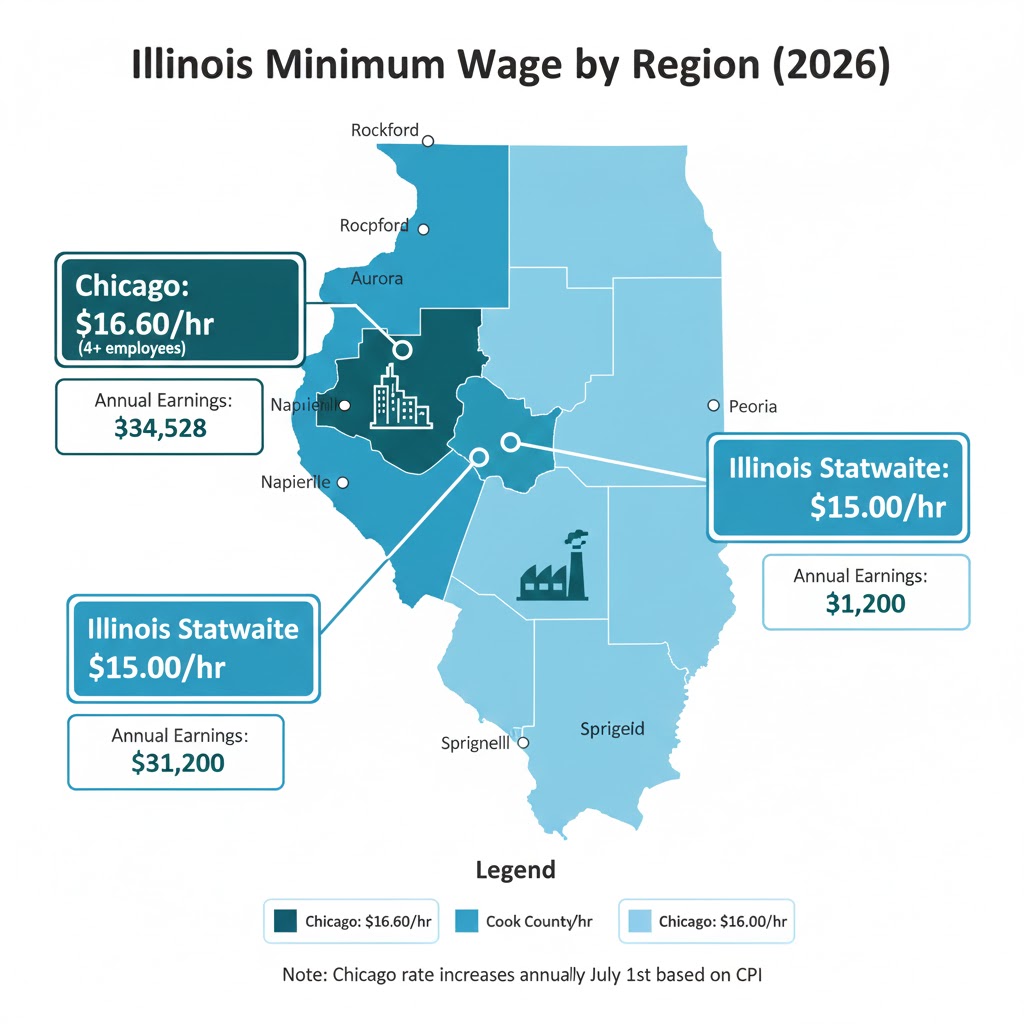
Step 1: Enter your Illinois hourly wage Input your current or expected hourly rate. Illinois’ statewide minimum wage is $15.00/hour as of 2026, with Chicago at $16.60/hour for employers with 4+ employees (as of July 1, 2025).
Step 2: Select your Illinois location Choose whether you work in Chicago or elsewhere in Illinois to apply the correct minimum wage. Chicago’s minimum wage is adjusted annually each July 1st.
Step 3: Input your working hours Enter hours per week (40 for full-time) and weeks per year (52 standard, or adjust for unpaid time off).
Step 4: Add overtime if applicable Illinois follows federal overtime rules requiring time-and-a-half after 40 hours per week. Input your typical overtime hours for accurate calculations.
Step 5: Review your Illinois results The calculator displays your gross salary plus all deductions including federal tax, Illinois flat tax (4.95%), FICA (Social Security 6.2% + Medicare 1.45%), and your net take-home pay.
Your Results Breakdown
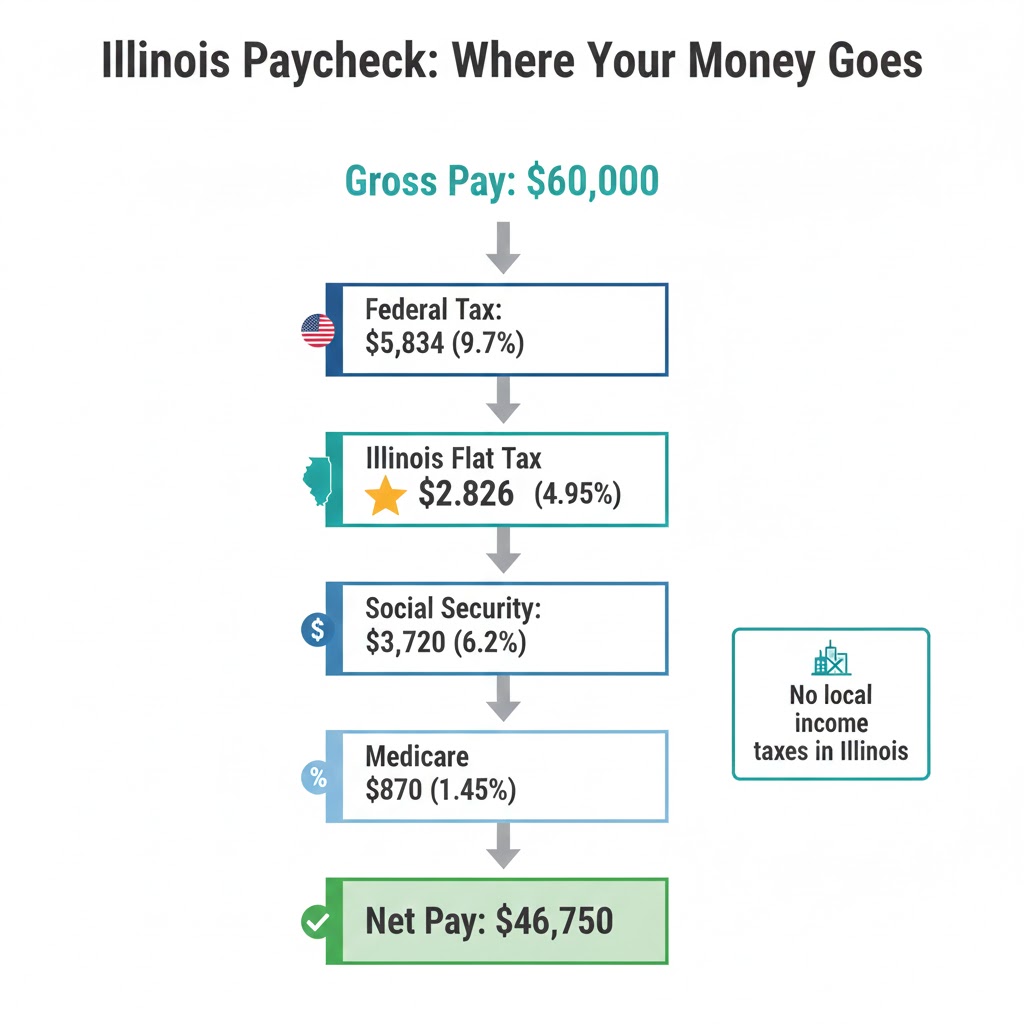
Once you enter your information, the calculator shows:
Gross Income:
- Hourly rate
- Daily earnings (8-hour day)
- Weekly gross pay
- Bi-weekly gross pay (most common in Illinois)
- Monthly gross pay
- Annual salary
Illinois State Deductions:
- Illinois flat income tax: 4.95% of taxable income (after personal exemption of $2,925)
- No local income taxes
- No city/county income taxes anywhere in Illinois
Federal Deductions:
- Federal income tax withholding (10%, 12%, 22%, 24%, 32%, 35%, 37% progressive brackets)
- Social Security (6.2% up to $176,100 in 2025 / $184,500 in 2026)
- Medicare (1.45% on all wages)
- Additional Medicare tax (0.9% over $200k single / $250k married)
Net Take-Home Pay:
- After all federal and Illinois deductions
- Monthly take-home amount
- Actual spending power in Illinois dollars
Illinois vs. Neighboring States:
- How your Illinois take-home compares to Indiana (3.15% flat tax) or Wisconsin (3.54-7.65% progressive)
- Effective tax rate in Illinois
- True hourly rate after all taxes
HOW TO CALCULATE HOURLY TO SALARY IN ILLINOIS
Understanding Illinois salary calculations is straightforward thanks to the state’s flat tax system, making it easier than most states with progressive tax brackets.
Hourly to Salary Calculator Illinois: Basic Formula
The core formula is simple, and Illinois’ flat 4.95% tax makes calculations predictable:
Gross Annual Salary = Hourly Rate × Hours Per Week × Weeks Per Year
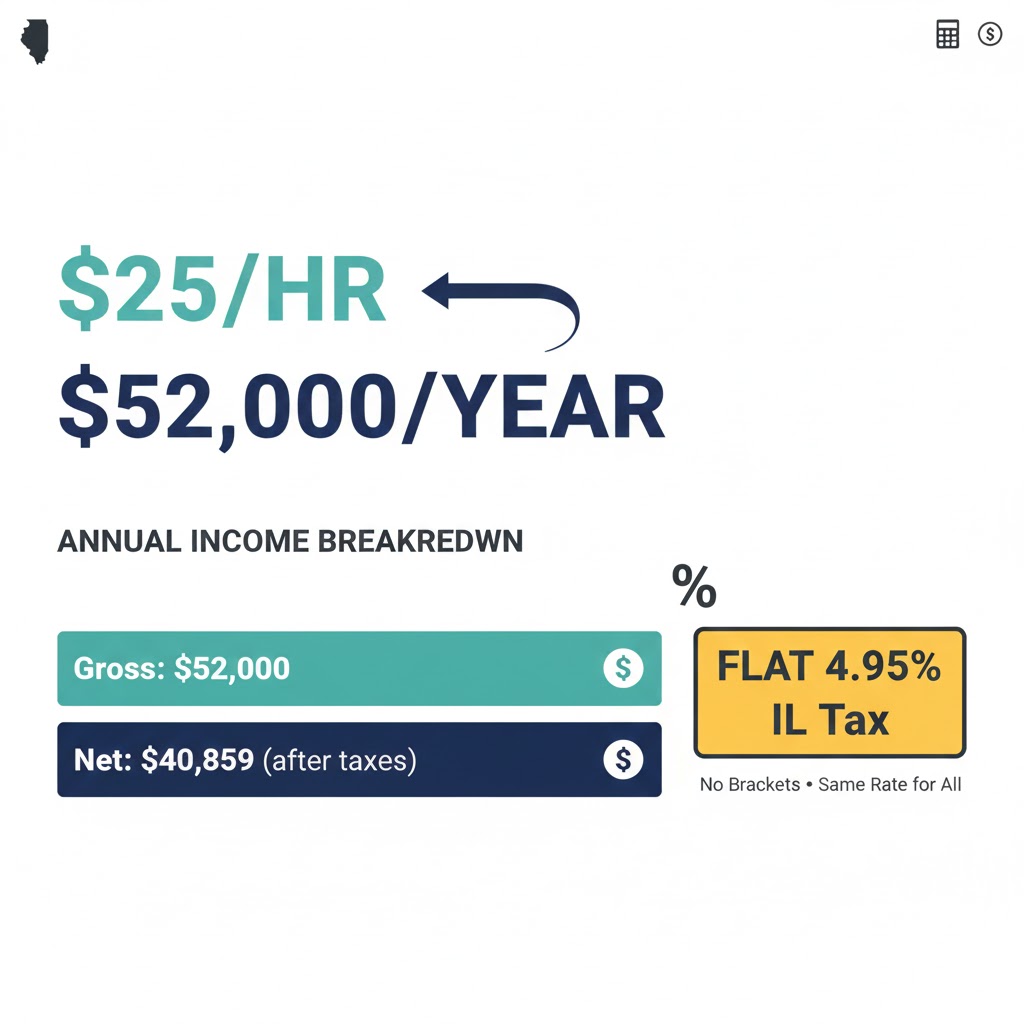
For Illinois workers at $25/hour, 40 hours/week, 52 weeks/year: $25 × 40 × 52 = $52,000 gross annual salary
However, Illinois net pay calculation requires subtracting:
- Federal income tax (~12% effective at $52k)
- Illinois state income tax: ($52,000 – $2,925 exemption) × 4.95% = $2,429
- Social Security: $52,000 × 6.2% = $3,224
- Medicare: $52,000 × 1.45% = $754
Net annual pay: ~$37,600 (72% of gross)
In comparison, the same $52,000 salary in Indiana (3.15% flat tax) yields ~$38,400 net pay (74% of gross), a difference of $800 annually or $67 per month, primarily due to Illinois’ higher state tax rate.
Step-by-Step Calculation for Illinois Workers
Step 1: Calculate gross salary Multiply your Illinois hourly rate by hours and weeks worked. Example: $20/hour × 40 hours × 52 weeks = $41,600
Step 2: Calculate Illinois state income tax Illinois uses a flat 4.95% tax on income after personal exemption:
- Taxable income: $41,600 – $2,925 (personal exemption) = $38,675
- Illinois tax: $38,675 × 4.95% = $1,914
Step 3: Calculate federal income tax For single filer earning $41,600 using 2026 federal brackets:
- Standard deduction: $16,100 (2026)
- Taxable income: $41,600 – $16,100 = $25,500
- First $11,925 at 10% = $1,193
- Remaining $13,575 at 12% = $1,629
- Total federal tax: $2,822
Step 4: Calculate FICA (Social Security + Medicare)
- Social Security: $41,600 × 6.2% = $2,579
- Medicare: $41,600 × 1.45% = $603
- Total FICA: $3,182
Step 5: Calculate Illinois net pay $41,600 – $1,914 (IL) – $2,822 (Fed) – $3,182 (FICA) = $33,682 net pay
Your Illinois take-home pay is 81% of gross at this income level.
Illinois-Specific Calculation Examples
Example 1: $20/hour in Chicago
Gross Calculation:
- Hourly rate: $20.00
- Hours per week: 40
- Weeks per year: 52
- Annual gross salary: $41,600
Illinois Deductions:
- IL state income tax: $1,914 (4.6% effective after exemption)
- Federal income tax: $2,822 (6.8% effective)
- FICA: $3,182 (7.65%)
- Total deductions: $7,918 (19.0%)
Net Pay:
- Annual net: $33,682
- Monthly net: $2,807
- Bi-weekly net: $1,296
- Take-home percentage: 81%
Chicago Context: At $20/hour in Chicago, you’re earning above both Illinois minimum wage ($15.00) and Chicago minimum wage ($16.60 for employers with 4+ employees). However, Chicago’s living wage for single adults is estimated at $19-21/hour. Chicago median 1-bedroom rent is $1,600-$1,900/month, consuming 57-68% of your take-home pay, making this salary challenging for independent living in the city proper but more manageable in Chicago suburbs.
Example 2: $30/hour in Suburban Chicago (DuPage County)
Gross Calculation:
- Hourly rate: $30.00
- Hours per week: 40
- Weeks per year: 52
- Annual gross salary: $62,400
Illinois Deductions:
- IL state income tax: $2,944 (4.7% effective after exemption)
- Federal income tax: $6,336 (10.2% effective)
- FICA: $4,774 (7.65%)
- Total deductions: $14,054 (22.5%)
Net Pay:
- Annual net: $48,346
- Monthly net: $4,029
- Bi-weekly net: $1,859
- Take-home percentage: 77.5%
DuPage County Context: At $30/hour in suburban Chicago counties (DuPage, Lake, Kane, Will), you’re earning a solid middle-class income. Suburban Chicago median 1-bedroom rent ranges from $1,200-$1,500/month, consuming 30-37% of your take-home pay—a comfortable ratio. Property taxes in Illinois suburbs are high (often $5,000-$10,000+ annually for homeowners), but this doesn’t directly affect renters.
Example 3: $15/hour at Illinois Minimum Wage
Gross Calculation:
- Hourly rate: $15.00 (Illinois minimum wage 2026)
- Hours per week: 40
- Weeks per year: 52
- Annual gross salary: $31,200
Illinois Deductions:
- IL state income tax: $1,400 (4.5% effective after exemption)
- Federal income tax: $1,812 (5.8% effective – lower bracket)
- FICA: $2,387 (7.65%)
- Total deductions: $5,599 (17.9%)
Net Pay:
- Annual net: $25,601
- Monthly net: $2,133
- Bi-weekly net: $985
- Take-home percentage: 82.1%
Illinois Minimum Wage Context: At Illinois’ $15.00 minimum wage, workers face lower tax rates due to federal standard deduction reducing taxable income and the personal exemption reducing Illinois tax. However, $15/hour is challenging even in lower-cost downstate Illinois cities. Many minimum wage workers qualify for federal EITC (Earned Income Tax Credit) and Illinois state credits, potentially adding $2,000-$6,000 in refunds at tax time.
Example 4: $25/hour with Regular Overtime in Illinois
Gross Calculation:
- Regular hourly rate: $25.00
- Regular hours: 40 per week
- Overtime hours: 5 per week (at time-and-a-half)
- Overtime rate: $37.50
Weekly Breakdown:
- Regular pay: $25 × 40 = $1,000
- Overtime pay: $37.50 × 5 = $187.50
- Total weekly: $1,187.50
- Annual gross: $61,750
Illinois Deductions:
- IL state income tax: $2,912 (4.7% effective)
- Federal income tax: $6,234 (10.1% effective)
- FICA: $4,724 (7.65%)
- Total deductions: $13,870 (22.5%)
Net Pay:
- Annual net: $47,880
- Monthly net: $3,990
- Bi-weekly net: $1,842
- Take-home percentage: 77.5%
Illinois Overtime Impact: The 5 hours of weekly overtime adds $9,750 to your annual gross income (regular 40 hours = $52,000). Illinois’ flat tax and federal taxes mean you keep about 76% of that overtime income after taxes, netting an additional $7,410 annually. Illinois follows standard federal overtime rules (after 40 hours/week) with time-and-a-half, no daily overtime or double-time provisions like California.
REVERSE CALCULATOR – ILLINOIS ANNUAL SALARY TO HOURLY RATE
Converting Illinois annual salaries to hourly rates helps you compare salaried positions with hourly jobs and understand your true per-hour earnings after Illinois’ flat tax.
How to Convert Illinois Salary to Hourly Wage
The reverse calculation divides annual salary by total hours worked, but understanding Illinois take-home requires factoring in the state’s 4.95% flat tax plus federal taxes.
Basic Formula: Hourly Rate = Annual Salary ÷ 2,080 hours (40 hours × 52 weeks)
Illinois Take-Home Hourly Rate: Effective Hourly Rate = (Annual Salary – Illinois tax – Federal tax – FICA) ÷ 2,080
This “effective hourly rate” shows what you actually earn per hour after Illinois’ combined tax burden, which ranges from 18% to 30% depending on your income level.
Salary to Hourly Formula for Illinois
Step 1: Divide annual salary by 2,080 This gives you gross hourly rate before any Illinois or federal deductions.
Step 2: Calculate Illinois flat tax impact Illinois tax is always 4.95% of taxable income (after $2,925 personal exemption):
- Approximate: ~4.5-4.8% of gross income for most earners
Step 3: Calculate federal tax impact Estimate 10-20% of annual salary for federal income tax (varies by bracket).
Step 4: Calculate FICA Always 7.65% (6.2% Social Security + 1.45% Medicare) up to Social Security wage cap.
Step 5: Determine effective hourly rate Subtract all taxes from annual salary, then divide by 2,080.
Example: $60,000 Illinois salary:
- Gross hourly: $60,000 ÷ 2,080 = $28.85/hour
- Illinois tax (~$2,826): -$1.36/hour
- Federal tax (~$5,834): -$2.80/hour
- FICA ($4,590): -$2.21/hour
- Effective hourly: $22.48/hour
Your Illinois take-home is $22.48/hour on a $60,000 salary, which is 78% of your gross hourly rate.
Illinois Salary Conversion Examples
Example: $50,000 salary to hourly in Illinois
Gross Calculation:
- Annual salary: $50,000
- Standard hours: 2,080 per year
- Gross hourly rate: $24.04/hour
Illinois Tax Impact:
- IL state income tax: $2,330 (4.66% effective after exemption)
- Federal income tax: $4,034 (8.1% effective)
- FICA: $3,825 (7.65%)
- Total annual deductions: $10,189
Net Illinois Earnings:
- Annual net: $39,811
- Effective hourly rate: $19.14/hour
- Take-home percentage: 79.6%
Illinois vs. Indiana Comparison: The same $50,000 salary in Indiana (3.15% flat tax):
- Annual net: ~$40,600
- Effective hourly: $19.52/hour
- Difference: $0.38/hour more in Indiana (about $789 annually)
Indiana’s lower flat tax (3.15% vs Illinois’ 4.95%) means Indiana workers keep more despite both states having flat-tax systems.
Example: $75,000 salary to hourly in Illinois
Gross Calculation:
- Annual salary: $75,000
- Standard hours: 2,080 per year
- Gross hourly rate: $36.06/hour
Illinois Tax Impact:
- IL state income tax: $3,568 (4.76% effective after exemption)
- Federal income tax: $9,534 (12.7% effective)
- FICA: $5,738 (7.65%)
- Total annual deductions: $18,840
Net Illinois Earnings:
- Annual net: $56,160
- Effective hourly rate: $27.00/hour
- Take-home percentage: 74.9%
Illinois Middle-Income Reality: At $75,000 in Illinois, you lose 25.1% to taxes compared to ~22% in Indiana or ~24% in Wisconsin. Illinois’ 4.95% flat rate means all income (after personal exemption) is taxed equally regardless of amount, providing tax simplicity but potentially higher burden for middle-income earners compared to states with progressive rates that tax lower income at lower rates.
Example: $100,000 salary to hourly in Illinois
Gross Calculation:
- Annual salary: $100,000
- Standard hours: 2,080 per year
- Gross hourly rate: $48.08/hour
Illinois Tax Impact:
- IL state income tax: $4,805 (4.81% effective after exemption)
- Federal income tax: $16,094 (16.1% effective)
- FICA: $7,650 (7.65%)
- Total annual deductions: $28,549
Net Illinois Earnings:
- Annual net: $71,451
- Effective hourly rate: $34.35/hour
- Take-home percentage: 71.5%
Six-Figure Illinois Reality: At $100,000 in Illinois, you’re still paying the same 4.95% state rate as someone earning $40,000 (after personal exemption). This flat-tax structure means Illinois doesn’t have the progressive state tax burden increase that states like California or Oregon have for six-figure earners. Combined federal-state-FICA burden reaches 28.5%.
High-Earner Illinois Tax Comparison
Annual Take-Home Pay Comparison:
| Annual Salary | IL Net Pay | IN Net Pay | WI Net Pay | Annual Difference (IL vs IN) |
|---|---|---|---|---|
| $50,000 | $39,811 | $40,600 | $40,100 | -$789 |
| $75,000 | $56,160 | $57,800 | $56,900 | -$1,640 |
| $100,000 | $71,451 | $73,700 | $71,800 | -$2,249 |
| $150,000 | $101,400 | $104,900 | $100,900 | -$3,500 |
| $200,000 | $130,000 | $134,400 | $128,600 | -$4,400 |
Illinois’ flat 4.95% tax means the state tax burden is consistent across income levels (as percentage of income after exemption), while Indiana’s lower 3.15% flat rate provides savings at all income levels. Wisconsin’s progressive system (3.54-7.65%) results in lower taxes for lower earners but similar burden to Illinois for $100k+ earners.
ILLINOIS TAXES, MINIMUM WAGE, AND YOUR PAYCHECK
Illinois Flat State Income Tax (2026)
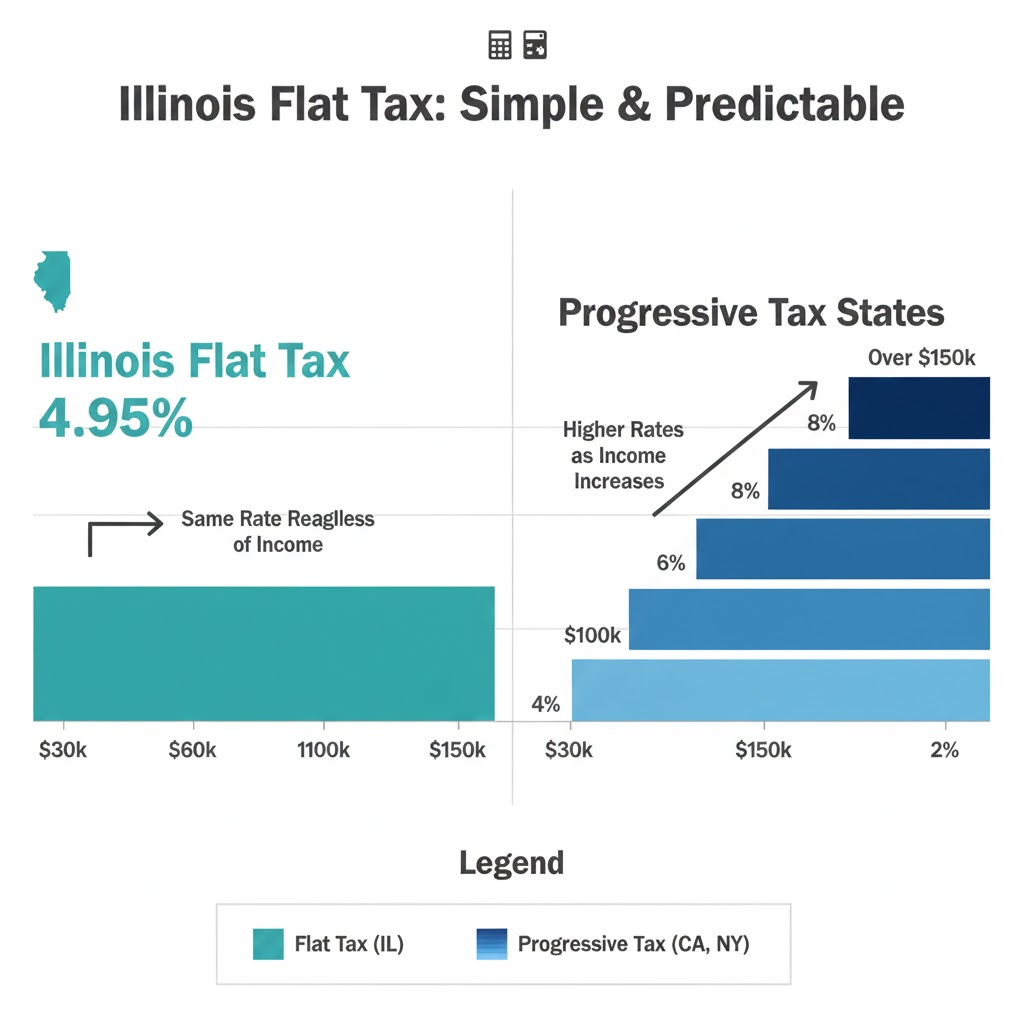
Illinois is one of only a few states with a flat income tax rate, making tax calculations simpler than progressive-bracket states.
Illinois Flat Tax Rate: 4.95%
This rate applies to all taxable income after personal exemptions, regardless of how much you earn.
Key Features:
- Same rate for everyone: Someone earning $30,000 and someone earning $300,000 both pay 4.95% on taxable income
- No tax brackets: Unlike most states, Illinois has no progressive brackets
- Simple calculation: Just multiply taxable income by 4.95%
- Rate history: Increased from 3.75% to 4.95% in 2017, remains unchanged since
Illinois Personal Exemption (2026)
Illinois allows a personal exemption that reduces your taxable income before applying the 4.95% rate.
Personal Exemption: $2,925 (2026)
This amount is subtracted from your income before calculating Illinois tax.
Examples of Illinois Tax Calculation:
Earning $40,000 annually:
- Gross income: $40,000
- Personal exemption: -$2,925
- Taxable income: $37,075
- Illinois tax: $37,075 × 4.95% = $1,835
- Effective rate: 4.59% of gross income
Earning $100,000 annually:
- Gross income: $100,000
- Personal exemption: -$2,925
- Taxable income: $97,075
- Illinois tax: $97,075 × 4.95% = $4,805
- Effective rate: 4.81% of gross income
Notice: The effective rate gets closer to 4.95% as income increases, since the $2,925 exemption becomes a smaller percentage of total income.
Illinois Tax Withholding Allowances
Illinois uses Form IL-W-4 for employees to claim withholding allowances, similar to federal W-4 but with different rules.
Illinois Withholding Allowances (2026):
- Basic allowance: $2,925 per allowance claimed
- Self allowance: 1 allowance if no one else can claim you as dependent
- Spouse allowance: 1 allowance if filing jointly
- Dependent allowances: 1 per eligible dependent
- Age/blindness allowances: 1 additional per person 65+ or legally blind
Withholding Calculation: Employers withhold Illinois tax at 4.95% after subtracting allowance amounts from gross wages.
Example: Employee earning $1,000 bi-weekly, claiming 2 allowances:
- Bi-weekly allowance amount: ($2,925 × 2) ÷ 26 pay periods = $225
- Taxable wages: $1,000 – $225 = $775
- Illinois withholding: $775 × 4.95% = $38.36 per paycheck
Why Illinois Has a Flat Tax
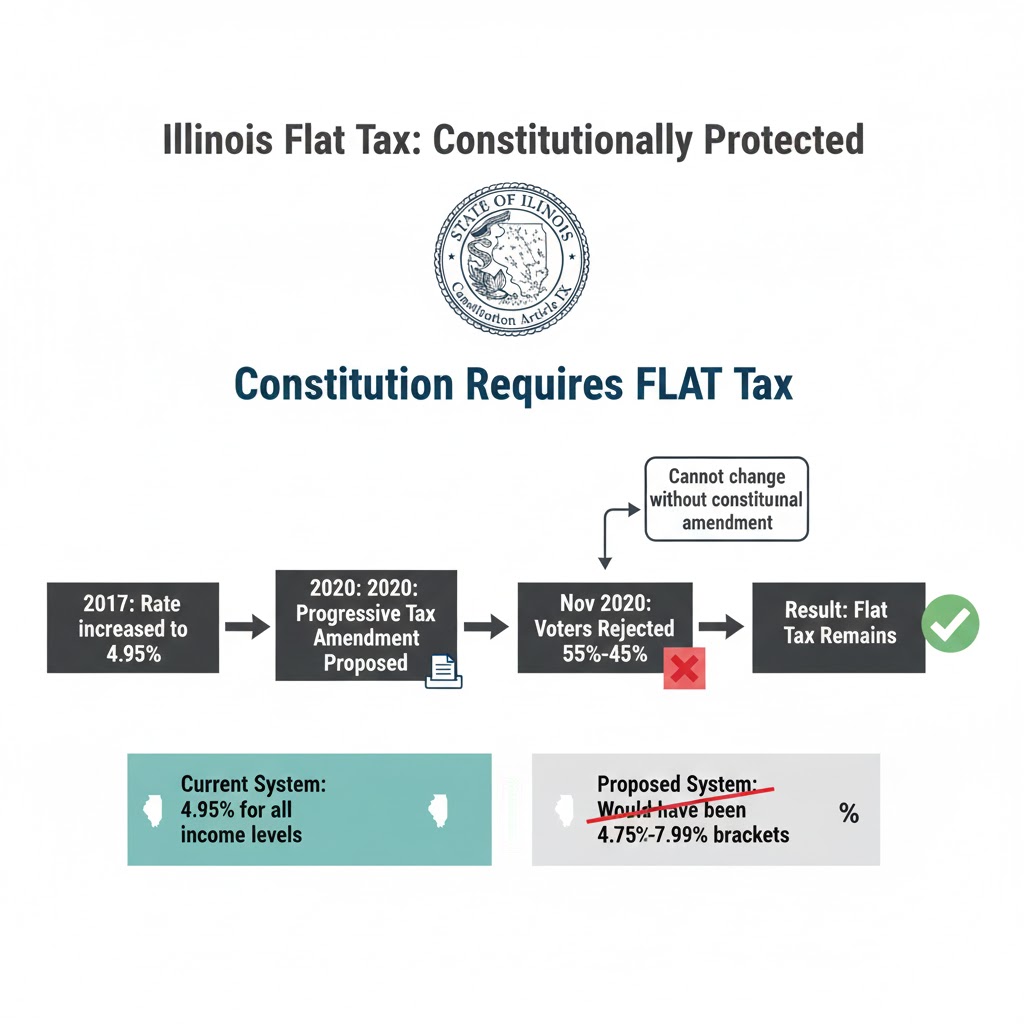
Illinois is constitutionally required to have a flat income tax rate.
Constitutional Requirement: The Illinois Constitution (Article IX, Section 3) mandates that income tax rates be “non-graduated” (flat), meaning:
- Cannot have progressive brackets
- Must tax all income at the same rate
- Any change requires constitutional amendment
Failed Progressive Tax Attempt: In November 2020, Illinois voters rejected a constitutional amendment that would have allowed progressive tax rates. The amendment failed 55%-45%, keeping the flat tax in place.
Illinois vs. Progressive Tax States:
| State | System | Rates | Impact |
|---|---|---|---|
| Illinois | Flat | 4.95% all income | Simple, same rate regardless of income |
| California | Progressive | 1%-13.3% brackets | Lower earners pay less, high earners pay more |
| Texas | None | 0% income tax | No state income tax, higher property/sales tax |
| Indiana | Flat | 3.15% all income | Similar to IL but lower rate |
| Wisconsin | Progressive | 3.54%-7.65% | Lower rates on first income, higher on top |
Flat Tax Pros:
- Simple calculation
- Easy to understand
- Predictable withholding
- No bracket creep
Flat Tax Cons:
- Low earners pay same rate as high earners
- No graduated relief for lower incomes
- Can result in higher burden on middle class vs. progressive states
Illinois Minimum Wage (2026)
Illinois reached its target $15.00 minimum wage in 2025 after a multi-year increase schedule.
Current Illinois Minimum Wage (2026):
- General minimum wage: $15.00/hour (workers 18+ years)
- Youth workers (under 18): $13.00/hour (if working less than 650 hours/year)
- Tipped workers: $9.00/hour (60% of minimum, must reach $15 with tips)
- Training wage: $14.50/hour (first 90 days only, for workers 18+, increased to $15.00 in 2026)
No Further Scheduled Increases: Illinois’ minimum wage increase schedule ended with the $15.00 rate on January 1, 2025. There are currently no scheduled future increases without new legislation. Unlike some states, Illinois does not have automatic inflation adjustments for minimum wage.
Illinois Minimum Wage History
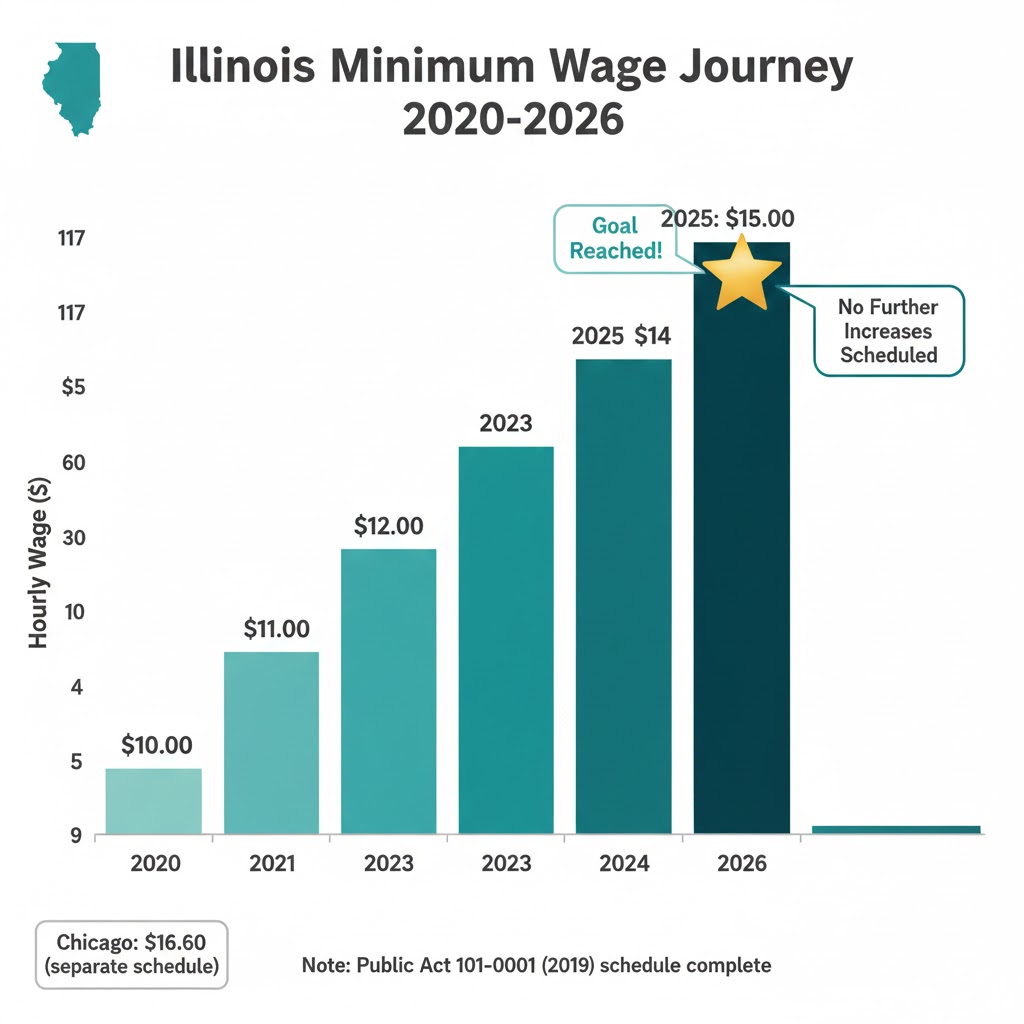
Historical Increases (2020-2025):
- January 1, 2020: $9.25/hour → $10.00/hour
- January 1, 2021: $10.00/hour → $11.00/hour
- January 1, 2022: $11.00/hour → $12.00/hour
- January 1, 2023: $12.00/hour → $13.00/hour
- January 1, 2024: $13.00/hour → $14.00/hour
- January 1, 2025: $14.00/hour → $15.00/hour (current)
- January 1, 2026: $15.00/hour (no change)
Public Act 101-0001 (2019): This law, signed by Governor Pritzker, scheduled the gradual increase from $8.25 in 2019 to $15.00 in 2025. The schedule is now complete.
Chicago Minimum Wage (2026)
Chicago has its own higher minimum wage that applies to employers with 4 or more employees.
Chicago Minimum Wage (as of July 1, 2025):
- General workers: $16.60/hour (employers with 4+ employees)
- Tipped workers: $12.62/hour (76% of general minimum)
- Youth workers (under 18): $16.50/hour
- City contract workers: $17.80/hour
Chicago Adjustments: Chicago’s minimum wage increases annually every July 1st based on Consumer Price Index (CPI) or 2.5%, whichever is lower. This ensures the wage keeps pace with inflation but caps increases at 2.5% annually.
July 1, 2026 Projection: Based on the 2.5% cap, Chicago minimum wage is projected to reach approximately $17.00-$17.05/hour by July 1, 2026.
Chicago Tipped Wage Phase-Out: Chicago passed the “One Fair Wage Ordinance” in 2023, gradually eliminating the tipped minimum wage:
- July 1, 2024: Tip credit reduced to 32% of minimum
- July 1, 2025: Tip credit reduced to 24% of minimum (current: $12.62)
- July 1, 2026: Tip credit reduced to 16% of minimum
- July 1, 2027: Tip credit reduced to 8% of minimum
- July 1, 2028: No tip credit – tipped workers receive full minimum wage + tips
This makes Chicago one of the few major cities phasing out the sub-minimum tipped wage entirely.
Cook County Minimum Wage
Cook County (excluding Chicago city limits) follows either Illinois state minimum or its own calculated rate based on CPI, whichever is higher.
Cook County Minimum Wage (2026):
- General minimum: $15.00/hour (currently mirrors Illinois state minimum)
- Tipped workers: $9.00/hour (mirrors Illinois tipped minimum)
Cook County Calculation Rule: The county uses the highest of:
- Federal minimum wage ($7.25)
- Illinois minimum wage ($15.00)
- County calculated rate based on CPI
Exception: If Cook County unemployment rate reaches or exceeds 8.5%, the county-calculated rate is not used.
Currently, Illinois state minimum ($15.00) is the controlling rate for Cook County.
Illinois Overtime Pay Rules
Illinois follows federal Fair Labor Standards Act (FLSA) overtime requirements with few state-specific variations.
Illinois Overtime Rules:
- Overtime required after: 40 hours in a workweek
- Overtime rate: Time-and-a-half (1.5× regular hourly rate)
- No daily overtime: Illinois does not require overtime for long workdays (unlike California’s 8-hour rule)
- No double-time: Illinois has no double-time provisions
- Weekly calculation: Based on 7-day workweek, not bi-weekly or monthly
Overtime Calculation Example:
Scenario: Work 50 hours at $20/hour
- First 40 hours: $20 × 40 = $800 (regular time)
- Next 10 hours: $30 × 10 = $300 (overtime)
- Total weekly pay: $1,100
Illinois Overtime Exemptions
Many Illinois workers are exempt from overtime requirements under federal FLSA rules.
Common FLSA Exemptions (apply in Illinois):
- Executive employees: Manage 2+ employees, have hiring/firing authority
- Administrative employees: Office work requiring discretion/judgment on significant matters
- Professional employees: Work requiring advanced knowledge/education
- Computer professionals: Earning at least $35.47/hour (federal 2024 threshold)
- Outside sales employees: Primary duty is making sales outside employer’s place of business
Salary Threshold for Exemption: To qualify for executive, administrative, or professional exemptions, employees must earn at least:
- $684/week ($35,568 annually) – Federal minimum (applies in Illinois)
Important: Illinois does not have a higher state-specific salary threshold like California or New York. Federal thresholds apply.
Common Misclassifications:
- Paying salary but employee doesn’t meet duties test
- Classifying as “manager” but employee primarily does non-management work
- Computer workers earning under $35.47/hour (or salary threshold)
- Inside sales employees (outside sales exemption doesn’t apply)
Illinois vs. Neighboring States Tax Comparison
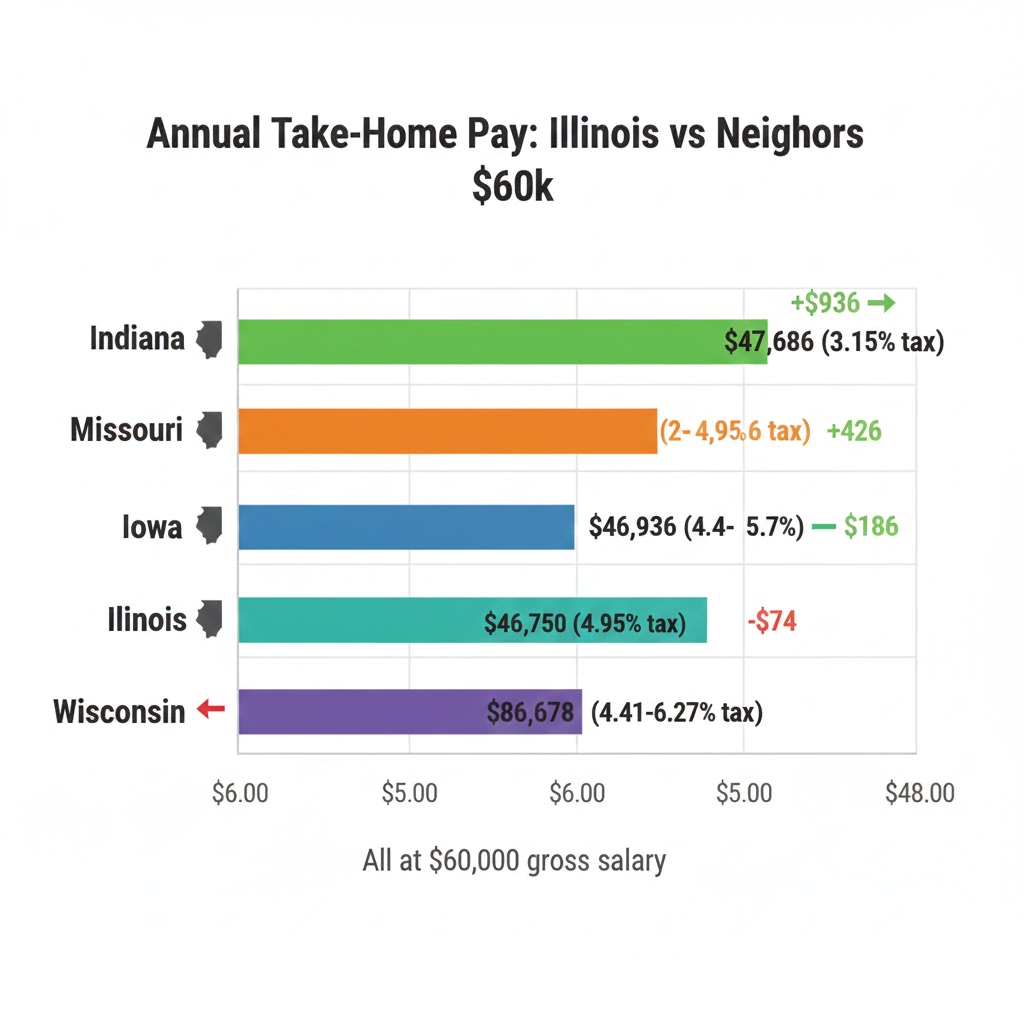
Annual Take-Home Pay Comparison at $60,000 Salary:
| State | State Tax Rate | State Tax Amount | Total Deductions | Net Take-Home | vs Illinois |
|---|---|---|---|---|---|
| Illinois | 4.95% flat | $2,826 | $13,250 | $46,750 | Baseline |
| Indiana | 3.15% flat | $1,890 | $12,314 | $47,686 | +$936 (+2.0%) |
| Wisconsin | 4.41-6.27% progressive | $2,900 | $13,324 | $46,676 | -$74 (-0.2%) |
| Iowa | 4.4-5.7% progressive | $2,640 | $13,064 | $46,936 | +$186 (+0.4%) |
| Missouri | 2-4.95% progressive | $2,400 | $12,824 | $47,176 | +$426 (+0.9%) |
Key Takeaways:
- Indiana’s lower flat tax (3.15%) provides clear advantage at all income levels
- Wisconsin’s progressive system results in similar burden to Illinois for middle incomes
- Missouri’s progressive rates favor lower/middle earners
- Illinois’ 4.95% flat rate is middle-of-the-pack among Midwest states
High-Income Comparison ($150,000 salary):
| State | State Tax | Net Take-Home | vs Illinois |
|---|---|---|---|
| Illinois | $7,281 (4.95%) | $106,000 | Baseline |
| Indiana | $4,725 (3.15%) | $109,200 | +$3,200 |
| Wisconsin | $10,620 (7.08% effective) | $103,100 | -$2,900 |
| Iowa | $8,055 (5.37% effective) | $105,600 | -$400 |
Observation: Illinois’ flat 4.95% becomes advantageous for high earners compared to progressive-tax Wisconsin, but Indiana’s lower flat rate still wins.
Illinois Cost of Living by Region
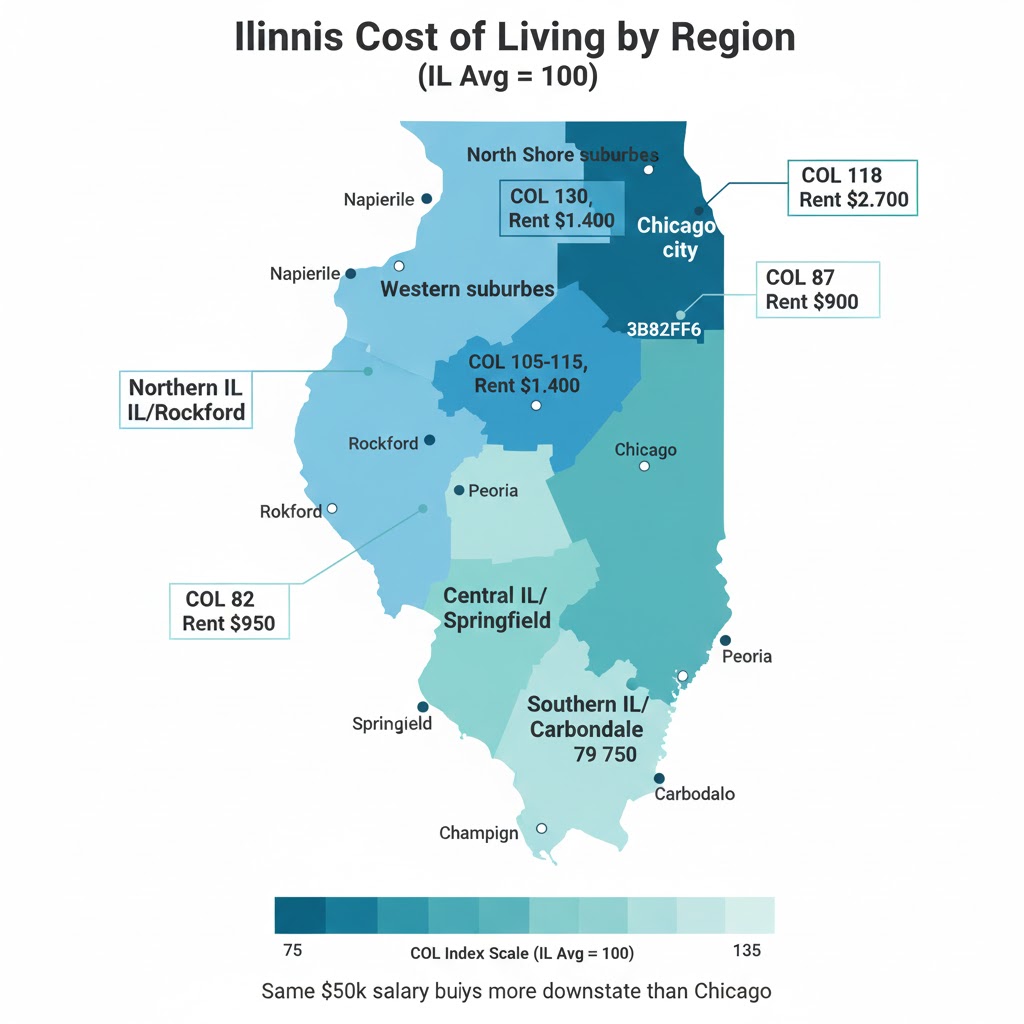
Illinois has significant cost-of-living variation between expensive Chicago area, mid-sized cities, and affordable rural regions.
Illinois Cost of Living Index by Region (Illinois Average = 100):
| Region | Overall COL Index | Housing Index | Key Factor |
|---|---|---|---|
| Chicago (city) | 118 | 145 | Urban housing costs |
| Chicago Suburbs (North Shore) | 130 | 165 | Wealthy suburbs |
| Chicago Suburbs (West/South) | 105 | 120 | Moderate suburbs |
| Naperville/Western Suburbs | 115 | 138 | Affluent suburbs |
| Springfield | 87 | 78 | State capital, affordable |
| Rockford | 82 | 72 | Northern IL, affordable |
| Peoria | 85 | 75 | Central IL city |
| Champaign-Urbana | 88 | 80 | College town |
| Carbondale/Southern IL | 79 | 68 | Rural, lowest costs |
Illinois Living Wage by City (2026)
The “living wage” represents the hourly rate needed to cover basic necessities without government assistance. Illinois living wages vary by region.
Living Wage Estimates for Illinois (2026):
| City/Region | Living Wage/Hour | Annual Living Wage | vs State Min Wage Gap |
|---|---|---|---|
| Chicago | $21.00/hour | $43,680 | -$6.00/hour |
| Chicago Suburbs | $19.50/hour | $40,560 | -$4.50/hour |
| Naperville/Aurora | $20.00/hour | $41,600 | -$5.00/hour |
| Rockford | $16.50/hour | $34,320 | -$1.50/hour |
| Peoria | $16.00/hour | $33,280 | -$1.00/hour |
| Springfield | $16.25/hour | $33,800 | -$1.25/hour |
| Champaign-Urbana | $16.75/hour | $34,840 | -$1.75/hour |
| Carbondale | $15.50/hour | $32,240 | -$0.50/hour |
Key Insight: Even at Illinois’ $15.00 minimum wage (or Chicago’s $16.60), workers earn only 71-97% of living wage depending on location. The gap is most severe in Chicago where minimum wage covers just 71% of living wage requirements.
Chicago Living Wage Breakdown
Chicago Living Wage ($21/hour for single adult):
Monthly expenses at $21/hour ($43,680 annually):
- Take-home pay: ~$2,950/month (after all taxes)
- Housing (1-BR): $1,700-$1,900 (58-64% of income)
- Food: $400 (14%)
- Transportation (CTA pass): $105 (4%)
- Healthcare: $150 (5%)
- Other necessities: $400 (14%)
- Savings/emergency: $195 (7%)
Reality at Chicago minimum wage ($16.60/hour):
- Take-home: ~$2,340/month
- Shortfall: $610/month vs. living wage
- Must make compromises: roommates, cheaper neighborhoods, reduced food budget
Illinois Property Tax Context
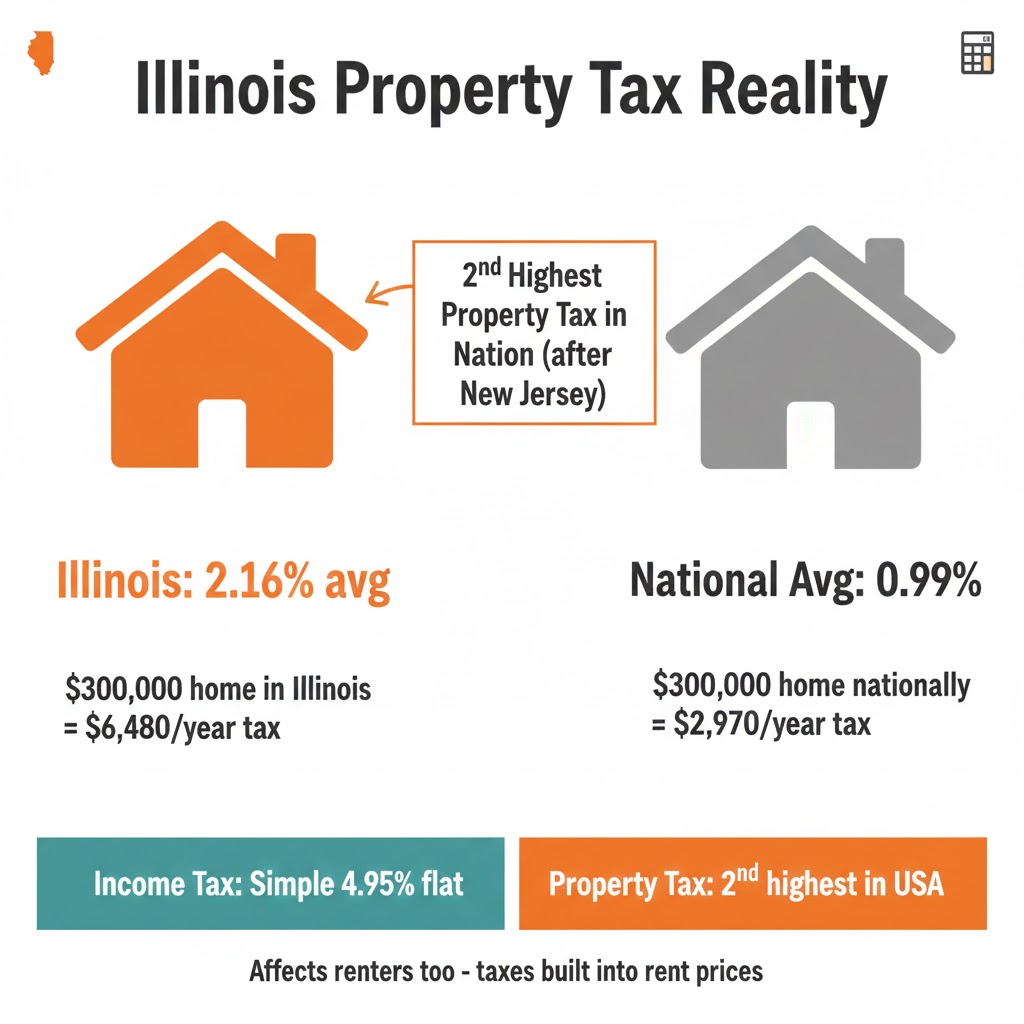
While Illinois has no local income taxes, the state has the second-highest property taxes in the nation (after New Jersey).
Illinois Property Tax Facts:
- Average effective rate: 2.16% of home value (national average: 0.99%)
- Cook County average: 2.19% of assessed value
- DuPage County: 2.25%
- Example: $300,000 home = ~$6,480-$6,750 annual property tax
Impact on Renters: Property taxes are built into rent prices, indirectly affecting all Illinois residents even if not homeowners.
Why High Property Taxes:
- Local government funding (schools, police, fire, roads)
- Illinois has 6,963 local taxing districts—most in the nation
- Pension obligations for public employees
- No state aid to some services that other states fund
Illinois Sales Tax Rates
Illinois has combined state and local sales taxes but no local income taxes.
Illinois Sales Tax (2026):
- State rate: 6.25%
- Local rates: 0.25% to 4.75% additional
- Combined rates: 6.5% to 11.0% depending on location
Major Cities Combined Sales Tax:
- Chicago: 10.25% (one of highest in nation)
- Aurora: 8.75%
- Naperville: 8.75%
- Joliet: 9.00%
- Rockford: 8.75%
- Peoria: 9.25%
- Springfield: 8.75%
Trade-off: Illinois’ flat 4.95% income tax is moderate, but high property and sales taxes increase overall tax burden, especially in Chicago area.
Popular Illinois Hourly to Salary Conversions
Quick reference tables showing exact Illinois take-home pay after all federal and state deductions.
Common Illinois Hourly Rates to Annual Salary:
| Hourly Rate | Annual Gross | IL Tax | Federal Tax | FICA | Total Deductions | Annual Net | Monthly Net | % Take-Home |
|---|---|---|---|---|---|---|---|---|
| $15.00 (IL min) | $31,200 | $1,400 | $1,812 | $2,387 | $5,599 | $25,601 | $2,133 | 82.1% |
| $16.60 (Chicago) | $34,528 | $1,564 | $2,203 | $2,641 | $6,408 | $28,120 | $2,343 | 81.4% |
| $18/hour | $37,440 | $1,706 | $2,545 | $2,864 | $7,115 | $30,325 | $2,527 | 81.0% |
| $20/hour | $41,600 | $1,914 | $2,822 | $3,182 | $7,918 | $33,682 | $2,807 | 81.0% |
| $25/hour | $52,000 | $2,429 | $4,734 | $3,978 | $11,141 | $40,859 | $3,405 | 78.6% |
| $30/hour | $62,400 | $2,944 | $6,336 | $4,774 | $14,054 | $48,346 | $4,029 | 77.5% |
| $35/hour | $72,800 | $3,459 | $8,534 | $5,569 | $17,562 | $55,238 | $4,603 | 75.9% |
| $40/hour | $83,200 | $3,974 | $10,934 | $6,365 | $21,273 | $61,927 | $5,161 | 74.4% |
| $50/hour | $104,000 | $5,003 | $16,534 | $7,956 | $29,493 | $74,507 | $6,209 | 71.6% |
Key Insights:
- Illinois minimum wage workers keep 82.1% (lowest tax burden)
- Middle earners ($25-35/hour) keep 76-79%
- Higher earners ($40-50/hour) keep 71-74%
- Illinois flat 4.95% tax means state burden is consistent across income levels
- Federal progressive brackets cause most take-home variation
For complete Calculations Guide Visit Our Blog Page.
Common Illinois Annual Salaries to Hourly Rate:
| Annual Salary | Gross Hourly | IL Tax | Federal Tax | FICA | Annual Net | Net Monthly | Effective Hourly |
|---|---|---|---|---|---|---|---|
| $35,000 | $16.83/hr | $1,588 | $2,282 | $2,678 | $28,452 | $2,371 | $13.68/hr |
| $40,000 | $19.23/hr | $1,835 | $2,634 | $3,060 | $32,471 | $2,706 | $15.61/hr |
| $45,000 | $21.63/hr | $2,083 | $3,234 | $3,443 | $36,240 | $3,020 | $17.42/hr |
| $50,000 | $24.04/hr | $2,330 | $4,034 | $3,825 | $39,811 | $3,318 | $19.14/hr |
| $60,000 | $28.85/hr | $2,826 | $5,834 | $4,590 | $46,750 | $3,896 | $22.48/hr |
| $75,000 | $36.06/hr | $3,568 | $9,534 | $5,738 | $56,160 | $4,680 | $27.00/hr |
| $100,000 | $48.08/hr | $4,805 | $16,094 | $7,650 | $71,451 | $5,954 | $34.35/hr |
| $125,000 | $60.10/hr | $6,043 | $23,594 | $9,388 | $85,975 | $7,165 | $41.33/hr |
Summary: Illinois Hourly to Salary Calculations
Converting hourly wages to annual salary in Illinois is straightforward thanks to the state’s constitutionally-mandated flat 4.95% income tax—one of the simplest tax systems in the United States.
Key Takeaways for Illinois Workers
Flat Tax Simplicity: Illinois’ 4.95% flat tax means everyone pays the same state rate (after $2,925 personal exemption) regardless of income. This makes Illinois calculations easier than progressive-tax states but means lower earners don’t get graduated tax relief. The flat tax is constitutionally protected and cannot be changed without voter approval of a constitutional amendment.
No Local Income Taxes: Unlike Ohio, Pennsylvania, or Indiana (which allows local taxes), Illinois has zero city or county income taxes anywhere in the state. However, this is offset by the second-highest property taxes in the nation and high sales taxes, especially in Chicago (10.25%).
Minimum Wage Progress: Illinois reached its $15.00 statewide minimum wage goal in 2025 after a six-year phase-in schedule. Chicago has its own higher minimum ($16.60 as of July 2025) with annual CPI increases capped at 2.5%. No further state increases are scheduled without new legislation.
Chicago vs. Rest of State: Chicago’s higher minimum wage ($16.60 vs. $15.00), higher sales tax (10.25% vs. 6.5-9%), and significantly higher cost of living create a distinct economic environment from the rest of Illinois. A $50,000 salary goes much further in Springfield or Rockford than in Chicago proper.
Standard Overtime Only: Illinois follows federal FLSA overtime (after 40 hours/week, time-and-a-half) with no daily overtime, double-time, or enhanced provisions like some other states. The federal salary threshold ($684/week) applies for overtime exemptions, with no higher Illinois-specific threshold.
Midwest Tax Competition: Illinois’ 4.95% flat tax is higher than Indiana (3.15%), similar to Wisconsin for middle incomes (4.41-6.27% progressive), but lower than Wisconsin for high earners. Many Illinois residents work across state lines in Indiana or Wisconsin, creating tax arbitrage opportunities.
Take-Home Reality: Illinois workers keep 71-82% of gross pay depending on income level. State tax takes 4.5-4.95%, federal progressive tax takes 6-20%, and FICA takes 7.65%. The flat state tax means Illinois burden is predictable and consistent across income levels.
High Property Tax Context: While Illinois income tax is moderate, property taxes averaging 2.16% of home value (vs. 0.99% nationally) significantly impact total tax burden, especially for homeowners in Cook County and Chicago suburbs. These taxes fund local services and schools but make Illinois one of the highest overall tax states despite the simple flat income tax.
Use this calculator for comparing Illinois job offers across regions, understanding true take-home pay in Chicago vs. downstate, negotiating salaries with Illinois cost-of-living and tax context, planning budgets based on flat 4.95% state tax plus federal taxes, and evaluating Illinois opportunities versus neighboring states like Indiana (lower taxes) or Wisconsin (progressive system).
Whether you’re earning Illinois’ $15.00 minimum wage, Chicago’s $16.60 minimum, or a six-figure salary in the Chicago suburbs, the flat 4.95% tax provides predictability and simplicity in calculating your take-home pay across Illinois’ economically diverse landscape from the high-cost Chicagoland area to affordable Central and Southern Illinois communities.