Whether you’re evaluating a job offer, planning your budget, or negotiating compensation, understanding how your hourly wage translates to an annual salary is essential. Our hourly to salary calculator Maryland helps employees and employers quickly estimate yearly earnings while accounting for Maryland’s unique tax structure, including state and local income taxes that vary by county.
Maryland Hourly to Salary Calculator
Calculate your Maryland salary using our 2-in-1 Maryland hourly to salary calculator with county-specific tax settings. Input your hourly rate (MD minimum: $15.00, rising to $15.50 in 2026), add overtime, and instantly see your take-home pay after Maryland’s progressive state tax (2%-6.5%), county tax (2.25%-3.20% varying by 23 counties plus Baltimore City), federal taxes, and FICA deductions.
Calculate your take-home pay after federal taxes, state income tax, and local county taxes.
Quick Conversion Guide
How to Convert Hourly to Salary in Maryland
The basic formula for converting hourly pay to annual salary is straightforward:
Annual Salary = Hourly Rate × Hours Per Week × Weeks Per Year
For a standard full-time position working 40 hours per week for 52 weeks:
Annual Salary = Hourly Rate × 40 × 52
Example: If you earn $25 per hour working full-time:
- Weekly earnings: $25 × 40 = $1,000
- Annual salary: $1,000 × 52 = $52,000
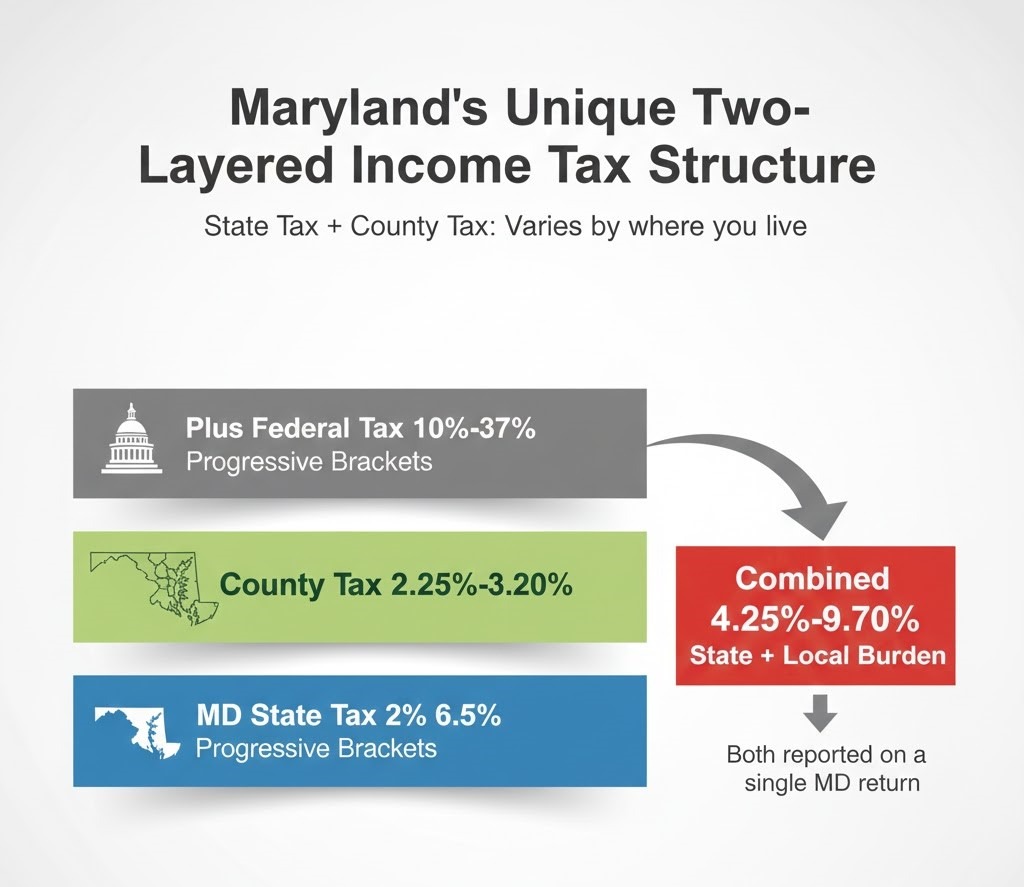
This calculation provides your gross annual income before any taxes or deductions are withheld. In Maryland, your actual take-home pay will be lower due to federal income tax, Maryland state tax (ranging from 2% to 6.5%), and local county taxes (ranging from 2.25% to 3.20%).
How to Convert Salary to Hourly in Maryland
To determine your equivalent hourly wage from an annual salary:
Hourly Rate = Annual Salary ÷ (Hours Per Week × Weeks Per Year)
For full-time work (40 hours per week, 52 weeks per year):
Hourly Rate = Annual Salary ÷ 2,080
Example: If your annual salary is $60,000:
- Hourly rate: $60,000 ÷ 2,080 = $28.85 per hour
This assumes 2,080 work hours annually, which is the standard calculation based on a 40-hour workweek. However, if you take unpaid time off or work fewer weeks, adjust the formula accordingly.
Common Hourly to Annual Salary Conversions
Here are typical Maryland hourly wages converted to annual salaries based on a standard 2,080-hour work year:
| Hourly Rate | Annual Salary |
|---|---|
| $15.00 | $31,200 |
| $20.00 | $41,600 |
| $25.00 | $52,000 |
| $30.00 | $62,400 |
| $35.00 | $72,800 |
| $40.00 | $83,200 |
| $50.00 | $104,000 |
Quick Mental Calculation Method: Double your hourly rate and add three zeros for an approximate annual salary. For example, $20/hour × 2 = $40, then add three zeros = $40,000. This provides a close estimate for full-time work.
Understanding Hourly to Salary Calculations in Maryland
Basic Conversion Formula
The standard conversion uses 2,080 hours as the annual work hours for full-time employment. This number comes from:
- 40 hours per week (standard full-time)
- 52 weeks per year
- 40 × 52 = 2,080 total hours
However, this assumes no unpaid time off. If you take unpaid vacation or holidays, you’ll need to subtract those hours from your calculation to get an accurate annual income figure.
Standard Work Hours and Weeks Per Year
While 2,080 hours is the standard baseline, actual work hours can vary:
Full-Time Employment: Most full-time positions in Maryland require 40 hours per week. Some industries may define full-time as 35-37.5 hours per week, which would result in 1,820-1,950 annual work hours.
Working Weeks Per Year: The standard 52-week calculation assumes you work every week of the year. Many employees account for:
- Paid time off (PTO)
- Holidays
- Sick days
- Unpaid leave
If you receive paid vacation and holidays, these days are already included in your annual salary. However, if you take unpaid time off, you should calculate based on actual weeks worked.
Example with Unpaid Time: If you work 50 weeks per year (taking 2 weeks unpaid vacation):
- Annual salary: $25/hour × 40 hours × 50 weeks = $50,000 (instead of $52,000)
Part-Time vs Full-Time Calculations
Part-Time Work: For employees working less than 40 hours per week, simply adjust the hours per week in your calculation.
Example: Working 25 hours per week at $18 per hour:
- Weekly pay: $18 × 25 = $450
- Annual salary: $450 × 52 = $23,400
Full-Time Work: Standard calculation uses 40 hours per week. Maryland labor law doesn’t strictly define full-time employment, but the Affordable Care Act (ACA) considers 30 hours per week or 130 hours per month as full-time for benefits purposes.
Including Overtime in Your Calculations
Maryland overtime regulations require employers to pay 1.5 times the regular hourly rate for hours worked beyond 40 per week (with some industry-specific exceptions).
Calculating Overtime Impact:
If you regularly work overtime, your actual annual earnings will exceed the standard calculation. For example, if you work 45 hours per week with 5 hours of overtime:
Regular pay: $20/hour × 40 hours = $800 Overtime pay: $20 × 1.5 = $30/hour × 5 hours = $150 Weekly total: $950 Annual total: $950 × 52 = $49,400
This is significantly higher than the base $41,600 annual salary ($20 × 40 × 52) without overtime.
Industry-Specific Overtime Rules:
- Most employees: Overtime after 40 hours/week
- Bowling establishments and certain care facilities: Overtime after 48 hours/week
- Agricultural workers: Overtime after 60 hours/week
When using an hourly to salary calculator for Maryland, consider whether overtime is a regular part of your schedule to get an accurate picture of your annual earnings.
Maryland-Specific Paycheck Information
Overview of Maryland Taxes
Maryland operates a unique two-layer income tax system where residents pay both state and local taxes on a single tax return. Understanding this structure is essential when converting your hourly wage to annual salary, as your actual take-home pay depends on both your state tax bracket and your county of residence.
Maryland State Income Tax Rates
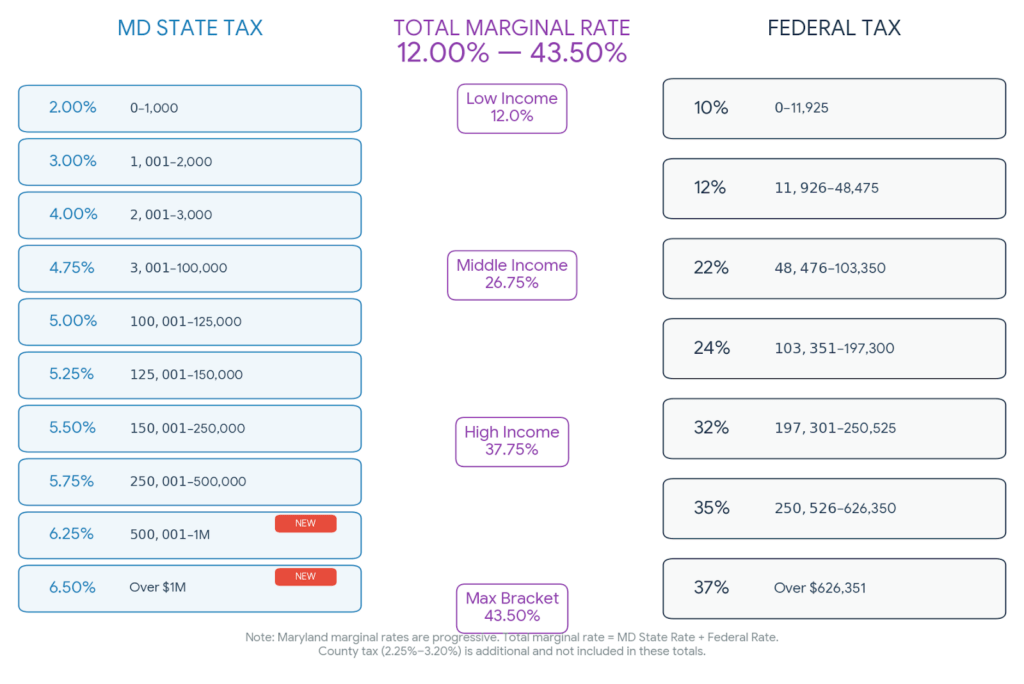
Maryland uses a progressive income tax system with rates ranging from 2% to 6.50% for tax year 2026. The state added two new brackets for high-income earners: 6.25% for income between $500,001 and $1,000,000 (single filers) or $600,001 to $1,200,000 (joint filers), and 6.50% for income above $1,000,001 (single) or $1,200,001 (joint).
2026 Maryland State Tax Brackets (Single/Married Filing Separately):
| Taxable Income Range | Tax Rate |
|---|---|
| $0 – $1,000 | 2% |
| $1,001 – $2,000 | 3% |
| $2,001 – $3,000 | 4% |
| $3,001 – $100,000 | 4.75% |
| $100,001 – $125,000 | 5% |
| $125,001 – $150,000 | 5.25% |
| $150,001 – $250,000 | 5.50% |
| $250,001 – $500,000 | 5.75% |
| $500,001 – $1,000,000 | 6.25% |
| Over $1,000,000 | 6.50% |
2026 Maryland State Tax Brackets (Married Filing Jointly/Head of Household):
| Taxable Income Range | Tax Rate |
|---|---|
| $0 – $1,000 | 2% |
| $1,001 – $2,000 | 3% |
| $2,001 – $3,000 | 4% |
| $3,001 – $150,000 | 4.75% |
| $150,001 – $175,000 | 5% |
| $175,001 – $225,000 | 5.25% |
| $225,001 – $300,000 | 5.50% |
| $300,001 – $600,000 | 5.75% |
| $600,001 – $1,200,000 | 6.25% |
| Over $1,200,000 | 6.50% |
Maryland’s progressive system means each dollar is taxed at the rate for its bracket, not your entire income at your top rate.
Maryland County and Local Income Taxes
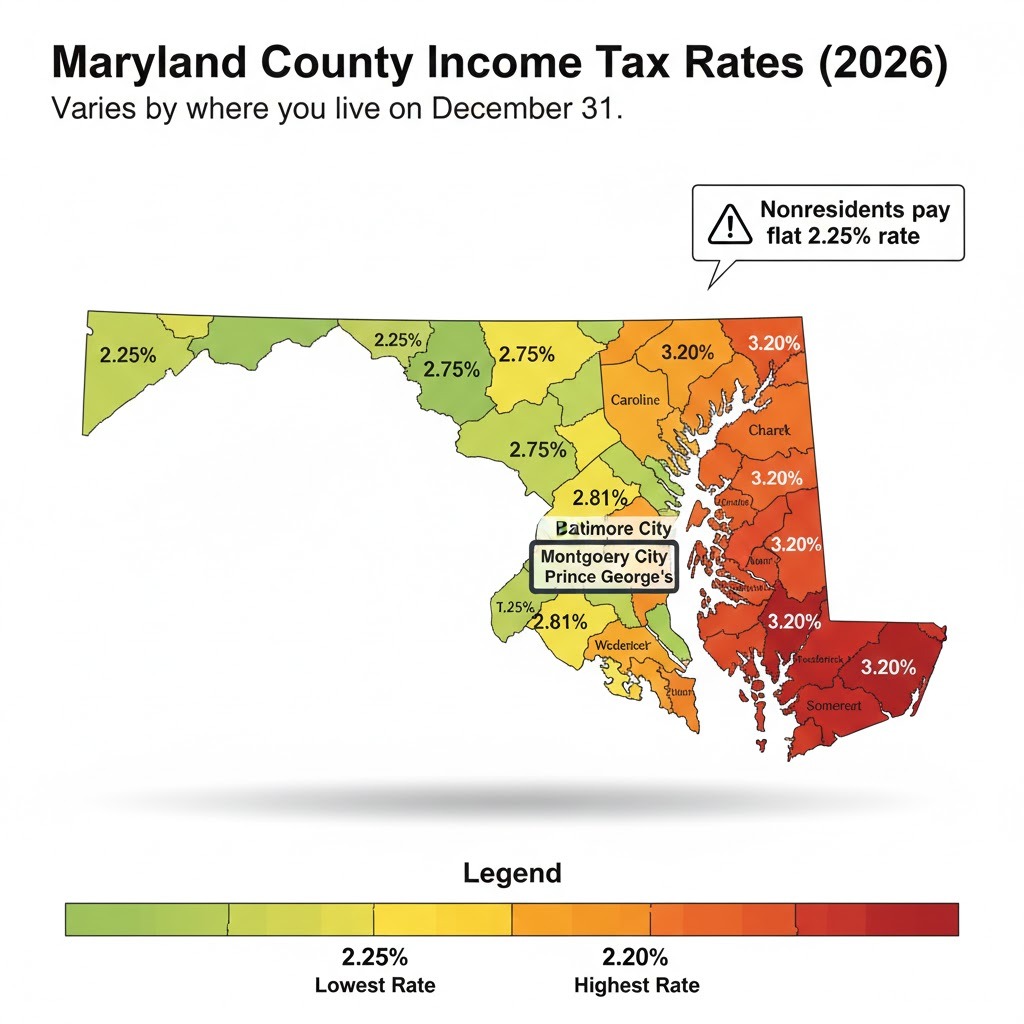
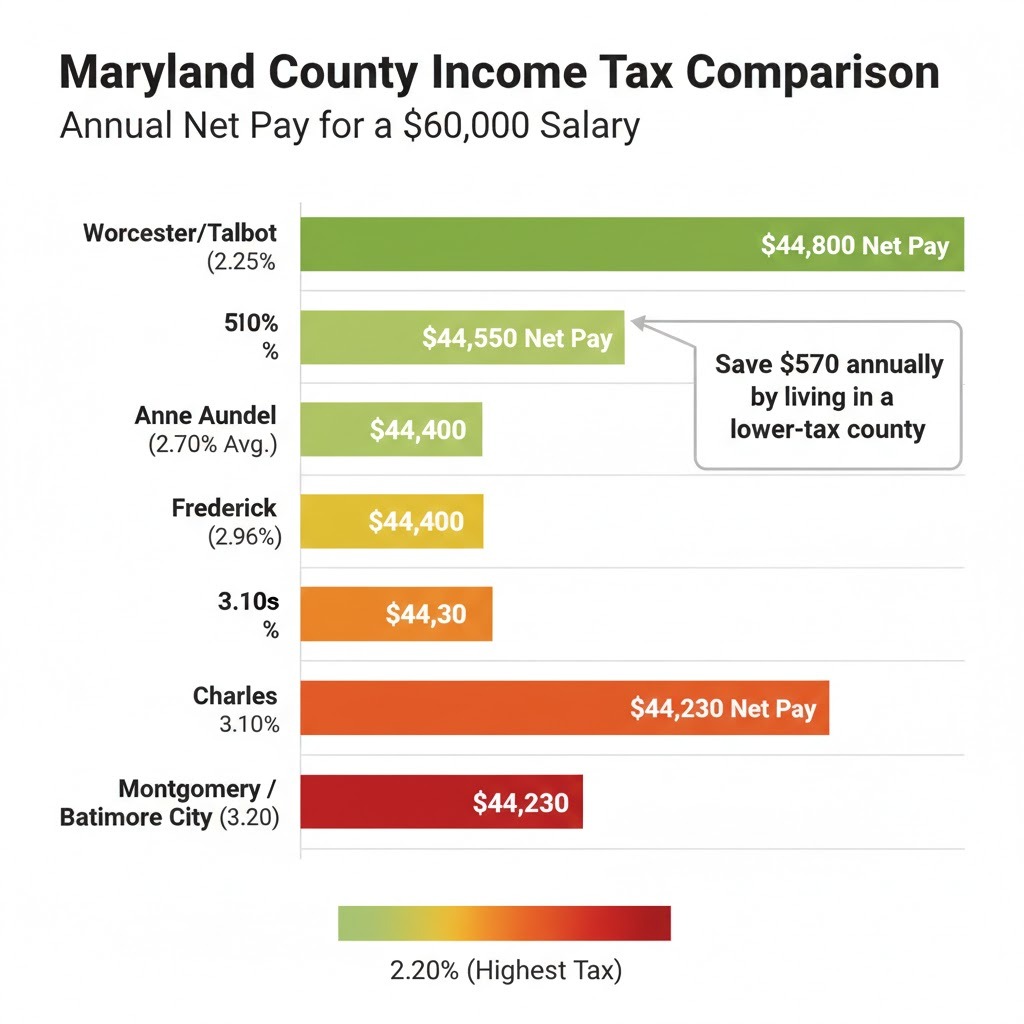
Maryland’s 23 counties and Baltimore City impose local income taxes paid with your state return. These rates significantly impact your take-home pay when converting hourly wages to annual salary.
2026 Local Tax Rates by County:
| County | Local Tax Rate |
|---|---|
| Allegany | 3.05% |
| Anne Arundel | 2.25% – 2.94% (progressive) |
| Baltimore City | 3.20% |
| Baltimore County | 3.20% |
| Calvert | 3.00% |
| Caroline | 3.20% |
| Carroll | 3.20% |
| Cecil | 3.00% |
| Charles | 3.10% |
| Dorchester | 3.00% |
| Frederick | 2.96% |
| Garrett | 2.65% |
| Harford | 3.06% |
| Howard | 3.20% |
| Kent | 3.20% |
| Montgomery | 3.20% |
| Prince George’s | 3.20% |
| Queen Anne’s | 3.20% |
| St. Mary’s | 3.00% |
| Somerset | 3.20% |
| Talbot | 2.40% |
| Washington | 2.95% |
| Wicomico | 3.20% |
| Worcester | 2.25% |
Nonresidents working in Maryland pay a flat 2.25% local rate regardless of where in Maryland they work.
Combined Tax Example: If you earn $60,000 annually and live in Montgomery County, you pay:
- Maryland state tax: approximately $2,527
- Montgomery County local tax (3.20%): $1,920
- Total Maryland taxes: $4,447
The maximum county rate increased from 3.20% to 3.30% for tax years after December 31, 2024, giving counties authority to raise rates within this new ceiling.
Maryland Tax Brackets 2026
For tax year 2026, Maryland’s standard deduction amounts are $3,350 for single/married filing separately and $6,700 for married filing jointly/head of household. These deductions reduce your taxable income before applying the tax brackets.
Additional 2026 Tax Considerations:
Maryland implemented a 2% capital gains surtax for taxpayers with federal adjusted gross income exceeding $350,000. This affects high earners with investment income but doesn’t typically impact standard wage calculations.
Maryland itemized deductions are reduced by 7.5% of federal AGI over $200,000 (or $100,000 for married filing separately), which can increase taxable income for higher earners.
Federal Taxes in Maryland
Maryland residents pay federal taxes in addition to state and local taxes. When calculating your take-home pay from an hourly wage, you must account for all federal withholdings.
Federal Income Tax Withholding
Federal income tax is calculated based on your W-4 form information, filing status, and income level. The IRS uses a progressive tax structure with seven brackets for 2026:
2026 Federal Tax Brackets (Single):
| Taxable Income Range | Tax Rate |
|---|---|
| $0 – $11,925 | 10% |
| $11,926 – $48,475 | 12% |
| $48,476 – $103,350 | 22% |
| $103,351 – $197,300 | 24% |
| $197,301 – $250,525 | 32% |
| $250,526 – $626,350 | 35% |
| Over $626,350 | 37% |
The 2026 standard deduction is $15,000 for single filers and $30,000 for married filing jointly.
FICA Taxes (Social Security & Medicare)
FICA imposes two payroll taxes: 12.4% for Social Security and 2.9% for Medicare, totaling 15.3%. Employees and employers each pay half.
Social Security Tax:
- Employee rate: 6.2% on wages up to $184,500 for 2026
- Once you earn more than $184,500 annually, no additional Social Security tax is withheld
- Maximum Social Security tax: $11,439 per year ($184,500 × 6.2%)
Medicare Tax:
- Employee rate: 1.45% on all wages with no income cap
- Medicare applies to every dollar you earn, regardless of how much you make
Example FICA Calculation: If you earn $25/hour working full-time (40 hours/week × 52 weeks):
- Annual gross: $52,000
- Social Security: $52,000 × 6.2% = $3,224
- Medicare: $52,000 × 1.45% = $754
- Total FICA: $3,978
Additional Medicare Tax
High earners pay an additional 0.9% Medicare tax on wages exceeding $200,000 for single filers or $250,000 for married filing jointly. This additional tax has no employer match.
For an employee earning $225,000 annually (single):
- Regular Medicare: $225,000 × 1.45% = $3,262.50
- Additional Medicare: ($225,000 – $200,000) × 0.9% = $225
- Total Medicare: $3,487.50
FUTA (Federal Unemployment Tax)
FUTA is an employer-only tax and does not affect employee take-home pay. Employers pay 6% on the first $7,000 of each employee’s wages, though most receive a credit bringing the effective rate to 0.6%.
Calculating Your Take-Home Pay
What is Gross Pay?
Gross pay represents your total earnings before any deductions or taxes are withheld. When converting hourly to salary, this is your base calculation:
Gross Annual Pay = Hourly Rate × Hours Worked Annually
For a standard full-time employee:
- $30/hour × 2,080 hours = $62,400 gross annual pay
- $62,400 ÷ 12 months = $5,200 gross monthly pay
- $62,400 ÷ 26 pay periods = $2,400 gross biweekly pay
What is Net Pay?
Net pay (take-home pay) is what remains after all taxes and deductions are withheld from your gross pay:
Net Pay = Gross Pay – (Federal Tax + State Tax + Local Tax + FICA + Other Deductions)
Real Example: $30/hour full-time in Baltimore City
- Gross annual: $62,400
- Federal income tax: ~$6,850 (estimates vary by filing status)
- Maryland state tax: ~$2,977
- Baltimore City local tax (3.20%): $1,997
- Social Security (6.2%): $3,869
- Medicare (1.45%): $905
- Net annual pay: ~$45,802
- Take-home: ~$1,762 biweekly
Your actual take-home depends on your W-4 elections, pre-tax benefit deductions, and filing status.
Understanding Pay Frequency
Weekly: 52 paychecks per year
- Gross annual salary ÷ 52
Bi-Weekly: 26 paychecks per year (most common)
- Gross annual salary ÷ 26
- Paid every two weeks
Semi-Monthly: 24 paychecks per year
- Gross annual salary ÷ 24
- Paid twice monthly (typically 1st and 15th)
Monthly: 12 paychecks per year
- Gross annual salary ÷ 12
Difference Between Bi-Weekly and Semi-Monthly
Bi-Weekly Pay:
- Exactly 26 pay periods annually
- Two months have three paychecks
- Each paycheck: Annual salary ÷ 26
- Example: $52,000 annual = $2,000 per paycheck
Semi-Monthly Pay:
- Exactly 24 pay periods annually
- Two paychecks every month
- Each paycheck: Annual salary ÷ 24
- Example: $52,000 annual = $2,166.67 per paycheck
Bi-weekly results in smaller individual paychecks but two “extra” paychecks per year (in months with three pay periods).
Deductions and Benefits
Pre-Tax Deductions
Pre-tax deductions reduce your taxable income, lowering both federal and Maryland state taxes.
401(k) and 403(b) Retirement Contributions
- 2026 contribution limit: $23,500 (under age 50)
- Catch-up contribution (age 50+): additional $7,500
- Reduces federal, state, and local taxable income
- Still subject to FICA taxes
Example: Earning $60,000 with $5,000 in 401(k) contributions
- Taxable income for federal/state: $55,000
- Social Security/Medicare calculated on full $60,000
Health Insurance Premiums
Employer-sponsored health insurance premiums are typically pre-tax, reducing your taxable wages for federal and Maryland income taxes.
Health Savings Accounts (HSA)
- 2026 limits: $4,300 (individual), $8,550 (family)
- Triple tax advantage: pre-tax contributions, tax-free growth, tax-free withdrawals for medical expenses
- Must have a high-deductible health plan
Flexible Spending Accounts (FSA)
- 2026 limit: $3,300 for healthcare FSA
- Dependent care FSA: $5,000 per household
- Use-it-or-lose-it rules apply (though some plans allow carryover)
Post-Tax Deductions
Post-tax deductions are taken after all taxes are calculated and don’t reduce taxable income.
Roth 401(k) Contributions
- Same contribution limits as traditional 401(k)
- No upfront tax benefit
- Tax-free withdrawals in retirement
- Still subject to FICA taxes
Life Insurance Premiums
Employer-provided life insurance over $50,000 is taxable income. Additional voluntary coverage is usually paid post-tax.
Disability Insurance
Short-term and long-term disability premiums paid by employees are typically post-tax deductions.
Union Dues
Union membership fees are deducted post-tax from your paycheck.
Fringe Benefits and Supplemental Wages
How Bonuses are Taxed in Maryland
Bonuses are considered supplemental wages and may be withheld at a flat 22% federal rate (or your marginal rate). Maryland state and local taxes also apply.
Example: $5,000 bonus
- Federal withholding: $1,100 (22%)
- Maryland state: ~$288 (5.75%)
- Local tax (3.20%): $160
- FICA: $383
- Net bonus: ~$3,069
Commission Taxation
Commissions follow the same tax treatment as bonuses. They’re added to your regular wages and taxed accordingly.
Stock Options and RSUs
Restricted Stock Units (RSUs) and stock options are taxed as ordinary income when they vest. Maryland taxes these at regular income rates, and they’re subject to FICA up to the Social Security wage base.
Maryland Employment Specifics
Maryland Form MW507 – Employee Withholding
Form MW507 is Maryland’s equivalent to the federal W-4. This form determines how much Maryland state and local tax your employer withholds from each paycheck.
How to Fill Out Form MW507
Personal Information:
- Name, address, Social Security number
- County of residence (determines local tax rate)
Exemptions:
- Basic personal exemption
- Exemptions for dependents
- Additional exemptions reduce withholding
Special Situations:
- Claim exempt status if you had no tax liability last year and expect none this year
- Request additional withholding if needed
Updating Your Withholding Information
Update your MW507 when:
- You move to a different Maryland county (changes local tax rate)
- Your marital status changes
- You have a child or dependent
- You want to adjust withholding amounts
Submit the updated form to your employer’s payroll department. Changes typically take effect within 1-2 pay periods.
Claiming Exemptions
Each exemption reduces the amount of Maryland tax withheld. However, claiming too many exemptions could result in owing taxes at year-end. The basic exemption is $3,350 for 2026.
Federal W-4 Form for Maryland Employees
2026 W-4 Changes
The W-4 redesigned in 2020 eliminated withholding allowances. Instead, employees:
- Select filing status
- Claim dependents
- Report other income
- Claim deductions
- Request additional withholding
Multiple Jobs and Withholding
If you work multiple jobs or your spouse works, complete Step 2 on Form W-4 to ensure accurate withholding. The IRS Tax Withholding Estimator can help determine the correct amount.
Claiming Dependents
Claim $2,000 per qualifying child under 17 and $500 for other dependents. This reduces your federal tax withholding.
Multi-State Employment
Maryland Reciprocal Tax Agreements
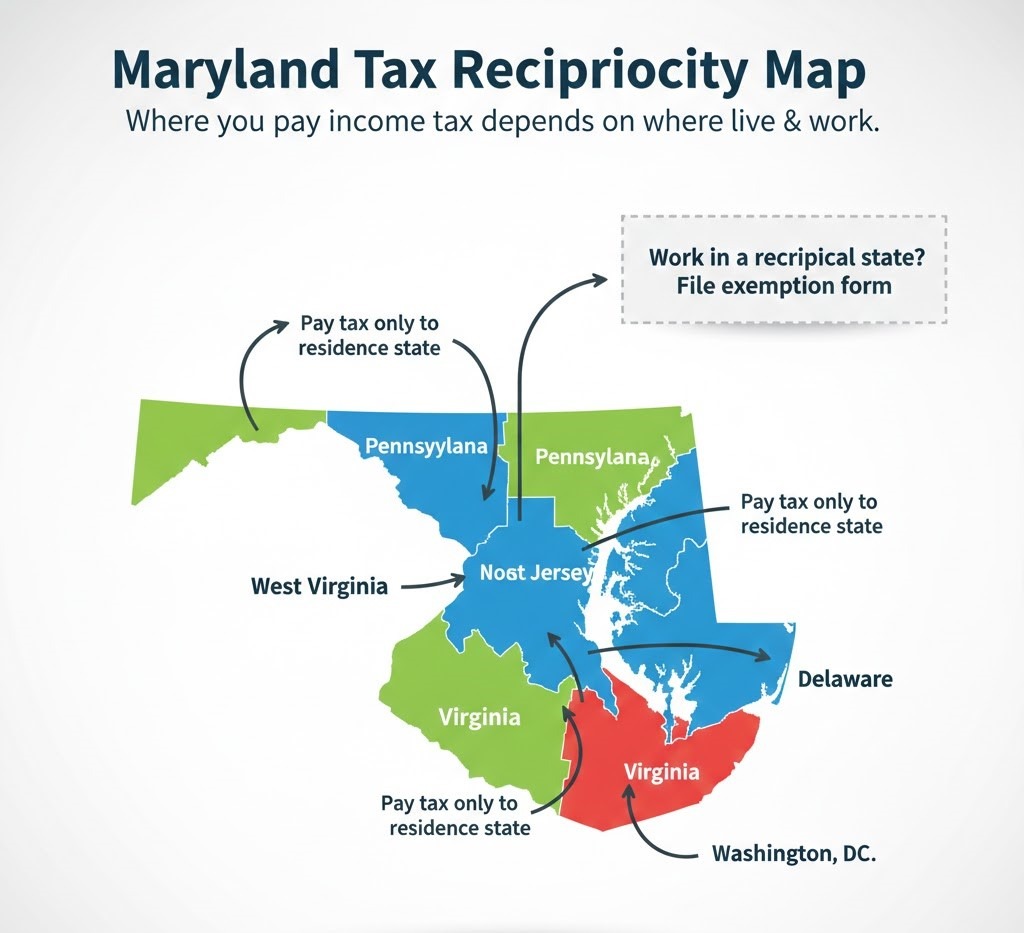
Maryland has reciprocal agreements with:
- Pennsylvania
- Virginia
- West Virginia
- Washington, D.C.
Under these agreements, you pay income tax only to your state of residence, not where you work.
Living in Maryland, Working in Another State
If you work in a state without reciprocity (like Delaware or New Jersey), you’ll pay tax to that state and receive a credit on your Maryland return to avoid double taxation.
Living in Another State, Working in Maryland
You’ll pay Maryland tax as a nonresident on Maryland-sourced income. File Form 505 (nonresident return) and pay the 2.25% nonresident local rate plus applicable state tax.
Nonresident Tax Rate in Maryland
Nonresidents pay a flat 2.25% local income tax instead of the varying county rates that residents pay. You still pay Maryland state income tax at the same progressive rates as residents.
Maryland Employer Withholding Requirements
Maryland employers must withhold state and local income taxes from employee wages. These withholdings are based on the employee’s Form MW507 elections and their county of residence.
Employer Responsibilities:
- Withhold Maryland state income tax based on employee’s filing status and exemptions
- Withhold local county tax based on employee’s county of residence (2.25% to 3.20%)
- For nonresident employees, withhold flat 2.25% local tax
- Remit withheld taxes to the Maryland Comptroller
- File quarterly employer withholding returns (Form MW506)
- Provide annual W-2 forms to employees by January 31
Withholding Tax Payment Schedule:
Employers remit withholding taxes based on their total annual withholding liability:
- Less than $15,000 annually: Monthly payments
- $15,000 to $899,999 annually: Accelerated weekly payments
- $900,000 or more annually: Daily electronic payments
New employers typically start with monthly filing until their withholding history determines their payment frequency.
Maryland Unemployment Insurance (SUI) Tax Rates
Maryland unemployment insurance tax rates for contributory employers range from 0.30% to 7.50% for 2026, with Tax Table A in effect. The specific rate assigned to each employer depends on their benefit ratio and employment history.
Tax Rate Categories:
New Account Rate: Assigned to new employers who don’t qualify for an experience rate, ranging from 1% to 2.6% depending on the year. New employers in construction headquartered outside Maryland receive the average construction industry rate.
Experience Rate: Calculated based on an employer’s benefit charges divided by taxable wages over the three fiscal years prior to the computation date (July 1). Employers become eligible after paying wages in at least two fiscal years.
Standard Rate: The highest rate of 7.50%, assigned when an employer fails to file quarterly tax and wage reports.
Taxable Wage Base:
For Maryland unemployment insurance purposes, taxable wages are defined as the first $8,500 earned by each employee in a calendar year. Once an employee earns more than $8,500 in a year, no additional SUI tax is owed for that employee.
Example SUI Calculation:
- Employee earns $60,000 annually
- Employer’s SUI rate: 2.6% (new account rate)
- SUI tax: $8,500 × 2.6% = $221 per employee
- Total tax liability for 10 employees: $2,210
Experience Rate Notices:
Each January, employers receive an Experience Rate Notice showing their unemployment insurance tax rate for the calendar year. Employers can protest their rate within 30 days through the Maryland Unemployment Insurance Portal (BEACON).
Workers’ Compensation Requirements
Maryland employers must carry workers’ compensation insurance if they have one or more employees, including part-time workers. This requirement protects employees who suffer work-related injuries or illnesses.
Coverage Requirements:
- All employers with at least one employee must have coverage
- Coverage must be in place before the first day of employment
- Household employers need coverage if paying $1,000 or more per quarter
- Independent contractors are generally not covered (though misclassification can create liability)
Penalties for Non-Compliance:
Employers without required workers’ compensation insurance face:
- Stop-work orders
- Criminal penalties up to $10,000 in fines
- Up to one year imprisonment
- Personal liability for injured worker’s medical costs and lost wages
Workers’ compensation premiums are calculated based on payroll, job classification codes, and the employer’s claims history. Rates vary by industry and risk level.
Maryland New Hire Reporting
Maryland employers must report new hires within 20 days of their hire date to the Maryland State Directory of New Hires. This requirement helps locate parents for child support enforcement and prevents improper unemployment and workers’ compensation payments.
Required Information:
- Employee’s name, address, and Social Security number
- Employer’s name, address, and Federal Employer Identification Number (FEIN)
- Employee’s first day of work
Employers can report online through the Maryland New Hire Registry, by fax, or by mail. Multi-state employers may designate one state for all reporting.
Payroll Stub Requirements
Maryland employers must provide employees with a wage statement (pay stub) for each pay period showing:
- Gross wages earned
- All deductions (federal tax, state tax, local tax, FICA, benefits, etc.)
- Net wages paid
- Pay period dates
- Number of hours worked (for hourly employees)
For tipped employees using the tip credit, the wage statement must show the employee’s effective hourly rate including employer-paid cash wages plus tips for each workweek.
Wage statements can be provided electronically if the employee has access to a printer or can retain electronic copies. Paper statements are required if requested by the employee.
Final Paycheck Rules in Maryland
When employment ends, wages for work performed before termination are due on or before the regular payday for that employee. Maryland doesn’t distinguish between voluntary resignation and involuntary termination for final paycheck timing.
Key Points:
- Final pay must include all earned wages through the last day worked
- Unused vacation time must be paid if company policy or contract requires it
- Maryland doesn’t require payment for accrued but unused sick leave unless specified in policy
- Employers can’t withhold final pay for unreturned equipment without employee authorization
- Employees who give notice aren’t entitled to work or be paid during the notice period unless the employer agrees
Example: If regular payday is every other Friday and an employee’s last day is Tuesday, January 7, the final paycheck is due on the next regular payday (Friday, January 10), assuming that Friday covers the pay period including January 7.
Required Time Off and Leave Policies
Maryland has several leave requirements that employers must understand when calculating total compensation and employment costs.
Maryland Minimum Wage
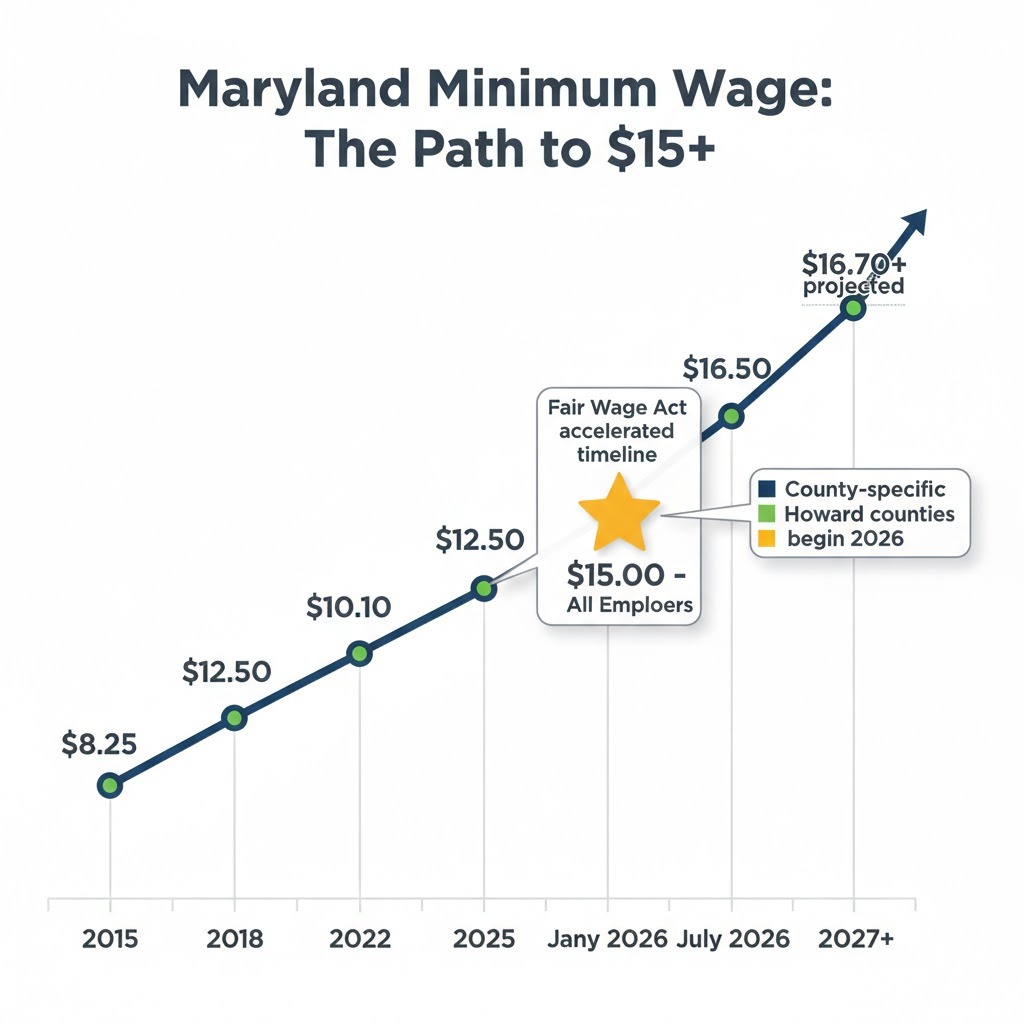
Maryland’s minimum wage is $15.00 per hour for all employers as of January 1, 2025. However, the rate will increase to $15.50 on January 1, 2026, and to $16.00 on July 1, 2026 for counties like Montgomery and Howard.
Special Rates:
- Tipped employees: $3.63 per hour minimum cash wage (tips must bring total to minimum wage)
- Youth under 18: 85% of minimum wage ($12.75/hour through December 31, 2025)
- Heightened security locations: $16.00 per hour minimum
Maryland Overtime Pay
Maryland generally follows the federal FLSA for overtime, requiring non-exempt employees to receive 1.5 times their regular rate for all hours worked over 40 in a workweek.
Industry-Specific Overtime Thresholds:
Bowling establishments and care institutions (excluding hospitals) that offer on-site services must pay overtime only after 48 hours of work per week
Agricultural workers see the overtime threshold extended to 60 hours per week
Overtime Exemptions:
Common overtime-exempt positions include:
- Executive, administrative, and professional employees meeting salary and duties tests
- Outside salespeople
- Certain commissioned retail employees
- Computer professionals earning above the salary threshold
- Independent contractors
Maryland doesn’t recognize the federal “highly compensated employee” exemption, meaning some employees exempt under federal law may still qualify for overtime under state law.
Maryland Cost of Living and Salary Insights
Average Salary in Maryland
The average annual salary in Maryland is $61,849 as of late 2025. This translates to approximately $29.74 per hour for full-time work, or $1,189.40 per week.
Salary Distribution:
Most salaries in Maryland range between $43,500 (25th percentile) to $79,150 (75th percentile) annually. This wide range reflects Maryland’s diverse economy, from service sector jobs to high-paying government, technology, and healthcare positions.
Maryland Median Household Income
Maryland had the third highest median household income among states, with a median household income of $102,905 in 2024. This is significantly higher than the national median, reflecting the state’s proximity to Washington D.C. and concentration of federal employees, contractors, and professional services.
Income by Household Type:
The median income for single person households in Maryland is $54,396
The median salary for full-time workers in Maryland is $73,141
The median family income for Maryland is $124,487
Living Wage Calculator for Maryland
The living wage is the hourly rate that an individual must earn to support themselves and their family, working full-time or 2,080 hours per year. Living wage calculations consider typical expenses including food, housing, transportation, healthcare, and other necessities.
Living Wage vs. Minimum Wage:
The living wage in Maryland varies significantly by household composition and county. For example:
- Single adult: approximately $18-$22/hour
- Single adult with one child: approximately $32-$38/hour
- Two working adults with two children: approximately $22-$26/hour per adult
These rates exceed Maryland’s $15.00 minimum wage, highlighting the gap between minimum wage and the true cost of living in the state.
Maryland Salary by City/County
Baltimore:
Baltimore salaries vary widely, with some of the highest-paying positions in healthcare, government, and education. The city’s cost of living is moderate compared to suburban Maryland counties.
Montgomery County:
Montgomery County has some of the highest salaries and living costs in Maryland. The county’s proximity to Washington D.C. and concentration of federal contractors, biotech companies, and professional services firms drive higher wage levels. The county’s local tax rate of 3.20% is among the highest in the state.
Prince George’s County:
Prince George’s County salaries reflect its mix of government employees, healthcare workers, and service industry positions. The county shares Montgomery County’s 3.20% local tax rate.
High-Paying Cities:
Fort Meade has the highest average salary in Maryland at $103,406 annually, followed by Linthicum at $83,771. Fort Meade’s high salaries reflect the concentration of federal cybersecurity and defense contractors near Fort George G. Meade military installation.
Comparing Your Maryland Salary to National Averages
Maryland salaries consistently rank among the highest in the nation due to:
- High concentration of federal government employees and contractors
- Proximity to Washington D.C.
- Strong education and healthcare sectors
- Biotech and technology industries
- High cost of living requiring higher wages
When converting hourly wages to annual salary in Maryland, consider that equivalent positions in other states may pay less but also have lower living costs and tax burdens.
Adjusting Your Tax Withholdings
Review your Form W-4 and MW507 annually to ensure accurate withholding. Life changes like marriage, divorce, having children, or buying a home may warrant withholding adjustments.
Avoid Over-Withholding:
If you consistently receive large tax refunds, you’re essentially giving the government an interest-free loan. Reduce your withholding to keep more money in each paycheck.
Avoid Under-Withholding:
Owing significant taxes at year-end can create financial strain and may result in penalties. If you have additional income sources (side business, investments, rental property), increase withholding or make quarterly estimated tax payments.
Taking Advantage of Pre-Tax Benefits
Maximize pre-tax contributions to reduce taxable income:
Retirement Accounts: Contribute the maximum to your 401(k) or 403(b) ($23,500 in 2026, plus $7,500 catch-up if 50+). Traditional IRA contributions may also be deductible.
HSA Contributions: If you have a high-deductible health plan, max out HSA contributions ($4,300 individual, $8,550 family in 2026). HSA funds roll over year to year and can be invested for retirement.
FSA Contributions: Use healthcare FSA ($3,300 limit) and dependent care FSA ($5,000 limit) to pay for eligible expenses with pre-tax dollars.
Example Tax Savings:
If you earn $75,000 in Maryland (Montgomery County) and contribute $10,000 to your 401(k):
- Federal tax savings: ~$2,200 (22% bracket)
- Maryland state tax: ~$575 (5.75%)
- Local tax: $320 (3.20%)
- Total annual savings: ~$3,095
Planning for Tax Season
Throughout the Year:
- Keep records of deductible expenses (mortgage interest, property taxes, charitable donations)
- Track mileage if you use your vehicle for business
- Save receipts for work-related expenses not reimbursed by your employer
- Review pay stubs regularly to ensure accurate withholding
Tax Credits and Deductions:
Maryland offers several tax credits including:
- Earned Income Tax Credit (EITC)
- Child and Dependent Care Credit
- Homeowners’ Property Tax Credit
- Student loan debt relief tax credit (for certain occupations)
Understanding Pay Raises and Promotions
When you receive a raise, your take-home pay increase will be less than the gross increase due to taxes.
Example:
$20/hour to $22/hour raise ($2/hour = $4,160 annually for full-time work):
- Federal tax (22%): -$915
- Maryland state (5.75%): -$239
- Local tax (3.20%): -$133
- FICA (7.65%): -$318
- Net increase: ~$2,555 ($1.23/hour)
Understanding this tax impact helps set realistic expectations for salary negotiations and budgeting.
Additional Maryland Resources
Maryland Department of Labor Resources
Division of Unemployment Insurance:
- BEACON portal for employer tax filing
- Unemployment insurance information
- New hire reporting
- Website: labor.maryland.gov
Employment Standards Service:
- Minimum wage information
- Wage and hour laws
- Poster requirements
- Complaint filing
- Phone: 410-767-2357
Maryland Comptroller Tax Information
Individual Income Tax:
- Tax forms and instructions
- Withholding tax information
- Form MW507 (employee withholding)
- Online filing services
- Website: marylandtaxes.gov
Employer Withholding:
- Employer registration
- Quarterly withholding returns
- Payment schedules
- Combined Registration Application
Maryland Wage and Hour Laws
Maryland wage laws cover:
- Minimum wage requirements
- Overtime regulations
- Payment of wages timing
- Deductions from wages
- Final paycheck requirements
- Pay stub requirements
Access the complete Maryland wage and hour laws at Labor and Employment Code Title 3.
Maryland Employment Forms and Documents
Essential Forms:
- Form MW507: Employee’s Maryland Withholding Exemption Certificate
- Form MW508: Maryland Withholding Exemption Certificate (for nonresidents)
- Form MW506: Employer’s Quarterly Withholding Tax Return
- Federal Form W-4: Employee’s Withholding Certificate
- Form I-9: Employment Eligibility Verification
Latest Maryland Payroll and Tax Insights
2026 Maryland Tax Law Changes
Several important changes affect Maryland payroll in 2026:
Minimum Wage Increases: The minimum wage will increase to $15.50 on January 1, 2026, and to $16.00 on July 1, 2026 in certain counties including Montgomery and Howard.
Unemployment Tax Table: Tax Table A remains in effect for 2026, maintaining the lowest SUI rates (0.30% to 7.50%) for Maryland employers.
FAMLI Implementation: Maryland’s Family and Medical Leave Insurance (FAMLI) program launches in 2026, with employee payroll tax collections beginning July 1, 2025. The employee contribution rate is 0.45% of wages up to the Social Security wage base.
Maryland Minimum Wage Updates
Maryland’s minimum wage has increased significantly in recent years as part of a multi-year phase-in to $15.00 per hour. The Fair Wage Act accelerated these increases, bringing all employers to the $15.00 rate by January 1, 2025.
Historical Context:
- 2015: $8.25
- 2018: $10.10
- 2022: $12.50 (large employers)
- 2025: $15.00 (all employers)
- 2026: $15.50-$16.00 (select counties)
Recent Maryland Employment Legislation
Maryland RELIEF Act (2021): Provided temporary relief during the pandemic by allowing employers to choose between pre-pandemic and current experience for calculating unemployment tax rates. This provision expired for 2025 tax year calculations.
PORT Act (2024): The Protecting Opportunities and Regional Trade Act specified that unemployment benefit charges related to the Francis Scott Key Bridge collapse will not impact an employer’s 2025 tax rate.
Fair Wage Act (2023): Accelerated the minimum wage schedule, bringing all employers to $15.00 per hour by 2024 instead of the original 2025 (large employers) and 2026 (small employers) timeline.
Maryland Payroll Processing Guide
Best Practices for Maryland Employers:
- Registration: Register with Maryland Comptroller for withholding tax and Maryland Department of Labor for unemployment insurance before hiring employees.
- Classification: Properly classify workers as employees or independent contractors. Misclassification can result in back taxes, penalties, and legal liability.
- Timekeeping: Maintain accurate records of hours worked for at least three years, as required by Maryland wage and hour law.
- Tax Deposits: Remit withholding taxes according to your payment schedule (daily, weekly, or monthly) to avoid penalties.
- Quarterly Returns: File Form MW506 quarterly to report withholding taxes and file unemployment insurance contribution reports through BEACON.
- Annual Reporting: Provide W-2 forms to employees by January 31 and file W-2s with Social Security Administration.
- Poster Compliance: Display required labor law posters in a conspicuous location accessible to all employees.
Why Use Our Hourly to Salary Calculator Maryland?
Accurate Financial Planning
Converting your hourly wage to an annual salary helps you budget effectively, evaluate job offers, and plan for major expenses. Understanding your gross annual income and estimated take-home pay allows you to make informed financial decisions about housing, transportation, savings, and lifestyle choices.
Time-Saving and Easy to Use
Manual calculations require tracking multiple tax rates, deductions, and pay periods. Our calculator instantly provides accurate results, saving you time and reducing the risk of calculation errors.
Up-to-Date with 2026 Tax Laws
Tax rates, brackets, and wage bases change annually. Our calculator reflects current Maryland state and local tax rates, federal tax brackets, FICA rates, and the 2026 Social Security wage base to ensure accurate calculations.
Comprehensive Breakdown of All Deductions
See exactly how federal income tax, Maryland state tax, local county tax, Social Security, and Medicare affect your paycheck. Understanding where your money goes helps you make strategic decisions about withholding adjustments and pre-tax benefit contributions.
Free and No Registration Required
Access professional-grade paycheck calculations without creating an account, providing personal information, or paying fees. Calculate as many scenarios as needed to compare different hourly rates, counties, and filing statuses.
Ready to convert your hourly wage to annual salary? Use our hourly to salary calculator Maryland above to see your gross annual income and estimated take-home pay after all taxes and deductions. Whether you’re evaluating a new job offer, planning a career change, or simply want to understand your earnings better, our calculator provides the accurate, comprehensive information you need to make confident financial decisions in Maryland.