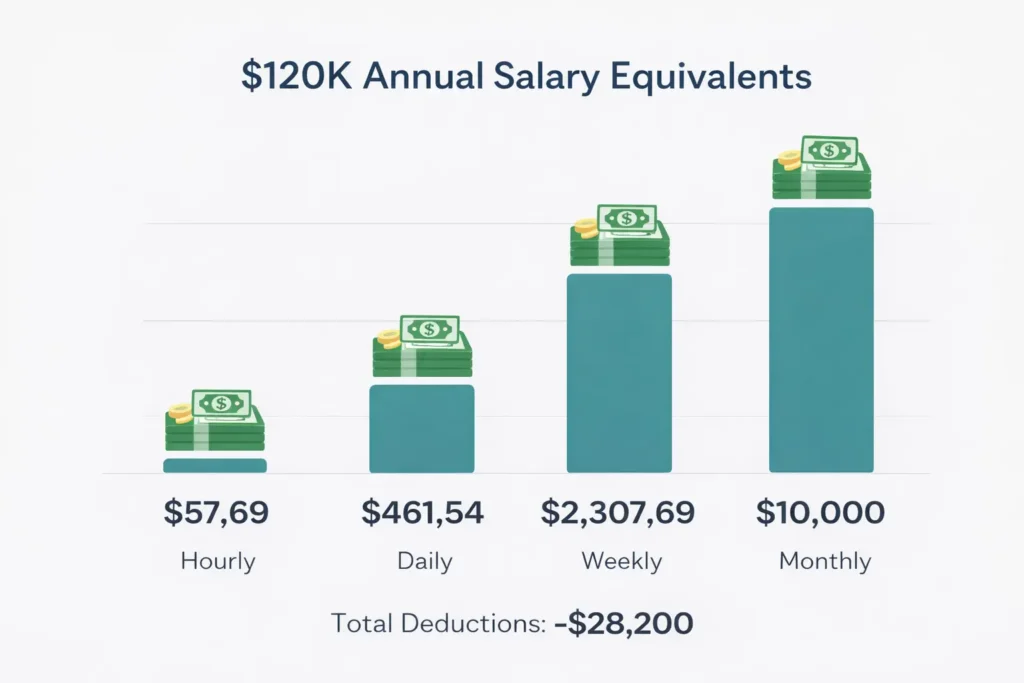
You earn $120,000 per year and need to know your hourly rate. The standard calculation gives you $57.69 per hour based on 2,080 working Texas hours annually. However, this number changes based on your vacation time, work schedule, and tax situation. This guide breaks down every calculation method, shows your real take-home pay, and helps you understand what a 120k salary hourly truly means for your financial future.
Whether you’re comparing job offers, negotiating compensation, or planning your budget, knowing your exact hourly wage matters. We’ll show you the math behind every scenario and give you the tools to make smart career decisions.
Quick Answer: $120,000 Salary Converted to Hourly Rate
Your annual salary of $120,000 converts to different hourly salary calculator rates depending on how you calculate it:
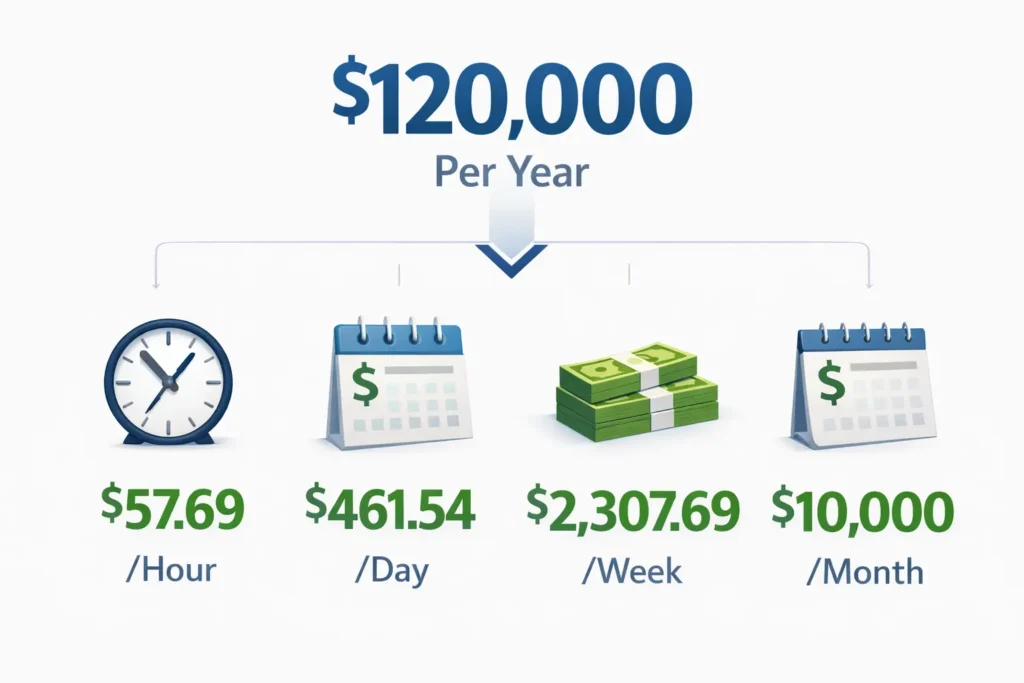
Standard Calculation (52 weeks):
- Total hours: 2,080 (52 weeks × 40 hours)
- Hourly rate: $57.69
- Best for: Salaried employees with paid vacation
With 2 Weeks Unpaid Vacation:
- Total hours: 2,000 (50 weeks × 40 hours)
- Hourly rate: $60.00
- Best for: Contract workers or employees without PTO
After Federal Taxes:
- Gross pay: $57.69/hour
- Net pay: $48.82/hour
- Tax rate: 15.38% effective
| Calculation Method | Hours Per Year | Hourly Rate |
|---|---|---|
| Standard full-time | 2,080 | $57.69 |
| With 2 weeks’ unpaid | 2,000 | $60.00 |
| With 3 weeks unpaid | 1,960 | $61.22 |
| With 4 weeks of unpaid | 1,920 | $62.50 |
| After federal taxes | 2,080 | $48.82 |
The median salary in America sits at $77,719 according to the U.S. Bureau of Labor Statistics. Your $120,000 puts you 54% above this benchmark, placing you in the top 25% of earners nationwide.
How to Calculate 120k to Hourly (Step-by-Step Formula)
Converting 120k to hourly requires simple division, but the hours you divide by change everything.
Standard Calculation Method
Take your yearly salary and divide by total working hours:
Formula: $120,000 ÷ 2,080 hours = $57.69/hour
Here’s the breakdown:
- 52 weeks in a year
- 40 hours per week (standard work week)
- 52 × 40 = 2,080 total hours
Use this method when your employer pays you for all 52 weeks, including paid holidays, sick days, and vacation. Most full-time positions with benefits packages fall into this category.
Alternative Calculation Methods
The 50-Week Method works better for independent contractors:
$120,000 ÷ 2,000 hours = $60.00/hour
This assumes two weeks of unpaid time off. Many freelancers and 1099 contractors use this calculation because they don’t get paid vacation.
The Actual Working Days Method gives the most precise number for 2026:
- Total days in 2026: 365
- Weekend days: 104
- Weekdays: 261
- Federal holidays: 11
- Actual working days: 250
Calculation: 250 days × 8 hours = 2,000 hours Result: $120,000 ÷ 2,000 = $60.00/hour
This method accounts for every federal holiday your company observes, from New Year’s Day to Christmas.
Part-Time Equivalent Calculations
Want to know what 120k to hourly looks like at 30 hours per week?
- 30 hours × 52 weeks = 1,560 hours
- $120,000 ÷ 1,560 = $76.92/hour
For a 20-hour work week:
- 20 hours × 52 weeks = 1,040 hours
- $120,000 ÷ 1,040 = $115.38/hour
These calculations help you understand prorated salaries or part-time positions that claim “$120k equivalent.”
What is the Hourly Rate for 120,000 a Year? (All Scenarios)
The hourly rate for 120,000 a year depends entirely on your employment situation. Let’s break down every scenario.
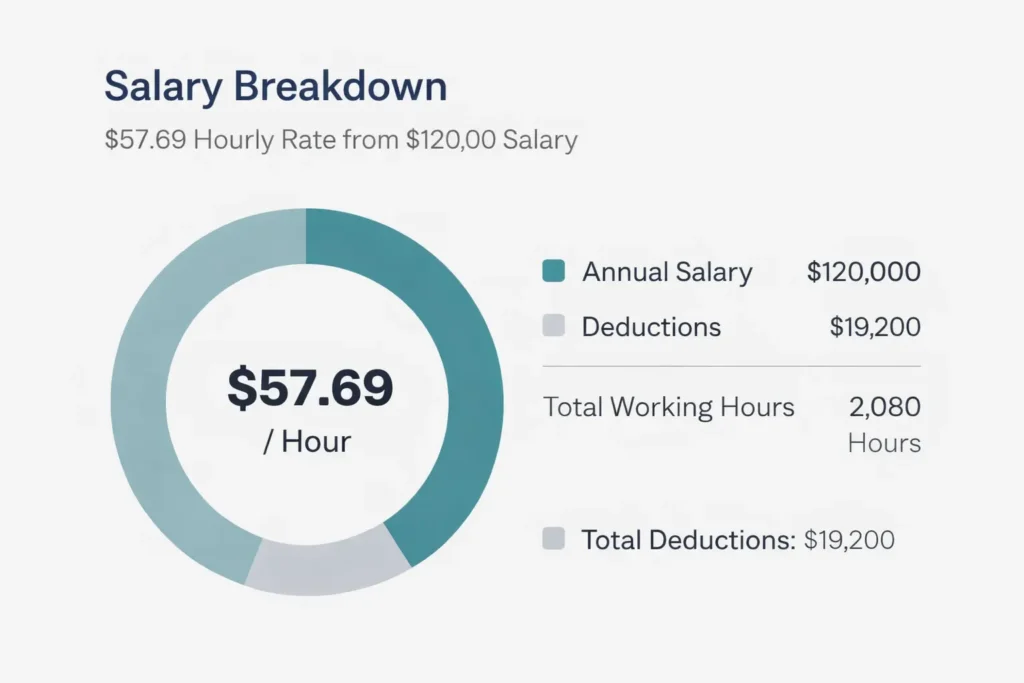
Scenario 1: Full-Time Employee with Paid Benefits
You work for a company offering comprehensive benefits:
Your numbers:
- Base calculation: $57.69/hour
- Paid holidays: 11 days
- PTO: 15 days
- Sick days: 5 days
- Total paid non-working days: 31 days
Even though you don’t work those 31 days, your employer pays you. Your effective rate stays at $57.69/hour across all 2,080 hours because your annual salary doesn’t change.
Total compensation value adds more:
- Health insurance employer contribution: $8,000/year
- 401(k) matching (5%): $6,000/year
- Life insurance: $500/year
- Total benefits: $14,500/year
Real compensation: $134,500 ÷ 2,080 = $64.66/hour
Scenario 2: Full-Time Employee Without Paid Time Off
You receive $120,000 but don’t get paid vacation:
- Work weeks: 50 (minus 2 unpaid weeks)
- Total hours: 2,000
- Hourly wage: $60.00
Your employer might offer unpaid time off, but those weeks don’t count toward your yearly salary. The calculation excludes any time you don’t receive payment.
With three weeks unpaid:
- Work weeks: 49
- Total hours: 1,960
- Hourly rate: $61.22
With four weeks unpaid:
- Work weeks: 48
- Total hours: 1,920
- Hourly rate: $62.50
Scenario 3: Independent Contractor or Freelancer
Contractors and freelancers need higher rates to match W2 employee compensation:
Your costs as a contractor:
- Self-employment tax (15.3%): $18,360
- Health insurance (no employer subsidy): $8,000
- No 401(k) matching: $6,000 opportunity cost
- No paid vacation: Must account for unpaid time
- Business expenses: $3,000-5,000
To net $120,000 equivalent, you need:
- Base rate needed: $72.00-75.00/hour
- Working hours: 2,000 (50 weeks)
- Gross income target: $144,000-150,000
The Federal Trade Commission notes that independent contractors must cover their own FICA taxes, Medicare taxes, and Social Security taxes, doubling these costs compared to traditional employees.
Scenario 4: Overtime-Eligible Hourly Position
If you’re a non-exempt hourly employee earning the equivalent of $120,000:
Regular hours (40/week):
- Base rate: $57.69/hour
- Annual from base: $120,000
With overtime (time and a half):
- Overtime pay: $86.54/hour
- 5 hours weekly overtime: $22,465/year extra
- Total annual: $142,465
With double time (weekends/holidays):
- Double time rate: $115.38/hour
- 2 Sundays monthly: $22,060/year extra
- Total annual: $142,060
The Fair Labor Standards Act requires overtime pay at 1.5× your regular rate for hours beyond 40 per week, unless you’re an exempt salaried employee.
$120k Salary Breakdown – All Time Periods
Understanding your 120k salary hourly rate helps, but you need to see every time period for effective budgeting.
| Time Period | Gross Amount | After Tax (15.38%) | After Tax + FICA (22.65%) |
|---|---|---|---|
| Yearly | $120,000 | $101,541 | $92,820 |
| Monthly | $10,000 | $8,462 | $7,735 |
| Biweekly | $4,615 | $3,906 | $3,570 |
| Weekly | $2,308 | $1,953 | $1,785 |
| Daily | $462 | $391 | $357 |
| Hourly | $57.69 | $48.82 | $44.63 |
Monthly Salary from $120k
Your gross pay hits $10,000 every month. This clean number makes budget planning simple:
Recommended allocation (50/30/20 rule):
- Needs (50%): $5,000 for housing, utilities, groceries, transportation
- Wants (30%): $3,000 for dining, entertainment, hobbies, travel
- Savings (20%): $2,000 for emergency fund, retirement, investments
After federal taxes, you take home $8,462 monthly. After FICA taxes, too, expect $7,735.
Housing affordability follows the 28% rule:
- Maximum housing cost: $2,800/month
- Includes mortgage/rent, insurance, property tax, HOA fees
- Keeps you financially stable
Biweekly Salary from $120k
Most companies pay every two weeks, giving you 26 paychecks annually:
$120,000 ÷ 26 = $4,615 per paycheck (gross)
After withholdings:
- Federal tax: $709
- FICA taxes: $353
- Net paycheck: $3,553
Two months each year give you three paychecks instead of two. Use these “extra” checks for:
- Debt payoff
- Emergency fund building
- Annual expenses (insurance, property tax)
- Investment contributions
Semi-monthly pay (24 checks) differs:
- $120,000 ÷ 24 = $5,000 per paycheck
- Higher individual amounts
- Easier monthly budget alignment
Weekly Salary from $120k
Breaking down to weekly helps with short-term planning:
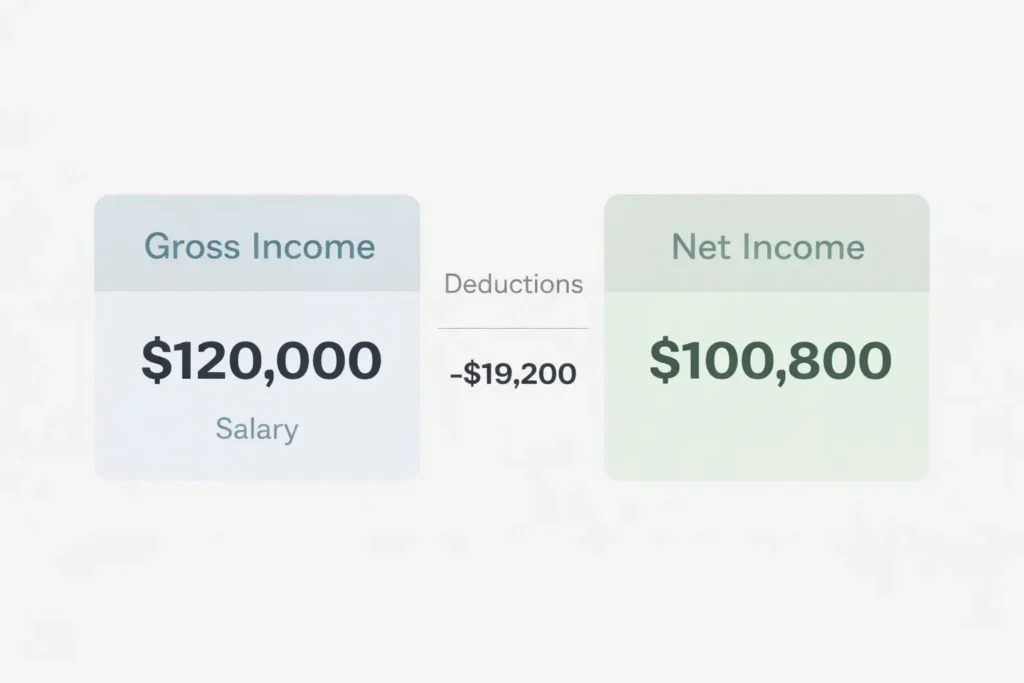
Gross weekly: $2,308 Net weekly (after all taxes): $1,785
This weekly take-home pay covers:
- Groceries: $250-300
- Gas: $60-80
- Dining out: $150-200
- Entertainment: $100-150
- Savings: $400-500
- Remaining for monthly bills
Daily Salary from $120k
Your daily rate based on 260 working days (excluding weekends):
Gross daily: $462 Net daily: $357
This perspective helps you value:
- Sick days: Each costs you $462 in unpaid scenarios
- Vacation days: Worth $462 each
- Work from home savings: Gas, lunch, coffee add up to $30-40 daily
After-Tax Hourly Rate: What You Actually Take Home
Your gross pay of $57.69/hour looks great on paper. Your net pay tells the real story.
Federal Tax Breakdown
The IRS taxes your $120,000 through progressive brackets for 2026:
Tax brackets (single filer):
- 10% on first $11,600: $1,160
- 12% on $11,601-$47,150: $4,266
- 22% on $47,151-$100,525: $11,742
- 24% on $100,526-$120,000: $4,674
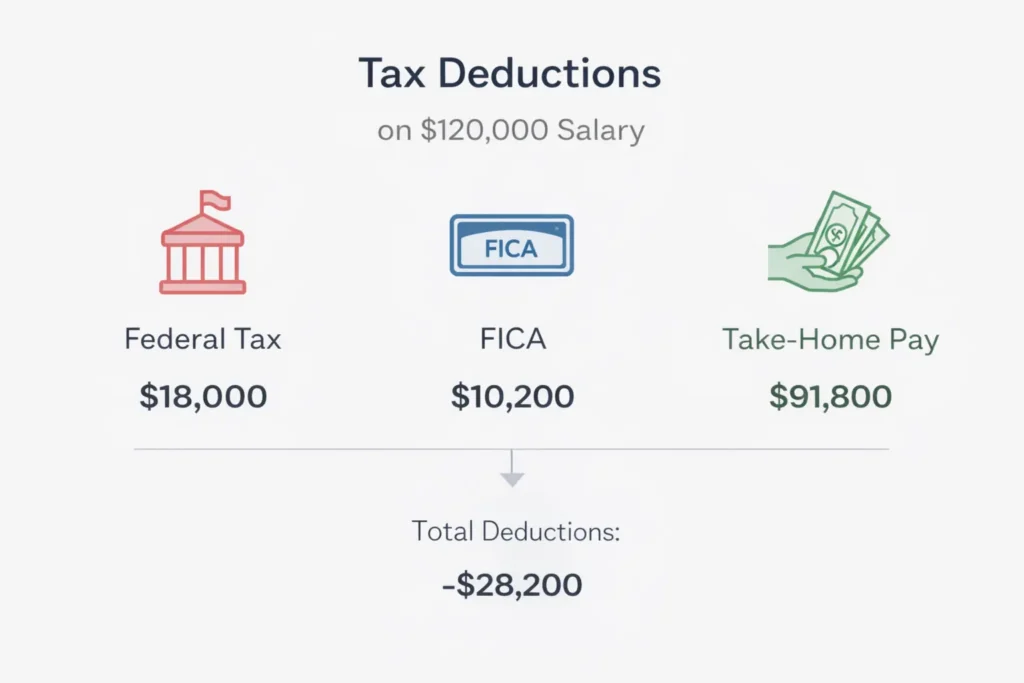
Total federal taxes: $21,842. Effective tax rate: 18.20% After-tax income: $98,158 After-tax hourly: $47.19
The Tax Foundation reports that median income households pay an effective tax rate of 13.5%, making the $120k rate about 35% higher.
State Tax Considerations
Your location dramatically changes take-home pay:
No income tax states (0% state tax):
- Alaska, Florida, Nevada, South Dakota, Tennessee, Texas, Washington, Wyoming
- After-tax hourly: $47.19 (federal only)
Low tax states (1-5% rate):
- North Dakota, Pennsylvania, Indiana, Ohio, Michigan
- After-tax hourly: $44.50-46.00
High tax states (8-13% rate):
- California (9.3% on $120k): After-tax hourly $42.83
- New York (6.85% on $120k): After-tax hourly $43.95
- Hawaii (8.25% on $120k): After-tax hourly $43.43
California calculation:
- Federal: $21,842
- State: $11,160
- Total taxes: $32,002
- Net annual: $88,998
- Net hourly: $42.78
Moving from California to Texas saves you $11,160 annually—that’s $5.37/hour more in your pocket.
FICA and Additional Deductions
Social Security tax (6.2%):
- $120,000 × 6.2% = $7,440
- Maxes out at $160,200 of income
Medicare tax (1.45%):
- $120,000 × 1.45% = $1,740
- No income limit
Total FICA taxes: $9,180 FICA hourly cost: $4.41
Complete deduction breakdown:
| Deduction Type | Annual Amount | Hourly Cost |
|---|---|---|
| Federal income tax | $21,842 | $10.50 |
| State tax (5% avg) | $6,000 | $2.88 |
| Social Security | $7,440 | $3.58 |
| Medicare | $1,740 | $0.84 |
| Total deductions | $37,022 | $17.80 |
| Net income | $82,978 | $39.89 |
Add health insurance premiums ($3,600/year employee share) and 401(k) contributions ($12,000 for 10%), and your net hourly drops to $32.38.
Real take-home after all common deductions: $67,378 annually or $32.39/hour.
Is $120,000 a Year Good Pay? (Context & Comparisons)
Numbers without context mean nothing. Let’s compare your $120,000 to national benchmarks.
How $120k Compares to National Averages
U.S. median salary (2024 data): $77,719
Your advantage: +$42,281 or 54% higher
You earn more than approximately 75% of American workers. The Social Security Administration shows that only 25% of wage earners cross the $100,000 threshold.
Median household income: $68,700
Your individual income exceeds what most entire households earn. This puts you ahead of 70% of American households.
Top income thresholds:
- Top 25%: $85,000+ (you’re here)
- Top 10%: $134,000 (close—you’re at 89th percentile)
- Top 5%: $175,000
- Top 1%: $500,000+
Cost of Living Adjustments by City
Your purchasing power changes drastically by location:
High-cost cities (where $120k feels like less):
| City | Equivalent Value | Purchasing Power Loss |
|---|---|---|
| San Francisco | $62,000 | -48% |
| New York City | $68,000 | -43% |
| Los Angeles | $72,000 | -40% |
| Seattle | $78,000 | -35% |
| Boston | $80,000 | -33% |
In San Francisco, your $120,000 buys what $62,000 buys in an average American city. Housing costs consume 50-60% of after-tax income instead of the recommended 28%.
Medium-cost cities (where $120k is comfortable):
| City | Equivalent Value | Purchasing Power Gain |
|---|---|---|
| Austin | $105,000 | -12% |
| Denver | $102,000 | -15% |
| Portland | $100,000 | -17% |
| Atlanta | $108,000 | -10% |
| Phoenix | $110,000 | -8% |
Low-cost cities (where $120k goes far):
| City | Equivalent Value | Purchasing Power Gain |
|---|---|---|
| Nashville | $140,000 | +17% |
| Indianapolis | $152,000 | +27% |
| Oklahoma City | $160,000 | +33% |
| Memphis | $165,000 | +38% |
| Wichita | $172,000 | +43% |
The Council for Community and Economic Research tracks cost-of-living indices quarterly. Housing costs vary by 300% between the most and least expensive metros.
Industry Salary Benchmarks
Your $120k position varies from entry-level to executive, depending on the industry:
Technology (data from Glassdoor 2025):
- Junior software engineer: $95,000-110,000 (you’re above entry)
- Mid-level developer: $120,000-145,000 (you’re at the floor)
- Senior engineer: $150,000-190,000
- Staff engineer: $180,000-230,000
Healthcare:
- Registered nurse: $75,000-90,000 (you’re 40% higher)
- Nurse practitioner: $110,000-130,000 (you’re mid-range)
- Healthcare administrator: $95,000-125,000 (you’re high-end)
- Physician assistant: $115,000-140,000 (you’re entry-level)
Finance:
- Financial analyst: $70,000-95,000 (you’re 30% above)
- Senior analyst: $100,000-130,000 (you’re mid-range)
- Finance manager: $115,000-145,000 (you’re entry-level)
- Director of finance: $140,000-180,000
Education:
- Teacher: $45,000-65,000 (you earn 100% more)
- Principal: $95,000-125,000 (you’re high-end)
- Superintendent: $140,000-220,000
- University professor: $80,000-140,000 (you’re above average)
Marketing:
- Marketing coordinator: $50,000-65,000
- Marketing manager: $85,000-110,000 (you’re 15% above)
- Senior marketing manager: $110,000-140,000 (your entry to mid)
- Director of marketing: $130,000-175,000
The Bureau of Labor Statistics tracks median salaries across 800+ occupations. Your $120,000 places you in the top 15-25% across most professional fields.
2026 Working Days & Precise Calculations
Generic calculations miss important details. Let’s get precise for 2026.
Actual Working Days in 2026
Calendar breakdown:
- Total days: 365
- Weekends (Saturday/Sunday): 104 days
- Weekdays (Monday-Friday): 261 days
Federal holidays in 2026 (11 total):
- New Year’s Day: Thursday, January 1
- Martin Luther King Jr. Day: Monday, January 19
- Presidents’ Day: Monday, February 16
- Memorial Day: Monday, May 25
- Independence Day: Saturday, July 4 (observed Friday, July 3)
- Labor Day: Monday, September 7
- Columbus Day: Monday, October 12
- Veterans Day: Wednesday, November 11
- Thanksgiving: Thursday, November 26
- Day after Thanksgiving: Friday, November 27
- Christmas: Friday, December 25
Holidays falling on weekdays: 10 Holidays observed on weekdays: 11 (July 4th observed July 3rd)
Real working days: 261 weekdays – 11 holidays = 250 days
Most Accurate 2026 Hourly Calculation
Using actual working days:
250 days × 8 hours = 2,000 hours $120,000 ÷ 2,000 = $60.00/hour
This calculation beats the standard 2,080-hour method for W2 employees who receive paid holidays. You work 250 days but get paid for 260 weekdays (including holidays).
Effective hourly (paid for 260 days, work 250 days): 260 days × 8 hours = 2,080 hours $120,000 ÷ 2,080 = $57.69/hour
The difference: When you don’t work holidays but still get paid, your effective rate drops to $57.69 even though you earn $60/hour on days you actually work.
PTO and Sick Day Impact
Most employers offer additional time off:
Typical PTO package:
- Vacation days: 10-15 days
- Sick days: 5-7 days
- Personal days: 2-3 days
- Total: 17-25 days
Adjusted working days: 250 standard working days – 20 average PTO days = 230 actual workdays
230 days × 8 hours = 1,840 hours worked $120,000 ÷ 1,840 = $65.22/hour (effective rate when working)
You still receive $120,000 annually, but you only work 1,840 hours. Your hourly wage during actual work hours rises to $65.22, though your annual salary stays fixed.
Comparing Salary vs Hourly Employment
Should you take a salaried $120k position or an hourly equivalent? The math reveals surprising differences.
Benefits of a Salaried Position at $120k
Guaranteed income stability:
- Same paycheck regardless of hours worked
- No income loss during slow periods
- Predictable monthly budget
- No tracking hours or timesheets
Comprehensive benefits packages:
- Health insurance (employer pays 70-80%): $6,400-8,000 value
- Dental and vision: $800-1,200 value
- 401(k) matching (average 4.7%): $5,640 value
- Life insurance: $300-500 value
- Disability insurance: $400-600 value
- Total benefits value: $13,500-16,000 annually
Paid time off included:
- Vacation: $4,615-6,923 (10-15 days)
- Sick days: $2,308-3,231 (5-7 days)
- Federal holidays: $5,077 (11 days)
- Total PTO value: $12,000-15,231
Career advancement opportunities:
- Promotion paths clearer in salaried roles
- Professional development budgets
- Networking opportunities
- Leadership training access
Total compensation for salaried $120k position:
- Base: $120,000
- Benefits: $14,500
- PTO: $13,500
- Total value: $148,000
- Effective hourly: $71.15
Equivalent Hourly Position Requirements
To match a $120k salaried position’s total value, your hourly rate must compensate for missing benefits:
Benefits you must self-fund:
- Health insurance (individual plan): $7,200-9,600
- Retirement (no match, need 10% savings): $12,000
- No paid vacation (20 days): $9,600 lost income
- No paid holidays (11 days): $5,280 lost income
- Total gap: $34,080
Required hourly rate calculation:
- Target annual: $120,000 base + $34,080 benefits = $154,080
- Working hours: 2,000 (50 weeks)
- Minimum hourly: $77.04
Conservative hourly equivalent: $75.00-80.00/hour
At $75/hour working 2,000 hours:
- Gross income: $150,000
- Self-employment tax (15.3%): -$22,950
- Health insurance: -$8,400
- No 401(k) match: Must save 15% = -$22,500
- Net available: $96,150
Compared to a salaried position:
- $120,000 base
- Employer FICA (7.65%): +$9,180 (they pay this)
- Benefits: +$14,500
- Net equivalent: $143,680
- After personal tax (18%): $117,817
The hourly position needs $80-85/hour to truly match salaried compensation.
Decision Framework
Choose salaried when:
- You value income stability over flexibility
- Benefits packages matter to you (especially with family)
- Career growth opportunities exist
- You prefer not tracking hours
- Company culture fits your style
Choose hourly when:
- Your rate exceeds $80/hour
- You want overtime pay potential
- Flexibility matters more than security
- You’re building a freelance business
- Multiple income streams appeal to you
Hybrid considerations:
- Some companies offer salaried positions with overtime eligibility
- Bonus structures can bridge gaps
- Stock options add significant value
- Professional development budgets matter
Using Your Hourly Rate for Financial Planning
Knowing your $57.69 hourly rate unlocks smarter financial decisions.
Budgeting with Your Hourly Rate
The 50/30/20 rule adapted to $120k:
After-tax monthly (federal only): $8,462
Needs (50%): $4,231
- Housing: $2,100 (25% of gross)
- Utilities: $200
- Groceries: $400
- Transportation: $350
- Insurance: $500
- Minimum debt payments: $681
Wants (30%): $2,539
- Dining out: $500
- Entertainment: $300
- Hobbies: $400
- Shopping: $400
- Subscriptions: $200
- Travel fund: $739
Savings (20%): $1,692
- Emergency fund: $846
- Retirement (beyond employer match): $423
- Investment accounts: $423
An hourly perspective helps spending decisions:
- $200 concert tickets = 3.5 hours of work
- $60,000 car = 1,040 hours of work (6 months)
- $15 daily coffee = 15 minutes of work (60 hours yearly)
- $2,000 vacation = 35 hours of work
This framework reveals whether purchases justify the time investment.
Savings Goals Based on Hourly Rate
Emergency fund target: 6 months expenses = $50,000
At $1,692 monthly savings:
- Timeline: 29.5 months
- Hourly allocation: $10.25/hour to emergency fund
- Weeks of work: 866 hours total
Retirement savings (15% rule):
- Annual target: $18,000
- Monthly: $1,500
- Hourly rate allocated: $8.65
- Assumes employer match covers additional 5%
Home down payment (20% on $400k house):
- Target: $80,000
- Timeline: 3-4 years at $2,000/month
- Hourly allocation: $12.12
- Total work hours: 1,387
The Employee Benefit Research Institute recommends saving 15% of gross income for retirement starting in your 20s-30s.
Lifestyle Affordability at $120k
Housing affordability (28% rule):
- Maximum housing cost: $2,800/month ($33,600/year)
- Equals: 48.5 hours of work monthly
- Comfortable range: $2,000-2,500/month
Home price range:
- 20% down payment saved: $60,000-80,000
- Monthly payment at 7% rate: $2,500
- Home price: $380,000-420,000
- Median home price (Q4 2024): $417,700 (you’re right at market)
Vehicle affordability (10% rule):
- Maximum car payment: $1,000/month
- Total vehicle budget (insurance, gas, maintenance): $1,200/month
- Car price: $40,000-45,000
- Comfortable range: $30,000-35,000
Student loan management:
- Federal recommendation: <10% of gross income
- Maximum comfortable: $1,000/month ($12,000/year)
- At 6% rate, supports: $140,000 loan balance
- Aggressive payoff: $1,500/month clears $100k in 6 years
Discretionary spending power:
- After needs and savings: $2,500-3,000/month
- Annual vacation budget: $6,000-8,000
- Dining and entertainment: $6,000-8,000
- Hobbies and interests: $4,000-6,000
- Shopping and personal: $4,000-6,000
Career Growth: Reaching and Exceeding $120k
Understanding paths to $120k helps you plan career progression.
Industries Where $120k is Standard
Technology sector:
- Software engineer (3-5 years): $110,000-140,000
- Product manager (mid-level): $120,000-155,000
- Data scientist: $115,000-145,000
- DevOps engineer: $120,000-150,000
- UX designer (senior): $110,000-135,000
Healthcare administration:
- Healthcare manager: $105,000-135,000
- Clinical director: $115,000-140,000
- Practice administrator: $100,000-130,000
- Health informatics specialist: $110,000-130,000
Financial services:
- Financial advisor (experienced): $100,000-150,000
- Accounting manager: $100,000-130,000
- Corporate finance analyst (senior): $110,000-140,000
- Risk manager: $105,000-135,000
Sales and business development:
- Sales manager: $90,000 base + $30,000-50,000 commission
- Account executive (enterprise): $80,000 base + $40,000-60,000 commission
- Business development director: $100,000-140,000
Project and program management:
- Senior project manager: $110,000-140,000
- Program manager: $115,000-145,000
- Scrum master (experienced): $100,000-130,000
Skills That Command $120k+
Technical skills:
- Cloud platforms (AWS, Azure, Google Cloud): +$15,000-25,000
- Data analysis (Python, R, SQL): +$10,000-20,000
- Cybersecurity certifications (CISSP, CEH): +$20,000-30,000
- Machine learning and AI: +$25,000-40,000
- Enterprise architecture: +$20,000-35,000
Leadership competencies:
- Team management experience: +$15,000-25,000
- P&L responsibility: +$20,000-35,000
- Strategic planning: +$15,000-25,000
- Change management: +$10,000-20,000
Certifications with ROI:
- PMP (Project Management Professional): +$16,000 average
- CPA (Certified Public Accountant): +$20,000-30,000
- CFA (Chartered Financial Analyst): +$25,000-50,000
- AWS Certified Solutions Architect: +$18,000-28,000
- Six Sigma Black Belt: +$15,000-25,000
The Project Management Institute found that PMP certification holders earn 25% more than non-certified peers.
Timeline to $120k by Career Stage
Entry-level start ($50,000-60,000):
- Years 1-3: Focus on skill building (+$5,000-10,000 yearly)
- Years 4-6: Mid-level promotion (+$10,000-15,000 jump)
- Years 7-9: Senior role (+$15,000-20,000 jump)
- Year 10: Reach the $120,000 mark
Mid-career transition ($80,000-90,000):
- Year 1: Certification or advanced degree (+$5,000-8,000)
- Year 2: Expand responsibilities (+$8,000-12,000)
- Year 3: Promotion or job change to $120,000
Career switcher ($60,000-70,000 in a different field):
Months 1-6: Skills training (bootcamp, certification)
- Months 7-12: Entry at $80,000-90,000
- Years 2-3: Rapid advancement to $100,000-110,000
- Years 4-5: Break $120,000 threshold
Negotiating to $120k Equivalent
Salary negotiation strategies:
Research comparable roles:
- Use Glassdoor, Salary.com, Payscale, and LinkedIn Salary
- Focus on your metro area
- Match experience level exactly
- Document 3-5 data points
Conversation framework: “Based on my research, similar roles in [city] with [X years experience] and [specific skills] range from $115,000-135,000. Given my track record of [specific achievements], I’m targeting $120,000-125,000.”
Converting hourly offers:
- Employer offers: $60/hour contract
- Calculate: $60 × 2,000 hours = $120,000
- Missing benefits: ~$15,000
- Counter: “To match my current total compensation, I need $70-72/hour.”
Equity and bonus considerations:
- Base $110,000 + 10% bonus target = $121,000 total cash
- Base $100,000 + $20,000 equity/year = $120,000
- Evaluate vesting schedules on equity
- Consider bonus achievement rates (often 80-90% of target)
Non-salary negotiation to bridge gaps:
- Additional PTO (worth $2,308 per day)
- Work from home flexibility (saves $3,000-5,000 commuting)
- Professional development budget ($3,000-5,000)
- Signing bonus ($10,000-20,000)
- Earlier promotion review (6 months vs 12)
Conclusion
Your 120k salary hourly rate of $57.69 represents solid compensation, placing you well above national averages. After taxes, you take home $40-49/hour, depending on location—enough to live comfortably in most American cities while building wealth through consistent saving and investing.
The exact calculation depends on your specific situation. Salaried employees with benefits enjoy total compensation worth $65-71/hour. Contractors need $72-80/hour to match that value. Understanding these numbers helps you negotiate better, budget smarter, and make career decisions that truly improve your financial posit