Quick conversion: Multiply your hourly rate by 2,080 to calculate annual salary.
Example: $25/hour × 2,080 hours = $52,000 per year in Utah.
This guide covers both hourly to salary and salary to hourly conversions specific to Utah workers, including the state’s 4.50% flat income tax rate effective 2025.
Hourly to Salary Calculator Utah
Calculate your Utah salary using our 2-in-1 hourly to salary calculator Utah with simple flat-tax precision. Input your hourly rate (UT minimum: $7.25 federal rate), add overtime, and instantly see your take-home pay after Utah’s straightforward 4.50% flat income tax (same rate for all earners, effective 2025), federal taxes, and FICA-keeping 75-79% of gross pay with predictable, easy calculations.
Hourly to Salary Conversion in Utah
Basic Conversion Formula
Hourly Rate × 2,080 hours = Annual Salary
The 2,080 figure represents 40 hours per week multiplied by 52 weeks per year.
Quick Reference Conversion Table
| Hourly Rate | Weekly (40hrs) | Biweekly | Monthly | Annual |
|---|---|---|---|---|
| $10 | $400 | $800 | $1,733 | $20,800 |
| $15 | $600 | $1,200 | $2,600 | $31,200 |
| $20 | $800 | $1,600 | $3,467 | $41,600 |
| $25 | $1,000 | $2,000 | $4,333 | $52,000 |
| $30 | $1,200 | $2,400 | $5,200 | $62,400 |
| $35 | $1,400 | $2,800 | $6,067 | $72,800 |
| $40 | $1,600 | $3,200 | $6,933 | $83,200 |
| $45 | $1,800 | $3,600 | $7,800 | $93,600 |
| $50 | $2,000 | $4,000 | $8,667 | $104,000 |
| $60 | $2,400 | $4,800 | $10,400 | $124,800 |
Part-Time and Variable Hours Calculations
20 hours per week (part-time):
- $18/hour × 20 hours × 52 weeks = $18,720 annually
30 hours per week:
- $22/hour × 30 hours × 52 weeks = $34,320 annually
50 hours per week (including overtime):
- Regular: $20/hour × 40 hours = $800
- Overtime: $30/hour × 10 hours = $300
- Weekly total: $1,100 × 52 = $57,200 annually
After-Tax Take-Home Pay in Utah
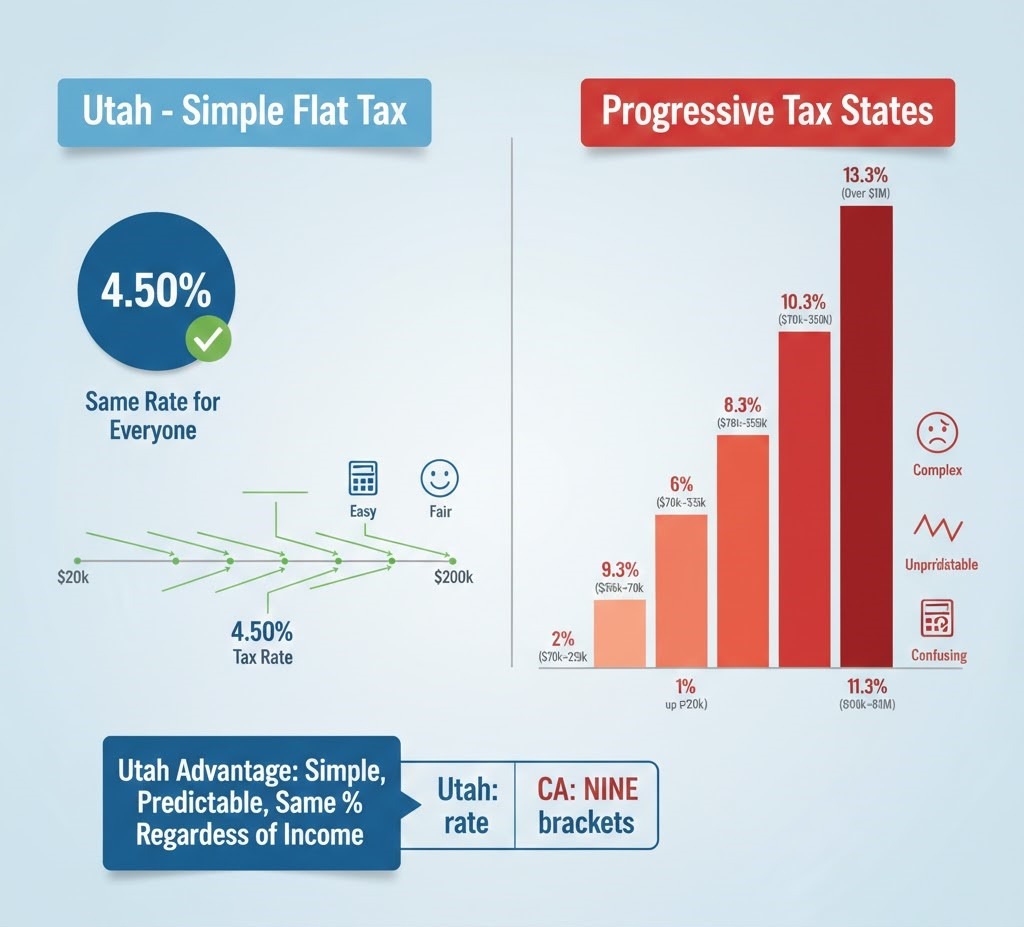
Utah’s 4.50% flat income tax applies to all income levels effective January 2025. This simplifies calculations compared to states with progressive tax brackets.
$25/hour example ($52,000 annually):
- Gross annual: $52,000
- Federal income tax: ~$4,500
- Social Security (6.2%): $3,224
- Medicare (1.45%): $754
- Utah state tax (4.50%): $2,340
- Total deductions: $10,818 (20.8%)
- Net take-home: $41,182 annually
- Net weekly: $792
- Effective net hourly rate: $19.80
Take-Home Pay by Hourly Rate (Utah, Single Filer)
| Hourly | Annual Gross | Federal+FICA | Utah Tax (4.50%) | Total Tax | Annual Net | Net Hourly |
|---|---|---|---|---|---|---|
| $15 | $31,200 | $5,148 | $1,404 | $6,552 | $24,648 | $11.85 |
| $20 | $41,600 | $7,488 | $1,872 | $9,360 | $32,240 | $15.50 |
| $25 | $52,000 | $10,478 | $2,340 | $12,818 | $39,182 | $18.84 |
| $30 | $62,400 | $14,168 | $2,808 | $16,976 | $45,424 | $21.84 |
| $35 | $72,800 | $18,278 | $3,276 | $21,554 | $51,246 | $24.64 |
| $40 | $83,200 | $22,638 | $3,744 | $26,382 | $56,818 | $27.32 |
| $50 | $104,000 | $32,108 | $4,680 | $36,788 | $67,212 | $32.31 |
| $60 | $124,800 | $42,878 | $5,616 | $48,494 | $76,306 | $36.69 |
Your actual take-home is roughly 75-79% of gross pay in Utah after all taxes.
Utah Minimum Wage Context
Current Utah minimum wage: $7.25/hour This equals the federal minimum wage and hasn’t increased since 2009.
Annual earnings at minimum wage:
- $7.25 × 2,080 = $15,080 annually
- After taxes: approximately $12,870 net
- Net hourly: $6.19
Tipped minimum wage: $2.13/hour Total compensation (wages + tips) must equal at least $7.25/hour.
Youth training wage: $4.25/hour Applies to workers under 18 during first 90 days of employment.
Overtime Calculation in Utah
Utah follows federal Fair Labor Standards Act requirements. Overtime pay at 1.5× regular rate applies to hours exceeding 40 per week.
Example: $22/hour base rate
- Regular rate: $22/hour
- Overtime rate: $33/hour
- Week with 45 hours: (40 × $22) + (5 × $33) = $880 + $165 = $1,045
- Annual with consistent 45-hour weeks: $1,045 × 52 = $54,340
Salary to Hourly Conversion in Utah
Reverse Calculation Formula
Annual Salary ÷ 2,080 hours = Hourly Rate
Common Salary to Hourly Conversions
| Annual Salary | Hourly Rate | Weekly Gross | Biweekly Gross | Monthly Gross |
|---|---|---|---|---|
| $25,000 | $12.02 | $481 | $962 | $2,083 |
| $30,000 | $14.42 | $577 | $1,154 | $2,500 |
| $35,000 | $16.83 | $673 | $1,346 | $2,917 |
| $40,000 | $19.23 | $769 | $1,538 | $3,333 |
| $45,000 | $21.63 | $865 | $1,731 | $3,750 |
| $50,000 | $24.04 | $962 | $1,923 | $4,167 |
| $60,000 | $28.85 | $1,154 | $2,308 | $5,000 |
| $70,000 | $33.65 | $1,346 | $2,692 | $5,833 |
| $80,000 | $38.46 | $1,538 | $3,077 | $6,667 |
| $90,000 | $43.27 | $1,731 | $3,462 | $7,500 |
| $100,000 | $48.08 | $1,923 | $3,846 | $8,333 |
Adjusting for Actual Work Hours
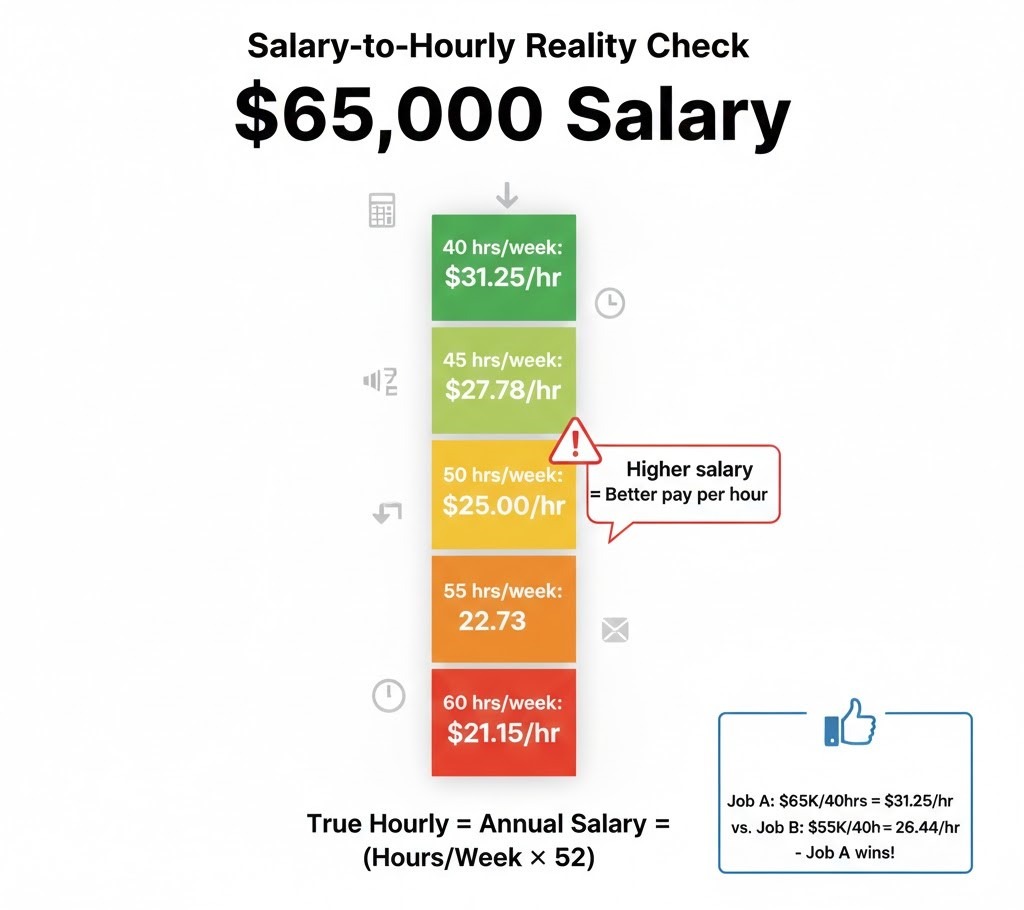
Many salaried positions require more than 40 hours weekly. Calculate your true hourly rate using actual hours worked.
$65,000 salary with different weekly hours:
- 40 hours: $65,000 ÷ 2,080 = $31.25/hour
- 45 hours: $65,000 ÷ 2,340 = $27.78/hour
- 50 hours: $65,000 ÷ 2,600 = $25.00/hour
- 55 hours: $65,000 ÷ 2,860 = $22.73/hour
A higher salary requiring significantly more hours may actually pay less per hour than a lower salary with standard hours.
After-Tax Hourly Equivalent
$60,000 salary example:
- Gross hourly: $28.85
- Annual taxes (about 23%): $13,800
- Net annual: $46,200
- Net hourly: $22.21
$80,000 salary example:
- Gross hourly: $38.46
- Annual taxes (about 26%): $20,800
- Net annual: $59,200
- Net hourly: $28.46
Utah Tax Advantage Compared to Other States
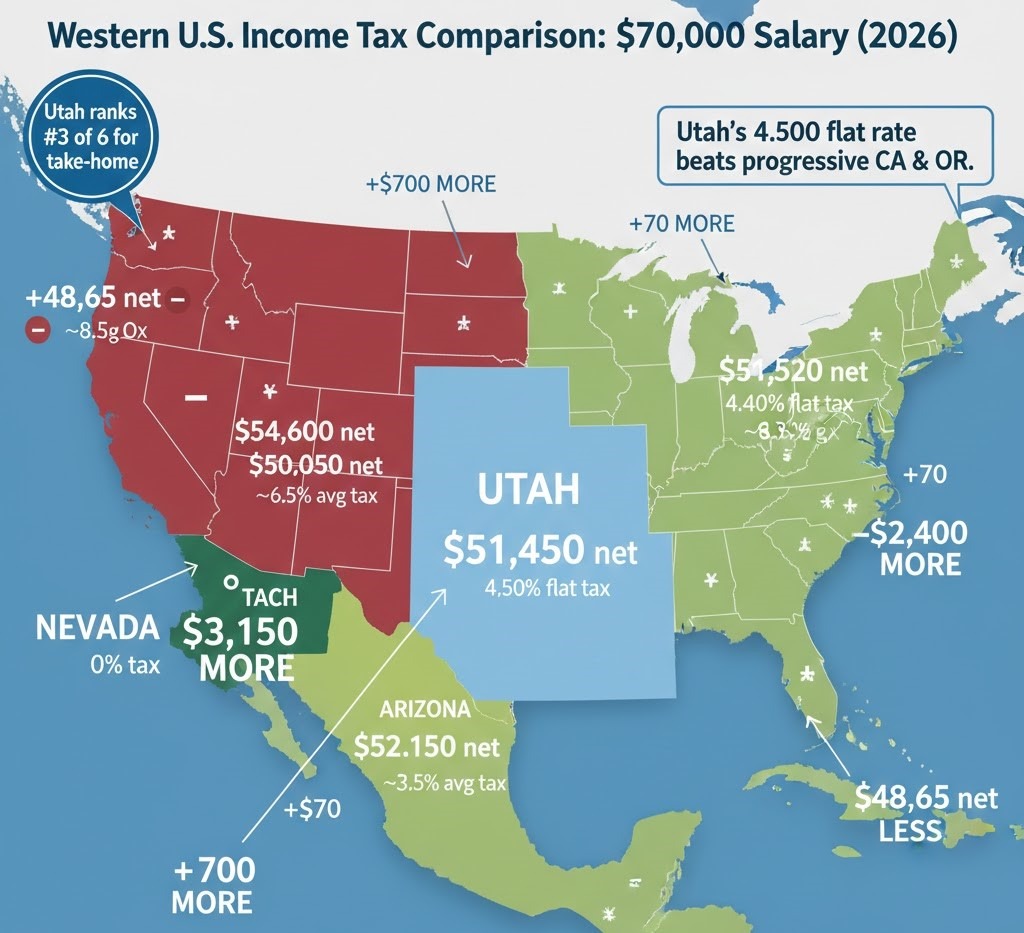
Utah’s 4.50% flat tax rate provides significant advantages over high-tax states with progressive systems.
$70,000 salary tax comparison:
| State | State Tax Rate | State Tax | Total Taxes | Take-Home | Difference from Utah |
|---|---|---|---|---|---|
| Utah | 4.50% | $3,150 | $18,550 | $51,450 | Baseline |
| California | ~6.5% avg | $4,550 | $19,950 | $50,050 | -$1,400 |
| Oregon | ~8.5% avg | $5,950 | $21,350 | $48,650 | -$2,800 |
| Colorado | 4.40% | $3,080 | $18,480 | $51,520 | +$70 |
| Arizona | ~3.5% avg | $2,450 | $17,850 | $52,150 | +$700 |
| Nevada | 0% | $0 | $15,400 | $54,600 | +$3,150 |
Utah’s moderate flat tax provides predictability while funding state services. No local income taxes exist in Utah cities.
Comparing Job Offers
When evaluating positions, convert everything to hourly rates for accurate comparison.
Job A: $28/hour, 40 hours/week
- Annual: $58,240
- Expected hours: 40/week
- True hourly: $28.00
Job B: $62,000 salary
- Hourly equivalent: $29.81
- Expected hours: 45/week
- True hourly: $26.50
Job A pays better per hour despite lower gross salary.
Practical Applications and Utah-Specific Considerations
Total Compensation Beyond Base Pay
Benefits add substantial value to compensation packages. Factor these when comparing positions.
Health insurance value: Employer-provided coverage typically worth $6,000-10,000 annually for single coverage, $15,000-24,000 for family coverage.
401(k) matching:
- 4% match on $55,000 salary = $2,200/year
- 6% match = $3,300/year
- Full match adds $1.06-1.59/hour to effective compensation
Paid time off:
- 2 weeks (80 hours) at $25/hour = $2,000 value
- 3 weeks (120 hours) = $3,000 value
- 4 weeks (160 hours) = $4,000 value
Total compensation example:
Position A: $24/hour, minimal benefits
- Base: $49,920
- Health insurance: $0 (employee pays)
- 401k match: $0
- PTO: 5 days ($960 value)
- Total: $50,880
Position B: $22/hour, strong benefits
- Base: $45,760
- Health insurance: $8,400 employer contribution
- 401k match: $2,288 (5%)
- PTO: 15 days ($2,640 value)
- Total: $59,088
Position B provides $8,208 more total annual compensation despite $2/hour lower base rate.
Tax Optimization Strategies for Utah Workers
Pre-tax retirement contributions: Contributing $10,000 to 401(k) on $60,000 salary reduces taxable income to $50,000. This saves:
- Federal taxes: ~$2,200
- Utah taxes: $450
- Total savings: $2,650
Health Savings Account (HSA):
- Individual contribution limit: $4,300 (2025)
- Family limit: $8,550
- Triple tax benefit: deductible contribution, tax-free growth, tax-free qualified withdrawals
- Saves approximately 27% combined federal and state taxes
$60,000 salary with optimization:
Without optimization:
- Taxable income: $60,000
- Total taxes: $13,800
- Take-home: $46,200
With $10,000 401k + $5,000 HSA:
- Taxable income: $45,000
- Total taxes: $9,750
- Take-home after contributions: $45,250
- Plus $15,000 saved for retirement/healthcare
Similar take-home but $15,000 in assets built.
Cost of Living in Utah Cities
Utah’s cost of living varies significantly by location. Salary requirements differ accordingly.
Housing costs (median rent 1-bedroom):
- Salt Lake City: $1,300-1,600/month
- Provo: $900-1,200/month
- Ogden: $850-1,100/month
- St. George: $1,000-1,300/month
- Park City: $1,800-2,500/month
Hourly wages needed for housing (30% rule):
- Salt Lake City: $25-31/hour
- Provo: $17-23/hour
- Ogden: $16-21/hour
- St. George: $19-25/hour
- Park City: $35-48/hour
Utah Wage Laws and Employee Rights
Wage payment frequency: Utah requires at least semi-monthly pay on regular paydays. Payday must occur within 10 days of pay period end.
Final paycheck timing: Employers must pay final wages within 24 hours of termination.
Allowed deductions: Employers can only deduct from wages when:
- Required by law (taxes, court orders)
- Employee authorizes in writing
- Related to retirement contributions
Wage theft protections: Utah prohibits employers from withholding earned wages. Workers can file claims with Utah Labor Commission for unpaid wages.
Resources for Utah Workers
Utah Department of Workforce Services:
- Wage information and labor law guidance
- Website: jobs.utah.gov
Utah State Tax Commission:
- Tax rates, forms, and withholding information
- Website: tax.utah.gov
Utah Labor Commission:
- Wage claims and worker rights
- Minimum wage information
- Website: laborcommission.utah.gov
Online salary calculators: Multiple free calculators provide Utah-specific estimates:
- ADP Utah Calculator
- PaycheckCity Utah
- SmartAsset Utah Calculator
- Gusto Utah Calculator
Always verify calculations with multiple tools and consult tax professionals for complex situations.
When to Seek Professional Advice
Consult a tax professional if:
- Self-employed with variable income
- Multiple income streams
- Substantial deductions or credits
- Business owner calculating employee compensation
- Investment income or rental properties
Consult an employment attorney if:
- Overtime pay disputes
- Wage theft or unpaid wages
- Employee misclassification concerns
- Salary reduction without notice
- Final paycheck issues
Making Informed Financial Decisions
Understanding hourly to salary conversions empowers Utah workers to evaluate job offers accurately, budget effectively, and plan financial futures. Utah’s flat 4.50% income tax provides simplicity and moderate taxation compared to progressive systems in other states.
Key principles:
- Always calculate true hourly rate using actual work hours
- Factor total compensation including benefits
- Understand after-tax take-home for realistic budgeting
- Compare positions using standardized hourly rates
- Optimize taxes through pre-tax contributions
- Know your rights under Utah wage laws
Whether evaluating new employment, negotiating raises, or planning budgets, accurate salary conversions provide the foundation for sound financial decisions. Utah’s straightforward tax structure makes these calculations more predictable than in states with complex progressive brackets.