Quick conversion: Multiply your hourly rate by 2,080 to get your annual salary.
For example, $25/hour × 2,080 hours = $52,000 per year in Minnesota.
This hourly to salary calculator Minnesota helps workers and employers convert between hourly wages and annual salaries while accounting for Minnesota’s specific tax rates.
How to Convert Hourly to Salary in Minnesota
Use our per hour to salary calculator on homepage. Just click on the advanced option and select the location Minnesota and get your calculation.
The Basic Formula
Hourly Rate × Hours Per Week × 52 Weeks = Annual Salary
Standard calculation uses 40 hours per week:
Hourly Rate × 2,080 = Annual Salary
Quick Conversion Table
| Hourly Rate | Weekly (40 hrs) | Monthly | Annual Salary |
|---|---|---|---|
| $15 | $600 | $2,600 | $31,200 |
| $20 | $800 | $3,467 | $41,600 |
| $25 | $1,000 | $4,333 | $52,000 |
| $30 | $1,200 | $5,200 | $62,400 |
| $35 | $1,400 | $6,067 | $72,800 |
| $40 | $1,600 | $6,933 | $83,200 |
| $45 | $1,800 | $7,800 | $93,600 |
| $50 | $2,000 | $8,667 | $104,000 |
For Different Work Schedules
Part-time (20 hours/week):
- $20/hour × 20 × 52 = $20,800 annually
Full-time (40 hours/week):
- $20/hour × 40 × 52 = $41,600 annually
Overtime included (50 hours/week):
- Regular: $20 × 40 = $800
- Overtime: $30 × 10 = $300
- Weekly total: $1,100 × 52 = $57,200 annually
Minnesota Tax Rates for 2025
Understanding Minnesota taxes is critical for accurate salary calculations.
Minnesota State Income Tax Brackets 2026
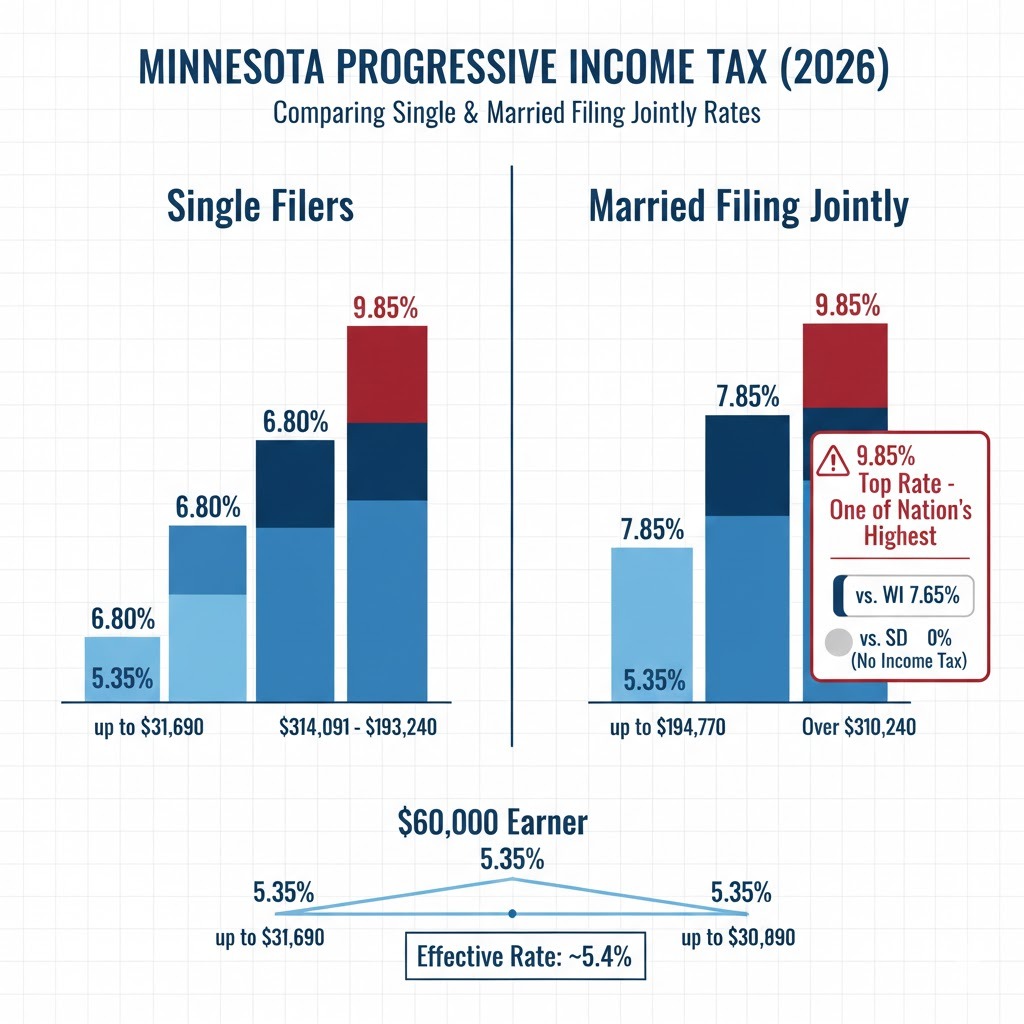
Single Filers:
- 5.35% on income up to $31,690
- 6.80% on income $31,691 to $104,090
- 7.85% on income $104,091 to $193,240
- 9.85% on income over $193,240
Married Filing Jointly:
- 5.35% on income up to $48,850
- 6.80% on income $48,851 to $194,770
- 7.85% on income $194,771 to $310,070
- 9.85% on income over $310,070
Why Minnesota Taxes Matter
Minnesota has one of the highest state income tax rates in the nation. The top rate of 9.85% significantly impacts take-home pay.
No local income taxes: Unlike some states, Minnesota cities don’t impose additional local income taxes.
Progressive system: You pay different rates on different portions of your income, not one flat rate on everything.
After-Tax Take-Home Pay in Minnesota
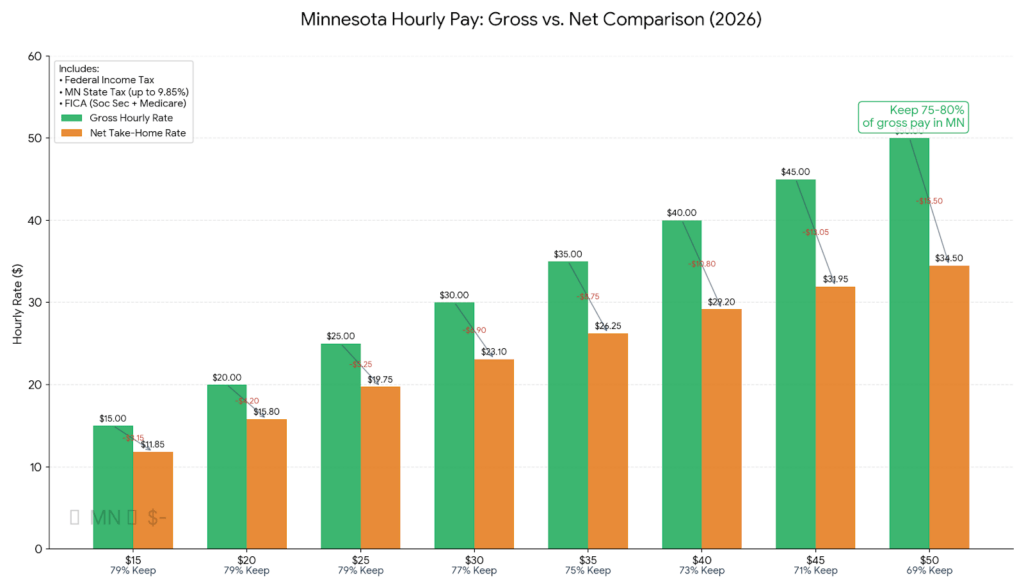
Federal + Minnesota Taxes Combined
Example: $25/hour ($52,000 annually), Single Filer
Gross annual: $52,000
Federal taxes:
- Income tax: ~$4,500
- Social Security: $3,224 (6.2%)
- Medicare: $754 (1.45%)
- Federal total: $8,478
Minnesota state tax: ~$2,450
Total taxes: $10,928 (21%)
Net take-home: $41,072 annually ($788/week)
Take-Home by Hourly Rate (Minnesota, Single Filer)
| Hourly | Annual Gross | Total Tax | Annual Net | Net Hourly |
|---|---|---|---|---|
| $15 | $31,200 | $5,148 | $26,052 | $12.53 |
| $20 | $41,600 | $7,488 | $34,112 | $16.40 |
| $25 | $52,000 | $10,928 | $41,072 | $19.75 |
| $30 | $62,400 | $14,768 | $47,632 | $22.90 |
| $35 | $72,800 | $18,878 | $53,922 | $25.93 |
| $40 | $83,200 | $23,238 | $59,962 | $28.83 |
| $45 | $93,600 | $27,848 | $65,752 | $31.61 |
| $50 | $104,000 | $32,708 | $71,292 | $34.28 |
Key Insights
Your actual take-home is approximately 75-80% of gross pay in Minnesota after all taxes.
A $25/hour job gives you about $19.75/hour in actual spending power after taxes.
Higher earners face steeper tax rates due to Minnesota’s progressive system.
Salary to Hourly Calculator for Minnesota
Converting Annual Salary to Hourly Rate
Formula:
Annual Salary ÷ 2,080 = Hourly Rate
Common Salary Conversions
| Annual Salary | Hourly Rate | Weekly Gross | Monthly Gross |
|---|---|---|---|
| $30,000 | $14.42 | $577 | $2,500 |
| $40,000 | $19.23 | $769 | $3,333 |
| $50,000 | $24.04 | $962 | $4,167 |
| $60,000 | $28.85 | $1,154 | $5,000 |
| $70,000 | $33.65 | $1,346 | $5,833 |
| $80,000 | $38.46 | $1,538 | $6,667 |
| $90,000 | $43.27 | $1,731 | $7,500 |
| $100,000 | $48.08 | $1,923 | $8,333 |
For Different Work Hours
If you work 37.5 hours/week:
- $50,000 ÷ 1,950 hours = $25.64/hour
If you work 45 hours/week:
- $50,000 ÷ 2,340 hours = $21.37/hour
If you work 50 hours/week:
- $50,000 ÷ 2,600 hours = $19.23/hour
Calculate your true hourly rate based on actual hours worked, not just scheduled hours.
Minnesota Minimum Wage 2025
Current Rates
Large employers (annual gross revenue $500,000+):
- $11.13 per hour
Small employers (annual gross revenue under $500,000):
- $9.08 per hour
Annual Salary at Minimum Wage
Large employer minimum:
- $11.13/hour × 2,080 = $23,150 annually
Small employer minimum:
- $9.08/hour × 2,080 = $18,886 annually
Cities with Higher Minimums
Some Minnesota cities have local minimum wages exceeding state requirements:
- Minneapolis
- St. Paul
- Bloomington
- Duluth (for certain employers)
Check your specific city’s requirements as they vary by employer size and often increase annually.
Minnesota Overtime Laws
State Overtime Requirements
Minnesota requires overtime pay at 1.5× regular rate for:
- Hours worked over 48 in a workweek
Federal Overtime (Usually Applies Instead)
Most employers must follow federal FLSA rules:
- Hours worked over 40 in a workweek at 1.5× regular rate
Employers must follow whichever standard is more favorable to employees.
Overtime Calculation Example
Regular rate: $20/hour Overtime rate: $30/hour
Week with 50 hours:
- Regular: 40 hours × $20 = $800
- Overtime: 10 hours × $30 = $300
- Total weekly: $1,100
Annual with regular 50-hour weeks:
- $1,100 × 52 = $57,200 annually
How to Use This Calculator for Job Offers
Evaluating Hourly Positions
Offered $28/hour, 40 hours/week:
- Calculate annual gross: $28 × 2,080 = $58,240
- Estimate taxes (about 22%): $12,813
- Net annual income: $45,427
- Net monthly: $3,786
- True hourly after tax: $21.84
Evaluating Salary Positions
Offered $65,000 salary:
- Calculate hourly: $65,000 ÷ 2,080 = $31.25/hour
- Estimate taxes (about 24%): $15,600
- Net annual: $49,400
- Net monthly: $4,117
- True hourly after tax: $23.75
But if you work 50 hours weekly:
- Actual hours: 2,600/year
- True hourly: $65,000 ÷ 2,600 = $25/hour
- After-tax hourly: $19/hour
Always calculate based on real working hours.
Benefits to Include in Total Compensation
Beyond Base Pay
When comparing jobs, factor in these benefits:
Health insurance:
- Employer premium contribution: $400-800/month value
- Adds $4,800-9,600 to annual compensation
Retirement matching:
- 4% 401k match on $50,000 salary = $2,000/year
- 6% match = $3,000/year
Paid time off:
- 2 weeks PTO = 80 hours = $2,000 at $25/hour
- 3 weeks PTO = 120 hours = $3,000 at $25/hour
Other valuable benefits:
- Professional development budget
- Tuition reimbursement
- Stock options or profit sharing
- Flexible work arrangements
- Company vehicle or vehicle allowance
Total Compensation Example
Job A: $25/hour, minimal benefits
- Base: $52,000
- Health insurance: $0 (employee pays full premium)
- 401k match: $0
- PTO: 1 week ($1,000 value)
- Total comp: $53,000
Job B: $23/hour, excellent benefits
- Base: $47,840
- Health insurance: $7,200 value
- 401k match: $2,392 (5%)
- PTO: 3 weeks ($2,760 value)
- Total comp: $60,192
Job B pays $11,192 more in total compensation despite lower hourly rate.
Common Scenarios and Calculations
Switching from Hourly to Salary
Current: $22/hour, 40 hours/week
- Annual equivalent: $45,760
Offer: $48,000 salary
- Hourly equivalent: $23.08
- Increase: $2,240/year or 4.9%
But verify hours expected:
- If 45 hours required: $48,000 ÷ 2,340 = $20.51/hour (actually a pay cut)
Part-Time Work Calculations
$18/hour, 25 hours/week:
- Weekly gross: $450
- Monthly gross: $1,950
- Annual gross: $23,400
- After-tax annual: ~$19,500
- After-tax hourly: ~$15
Multiple Jobs Combined
Job 1: $20/hour × 30 hours = $600/week Job 2: $18/hour × 15 hours = $270/week
- Combined weekly: $870
- Combined annual: $45,240
- Blended hourly rate: $45,240 ÷ 2,340 = $19.33/hour
Tax Optimization for Minnesota Workers
Reduce Taxable Income
401k contributions:
- Max contribution: $23,000 (2024)
- Reduces state and federal taxable income
- Saves about 28% in combined taxes ($6,440)
HSA contributions:
- Family limit: $8,300 (2024)
- Triple tax advantage
- Saves about 28% ($2,324)
Example impact on $60,000 salary:
Without optimization:
- Taxable income: $60,000
- Taxes: $14,400
- Take-home: $45,600
With $10,000 401k + $5,000 HSA:
- Taxable income: $45,000
- Taxes: $9,900
- Take-home after contributions: $45,100
- Plus $15,000 saved for future
You pay similar take-home but build $15,000 in assets annually.
Filing Status Optimization
Married filing jointly provides:
- Wider tax brackets
- Higher standard deduction ($29,900 vs $14,950)
- Potential tax savings of $1,000-3,000+ annually
Compare filing jointly vs separately annually to determine best approach.
Official Resources
Minnesota Department of Revenue:
- Tax brackets and rates
- Form W4-MN (state withholding)
- Tax calculators
- Website: revenue.state.mn.us
Minnesota Department of Labor and Industry:
- Minimum wage updates
- Overtime regulations
- Worker rights information
- Website: dli.mn.gov
IRS:
- Federal tax information
- Form W-4
- Tax brackets
- Website: irs.gov
Online Calculators
Multiple free paycheck calculators available:
- ADP Minnesota Calculator
- PaycheckCity Minnesota
- SmartAsset Minnesota Calculator
- QuickBooks Minnesota Calculator
Use multiple calculators to verify accuracy.
When to Consult Professionals
Talk to a tax professional if:
- Self-employed with variable income
- Multiple income sources
- Significant deductions or credits
- Business owner calculating employee pay
- Complex tax situations
Talk to an employment attorney if:
- Disputes about overtime pay
- Minimum wage violations
- Misclassification concerns (employee vs contractor)
- Wage theft or unpaid wages
Minnesota vs Other States
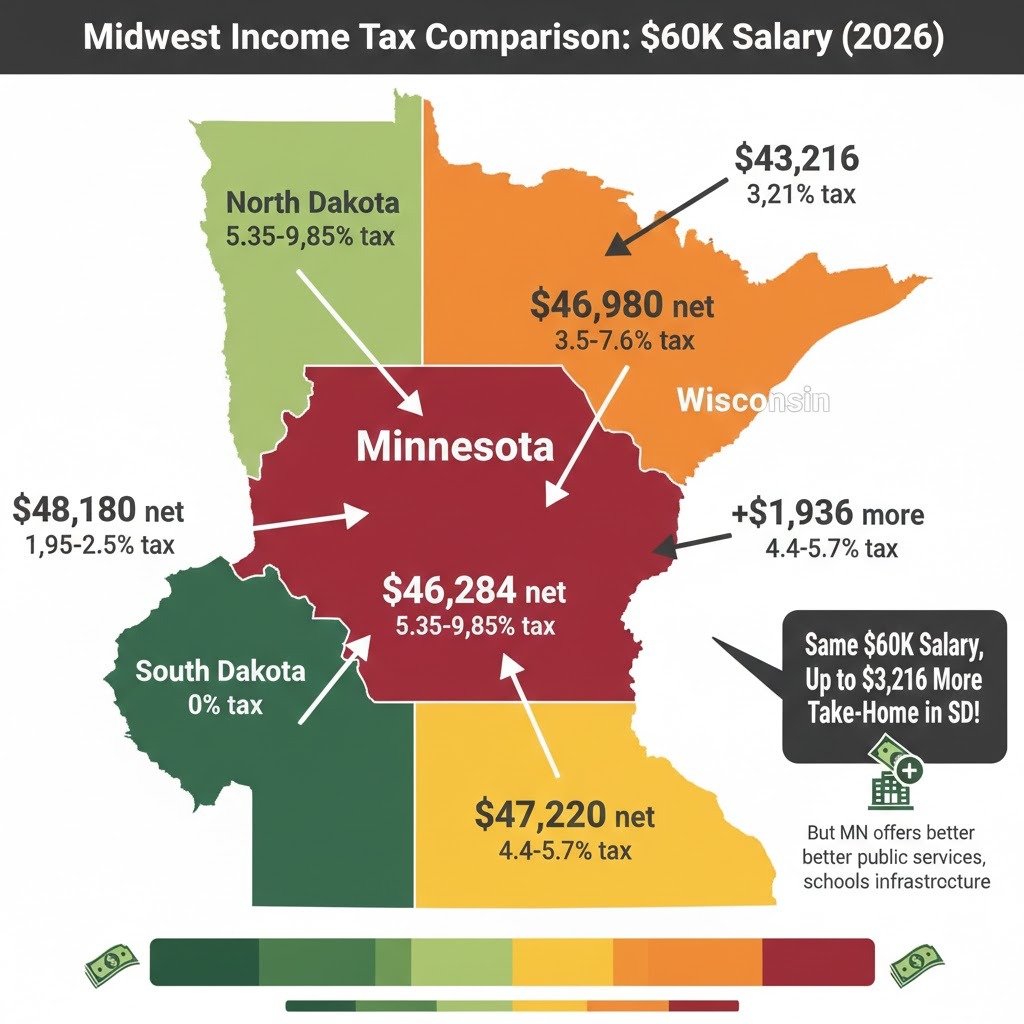
Tax Comparison
Minnesota: 5.35%-9.85% state income tax Wisconsin: 3.50%-7.65% state income tax Iowa: 4.40%-5.70% state income tax (after 2023 reforms) North Dakota: 1.95%-2.50% state income tax South Dakota: 0% state income tax
Impact on Take-Home Pay
$60,000 salary comparison:
| State | State Tax | Take-Home | Difference from MN |
| Minnesota | $3,216 | $46,284 | Baseline |
| Wisconsin | $2,520 | $46,980 | +$696 |
| Iowa | $2,280 | $47,220 | +$936 |
| North Dakota | $1,320 | $48,180 | +$1,896 |
| South Dakota | $0 | $49,500 | +$3,216 |
Same gross income, up to $3,216 more annually in take-home by living in a no-tax state.
Cost of Living Factors
Higher Minnesota taxes fund:
- Extensive public services
- Quality public schools
- Well-maintained infrastructure
- Robust social programs
Consider total cost of living, not just taxes, when comparing states.
Final Thoughts – Hourly to Salary Calculator Minnesota
Converting between hourly and salary in Minnesota requires understanding both the basic math and Minnesota’s specific tax structure.
Key takeaways:
- Use 2,080 hours for standard annual conversions
- Minnesota has high state income taxes (up to 9.85%)
- Always calculate true hourly rate using actual hours worked
- Factor in total compensation, not just base pay
- Optimize taxes through 401k and HSA contributions
- Verify calculations with multiple online calculators
For accurate paycheck estimates:
Use the official hourly to salary calculators Minnesota that account for federal taxes, Minnesota state taxes, FICA, and any pre-tax deductions. Manual calculations provide estimates but may miss nuances.
Whether evaluating job offers, budgeting, or simply understanding your true earnings, these calculations empower you to make informed financial decisions in Minnesota.