Whether you just received a job offer or you want to understand your real take-home pay, knowing how to convert between hourly and Hourly to Yearly Salary annual figures matters. Most free tools give you a single raw number — no tax breakdown, no province filter, no clarity on what actually lands in your bank account. This hourly to salary calculator Canada does it all in one place: gross income, net pay, CPP and EI deductions, provincial tax, and your true adjusted hourly wage after paid time off.
You can also run it in reverse. The built-in salary to hourly calculator Canada mode lets you take any annual salary and find out its real hourly equivalent — critical when you are weighing two job offers side by side.
How to Use This Hourly to Salary Calculator Canada
No complicated steps. Enter your details and the calculator does the rest.
Step 1: Choose your conversion direction Select Hourly to Annual or Annual to Hourly. Both modes update the outputs instantly.
Step 2: Enter your wage or salary Type your hourly rate or your gross annual salary, depending on the mode you selected.
Step 3: Select your province or territory This single step changes everything. Provincial income tax rates vary widely across Canada. Alberta has no provincial sales tax and one of the lowest tax burdens. Quebec has the highest combined rate. Your province determines your actual take-home pay, not just the gross number.
Step 4: Set your hours and weeks Choose between 37.5 or 40 hours per week — both are common standards in Canada. Enter your weeks per year and your total paid time off, including vacation days, sick days, and statutory holidays. The calculator uses these inputs to show your adjusted hourly wage, which is what you actually earn per hour worked once all paid days off are factored in.
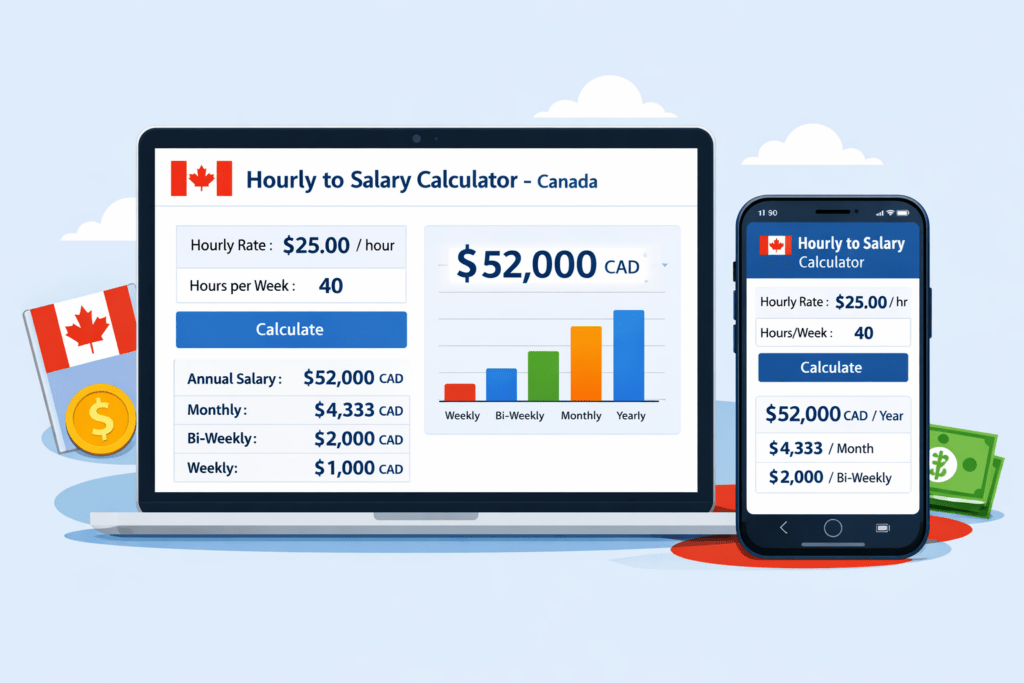
Step 5: Read your full pay breakdown The output shows gross income, net income, federal tax, provincial tax, CPP contributions, EI premiums, your effective tax rate, and a breakdown across monthly, bi-weekly, and weekly pay periods.
The Formula: How to Convert Hourly to Annual Salary in Canada
The core math is straightforward.
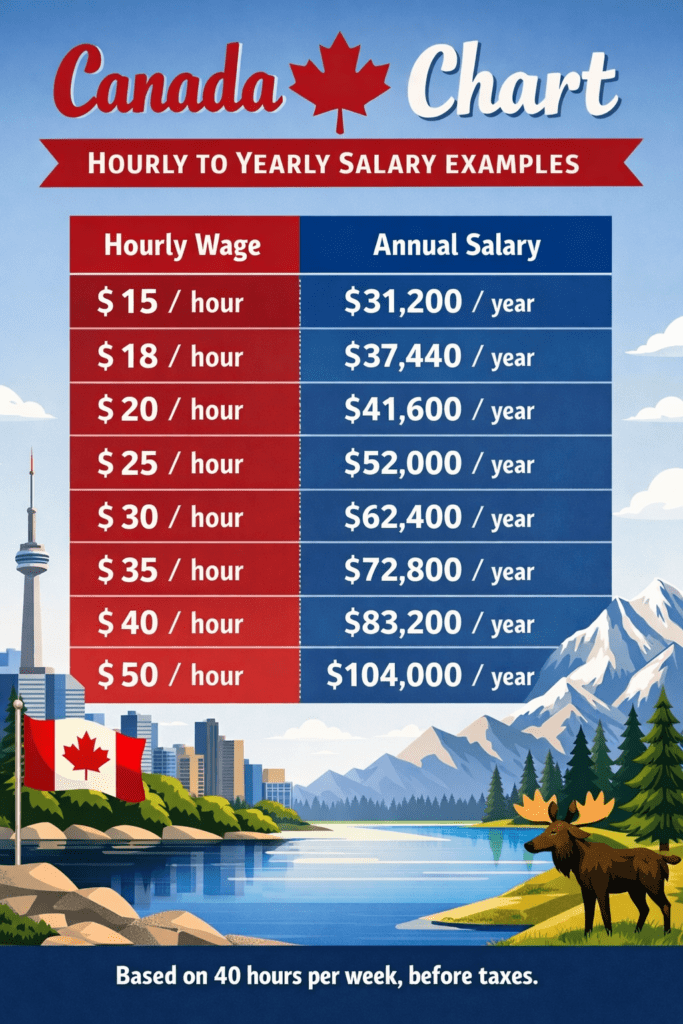
Gross Annual Salary = Hourly Rate × Hours Per Week × Weeks Per Year
Example at $25/hr with a standard 40-hour week and 52 weeks: $25 × 40 × 52 = $52,000/year
However, most Canadians do not work 52 full weeks. Once you subtract two weeks of vacation, the number drops: $25 × 40 × 50 = $50,000/year
Factor in 10 statutory holidays (roughly 2 additional weeks off) and the true adjusted figure drops further: $25 × 40 × 48 = $48,000/year
This is your adjusted annual income — the number that reflects what you actually earn for time worked, not just time on the payroll.
To go the other direction: Hourly Rate = Annual Salary ÷ (Hours Per Week × Weeks Worked Per Year)
Using the annual to hourly salary calculator Canada formula on a $55,000 salary: $55,000 ÷ (40 × 52) = $26.44/hr gross $55,000 ÷ (40 × 48) = $28.65/hr adjusted
That difference matters when you compare a salaried Salary Calculator Illinois offer to an hourly one. The hour to annual salary calculator Canada logic cuts both ways: the salary looks bigger until you account for unpaid overtime, long hours, and lost flexibility.
Gross vs. Net Pay in Canada — What You Actually Take Home
Your gross income is the number on your offer letter. Your net income — or take-home pay — is what hits your bank account after mandatory deductions. In Canada, those deductions include:
Federal income tax: Canada uses a progressive tax system. The 2025/2026 federal brackets are 15% on the first $57,375, 20.5% up to $114,750, 26% up to $158,519, 29% up to $220,000, and 33% above that. The basic personal amount for 2025 is $16,129, which reduces your taxable income at the federal level (Government of Canada, CRA T1 General 2025).
Provincial income tax: Each province sets its own brackets on top of federal tax. This is where living in Alberta versus Quebec changes your paycheck dramatically.
CPP contributions: The Canada Pension Plan rate for employees in 2025 is 5.95% on earnings between $3,500 and $68,500. For 2025, a second additional CPP2 contribution applies on earnings between $68,500 and $73,200 at 4%. Your employer matches your CPP1 contribution. (Source: Canada Revenue Agency)
EI premiums: The Employment Insurance premium rate for 2025 is $1.64 per $100 of insurable earnings, up to a maximum annual premium of $1,077.48 for employees.
Ontario Health Premium applies only to Ontario residents earning above $20,000.
QPP and QPIP replace CPP and standard EI for Quebec residents and are administered by Revenu Québec.
Here is how the same $52,000 gross annual salary plays out across four major provinces in 2025:
| Province | Gross | Federal Tax | Provincial Tax | CPP | EI | Net Take-Home |
|---|---|---|---|---|---|---|
| Alberta | $52,000 | ~$6,380 | ~$3,480 | ~$2,890 | ~$854 | ~$38,396 |
| Ontario | $52,000 | ~$6,380 | ~$4,540 | ~$2,890 | ~$854 | ~$37,336 |
| British Columbia | $52,000 | ~$6,380 | ~$4,210 | ~$2,890 | ~$854 | ~$37,666 |
| Quebec | $52,000 | ~$5,800 | ~$8,270 | ~$2,890 | ~$774 | ~$34,266 |
Note: Quebec uses QPP instead of CPP and QPIP instead of standard EI. Federal tax in Quebec is slightly lower due to the Quebec abatement. Figures are estimates based on 2025 CRA and Revenu Québec rates with no non-refundable credits beyond the basic personal amount.
The difference between Alberta and Quebec on the same $52,000 salary is over $4,100 per year in take-home pay. That is not a rounding error — it is four months of groceries.
Comparing Job Offers: How to Use the Hourly to Annual Salary Calculator Canada
This is the practical use case most tools ignore entirely. You have two offers. One is hourly, one is salaried. They look comparable on the surface. But they are not the same.
Job A: $28/hr, hourly, no benefits, variable hours between 32 and 45 per week Job B: $56,000/year, salaried, three weeks paid vacation, extended health and dental
Run Job A through the hourly wage to annual salary calculator Canada at 40 hrs × 52 weeks: $28 × 40 × 52 = $58,240 gross
That appears higher than Job B. But subtract the weeks where hours drop to 32 (say, 10 weeks per year): (40 × 42 weeks + 32 × 10 weeks) × $28 = $57,120 gross
Now factor in zero paid vacation — when Job A takes two weeks off, earnings stop. Equivalent loss: $28 × 40 × 2 = $2,240. Adjusted gross for Job A: roughly $54,880.
Job B pays $56,000 with three weeks paid vacation included. The adjusted hourly wage for Job B: $56,000 ÷ (40 × 49 weeks) = $28.57/hr
Add the employer-paid benefits package — typically worth $3,000 to $8,000 per year for extended health, dental, and life insurance — and Job B wins on total compensation.
Key rule: Always convert both offers to an adjusted annual figure before comparing. The canada salary to hourly calculator mode helps you reverse-engineer the true hourly rate of any salaried offer, including overtime expectations.

Self-Employed and Contractor Salary Conversion in Canada
The yearly to hourly salary calculator Canada formula changes when you work for yourself. Contractors face costs that salaried employees never see.
Double CPP: A self-employed person pays both the employee share (5.95%) and the employer share (5.95%) of CPP contributions — a combined rate of 11.9% on net self-employment income up to the maximum. That is $6,332 on full CPP-insurable earnings in 2025, compared to $2,890 for a T4 employee.
No EI by default: Self-employed Canadians do not pay EI premiums unless they voluntarily opt in through the CRA’s self-employed EI program.
GST/HST registration: Once your gross revenue exceeds $30,000 in four consecutive calendar quarters, you must register for GST/HST. This adds billing and filing obligations.
No employer benefits: No group health plan, no dental, no life insurance, no paid vacation, no sick days. These benefits typically cost an employer $3,000 to $10,000 per year per employee.
Rule of thumb: To match the total compensation of a $70,000 salaried employee, a contractor typically needs to bill between $85,000 and $95,000 per year — roughly 20 to 35% more — to cover the additional CPP burden, lack of benefits, administrative costs, and income variability gaps.
Use the hour to salary calculator Canada to set a floor for your contracting rate. Start with your target annual income, add 30% for self-employment costs, then divide by your billable hours.
Pay Periods in Canada — How Your Annual Salary Breaks Down
| Pay Frequency | Pay Periods Per Year | Notes |
|---|---|---|
| Weekly | 52 | Common in construction, trades |
| Bi-weekly | 26 | Most common across Canada |
| Semi-monthly | 24 | Many corporate and office roles |
| Monthly | 12 | Some government and academic positions |
The same $52,000 annual salary looks different on each paycheque:
- Weekly: $1,000 gross
- Bi-weekly: $2,000 gross
- Semi-monthly: $2,166.67 gross
- Monthly: $4,333.33 gross
Bi-weekly workers also get two “three-paycheque months” each year. Budget based on two paycheques per month, not 2.16. The extra two cheques are a bonus — not guaranteed income for fixed monthly expenses.
Important: When you use the annual salary to hourly calculator Canada mode on a salaried position, always confirm your employer’s pay period. A bi-weekly paycheque and a semi-monthly one have identical annual totals but different cash flow timing.
Minimum Wage Across Canada (2025) — Annual Equivalent
| Province / Territory | Min. Wage (2025) | Annual (40 hr / 52 wk) | Annual (37.5 hr / 50 wk) |
|---|---|---|---|
| Federal (regulated sectors) | $17.75 | $36,920 | $33,281 |
| Ontario | $17.20 | $35,776 | $32,250 |
| British Columbia | $17.40 | $36,192 | $32,625 |
| Alberta | $15.00 | $31,200 | $28,125 |
| Quebec | $16.10 | $33,488 | $30,188 |
| Saskatchewan | $15.00 | $31,200 | $28,125 |
| Manitoba | $15.80 | $32,864 | $29,625 |
| Nova Scotia | $15.70 | $32,656 | $29,438 |
| New Brunswick | $15.30 | $31,824 | $28,688 |
| PEI | $16.00 | $33,280 | $30,000 |
| Newfoundland & Labrador | $16.00 | $33,280 | $30,000 |
Note: Tipped, student, and special category workers may have a lower applicable minimum wage in provinces like Ontario and Quebec. British Columbia and Yukon are the only province and territory where the local minimum wage exceeds the federal rate as of mid-2025. (Source: ESDC, provincial labour ministries)
Average Hourly Wages in Canada by Industry (2025)
Understanding where your wage sits relative to Canadian averages helps you negotiate from a position of knowledge.
| Industry | Avg. Hourly Wage | Avg. Annual Salary (40 hr / 52 wk) |
|---|---|---|
| Mining, Oil & Gas | $47.86 | ~$99,548 |
| Utilities | $43.50 | ~$90,480 |
| Finance & Insurance | $38.00 | ~$79,040 |
| Construction | $35.80 | ~$74,464 |
| Healthcare & Social Assistance | $33.50 | ~$69,680 |
| Professional, Scientific & Technical | $38.50 | ~$80,080 |
| Real Estate | $27.90 | ~$58,032 |
| Educational Services | $32.00 | ~$66,560 |
| Retail Trade | $25.94 | ~$53,955 |
| Accommodation & Food Services | $19.55 | ~$40,664 |
Source: Statistics Canada, Labour Force Survey, average weekly earnings by industry (CANSIM Table 14-10-0204-01)
The national average hourly wage in Canada sits at approximately $34.85/hr as of 2025, equivalent to roughly $72,488 per year on a full 40-hour, 52-week schedule — or about $65,594 net after taxes in Ontario.
The Adjusted Hourly Wage — What You Actually Earn Per Hour Worked
Your listed hourly rate is not your true earning rate. Your adjusted hourly wage accounts for the hours you are paid but not actually working — vacation days, sick days, and statutory holidays.
Formula: Adjusted Hourly Wage = Annual Salary ÷ (Hours Actually Worked Per Year)
Hours actually worked = (Total weeks − PTO weeks) × Hours per week
Example: $52,000 salary, 40 hrs/week, 3 weeks vacation, 10 stat holidays (roughly 2 weeks): Hours worked = (52 − 5) × 40 = 1,880 hours Adjusted rate = $52,000 ÷ 1,880 = $27.66/hr
Compare this to a contractor billing $27/hr with no PTO — the salaried employee actually earns more per hour worked once benefits are factored in. This calculation is one the hourly rate to salary calculator Canada in this tool handles automatically.
How Province Changes Your Tax Bracket and Take-Home Pay
Canada’s federal tax system is the same for every resident. The provinces add their own layer on top. Here is what that looks like for a $75,000 gross annual salary:
| Province | Provincial Rate Range | Estimated Net Pay |
|---|---|---|
| Alberta | 10% flat (below $148,269) | ~$55,200 |
| Ontario | 5.05% to 9.15% | ~$53,100 |
| BC | 5.06% to 7.70% | ~$53,400 |
| Saskatchewan | 10.5% to 14.5% | ~$52,800 |
| Manitoba | 10.8% to 17.4% | ~$51,900 |
| Quebec | 14% to 19% | ~$49,400 |
Quebec applies a 16.5% Quebec abatement on federal tax, which reduces the federal portion but does not offset the significantly higher provincial rate. For most income levels above $50,000, Quebec residents take home the least among major provinces.
Knowing your province-specific marginal tax rate matters most when you get a raise, earn freelance income on top of employment, or contribute to your RRSP. An RRSP contribution reduces your taxable income at your marginal rate — meaning a $5,000 contribution saves $1,600 in tax if you are in the 32% combined bracket and $2,250 if you are in the 45% combined bracket.
Conclusion
Converting between hourly and annual pay in Canada takes more than simple multiplication. Provincial taxes, CPP, EI, paid time off, and employment type all shift the real number by thousands of dollars per year. The workers who negotiate from an informed position — knowing their adjusted hourly wage, effective tax rate, and true take-home pay — make better financial decisions at every stage of their career.
Use the figures from your calculation as a foundation for salary negotiations, mortgage applications, and annual budgeting. A $5/hr raise sounds significant. Knowing it adds roughly $9,360 gross — or about $6,500 net after Ontario taxes — tells you exactly what it means for your life. Run the numbers, compare the outcomes, and make decisions based on what you actually take home.