Calculate your New York City annual salary from hourly wage instantly, including NYC local income tax (3.078%-3.876%), New York State progressive income tax (3.9%-10.9% with 2026 rate cuts), federal taxes, FICA, and Paid Family Leave. Our free hourly to salary calculator NYC shows your exact take-home pay after all triple-layer deductions.
NYC Hourly to Salary Calculator
Triple-layer NYC tax: Federal + NY State + NYC Local · Includes 2026 middle-class rate cuts
Your Pay Details $ $ hrs wks hrs NYC Resident (5 Boroughs)Manhattan · Brooklyn · Queens · Bronx · Staten Island — adds 3.078–3.876% local tax Gross Annual – – /hr Take-Home Annual – – of gross Monthly Net – after all deductions Tax Burden Overview Federal NY State NYC Local FICA+Payroll Take-Home –% Effective total tax ratePercentage of gross income lost to all federal, state, city, and payroll taxes. Federal Taxes Federal Income TaxProgressive 10–37% – Social Security6.2% (cap $184,500) – Medicare1.45% + 0.9% over $200k – Federal Total – NY State Taxes (2026) NY State Income Tax3.9–10.9% (2026 rate cuts) – NY Disability Ins.0.5% (max $251.82) – Paid Family Leave0.432% (max $514.16) – NY State Total – NYC Local Tax NYC Resident Tax3.078–3.876% (4 brackets) – Effective NYC Rate – NYC Local Total – Gross Income Regular Pay – Overtime Pay1.5× rate – Daily Earnings – Annual Gross – Pay Period Breakdown — Net Take-Home Hourly Net – Weekly – Bi-Weekly – Monthly – Full Summary Annual Gross – (-) Federal Taxes – (-) NY State + Payroll – (-) NYC Local Tax – Annual Net Take-Home – 2026 NYC Tax Notes: NYC minimum wage is $17.00/hr (Jan 1, 2026). NY State reduced first 5 brackets by 0.1% in 2026 — additional 0.1% cut coming 2027. NYC residents pay triple-layer taxes: Federal + NY State (3.9–10.9%) + NYC Local (3.078–3.876%). Non-NYC residents (NJ, Westchester, CT) save 3–4% by avoiding local tax. Calculations are estimates; consult a tax professional for precise figures.
Part of Salary To Hourly Calculator Free 2026 NYC salary tools · Updated with latest IRS & NY State rates
Whether you earn New York City’s minimum wage of $17.00 per hour (as of January 1, 2026) or $100+ per hour in Manhattan, this calculator provides accurate results based on NYC’s unique three-tier tax system: federal, New York State, AND New York City local taxes-among the highest combined burdens in the nation. You can also convert NYC annual salary to hourly rate using the reverse calculator.
New York City workers face one of the most complex tax situations in America: New York State progressive rates (3.9%-10.9% after 2026 cuts for middle brackets), NYC local income tax (3.078%-3.876%), plus mandatory Paid Family Leave (0.432% in 2026), Disability Insurance (0.5%), and for some, the Metropolitan Commuter Transportation Mobility Tax (MCTMT). Combined effective rates can reach 35-50% for six-figure earners. Understanding your true earnings is crucial for navigating NYC’s high cost of living from Manhattan and Brooklyn to Queens, Bronx, and Staten Island.
Hourly to Salary Calculator NYC
Calculate your New York City salary using our 2-in-1 NYC hourly to salary calculator with triple-tax precision. Input your hourly rate (NYC minimum: $17.00, highest in NY State), add overtime, and instantly see your take-home pay after NYC’s local tax (3.078%-3.876%), New York State’s progressive tax (3.9%-10.9% with 2026 rate cuts), Paid Family Leave (0.432%), Disability Insurance (0.5%), and all federal deductions.
How to Use This NYC Calculator
Step 1: Enter your NYC hourly wage Input your current or expected hourly rate. NYC’s minimum wage is $17.00/hour as of January 1, 2026 ($16.50 in 2025), with automatic inflation-based increases starting 2027.
Step 2: Confirm NYC residency If you live in any of the five boroughs (Manhattan, Brooklyn, Queens, Bronx, Staten Island), you pay NYC local income tax (3.078%-3.876%) ON TOP of NY State tax. Non-residents working in NYC pay only NY State tax.
Step 3: Input your working hours Enter hours per week (40 for full-time) and weeks per year (52 standard, or adjust for vacation).
Step 4: Add overtime if applicable New York follows federal overtime rules (time-and-a-half after 40 hours/week). Input typical overtime hours for accurate calculations.
Step 5: Review your NYC results The calculator displays gross salary plus ALL deductions: federal tax, NY State tax (3.9-10.9%), NYC local tax (3.078-3.876%), FICA (7.65%), Paid Family Leave (0.432%), and Disability Insurance (0.5%), showing your net take-home pay after triple taxation.
Your Results Breakdown
Once you enter information, the calculator shows:
Gross Income:
- Hourly rate
- Daily earnings (8-hour day)
- Weekly gross pay
- Bi-weekly gross pay (most common in NYC)
- Monthly gross pay
- Annual salary
Federal Deductions:
- Federal income tax (10%, 12%, 22%, 24%, 32%, 35%, 37% progressive)
- Social Security (6.2% up to $184,500 in 2026)
- Medicare (1.45% on all wages)
- Additional Medicare (0.9% over $200k single/$250k married)
New York State Deductions:
- NEW 2026: NY State income tax with 0.2% middle-class cut (3.9%, 4.3%, 5.05%, 5.3%, 5.8%, 6.65%, 9.65%, 10.3%, 10.9% brackets)
- NY Disability Insurance: 0.5% up to $251.82 maximum
- NY Paid Family Leave: 0.432% up to $514.16 maximum (2026 rates)
NYC Local Deductions:
- NYC resident income tax: 3.078%, 3.762%, 3.819%, 3.876% (four brackets)
- MCTMT (if applicable): 0.34%-0.60% for high-earning self-employed in MCTD
Net Take-Home Pay:
- After federal, state, and local deductions
- Monthly take-home amount
- Actual spending power in expensive NYC dollars
How to Calculate Hourly to Salary in New York City
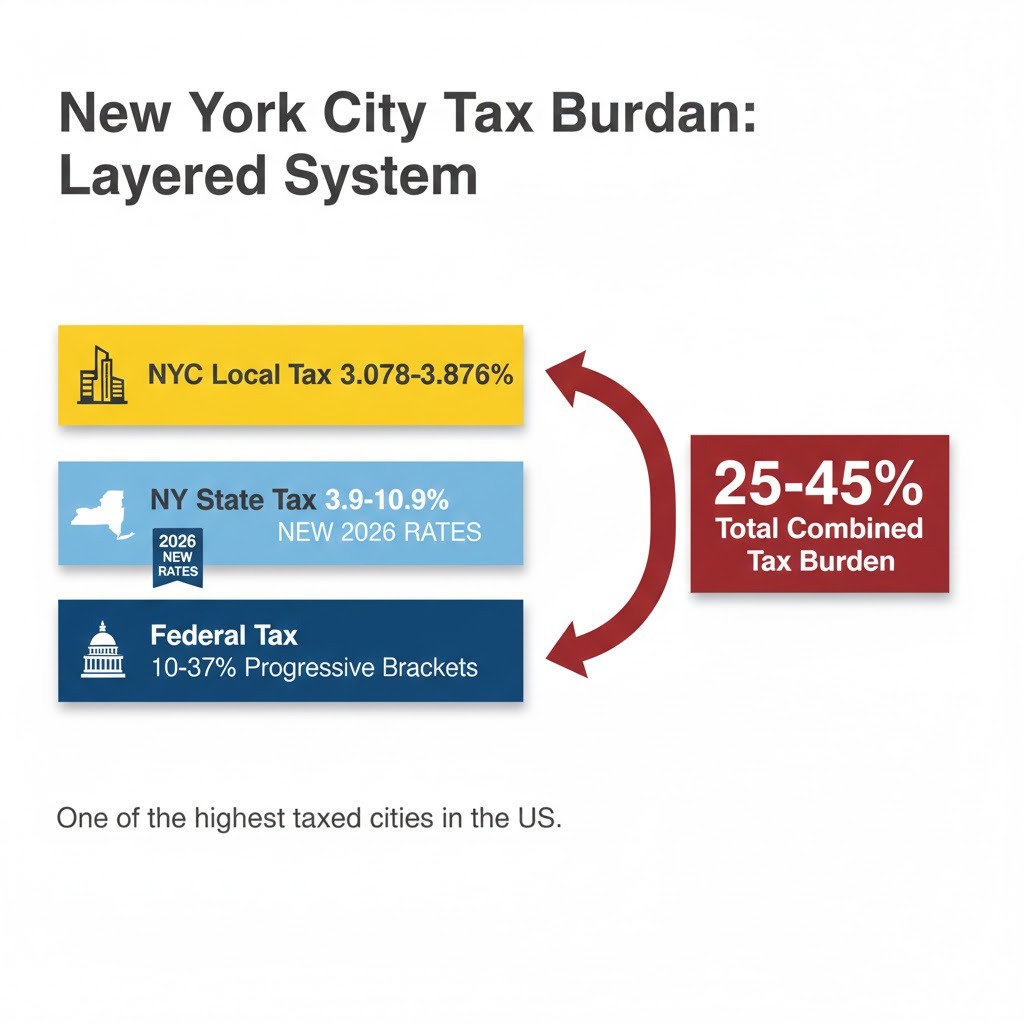
Understanding NYC salary calculations requires navigating three tax layers: federal (10-37%), New York State (3.9-10.9% after 2026 cuts), and NYC local (3.078-3.876%)-creating one of America’s highest combined tax burdens.
Basic NYC Salary Calculation Formula
The formula is standard, but NYC’s triple-layer taxation dramatically reduces take-home pay:
Gross Annual Salary = Hourly Rate × Hours Per Week × Weeks Per Year
For NYC workers at $25/hour, 40 hours/week, 52 weeks/year: $25 × 40 × 52 = $52,000 gross annual salary
However, NYC net pay calculation requires subtracting:
- Federal income tax (~12% effective at $52k)
- NEW NY State income tax: ~$2,200 (4.2% effective after 2026 middle-class cuts)
- NYC local income tax: ~$1,760 (3.4% effective)
- Social Security: $52,000 × 6.2% = $3,224
- Medicare: $52,000 × 1.45% = $754
- NY Disability: $52,000 × 0.5% = $260 (capped at $251.82)
- NY Paid Family Leave: $52,000 × 0.432% = $225 (capped at $514.16)
Net annual pay: ~$37,200 (72% of gross)
In comparison, the same $52,000 salary in Texas (no state/local tax) yields ~$40,100 net pay (77% of gross), a difference of $2,900 annually or $242 per month.
2026 New York Tax Reform: Middle-Class Rate Cuts
Major Changes Effective January 1, 2026:
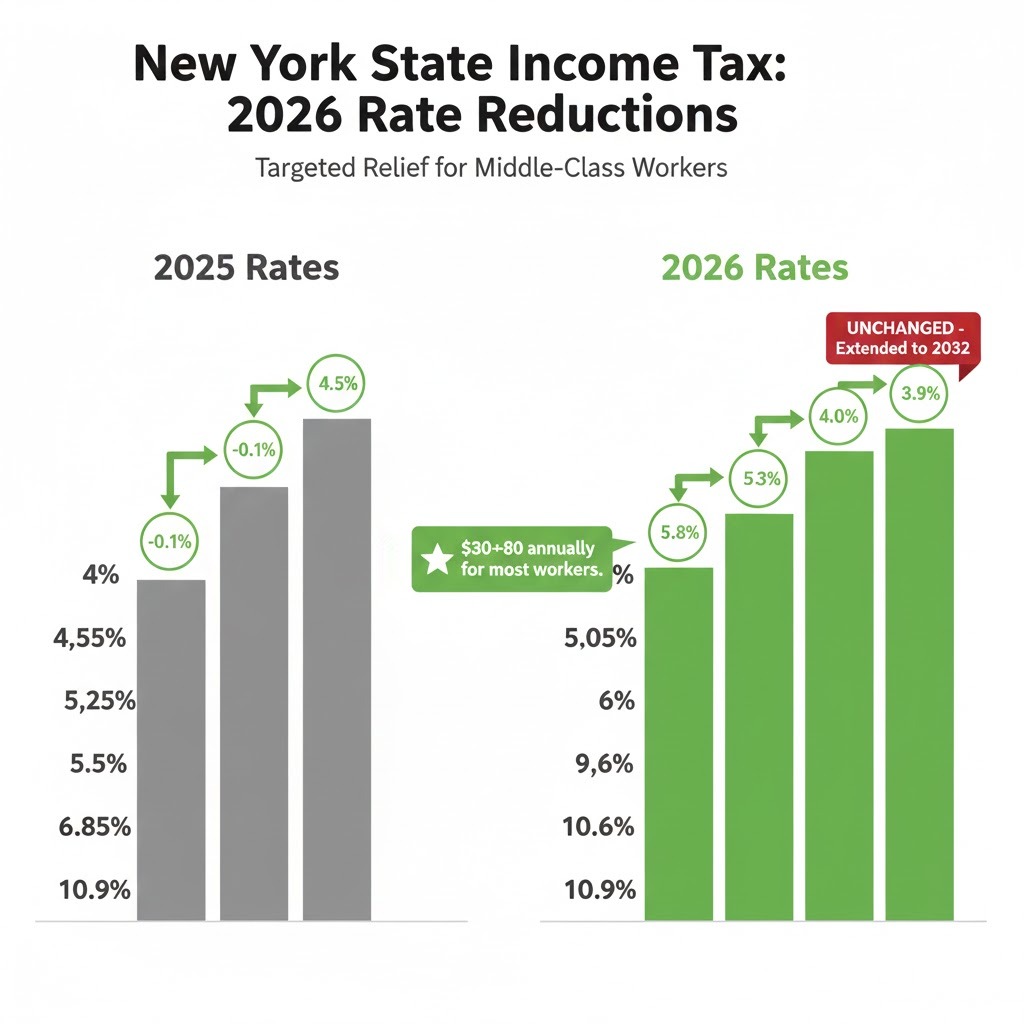
New York enacted a 0.2% tax reduction for the first five income tax brackets, phased over 2026-2027:
- 2026: 0.1% reduction (first phase)
- 2027: Additional 0.1% reduction (second phase)
OLD NY State Rates (2025):
- 4%, 4.5%, 5.25%, 5.5%, 6%, 6.85%, 9.65%, 10.3%, 10.9%
NEW NY State Rates (2026 – after 0.1% first-phase cut):
- 3.9%, 4.3%, 5.05%, 5.3%, 5.8%, 6.65%, 9.65%, 10.3%, 10.9%
The first five brackets get the cut; top three brackets (9.65%, 10.3%, 10.9%) remain unchanged and are extended through 2032.
Who Benefits:
- Single filers up to $215,400 income
- Married filing jointly up to $323,200
- Typical savings: $50-$300 annually depending on income
Who Doesn’t Benefit:
- High earners already in 9.65%+ brackets (over $215,400 single)
- Top rates (9.65%, 10.3%, 10.9%) extended through 2032 (originally set to expire 2027)
Step-by-Step Calculation for NYC Workers
Step 1: Calculate gross salary Multiply your NYC hourly rate by hours and weeks worked. Example: $20/hour × 40 hours × 52 weeks = $41,600
Step 2: Calculate NEW NY State income tax (2026 with cuts) For single filer earning $41,600:
Using NEW 2026 brackets after 0.1% reduction:
- First $8,500 at 3.9% = $332
- Next $2,700 ($11,200 – $8,500) at 4.3% = $116
- Next $2,100 ($13,300 – $11,200) at 5.05% = $106
- Next $7,850 ($21,150 – $13,300) at 5.3% = $416
- Remaining $20,450 ($41,600 – $21,150) at 5.8% = $1,186
Total NY State tax: $2,156 (5.2% effective)
Step 3: Calculate NYC local income tax For NYC resident earning $41,600:
NYC uses separate brackets:
- First $12,000 at 3.078% = $369
- Next $13,000 ($25,000 – $12,000) at 3.762% = $489
- Remaining $16,600 ($41,600 – $25,000) at 3.819% = $634
Total NYC tax: $1,492 (3.6% effective)
Step 4: Calculate federal income tax For single filer at $41,600:
- Standard deduction: $16,100 (2026)
- Taxable income: $25,500
- Federal tax: ~$3,100 (7.5% effective)
Step 5: Calculate FICA + NY payroll taxes
- Social Security: $41,600 × 6.2% = $2,579
- Medicare: $41,600 × 1.45% = $603
- NY Disability: $41,600 × 0.5% = $208 (capped at $251.82)
- NY Paid Family Leave: $41,600 × 0.432% = $180
- Total: $3,570
Step 6: Calculate NYC net pay $41,600 – $2,156 (NY State) – $1,492 (NYC) – $3,100 (Fed) – $3,570 (Payroll) = $31,282 net pay
Your NYC take-home pay is 75% of gross at this income level.
Compared to NYC suburbs (Westchester resident, works in NYC):
- No NYC local tax: Save $1,492
- Net pay: $32,774 (79%)
- Annual savings: $1,492 ($124/month)
This is why many NYC workers live in NJ/CT/Westchester to avoid the 3-4% NYC local tax.
NYC-Specific Calculation Examples
Example 1: $20/hour in Manhattan (NYC resident)
Gross Calculation:
- Hourly rate: $20.00
- Hours per week: 40
- Weeks per year: 52
- Annual gross salary: $41,600
Triple-Layer Taxation:
- NY State income tax (NEW 2026): $2,156 (5.2% effective)
- NYC local income tax: $1,492 (3.6% effective)
- Combined NY/NYC: $3,648 (8.8%)
- Federal income tax: $3,100 (7.5% effective)
- FICA: $3,182 (7.65%)
- NY Disability: $208 (0.5%)
- NY Paid Family Leave: $180 (0.43%)
- Total deductions: $10,318 (24.8%)
Net Pay:
- Annual net: $31,282
- Monthly net: $2,607
- Bi-weekly net: $1,203
- Take-home percentage: 75.2%
Manhattan Context: At $20/hour in Manhattan, you’re earning above NYC minimum wage ($17.00) but well below Manhattan’s estimated living wage of $28-32/hour for single adults. Manhattan median studio rent is $2,800-$3,500/month, consuming 80-134% of your take-home pay—essentially requiring roommates or living in outer boroughs. NYC’s combined 8.8% state+local tax adds significant burden compared to non-NYC areas.
Example 2: $30/hour in Brooklyn (NYC resident)
Gross Calculation:
- Hourly rate: $30.00
- Hours per week: 40
- Weeks per year: 52
- Annual gross salary: $62,400
Triple-Layer Taxation:
- NY State income tax (NEW 2026): $3,567 (5.7% effective)
- NYC local income tax: $2,266 (3.6% effective)
- Combined NY/NYC: $5,833 (9.3%)
- Federal income tax: $6,850 (11.0% effective)
- FICA: $4,774 (7.65%)
- NY Disability: $252 (max reached)
- NY Paid Family Leave: $270 (0.43%)
- Total deductions: $17,979 (28.8%)
Net Pay:
- Annual net: $44,421
- Monthly net: $3,702
- Bi-weekly net: $1,709
- Take-home percentage: 71.2%
Brooklyn Context: At $30/hour in Brooklyn, you’re earning a middle-class NYC income. Brooklyn median 1-bedroom rent is $2,200-$2,800/month, consuming 59-76% of your take-home pay. NYC’s combined 9.3% state+local burden means you’re losing nearly 10% just to NY/NYC taxes before federal even applies. Brooklyn is more affordable than Manhattan but still expensive by national standards.
Example 3: $17/hour at NYC Minimum Wage (2026)
Gross Calculation:
- Hourly rate: $17.00 (NYC minimum wage Jan 1, 2026)
- Hours per week: 40
- Weeks per year: 52
- Annual gross salary: $35,360
Triple-Layer Taxation:
- NY State income tax (NEW 2026): $1,675 (4.7% effective – lower brackets benefit from cuts)
- NYC local income tax: $1,169 (3.3% effective)
- Combined NY/NYC: $2,844 (8.0%)
- Federal income tax: $2,326 (6.6% effective)
- FICA: $2,705 (7.65%)
- NY Disability: $177 (0.5%)
- NY Paid Family Leave: $153 (0.43%)
- Total deductions: $8,205 (23.2%)
Net Pay:
- Annual net: $27,155
- Monthly net: $2,263
- Bi-weekly net: $1,044
- Take-home percentage: 76.8%
NYC Minimum Wage Context: At NYC’s $17.00 minimum wage (up from $16.50 in 2025), workers face lower tax rates due to progressive brackets but still struggle with NYC’s extreme cost of living. Even in the “cheapest” borough like Bronx, living wage is $23-26/hour. Many minimum wage workers qualify for NYS Earned Income Tax Credit (30% of federal), Empire State Child Credit, and federal EITC—potentially $3,000-$8,000 in refunds at tax time.
Important: NYC minimum wage rose $0.50 on January 1, 2026, and will increase annually based on CPI-W starting 2027.
Example 4: $25/hour with Overtime in Queens (NYC resident)
Gross Calculation:
- Regular hourly rate: $25.00
- Regular hours: 40 per week
- Overtime hours: 5 per week
- Overtime rate: $37.50 (time-and-a-half)
Weekly Breakdown:
- Regular pay: $25 × 40 = $1,000
- Overtime pay: $37.50 × 5 = $187.50
- Total weekly: $1,187.50
- Annual gross: $61,750
Triple-Layer Taxation:
- NY State income tax (NEW 2026): $3,517 (5.7% effective)
- NYC local income tax: $2,240 (3.6% effective)
- Combined NY/NYC: $5,757 (9.3%)
- Federal income tax: $6,750 (10.9% effective)
- FICA: $4,724 (7.65%)
- NY Disability: $252 (max)
- NY Paid Family Leave: $267 (0.43%)
- Total deductions: $17,750 (28.8%)
Net Pay:
- Annual net: $44,000
- Monthly net: $3,667
- Bi-weekly net: $1,692
- Take-home percentage: 71.2%
NYC Overtime Impact: The 5 hours of weekly overtime adds $9,750 to annual gross (regular 40 hours = $52,000). NYC’s triple taxation means you keep about 70% of that overtime income after taxes, netting an additional $6,825 annually. NYC/NY follow standard federal overtime (after 40 hours/week, time-and-a-half) with no daily overtime or double-time like California.
NYC vs. Suburbs: The Commuter Tax Advantage
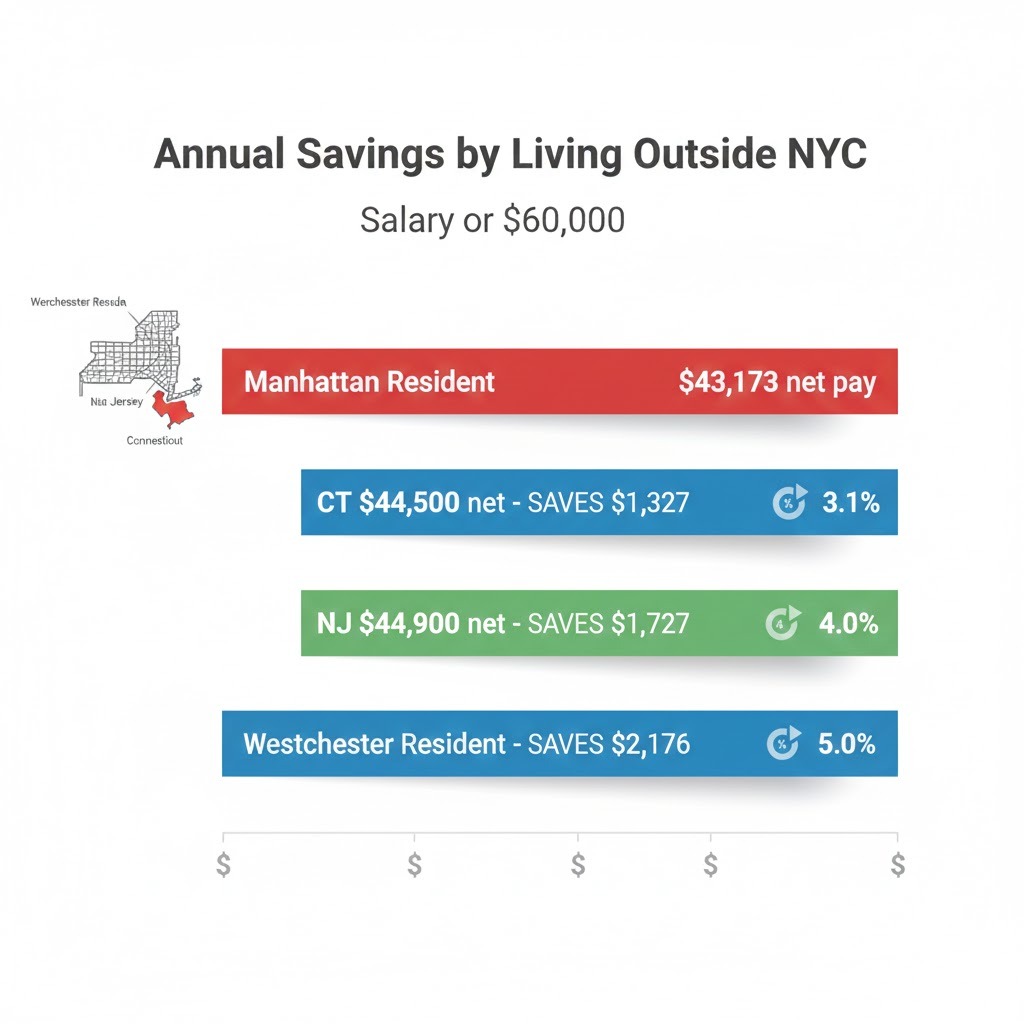
Many workers choose to live outside NYC’s five boroughs to avoid the 3-4% NYC local income tax:
Same $60,000 Salary Comparison:
| Location | NY State Tax | NYC Tax | Total Deductions | Annual Net | vs NYC Resident |
|---|---|---|---|---|---|
| Manhattan resident | $3,321 | $2,176 | $16,827 | $43,173 | Baseline |
| Westchester resident | $3,321 | $0 | $14,651 | $45,349 | +$2,176 (+5.0%) |
| NJ resident (Hudson County) | $3,321* | $0 | $15,100† | $44,900 | +$1,727 (+4.0%) |
| CT resident (Fairfield) | $3,321* | $0 | $15,500†† | $44,500 | +$1,327 (+3.1%) |
*Non-residents pay NY State tax on NY-source income †Includes NJ state tax (~5-7%) ††Includes CT state tax (~5-6.5%)
Key Insight: Westchester/LI residents working in NYC save the full 3-4% NYC local tax, adding $1,800-$2,400 annually at $60k income. However, commuting costs (Metro-North $400-600/month, NJ Transit $350-500/month) can offset some savings.
Why People Still Live in NYC Despite Tax:
- No commute time (2-3 hours daily saved)
- No monthly train ticket ($400-600)
- NYC lifestyle, culture, walkability
- For many, the convenience outweighs the 3-4% tax premium
Reverse Calculator – NYC Annual Salary to Hourly Rate
Converting NYC annual salaries to hourly rates helps you compare salaried positions with hourly jobs and understand your true per-hour earnings after NYC’s triple-layer tax system-federal, New York State, and NYC local.
How to Convert NYC Salary to Hourly Wage
The reverse calculation divides annual salary by total hours worked, but NYC’s triple taxation (federal + NY State 3.9-10.9% + NYC 3.078-3.876%) significantly reduces effective hourly earnings.
Basic Formula: Hourly Rate = Annual Salary ÷ 2,080 hours (40 hours × 52 weeks)
NYC Take-Home Hourly Rate: Effective Hourly Rate = (Annual Salary – Federal – NY State – NYC – FICA – NY Payroll) ÷ 2,080
This “effective hourly rate” shows what you actually earn per hour after NYC’s combined tax burden, which ranges from 24% to 45% depending on your income level.
Salary to Hourly Formula for NYC
Step 1: Divide annual salary by 2,080 This gives you gross hourly rate before any deductions.
Step 2: Calculate NEW NY State tax impact (2026 with cuts) After 2026 middle-class cuts, NY State takes:
- 3.9-5.8% for most earners (first 5 brackets got 0.1% cut)
- 9.65-10.9% for high earners (top 3 brackets unchanged)
- Effective rate: 4-10% depending on income
Step 3: Calculate NYC local tax impact NYC residents pay additional:
- 3.078% on first $12,000
- 3.762% on $12,001-$25,000
- 3.819% on $25,001-$50,000
- 3.876% over $50,000
- Effective rate: 3.1-3.9% depending on income
Step 4: Calculate NY mandatory payroll deductions
- NY Disability: 0.5% (max $251.82 annually)
- NY Paid Family Leave: 0.432% (max $514.16 annually)
Step 5: Calculate federal tax + FICA
- Federal: 10-32% for most earners
- FICA: 7.65% (Social Security + Medicare)
Step 6: Determine effective hourly rate Subtract all taxes from annual salary, then divide by 2,080.
Example: $60,000 NYC salary (resident):
- Gross hourly: $60,000 ÷ 2,080 = $28.85/hour
- NY State tax (~$3,321): -$1.60/hour
- NYC local tax (~$2,176): -$1.05/hour
- Federal tax (~$5,834): -$2.80/hour
- FICA ($4,590): -$2.21/hour
- NY payroll ($511): -$0.25/hour
- Effective hourly: $20.94/hour
Your NYC take-home is $20.94/hour on a $60,000 salary, which is 73% of gross hourly rate.
Same salary, NYC suburbs (Westchester resident):
- No NYC tax saves: $2,176 ($1.05/hour)
- Effective hourly: $22.00/hour (76% of gross)
NYC Salary Conversion Examples
Example: $50,000 salary to hourly in NYC (Manhattan resident)
Gross Calculation:
- Annual salary: $50,000
- Standard hours: 2,080 per year
- Gross hourly rate: $24.04/hour
NYC Triple-Tax Impact:
- NY State income tax (NEW 2026): $2,556 (5.1% effective)
- NYC local income tax: $1,726 (3.5% effective)
- Combined NY/NYC: $4,282 (8.6%)
- Federal income tax: $4,200 (8.4% effective)
- FICA: $3,825 (7.65%)
- NY Disability: $250 (0.5%)
- NY Paid Family Leave: $216 (0.43%)
- Total annual deductions: $12,773
Net NYC Earnings:
- Annual net: $37,227
- Effective hourly rate: $17.90/hour
- Take-home percentage: 74.5%
NYC vs. Westchester at $50,000:
- NYC resident: $37,227 net ($17.90/hr)
- Westchester resident: $39,000 net ($18.75/hr)
- Difference: $1,773 annually or $0.85/hour saved by living outside NYC
Example: $75,000 salary to hourly in NYC (Brooklyn resident)
Gross Calculation:
- Annual salary: $75,000
- Standard hours: 2,080 per year
- Gross hourly rate: $36.06/hour
NYC Triple-Tax Impact:
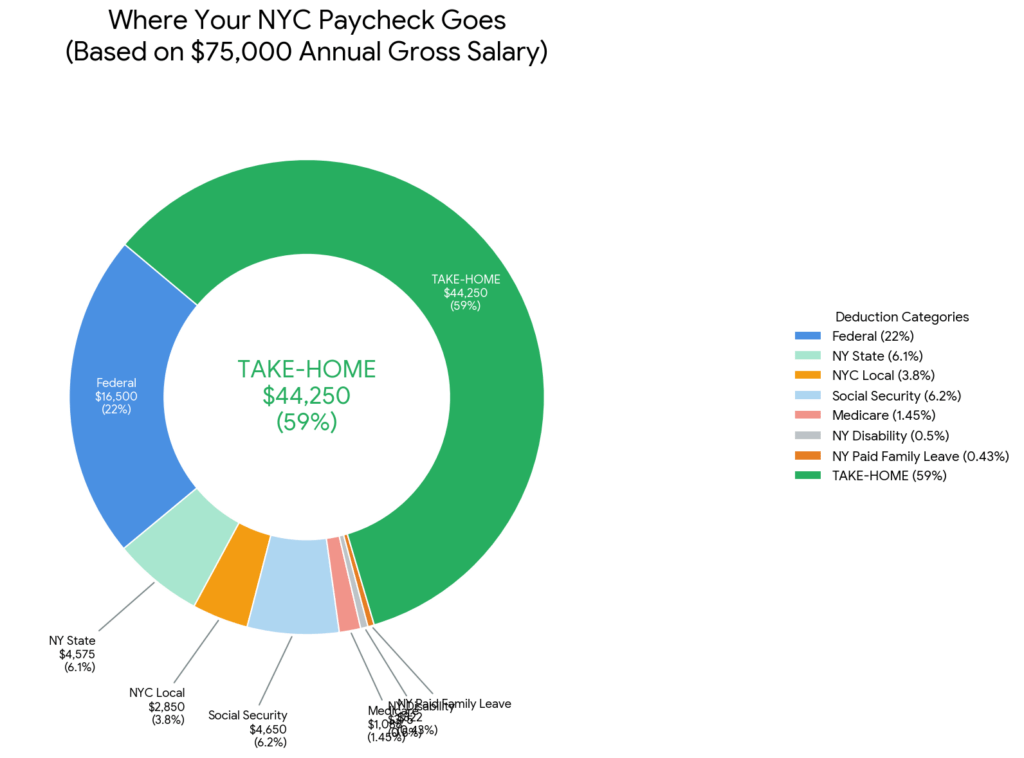
- NY State income tax (NEW 2026): $4,575 (6.1% effective)
- NYC local income tax: $2,817 (3.8% effective)
- Combined NY/NYC: $7,392 (9.9%)
- Federal income tax: $9,800 (13.1% effective)
- FICA: $5,738 (7.65%)
- NY Disability: $252 (max)
- NY Paid Family Leave: $324 (0.43%)
- Total annual deductions: $23,506
Net NYC Earnings:
- Annual net: $51,494
- Effective hourly rate: $24.76/hour
- Take-home percentage: 68.7%
NYC Tax Burden: At $75,000 in Brooklyn, you lose 31.3% to all taxes. NYC’s combined state+local takes 9.9% before federal even applies. This is why many mid-career NYC workers consider moves to Texas, Florida, or Nashville where same salary keeps $6,000-$9,000 more annually.
Example: $100,000 salary to hourly in NYC (Queens resident)
Gross Calculation:
- Annual salary: $100,000
- Standard hours: 2,080 per year
- Gross hourly rate: $48.08/hour
NYC Triple-Tax Impact:
- NY State income tax (NEW 2026): $6,725 (6.7% effective)
- NYC local income tax: $3,817 (3.8% effective)
- Combined NY/NYC: $10,542 (10.5%)
- Federal income tax: $16,500 (16.5% effective)
- FICA: $7,650 (7.65%)
- NY Disability: $252 (max)
- NY Paid Family Leave: $432 (0.43%)
- Total annual deductions: $35,376
Net NYC Earnings:
- Annual net: $64,624
- Effective hourly rate: $31.07/hour
- Take-home percentage: 64.6%
Six-Figure NYC Reality: At $100,000 in NYC, you’re paying 10.5% combined state+local taxes before federal applies. Combined burden reaches 35.4%. Many NYC tech workers earning $100k-$150k relocate to Austin, Miami, or Seattle (no state tax) and work remotely, saving $10,000-$15,000 annually.
Example: $150,000 salary in Manhattan (high earner, NYC resident)
Gross Calculation:
- Annual salary: $150,000
- Standard hours: 2,080 per year
- Gross hourly rate: $72.12/hour
NYC Triple-Tax Impact:
- NY State income tax (NEW 2026): $11,075 (7.4% effective – approaching 9.65% bracket)
- NYC local income tax: $5,717 (3.8% effective)
- Combined NY/NYC: $16,792 (11.2%)
- Federal income tax: $29,500 (19.7% effective)
- FICA: $10,948 (7.3% – SS caps at $184,500)
- NY Disability: $252 (max)
- NY Paid Family Leave: $514 (max)
- Total annual deductions: $58,006
Net NYC Earnings:
- Annual net: $91,994
- Effective hourly rate: $44.23/hour
- Take-home percentage: 61.3%
High-Earner NYC Tax Hit: At $150,000 in Manhattan, you’re losing 38.7% to taxes—nearly 2 out of every 5 dollars. NYC’s 11.2% state+local burden is among the highest in the nation. Many earning $150k+ consider:
- Moving to NJ/CT (saves 3.8% NYC tax = $5,700 at $150k)
- Moving to Florida/Texas (saves 10.5%+ = $15,000+)
- Negotiating higher salary to offset NYC tax burden
High-Earner NYC vs. No-Tax States Comparison
Annual Take-Home Pay: NYC vs. Miami/Austin (No State Tax)
| Annual Salary | NYC Net | Miami/Austin Net | Annual Difference | Monthly Difference | % More Take-Home |
|---|---|---|---|---|---|
| $50,000 | $37,227 | $39,000 | -$1,773 | -$148 | +4.8% |
| $75,000 | $51,494 | $57,500 | -$6,006 | -$501 | +11.7% |
| $100,000 | $64,624 | $73,000 | -$8,376 | -$698 | +13.0% |
| $150,000 | $91,994 | $105,000 | -$13,006 | -$1,084 | +14.1% |
| $200,000 | $118,000 | $136,000 | -$18,000 | -$1,500 | +15.3% |
| $300,000 | $171,000 | $201,000 | -$30,000 | -$2,500 | +17.5% |
Key Insights:
- NYC disadvantage grows with income
- At $100k, NYC costs $8,376 annually vs. no-tax states
- At $200k, NYC costs $18,000 annually (1.5 months of net pay!)
- At $300k, NYC costs $30,000 annually
Post-COVID Remote Work: Many NYC tech workers moved to Miami, Austin, Nashville during pandemic, keeping NYC salaries while avoiding NYC/NY taxes. Some companies now require in-office presence or adjust salaries for cost of living.
NYC Effective Tax Rates by Income
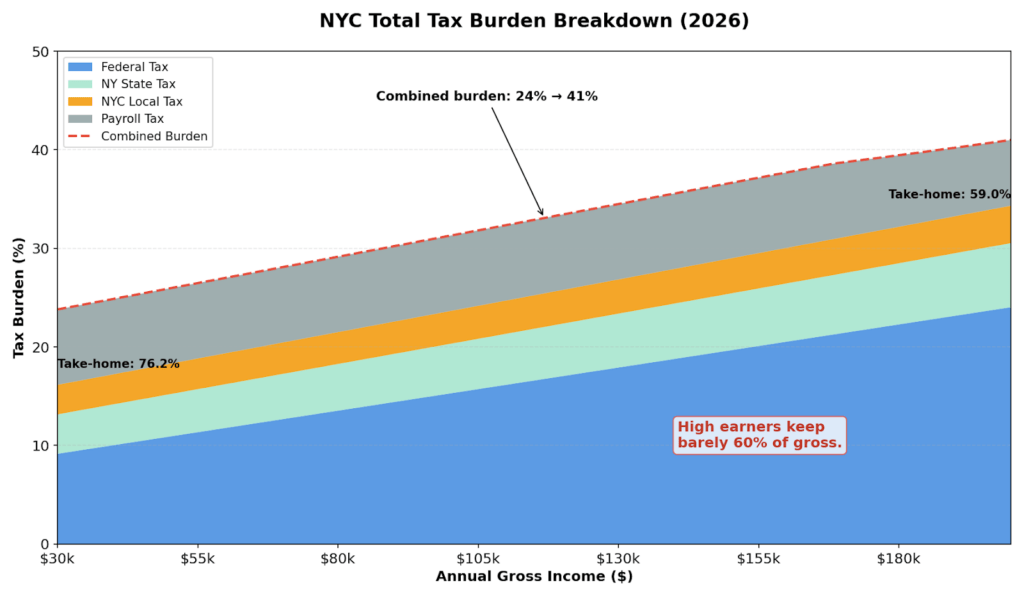
Combined NYC Burden (Federal + NY State + NYC Local + Payroll):
| Annual Income | NY State | NYC Local | Combined NY/NYC | Fed + FICA | Total Burden | Take-Home % |
|---|---|---|---|---|---|---|
| $30,000 | $1,346 (4.5%) | $898 (3.0%) | $2,244 (7.5%) | $4,893 | $7,137 (23.8%) | 76.2% |
| $50,000 | $2,556 (5.1%) | $1,726 (3.5%) | $4,282 (8.6%) | $8,241 | $12,773 (25.5%) | 74.5% |
| $75,000 | $4,575 (6.1%) | $2,817 (3.8%) | $7,392 (9.9%) | $15,538 | $23,506 (31.3%) | 68.7% |
| $100,000 | $6,725 (6.7%) | $3,817 (3.8%) | $10,542 (10.5%) | $24,150 | $35,376 (35.4%) | 64.6% |
| $150,000 | $11,075 (7.4%) | $5,717 (3.8%) | $16,792 (11.2%) | $40,448 | $58,006 (38.7%) | 61.3% |
| $200,000 | $15,725 (7.9%) | $7,617 (3.8%) | $23,342 (11.7%) | $58,658 | $82,000 (41.0%) | 59.0% |
Observations:
- NYC combined state+local ranges from 7.5-12% depending on income
- Federal + FICA add 16-29% on top
- Total burden: 24-41% for $30k-$200k earners
- High earners keep barely 60% of gross
NYC Cost of Living by Borough
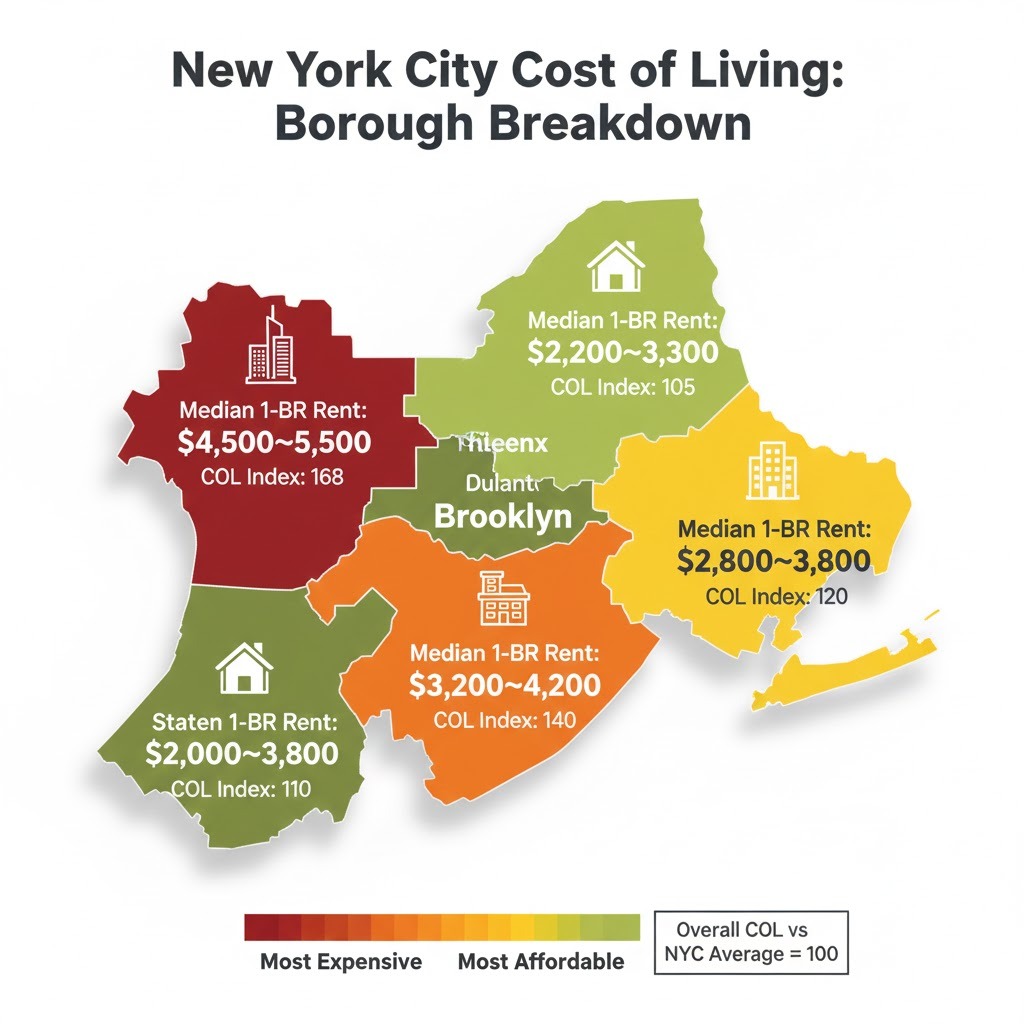
New York City has dramatic cost variation across its five boroughs, though all are expensive by national standards.
NYC Cost of Living Index (NYC Average = 100):
| Borough | Overall COL Index | Housing Index | Median 1-BR Rent | Key Factor |
|---|---|---|---|---|
| Manhattan | 168 | 250 | $3,500-$4,500 | Most expensive in U.S. |
| Brooklyn (Brownstone areas) | 145 | 210 | $2,800-$3,500 | Gentrified neighborhoods |
| Brooklyn (Other) | 125 | 165 | $2,200-$2,800 | More affordable areas |
| Queens | 115 | 145 | $1,900-$2,500 | Middle ground |
| Bronx | 105 | 120 | $1,600-$2,200 | Most affordable borough |
| Staten Island | 110 | 130 | $1,700-$2,300 | Car-dependent |
Manhattan Cost of Living
Manhattan Details:
- Overall COL: 168% of NYC average, 240% of national average
- Housing: 250% of NYC average
- Median studio: $2,800-$3,500/month
- Median 1-BR: $3,500-$4,500/month
- Median 2-BR: $5,000-$7,000/month
Manhattan Neighborhood Variation:
- Upper West/East Side: $3,000-$4,000 (studios)
- Midtown: $3,500-$5,000
- Financial District: $3,200-$4,500
- Greenwich Village/SoHo: $4,000-$6,000
- Lower East Side: $2,800-$3,800
What Manhattan Salary Buys:
- $60,000 (net $43,173): $3,598/month → Afford $1,200-$1,400 rent (30% rule) = Studio with roommates
- $100,000 (net $64,624): $5,385/month → Afford $1,600-$2,000 rent = Shared apartment or outer borough
- $150,000 (net $91,994): $7,666/month → Afford $2,300-$2,800 rent = Own studio or 1-BR in outer areas
Brooklyn Cost of Living
Brooklyn Details:
- Overall COL: 125-145% of NYC average (varies widely)
- Median 1-BR: $2,200-$3,500 (neighborhood dependent)
- Park Slope, Williamsburg, DUMBO: $2,800-$3,500
- Crown Heights, Bed-Stuy, Bushwick: $2,000-$2,600
- Bay Ridge, Bensonhurst, Sunset Park: $1,800-$2,400
Brooklyn as Middle Ground: More affordable than Manhattan but still expensive. Many young professionals choose Brooklyn for:
- Better value than Manhattan (20-30% cheaper)
- Still walkable/transit-accessible
- Vibrant neighborhoods
- Close to Manhattan jobs
Queens Cost of Living
Queens Details:
- Overall COL: 115% of NYC average
- Median 1-BR: $1,900-$2,500
- Astoria, Long Island City: $2,200-$2,800
- Forest Hills, Rego Park: $2,000-$2,600
- Flushing, Jamaica: $1,600-$2,200
Queens Advantages:
- 30-40% cheaper than Manhattan
- Diverse neighborhoods
- Subway/LIRR access
- More space for money
Bronx and Staten Island
Bronx:
- Most affordable borough
- Median 1-BR: $1,600-$2,200
- Riverdale, Pelham Bay: $1,800-$2,400
- South Bronx: $1,400-$1,800
- Trade-off: Longer commutes, fewer amenities
Staten Island:
- Car-dependent (limited subway)
- Median 1-BR: $1,700-$2,300
- Most suburban-feeling borough
- Ferry to Manhattan (free)
NYC Living Wage by Borough (2026)
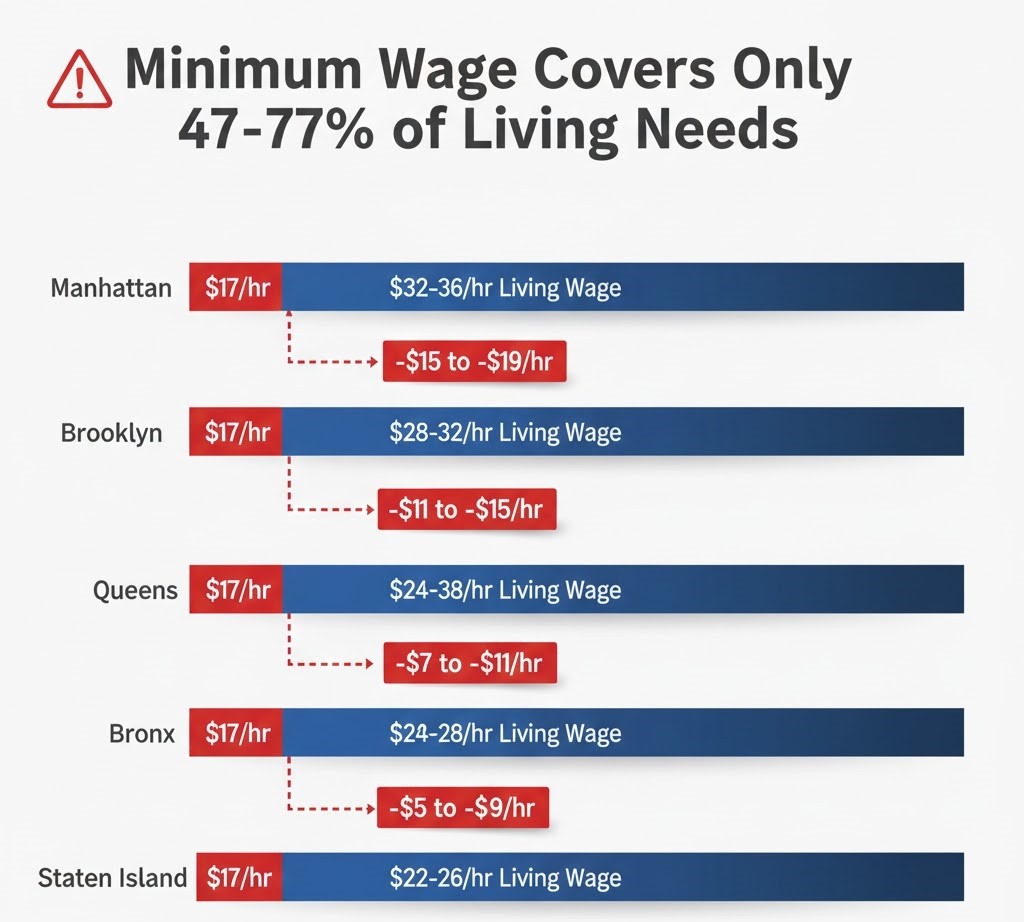
The “living wage” represents hourly rate needed for basic necessities without government assistance. NYC requires among the highest in the nation.
Living Wage Estimates for NYC (2026):
| Borough | Living Wage (Single) | Annual Living Wage | vs $17 Min Wage Gap |
|---|---|---|---|
| Manhattan | $32-36/hour | $66,560-$74,880 | -$15 to -$19/hour |
| Brooklyn (expensive areas) | $28-32/hour | $58,240-$66,560 | -$11 to -$15/hour |
| Brooklyn (affordable) | $24-28/hour | $49,920-$58,240 | -$7 to -$11/hour |
| Queens | $24-28/hour | $49,920-$58,240 | -$7 to -$11/hour |
| Bronx | $22-26/hour | $45,760-$54,080 | -$5 to -$9/hour |
| Staten Island | $23-27/hour | $47,840-$56,160 | -$6 to -$10/hour |
Gap Analysis:
- Manhattan: Minimum wage covers only 47-53% of living wage
- Brooklyn: Covers 54-71% depending on neighborhood
- Queens/Bronx: Covers 61-77%
- Even in “cheapest” borough (Bronx), $17/hour is insufficient
Family Living Wage:
- Single adult + 1 child (Manhattan): $52-60/hour combined
- 2 adults + 2 children (Brooklyn): $65-75/hour combined
- Childcare is largest expense after rent in NYC
Popular NYC Hourly to Salary Conversions
Quick reference showing exact NYC take-home pay after triple taxation.
Common NYC Hourly Rates to Annual Salary (NYC Resident):
| Hourly Rate | Annual Gross | NY State | NYC Local | Federal | FICA + NY Payroll | Total Deduct | Annual Net | Monthly Net | % Take-Home |
|---|---|---|---|---|---|---|---|---|---|
| $17 (NYC min) | $35,360 | $1,675 | $1,169 | $2,326 | $3,035 | $8,205 | $27,155 | $2,263 | 76.8% |
| $20/hour | $41,600 | $2,156 | $1,492 | $3,100 | $3,570 | $10,318 | $31,282 | $2,607 | 75.2% |
| $25/hour | $52,000 | $2,856 | $1,936 | $5,200 | $4,456 | $14,448 | $37,552 | $3,129 | 72.2% |
| $30/hour | $62,400 | $3,567 | $2,266 | $7,150 | $5,296 | $18,279 | $44,121 | $3,677 | 70.7% |
| $35/hour | $72,800 | $4,475 | $2,741 | $9,200 | $6,138 | $22,554 | $50,246 | $4,187 | 69.0% |
| $40/hour | $83,200 | $5,425 | $3,216 | $11,600 | $6,980 | $27,221 | $55,979 | $4,665 | 67.3% |
| $50/hour | $104,000 | $6,925 | $3,966 | $17,000 | $8,470 | $36,361 | $67,639 | $5,637 | 65.0% |
Key Insights:
- NYC minimum wage workers keep 76.8%
- Middle earners ($25-35/hour) keep 69-72%
- Higher earners ($40-50/hour) keep 65-67%
- NYC’s 3-4% local tax significantly reduces take-home vs. suburbs
Common NYC Annual Salaries to Hourly Rate (NYC Resident):
| Annual Salary | Gross Hourly | NY State | NYC Local | Federal + Payroll | Annual Net | Net Monthly | Effective Hourly |
|---|---|---|---|---|---|---|---|
| $40,000 | $19.23/hr | $2,006 | $1,380 | $6,814 | $29,800 | $2,483 | $14.33/hr |
| $50,000 | $24.04/hr | $2,556 | $1,726 | $8,491 | $37,227 | $3,102 | $17.90/hr |
| $60,000 | $28.85/hr | $3,321 | $2,176 | $10,676 | $43,827 | $3,652 | $21.07/hr |
| $75,000 | $36.06/hr | $4,575 | $2,817 | $16,114 | $51,494 | $4,291 | $24.76/hr |
| $100,000 | $48.08/hr | $6,725 | $3,817 | $24,834 | $64,624 | $5,385 | $31.07/hr |
| $150,000 | $72.12/hr | $11,075 | $5,717 | $41,214 | $91,994 | $7,666 | $44.23/hr |
| $200,000 | $96.15/hr | $15,725 | $7,617 | $58,658 | $118,000 | $9,833 | $56.73/hr |
Effective Hourly Rate Analysis: The “effective hourly rate” shows actual earning power after triple taxation:
- $50k salary: Lose $6.14/hour to taxes (25.5% reduction)
- $100k salary: Lose $17.01/hour to taxes (35.4% reduction)
- $200k salary: Lose $39.42/hour to taxes (41.0% reduction)
NYC’s progressive structure means higher earners lose increasingly more per hour worked.
NYC Taxes, Minimum Wage, & Your Paycheck
New York State Income Tax (2026 with Middle-Class Cuts)
New York State has a nine-bracket progressive tax system with rates from 3.9% to 10.9%. Starting in 2026, the first five brackets received a 0.1% reduction.
NY State Tax Brackets for Single Filers (2026 – After Cuts)
| Tax Rate | Income Range | Tax on Range | Cumulative Tax |
|---|---|---|---|
| 3.9% | $0 – $8,500 | Up to $332 | $332 |
| 4.3% | $8,501 – $11,200 | Up to $116 | $448 |
| 5.05% | $11,201 – $13,300 | Up to $106 | $554 |
| 5.3% | $13,301 – $21,150 | Up to $416 | $970 |
| 5.8% | $21,151 – $80,650 | Up to $3,451 | $4,421 |
| 6.65% | $80,651 – $215,400 | Up to $8,961 | $13,382 |
| 9.65% | $215,401 – $1,077,550 | Up to $83,192 | $96,574 |
| 10.3% | $1,077,551 – $5,000,000 | Up to $404,032 | $500,606 |
| 10.9% | Over $5,000,000 | 10.9% of excess | $500,606 + |
Key Changes:
- First 5 brackets (through $80,650) got 0.1% reduction in 2026
- Additional 0.1% reduction scheduled for 2027
- Top 3 brackets (9.65%, 10.3%, 10.9%) unchanged and extended through 2032
- Originally top brackets set to expire 2027, now permanent through 2032
NY State Tax Brackets for Married Filing Jointly (2026)
| Tax Rate | Income Range | Tax on Range | Cumulative Tax |
|---|---|---|---|
| 3.9% | $0 – $17,000 | Up to $663 | $663 |
| 4.3% | $17,001 – $22,400 | Up to $232 | $895 |
| 5.05% | $22,401 – $26,600 | Up to $212 | $1,107 |
| 5.3% | $26,601 – $42,300 | Up to $832 | $1,939 |
| 5.8% | $42,301 – $161,300 | Up to $6,902 | $8,841 |
| 6.65% | $161,301 – $323,200 | Up to $10,768 | $19,609 |
| 9.65% | $323,201 – $2,155,350 | Up to $176,803 | $196,412 |
| 10.3% | $2,155,351 – $5,000,000 | Up to $293,019 | $489,431 |
| 10.9% | Over $5,000,000 | 10.9% of excess | $489,431 + |
Married brackets are NOT exactly double: They’re close but not perfectly doubled, creating some “marriage penalty” situations in NY.
How NY’s Progressive System Works
You pay different rates on different portions of income—not one rate on all income.
Example: Single filer earning $75,000
Income taxed in layers using NEW 2026 rates:
- First $8,500 at 3.9% = $332
- Next $2,700 ($8,501-$11,200) at 4.3% = $116
- Next $2,100 ($11,201-$13,300) at 5.05% = $106
- Next $7,850 ($13,301-$21,150) at 5.3% = $416
- Remaining $53,850 ($21,151-$75,000) at 5.8% = $3,123
Total NY State tax: $4,093 Effective rate: 5.5% (much lower than 5.8% marginal)
NY State Effective Tax Rates by Income (2026)
| Annual Income | Marginal Rate | Effective Rate | Annual NY Tax | 2026 Savings vs 2025 |
|---|---|---|---|---|
| $30,000 | 5.8% | 4.5% | $1,346 | -$30 |
| $50,000 | 5.8% | 5.1% | $2,556 | -$50 |
| $75,000 | 5.8% | 5.5% | $4,093 | -$75 |
| $100,000 | 6.65% | 6.1% | $6,093 | -$80 |
| $150,000 | 6.65% | 6.7% | $10,093 | -$80 |
| $250,000 | 9.65% | 7.5% | $18,757 | -$80 |
| $500,000 | 9.65% | 8.7% | $43,507 | -$80 |
| $1,000,000 | 10.3% | 9.3% | $92,757 | $0 (no cut) |
2026 Savings: Most workers save $30-$80 annually from the 0.1% rate reduction. Not substantial, but welcome relief.
NYC Local Income Tax (Residents Only)
NYC imposes its own income tax on residents—one of few U.S. cities with local income tax. This is IN ADDITION to NY State tax.
Who Pays NYC Tax:
- Anyone who lives in one of the five boroughs (Manhattan, Brooklyn, Queens, Bronx, Staten Island)
- Based on residency, NOT work location
- If you live in NJ/CT/Westchester but work in NYC: NO NYC tax (only NY State)
NYC Tax Brackets (2026)
NYC has four brackets with rates from 3.078% to 3.876%:
For Single Filers:
| Rate | Income Range | Tax on Range | Cumulative Tax |
|---|---|---|---|
| 3.078% | $0 – $12,000 | Up to $369 | $369 |
| 3.762% | $12,001 – $25,000 | Up to $489 | $858 |
| 3.819% | $25,001 – $50,000 | Up to $955 | $1,813 |
| 3.876% | Over $50,000 | 3.876% of excess | $1,813 + |
For Married Filing Jointly:
| Rate | Income Range | Tax on Range | Cumulative Tax |
|---|---|---|---|
| 3.078% | $0 – $21,600 | Up to $665 | $665 |
| 3.762% | $21,601 – $45,000 | Up to $880 | $1,545 |
| 3.819% | $45,001 – $90,000 | Up to $1,719 | $3,264 |
| 3.876% | Over $90,000 | 3.876% of excess | $3,264 + |
NYC Effective Tax Rates:
| Income | Single Filer | Married Jointly |
|---|---|---|
| $30,000 | 3.1% ($930) | 2.8% ($840) |
| $50,000 | 3.5% ($1,750) | 3.2% ($1,600) |
| $75,000 | 3.7% ($2,775) | 3.5% ($2,625) |
| $100,000 | 3.8% ($3,800) | 3.6% ($3,600) |
| $150,000 | 3.9% ($5,850) | 3.7% ($5,550) |
Impact: NYC’s 3-4% local tax adds $1,500-$6,000 annually depending on income, making NYC among the highest-taxed cities in America when combined with NY State rates.
NYC Minimum Wage (2026)
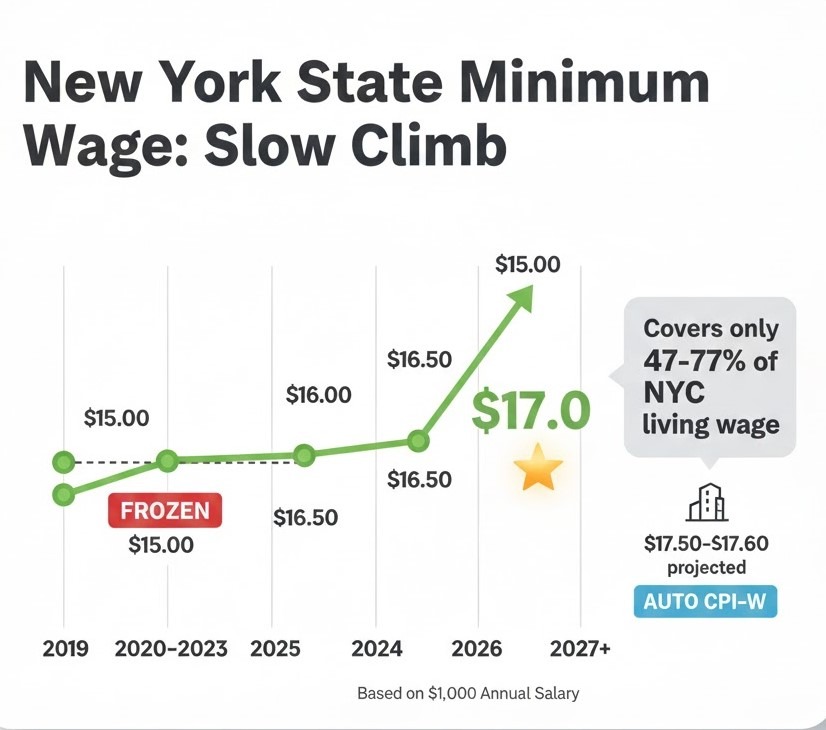
New York City has its own minimum wage, higher than NY State’s base rate.
NYC Minimum Wage (January 1, 2026):
- All NYC employers: $17.00/hour
- Increased from $16.50 (2025)
- Automatic inflation adjustments starting 2027
Historical NYC Minimum Wage:
- 2019: $15.00 (reached $15 goal)
- 2020-2023: $15.00 (frozen)
- 2024: $16.00 (increased after freeze)
- 2025: $16.50
- 2026: $17.00 (current)
Future Increases: Starting 2027, NYC minimum wage increases automatically based on Consumer Price Index for Urban Wage Earners (CPI-W) or 3%, whichever is less.
2027 Projection: Assuming 2.5-3% inflation, NYC minimum wage likely $17.50-$17.60 on January 1, 2027.
NYC vs. NY State Minimum Wage
Geographic Differences:
| Region | Minimum Wage (2026) |
|---|---|
| New York City | $17.00/hour |
| Long Island & Westchester | $17.00/hour |
| Upstate NY (Rest of State) | $16.00/hour |
NYC, Long Island, and Westchester have $1.00 higher minimum than upstate due to higher cost of living.
Annual Earnings at NYC Minimum Wage:
- Hourly: $17.00
- Weekly (40 hours): $680
- Monthly: $2,947
- Annual: $35,360
- After all NYC taxes: ~$27,155 net ($2,263/month)
NYC Tipped Minimum Wage
Food Service Workers (2026):
- Cash wage: $14.25/hour (up from $14.20 in 2025)
- Must reach $17.00/hour with tips
- If tips don’t bring worker to $17.00, employer must make up difference
Service Employees (2026):
- Cash wage: $17.00/hour (no tip credit)
- Includes non-food service workers
NYC is gradually moving toward eliminating tip credit—part of national “One Fair Wage” movement.
New York Paid Family Leave (2026)
NY Paid Family Leave is a mandatory employee-funded benefit providing paid time off for family care.
2026 Paid Family Leave Contribution:
- Rate: 0.432% of gross wages
- Maximum weekly wage: $1,189.92
- Maximum annual contribution: $514.16
Contribution Examples:
| Annual Income | 0.432% Contribution | Notes |
|---|---|---|
| $30,000 | $130 | Full 0.432% |
| $50,000 | $216 | Full 0.432% |
| $75,000 | $324 | Full 0.432% |
| $100,000 | $432 | Full 0.432% |
| $119,000 | $514.16 | Maximum reached |
| $150,000 | $514.16 | Capped at max |
Benefits (2026):
- Up to 12 weeks of leave annually
- 67% of average weekly wage (up from 55% when program started)
- Maximum weekly benefit: $1,189.92
- Covers bonding with new child, caring for family member with serious health condition
Benefit Examples:
Worker earning $50,000 ($962/week):
- Weekly PFL benefit: $645 (67% of $962)
- 12 weeks: $7,740 total benefit
- Your annual contribution: $216
- Return: 35.8x if you use it
Worker earning $100,000 ($1,923/week):
- Weekly PFL benefit: $1,189.92 (max – hit cap)
- 12 weeks: $14,279 total benefit
- Your annual contribution: $432
- Return: 33x if you use it
New York Disability Insurance
NY Disability Insurance is mandatory employee-funded short-term disability coverage.
2026 Disability Contribution:
- Rate: 0.5% of gross wages
- Maximum weekly wage: $503.64
- Maximum annual contribution: $251.82
Contribution Examples:
| Annual Income | 0.5% Contribution | Notes |
|---|---|---|
| $30,000 | $150 | Full 0.5% |
| $40,000 | $200 | Full 0.5% |
| $50,000 | $250 | Full 0.5% |
| $50,364+ | $251.82 | Maximum reached |
| $100,000 | $251.82 | Capped |
Benefits:
- Coverage for non-work-related injury/illness
- Up to 26 weeks of benefits
- 50% of average weekly wage
- Maximum weekly benefit: $251.82 (2026)
This is one of the lowest maximum benefits in the nation—hasn’t kept pace with cost of living.
NYC Overtime Rules
NYC/NY State follows federal overtime standards under the Fair Labor Standards Act (FLSA).
NYC Overtime Rules:
- Overtime after 40 hours in a workweek
- Rate: Time-and-a-half (1.5× regular rate)
- No daily overtime requirements
- No double-time provisions
- Weekly calculation only
Overtime Exemptions:
Salary Threshold (2026): To qualify for executive, administrative, professional exemptions in NYC:
- Must earn at least $1,200/week ($62,400 annually) for employers with 11+ employees
- $1,125/week ($58,500 annually) for employers with 10 or fewer
NYC thresholds are HIGHER than federal:
- Federal: $684/week ($35,568 annually)
- NYC (11+ employees): $1,200/week (75% higher than federal!)
- NYC (1-10 employees): $1,125/week (64% higher than federal!)
Many workers exempt in other states are overtime-eligible in NYC due to higher salary thresholds.
Example: Assistant manager earning $55,000:
- Exempt in most states (above federal $35,568)
- Non-exempt in NYC (below $58,500/$62,400)
- Entitled to overtime pay
Metropolitan Commuter Transportation Mobility Tax (MCTMT)
The MCTMT is an additional payroll tax in the NYC metropolitan region—applies to certain employers and high-earning self-employed.
Who Pays MCTMT:
- Employers in the Metropolitan Commuter Transportation District (MCTD)
- Self-employed individuals in MCTD earning over $50,000
MCTD Coverage:
- New York City (all 5 boroughs)
- Westchester, Rockland, Nassau, Suffolk, Orange, Putnam, Dutchess counties
MCTMT for Employers
Employer MCTMT Rate: 0.34% of total payroll
This is paid by the employer, not deducted from employee wages. However, it increases employer cost of NYC workers.
Example: Employer with $1,000,000 payroll:
- MCTMT: $3,400 annually
- Per employee (10 workers): $340 additional cost each
MCTMT for Self-Employed
Self-Employed MCTMT (2026):
- Applies to net earnings from self-employment over $50,000 in MCTD
- Rates:
- $50,000-$75,000: 0.34%
- $75,000-$100,000: 0.47%
- Over $100,000: 0.60%
Examples:
Self-employed earning $60,000 in NYC:
- MCTMT: $60,000 × 0.34% = $204 annually
Self-employed earning $120,000 in Manhattan:
- MCTMT: $120,000 × 0.60% = $720 annually
This is in addition to regular self-employment taxes (15.3% for Social Security/Medicare).
NYC Sales Tax Rates
NYC has combined state and local sales taxes among the highest in the nation.
NYC Combined Sales Tax (2026):
- State rate: 4%
- City rate: 4.5%
- MTA surcharge: 0.375%
- Total: 8.875%
What’s Taxable:
- Most goods and services
- Restaurant food
- Prepared food
- Clothing/shoes over $110 per item
What’s Exempt:
- Groceries (unprepared food)
- Prescription drugs
- Clothing/shoes under $110 per item
Annual Impact: For NYC resident spending $30,000 on taxable items:
- Sales tax paid: $2,663 annually
- This is ON TOP OF income taxes
Combined with high income taxes, NYC workers face substantial total tax burden when including both income and consumption taxes.
Summary: NYC Hourly to Salary Calculations
New York City workers navigate America’s most complex tax situation: federal progressive rates (10-37%), New York State progressive rates (3.9-10.9% after 2026 middle-class cuts), and NYC local income tax (3.078-3.876%)—creating combined state+local burdens of 7-14% before federal even applies. Add mandatory NY Paid Family Leave (0.432%), Disability Insurance (0.5%), and FICA (7.65%), and total deductions range from 24-45% depending on income.
NYC’s $17.00 minimum wage (January 1, 2026) is among the nation’s highest but covers only 47-77% of living wage estimates ($22-36/hour depending on borough). Manhattan requires $32-36/hour for single adults to afford basic expenses, while even the “cheapest” borough (Bronx) needs $22-26/hour. Combined with nation’s highest housing costs (Manhattan studio $2,800-$3,500, Brooklyn 1-BR $2,200-$3,500), NYC workers face extreme cost-of-living pressures.
NYC residents can avoid 3-4% local tax by living in NJ, CT, Westchester, or Long Island—saving $1,800-$6,000 annually depending on income. Many professionals choose this trade-off despite commuting costs. Post-COVID, remote workers saved even more by relocating to no-tax states (FL, TX, TN) while maintaining NYC salaries, saving $8,000-$30,000 annually for six-figure earners.
Use this calculator for comparing NYC job offers, understanding true take-home after triple taxation, evaluating NYC vs. suburb living (immediate 3-4% savings), planning budgets in expensive boroughs, and calculating the financial impact of relocating to lower-tax regions while remote working.