Calculate your Texas annual salary from hourly wage with zero state income tax deductions. As one of only nine states with no personal income tax, Texas workers keep significantly more of their paycheck compared to high-tax states like California, New York, or Illinois.
Use our free salary to hourly calculator Texas to see your exact take-home pay after federal income tax and FICA taxes only. Whether you earn Texas minimum wage of $7.25 per hour or $50+ per hour in Austin’s tech sector or Houston’s energy industry, this calculator shows your true earnings advantage in the Lone Star State.
Texas’s absence of state income tax means workers earning $50,000 annually keep approximately $2,000-$3,000 more per year compared to residents in California or New York. For a $75,000 earner, the annual savings jumps to $3,500-$4,500. Over a 30-year career, this tax advantage compounds to six figures in additional take-home pay.

Salary to Hourly Calculator Texas
Calculate your Texas salary using our 2-in-1 salary to hourly calculator with advanced location settings. Input your hourly rate (TX minimum: $7.25, matching federal minimum wage), add overtime, and instantly see your take-home pay after federal deductions—Texas has no state income tax, maximizing your take-home pay.
How to Use This Texas Calculator
Our Texas salary calculator is specifically designed to show your tax advantage compared to other states while providing accurate net pay calculations.
Step 1: Enter Your Texas Hourly Wage Input your current or expected hourly rate. Texas minimum wage is $7.25 (federal minimum), though many employers in major metros pay $12-18/hour for entry-level positions. There are no city-specific minimum wages in Texas as state law prohibits local jurisdictions from setting wages above state minimums.
Step 2: Select Your Hours Per Week Enter your typical working hours. Standard full-time is 40 hours per week in Texas. Many Texas industries (retail, hospitality, healthcare) offer part-time positions ranging from 20-35 hours weekly. The calculator adjusts annual salary calculations based on your actual schedule.
Step 3: Input Weeks Worked Annually Most full-time Texas workers use 52 weeks. However, if you take unpaid time off or work seasonally, adjust this number. Texas has no state-mandated paid sick leave or vacation requirements, so your paid time off depends entirely on your employer’s policies.
Step 4: Add Overtime Hours (Optional) Texas follows federal Fair Labor Standards Act (FLSA) overtime rules: time-and-a-half after 40 hours per week. Unlike California (which requires overtime after 8 hours in one day), Texas only mandates overtime for weekly hours exceeding 40. Input your average weekly overtime hours to see annual earnings impact.
Step 5: Select Your Texas City (Optional) Choose your metro area for cost-of-living context. While this doesn’t affect taxes (no local income taxes in Texas), it helps contextualize your earnings against regional housing costs, which vary from $800/month in rural areas to $2,000+ in Austin.
Your Texas Calculator Results
Once you input your information, the calculator displays comprehensive earnings data across all time periods:
Gross Income Breakdown:
- Hourly rate (your base wage)
- Daily earnings (8-hour standard day)
- Weekly gross pay (before any deductions)
- Bi-weekly gross pay (26 pay periods annually – most common in Texas)
- Semi-monthly gross pay (24 pay periods annually)
- Monthly gross pay (useful for budgeting rent, bills)
- Annual gross salary (total yearly earnings before taxes)
Federal Tax Deductions: Texas workers only face federal-level deductions:
- Federal income tax withholding (10% to 37% progressive brackets based on income)
- Social Security tax (6.2% on wages up to $176,100 in 2026)
- Medicare tax (1.45% on all wages)
- Additional Medicare tax (0.9% on wages over $200,000 single / $250,000 married)
- Total FICA: 7.65% for most workers
Texas State Deductions:
- Texas state income tax: $0
- Texas disability insurance: $0
- Texas paid family leave: $0
- Texas state unemployment: $0 (employer-paid only)
- Total Texas state deductions from paycheck: $0
Net Take-Home Pay: Your Texas net pay equals gross pay minus federal taxes only. This creates a significant advantage:
- Lower-income workers ($20k-40k): Keep 82-86% of gross pay
- Middle-income workers ($40k-75k): Keep 78-83% of gross pay
- Higher-income workers ($75k-150k): Keep 72-78% of gross pay
- High earners ($150k+): Keep 65-73% of gross pay
Compare these percentages to California (65-80%), New York (68-82%), or Illinois (70-81%) at the same income levels.
Texas Tax Advantage Calculator: The results also show how much more you keep compared to selected high-tax states:
- Your Texas annual net pay
- California equivalent net pay (for comparison)
- New York equivalent net pay (for comparison)
- Annual savings living in Texas
- Monthly savings living in Texas
- Lifetime savings (30-year career projection)
How to Calculate Hourly to Salary in Texas
Understanding Texas salary calculations helps you verify results, negotiate offers, and plan finances in the nation’s second-largest economy.
Basic Texas Salary Calculation Formula
The core conversion formula applies universally, but Texas’s zero-state-tax environment simplifies net pay calculations:
Gross Annual Salary = Hourly Rate × Hours Per Week × Weeks Per Year
Standard Full-Time Calculation: Hourly Rate × 40 hours × 52 weeks = Annual Gross Salary
Texas Net Pay Formula: Annual Gross – Federal Income Tax – FICA (7.65%) = Texas Net Pay
Notice what’s missing: No state income tax subtraction, no state disability insurance, no state paid family leave contributions. This mathematical simplicity means more money in your pocket.
Step-by-Step Texas Salary Calculation
Let’s walk through a complete calculation showing Texas’s advantage:
Example: $22/hour in Texas
Step 1: Calculate Gross Annual Salary $22/hour × 40 hours/week × 52 weeks/year = $45,760 annually
Step 2: Determine Federal Income Tax For single filer earning $45,760:
- Standard deduction: $14,600 (2026)
- Taxable income: $31,160
- Tax calculation:
- First $11,925 at 10% = $1,193
- Remaining $19,235 at 12% = $2,308
- Total federal tax: $3,501 annually
- Effective federal rate: 7.6%
Step 3: Calculate FICA Taxes
- Social Security: $45,760 × 6.2% = $2,837
- Medicare: $45,760 × 1.45% = $664
- Total FICA: $3,501 annually
- Combined FICA rate: 7.65%
Step 4: Texas State Tax
- Texas state income tax: $0
- Texas SDI: $0
- Other state deductions: $0
Step 5: Calculate Texas Net Pay $45,760 – $3,501 (federal) – $3,501 (FICA) = $38,758 net annually
Texas Take-Home Breakdown:
- Annual net: $38,758
- Monthly net: $3,230
- Bi-weekly net: $1,491
- Weekly net: $745
- Take-home percentage: 84.7%
Compare Same Salary in California:
- Gross: $45,760 (same)
- Federal tax: $3,501 (same)
- FICA: $3,501 (same)
- California state tax: ~$1,088
- California SDI: ~$549
- Total deductions: $8,639
- Net pay: $37,121
- Take-home: 81.1%
- Texas advantage: $1,637 annually or $136/month
Texas Calculation Examples by City
$18/hour in San Antonio
Gross Calculation:
- Hourly rate: $18.00
- Hours per week: 40
- Weeks per year: 52
- Annual gross salary: $37,440
Federal and FICA Deductions:
- Federal income tax: ~$2,680 (7.2% effective)
- Social Security (6.2%): $2,321
- Medicare (1.45%): $543
- Total federal/FICA: $5,544
Texas State Deductions:
- Texas state tax: $0
Net Pay Calculation:
- Annual net: $31,896
- Monthly net: $2,658
- Bi-weekly net: $1,227
- Take-home percentage: 85.2%
San Antonio Context: San Antonio has the lowest cost of living among major Texas metros. Median 1-bedroom apartment: $1,100-$1,300. At $18/hour with $2,658 monthly net, you have $1,358-$1,558 remaining after rent (51-59% of income for housing, within recommended 30-40% if you find lower-cost options or roommates).
San Antonio economy focuses on military (multiple bases), healthcare, and tourism. Major employers include USAA, H-E-B, Valero Energy, and five military installations. The city’s lower costs make $18/hour more livable than in Austin or Dallas.
$20/hour in Fort Worth
Gross Calculation:
- Hourly rate: $20.00
- Hours per week: 40
- Weeks per year: 52
- Annual gross salary: $41,600
Federal and FICA Deductions:
- Federal income tax: ~$3,280 (7.9% effective)
- Social Security (6.2%): $2,579
- Medicare (1.45%): $603
- Total federal/FICA: $6,462
Texas State Deductions:
- Texas state tax: $0
Net Pay Calculation:
- Annual net: $35,138
- Monthly net: $2,928
- Bi-weekly net: $1,351
- Take-home percentage: 84.5%
Fort Worth Context: Fort Worth, part of Dallas-Fort Worth metroplex, offers more affordable living than Dallas while maintaining proximity to major employment centers. Median 1-bedroom: $1,300-$1,500. Your $2,928 monthly net leaves $1,428-$1,628 after rent.
Fort Worth’s economy centers on aviation (Lockheed Martin, American Airlines), defense, and financial services. The city maintains a distinct identity from Dallas with more affordable housing and western heritage culture.
$25/hour in Dallas
Gross Calculation:
- Hourly rate: $25.00
- Hours per week: 40
- Weeks per year: 52
- Annual gross salary: $52,000
Federal and FICA Deductions:
- Federal income tax: ~$5,200 (10% effective)
- Social Security (6.2%): $3,224
- Medicare (1.45%): $754
- Total federal/FICA: $9,178
Texas State Deductions:
- Texas state tax: $0
Net Pay Calculation:
- Annual net: $42,822
- Monthly net: $3,568
- Bi-weekly net: $1,647
- Take-home percentage: 82.3%
Dallas Context: Dallas serves as North Texas’s economic powerhouse with diverse industries: finance (Bank of America, JPMorgan Chase), technology (Texas Instruments, AT&T headquarters), healthcare, and telecommunications. Median 1-bedroom: $1,500-$1,700.
At $25/hour earning $3,568 monthly net, you have $1,868-$2,068 remaining after rent. Dallas offers extensive job opportunities, though housing costs exceed Fort Worth and San Antonio. The city’s central location and major airport make it a corporate headquarters hub.
Dallas vs California at $52,000:
- Texas net: $42,822 (82.3%)
- California net: ~$40,478 (77.8%)
- Texas advantage: $2,344 annually ($195/month)
$28/hour in Houston
Gross Calculation:
- Hourly rate: $28.00
- Hours per week: 40
- Weeks per year: 52
- Annual gross salary: $58,240
Federal and FICA Deductions:
- Federal income tax: ~$6,450 (11.1% effective)
- Social Security (6.2%): $3,611
- Medicare (1.45%): $845
- Total federal/FICA: $10,906
Texas State Deductions:
- Texas state tax: $0
Net Pay Calculation:
- Annual net: $47,334
- Monthly net: $3,945
- Bi-weekly net: $1,821
- Take-home percentage: 81.3%
Houston Context: Houston, Texas’s largest city and fourth-largest in the U.S., dominates the energy sector. Major employers include ExxonMobil, Chevron, Shell, ConocoPhillips, and hundreds of energy service companies. The Texas Medical Center is the world’s largest medical complex.
Median 1-bedroom apartment: $1,250-$1,450. Your $3,945 monthly net provides $2,495-$2,695 after rent (37-42% for housing – very manageable). Houston offers excellent earning potential in energy, healthcare, and aerospace with relatively affordable living costs.
Houston’s port (busiest in U.S. by tonnage) and NASA Johnson Space Center provide additional economic diversity. No zoning laws create unique urban development patterns and generally lower housing costs than comparably-sized metros.
$30/hour in Austin
Gross Calculation:
- Hourly rate: $30.00
- Hours per week: 40
- Weeks per year: 52
- Annual gross salary: $62,400
Federal and FICA Deductions:
- Federal income tax: ~$7,150 (11.5% effective)
- Social Security (6.2%): $3,869
- Medicare (1.45%): $905
- Total federal/FICA: $11,924
Texas State Deductions:
- Texas state tax: $0
Net Pay Calculation:
- Annual net: $50,476
- Monthly net: $4,206
- Bi-weekly net: $1,941
- Take-home percentage: 80.9%
Austin Context: Austin has transformed into a major tech hub (“Silicon Hills”) attracting companies like Tesla (Gigafactory), Oracle (headquarters), Apple (major campus), Google, Facebook, and hundreds of startups. This growth increased both wages and living costs.
Median 1-bedroom apartment: $1,600-$1,900 (highest in Texas). Your $4,206 monthly net leaves $2,306-$2,606 after rent. While housing costs more, Austin offers higher wages, especially in technology, making $30/hour attainable for experienced workers.
Austin’s economy also includes University of Texas, state government, music/entertainment industry, and venture capital. The city’s rapid growth attracts young professionals seeking career advancement and quality of life.
Austin vs San Francisco at $62,400:
- Texas net: $50,476 (80.9%)
- California net: ~$47,187 (75.6%)
- Texas advantage: $3,289 annually ($274/month)
- Plus Austin housing costs 50-60% less than San Francisco
$35/hour in Oil & Gas Sector
Gross Calculation:
- Hourly rate: $35.00
- Hours per week: 40
- Weeks per year: 52
- Annual gross salary: $72,800
Federal and FICA Deductions:
- Federal income tax: ~$9,200 (12.6% effective)
- Social Security (6.2%): $4,514
- Medicare (1.45%): $1,056
- Total federal/FICA: $14,770
Texas State Deductions:
- Texas state tax: $0
Net Pay Calculation:
- Annual net: $58,030
- Monthly net: $4,836
- Bi-weekly net: $2,232
- Take-home percentage: 79.7%
Texas Oil & Gas Context: Texas leads the nation in energy production with Permian Basin (West Texas) and Eagle Ford Shale (South Texas) driving economic growth. Oil and gas workers often earn $30-50/hour with opportunities for overtime.
At $35/hour, you’re in skilled trades territory: welders, electricians, equipment operators, pipeline technicians. Many positions offer extensive overtime, with some workers earning $90,000-$120,000 annually through 50-60 hour work weeks.
The energy sector’s cyclical nature means boom periods (high oil prices) bring substantial earnings, while downturns require financial preparedness. Texas’s no-income-tax structure helps workers save during boom times.
$40/hour in Tech/Professional Services
Gross Calculation:
- Hourly rate: $40.00
- Hours per week: 40
- Weeks per year: 52
- Annual gross salary: $83,200
Federal and FICA Deductions:
- Federal income tax: ~$11,600 (13.9% effective)
- Social Security (6.2%): $5,158
- Medicare (1.45%): $1,206
- Total federal/FICA: $17,964
Texas State Deductions:
- Texas state tax: $0
Net Pay Calculation:
- Annual net: $65,236
- Monthly net: $5,436
- Bi-weekly net: $2,509
- Take-home percentage: 78.4%
Texas Tech/Professional Context: Austin’s tech sector increasingly offers $40/hour ($83,200 annually) for experienced software developers, engineers, and IT professionals. Dallas and Houston also host growing tech scenes with companies like AT&T, Texas Instruments, HP Enterprise, and Dell.
At this income level, Texas’s tax advantage becomes substantial. Compare to California:
- Texas net: $65,236 (78.4%)
- California net: ~$59,757 (71.8%)
- Annual advantage: $5,479 ($457/month)
Over 30-year career: $164,370 more in Texas
Professional services (accounting, legal, consulting, engineering) commonly pay $35-50/hour in major Texas metros. No state income tax helps professionals build wealth faster through higher savings rates.
$50/hour in High-Skilled Positions
Gross Calculation:
- Hourly rate: $50.00
- Hours per week: 40
- Weeks per year: 52
- Annual gross salary: $104,000
Federal and FICA Deductions:
- Federal income tax: ~$17,000 (16.3% effective)
- Social Security (6.2%): $6,448
- Medicare (1.45%): $1,508
- Total federal/FICA: $24,956
Texas State Deductions:
- Texas state tax: $0
Net Pay Calculation:
- Annual net: $79,044
- Monthly net: $6,587
- Bi-weekly net: $3,040
- Take-home percentage: 76.0%
Six-Figure Texas Earnings: At $50/hour, you enter six-figure territory ($104,000 annually). Texas metros offer these wages for:
- Senior software engineers (Austin tech companies)
- Healthcare specialists (doctors, nurse practitioners, specialized technicians)
- Energy sector professionals (petroleum engineers, geologists)
- Senior management positions
- Specialized tradespeople (master electricians, senior HVAC technicians)
Texas vs High-Tax States at $104,000:
| State | Annual Net | Take-Home % | vs Texas |
|---|---|---|---|
| Texas | $79,044 | 76.0% | Baseline |
| California | $70,916 | 68.2% | -$8,128/year |
| New York | $73,500 | 70.7% | -$5,544/year |
| Illinois | $75,400 | 72.5% | -$3,644/year |
| Florida | $79,044 | 76.0% | Same (no state tax) |
At this income level, Texas saves you $3,600-$8,100 annually compared to high-tax states. Over a 20-year career: $72,000-$162,000 additional wealth accumulation.
Comprehensive Texas Hourly to Annual Salary Table
Complete Conversion Reference (40 hours/week, 52 weeks/year):
| Hourly Rate | Annual Gross | Monthly Gross | Federal Tax | FICA (7.65%) | TX State Tax | Total Deductions | Annual Net | Monthly Net | Take-Home % |
|---|---|---|---|---|---|---|---|---|---|
| $7.25 | $15,080 | $1,257 | $800 | $1,154 | $0 | $1,954 | $13,126 | $1,094 | 87.0% |
| $10.00 | $20,800 | $1,733 | $1,250 | $1,591 | $0 | $2,841 | $17,959 | $1,497 | 86.3% |
| $12.00 | $24,960 | $2,080 | $1,650 | $1,909 | $0 | $3,559 | $21,401 | $1,783 | 85.7% |
| $15.00 | $31,200 | $2,600 | $2,200 | $2,387 | $0 | $4,587 | $26,613 | $2,218 | 85.3% |
| $18.00 | $37,440 | $3,120 | $2,680 | $2,864 | $0 | $5,544 | $31,896 | $2,658 | 85.2% |
| $20.00 | $41,600 | $3,467 | $3,280 | $3,182 | $0 | $6,462 | $35,138 | $2,928 | 84.5% |
| $22.00 | $45,760 | $3,813 | $3,900 | $3,501 | $0 | $7,401 | $38,359 | $3,197 | 83.8% |
| $25.00 | $52,000 | $4,333 | $5,200 | $3,978 | $0 | $9,178 | $42,822 | $3,568 | 82.3% |
| $28.00 | $58,240 | $4,853 | $6,450 | $4,455 | $0 | $10,905 | $47,335 | $3,945 | 81.3% |
| $30.00 | $62,400 | $5,200 | $7,150 | $4,774 | $0 | $11,924 | $50,476 | $4,206 | 80.9% |
| $35.00 | $72,800 | $6,067 | $9,200 | $5,569 | $0 | $14,769 | $58,031 | $4,836 | 79.7% |
| $40.00 | $83,200 | $6,933 | $11,600 | $6,365 | $0 | $17,965 | $65,235 | $5,436 | 78.4% |
| $45.00 | $93,600 | $7,800 | $14,200 | $7,160 | $0 | $21,360 | $72,240 | $6,020 | 77.2% |
| $50.00 | $104,000 | $8,667 | $17,000 | $7,956 | $0 | $24,956 | $79,044 | $6,587 | 76.0% |
Table Insights:
- Lower earners ($7.25-$15/hour) keep 85-87% of gross pay (highest nationwide)
- Middle earners ($20-30/hour) keep 81-85% of gross pay
- Higher earners ($35-50/hour) keep 76-80% of gross pay
- Consistent 0% state tax across all income levels (unlike progressive state taxes)
- FICA remains constant 7.65% for all workers under Social Security wage base
- Federal tax rises progressively from 5% to 16% effective rates
Compare to California at same wages (approximate net take-home):
- $15/hour TX: 85.3% vs CA: 82.2% = +3.1%
- $25/hour TX: 82.3% vs CA: 77.8% = +4.5%
- $40/hour TX: 78.4% vs CA: 71.8% = +6.6%
- $50/hour TX: 76.0% vs CA: 68.2% = +7.8%
Higher earners benefit more from Texas’s zero state tax due to California’s progressive rates up to 13.3%.
Reverse Calculator: Texas Hourly Rate to Annual Salary
Converting Texas annual salaries to hourly rates helps compare salaried positions with hourly jobs and understand your true per-hour earnings with Texas’s zero-state-tax advantage.
Texas Salary to Hourly Formula
Basic Conversion: Hourly Rate = Annual Salary ÷ 2,080 hours (40 hours/week × 52 weeks = 2,080 total annual hours)
Effective Hourly Rate (After Taxes): Texas Effective Rate = (Annual Salary – Federal Tax – FICA) ÷ 2,080
This “effective hourly rate” shows actual earning power after federal taxes but benefits from zero state tax burden.
Texas Salary Conversion Examples
$35,000 Annual Salary in Texas
Gross Hourly Calculation: $35,000 ÷ 2,080 hours = $16.83/hour gross
Texas Net Pay:
- Federal income tax: ~$2,400 (6.9% effective)
- FICA: $2,678 (7.65%)
- Texas state tax: $0
- Total deductions: $5,078
- Annual net: $29,922
- Effective hourly rate: $14.39/hour
- Take-home: 85.5%
Compared to Illinois:
- Illinois state tax (4.95%): ~$1,733
- Net pay: $28,189
- Effective hourly: $13.55/hour
- Texas advantage: $0.84/hour more ($1,733 annually)
$45,000 Annual Salary in Texas
Gross Hourly Calculation: $45,000 ÷ 2,080 hours = $21.63/hour gross
Texas Net Pay:
- Federal income tax: ~$3,850 (8.6% effective)
- FICA: $3,443 (7.65%)
- Texas state tax: $0
- Total deductions: $7,293
- Annual net: $37,707
- Effective hourly rate: $18.13/hour
- Take-home: 83.8%
Compared to New York:
- New York state tax: ~$1,950
- Net pay: $35,757
- Effective hourly: $17.19/hour
- Texas advantage: $0.94/hour more ($1,950 annually)
$60,000 Annual Salary in Texas
Gross Hourly Calculation: $60,000 ÷ 2,080 hours = $28.85/hour gross
Texas Net Pay:
- Federal income tax: ~$6,400 (10.7% effective)
- FICA: $4,590 (7.65%)
- Texas state tax: $0
- Total deductions: $10,990
- Annual net: $49,010
- Effective hourly rate: $23.56/hour
- Take-home: 81.7%
Compared to California:
- California state tax: ~$2,100
- California SDI: ~$720
- Total CA deductions: $13,810
- CA net pay: $46,190
- CA effective hourly: $22.21/hour
- Texas advantage: $1.35/hour more ($2,820 annually)
Over 30-year career: $84,600 more in Texas
$75,000 Annual Salary in Texas
Gross Hourly Calculation: $75,000 ÷ 2,080 hours = $36.06/hour gross
Texas Net Pay:
- Federal income tax: ~$9,800 (13.1% effective)
- FICA: $5,738 (7.65%)
- Texas state tax: $0
- Total deductions: $15,538
- Annual net: $59,462
- Effective hourly rate: $28.59/hour
- Take-home: 79.3%
Compared to California:
- California state tax: ~$3,150
- California SDI: ~$900
- Total CA deductions: $19,588
- CA net pay: $55,412
- CA effective hourly: $26.64/hour
- Texas advantage: $1.95/hour more ($4,050 annually)
Over 30-year career: $121,500 more in Texas
$100,000 Annual Salary in Texas
Gross Hourly Calculation: $100,000 ÷ 2,080 hours = $48.08/hour gross
Texas Net Pay:
- Federal income tax: ~$16,500 (16.5% effective)
- FICA: $7,650 (7.65%)
- Texas state tax: $0
- Total deductions: $24,150
- Annual net: $75,850
- Effective hourly rate: $36.47/hour
- Take-home: 75.9%
Compared to California:
- California state tax: ~$5,400
- California SDI: ~$1,200
- Total CA deductions: $31,750
- CA net pay: $68,250
- CA effective hourly: $32.81/hour
- Texas advantage: $3.66/hour more ($7,600 annually)
Over 30-year career: $228,000 more in Texas
$150,000 Annual Salary in Texas
Gross Hourly Calculation: $150,000 ÷ 2,080 hours = $72.12/hour gross
Texas Net Pay:
- Federal income tax: ~$30,500 (20.3% effective)
- FICA: $10,968 (7.31% – reduced SS rate after wage cap)
- Texas state tax: $0
- Total deductions: $41,468
- Annual net: $108,532
- Effective hourly rate: $52.18/hour
- Take-home: 72.4%
Compared to California:
- California state tax: ~$10,200
- California SDI: ~$1,800
- Total CA deductions: $53,468
- CA net pay: $96,532
- CA effective hourly: $46.41/hour
- Texas advantage: $5.77/hour more ($12,000 annually)
Over 30-year career: $360,000 more in Texas
At this income level, California’s 9.3% marginal state tax rate (plus SDI) creates massive Texas savings. High earners considering relocation save more absolute dollars in Texas.
Texas Salary to Hourly Comparison Table
Annual Salary Conversions with Take-Home Analysis:
| Annual Salary | Gross Hourly | TX Net Annual | TX Effective Hourly | TX Take-Home % | CA Net Annual | CA Effective Hourly | TX Advantage |
|---|---|---|---|---|---|---|---|
| $30,000 | $14.42/hr | $25,450 | $12.24/hr | 84.8% | $24,600 | $11.83/hr | $850/year |
| $40,000 | $19.23/hr | $33,200 | $15.96/hr | 83.0% | $31,700 | $15.24/hr | $1,500/year |
| $50,000 | $24.04/hr | $40,875 | $19.65/hr | 81.8% | $38,875 | $18.69/hr | $2,000/year |
| $60,000 | $28.85/hr | $49,010 | $23.56/hr | 81.7% | $46,190 | $22.21/hr | $2,820/year |
| $75,000 | $36.06/hr | $59,462 | $28.59/hr | 79.3% | $55,412 | $26.64/hr | $4,050/year |
| $90,000 | $43.27/hr | $69,300 | $33.32/hr | 77.0% | $64,350 | $30.94/hr | $4,950/year |
| $100,000 | $48.08/hr | $75,850 | $36.47/hr | 75.9% | $68,250 | $32.81/hr | $7,600/year |
| $125,000 | $60.10/hr | $93,125 | $44.77/hr | 74.5% | $84,375 | $40.56/hr | $8,750/year |
| $150,000 | $72.12/hr | $108,532 | $52.18/hr | 72.4% | $96,532 | $46.41/hr | $12,000/year |
Analysis:
- Texas effective hourly rate stays 5-12% higher than California across all income levels
- Higher earners see larger absolute dollar advantages ($7,600-$12,000 at $100k-$150k)
- Lower earners see highest percentage take-home (83-85% vs 79-82% in CA)
- No complex state tax calculations needed in Texas
Texas Tax Advantages in Detail
Texas’s tax structure provides unique benefits that extend beyond the obvious zero-income-tax headline.
No State Income Tax Explained
Texas Constitution (Article 8, Section 24) prohibits personal income taxes, though not explicitly. Any attempt to implement income tax would require constitutional amendment and voter approval – politically unlikely given Texas’s conservative lean and economic success without income tax.
How Texas Funds Government: Without income tax, Texas relies on:
- Sales Tax Revenue (26% of state budget):
- State rate: 6.25%
- Local additions: Up to 2%
- Combined max: 8.25%
- Higher than some states but lower than California (up to 10.75%)
- Property Tax Revenue (not collected by state):
- Local governments and school districts
- Averages 1.6-1.8% of home value
- Higher than national average (1.1%)
- $300,000 home = $4,800-$5,400 annually
- Business Franchise Tax:
- 0.375% for wholesale/retail
- 0.75% for other businesses
- Paid by businesses, not workers
- Oil and Gas Production Taxes:
- Severance taxes on extraction
- Provides substantial revenue during boom periods
- Reduces tax burden on residents
- Federal Transfers:
- Highway funds
- Healthcare programs
- Education grants
Net Effect for Workers: Even accounting for higher property and sales taxes, Texas workers at most income levels pay less total tax than residents of income-tax states. The breakeven depends on spending habits and home ownership.
True Texas Tax Burden Analysis
Let’s examine total tax burden including all taxes (income, sales, property) to see if Texas’s “no income tax” truly benefits workers or if other taxes offset the savings.
Single Worker, $60,000 Annual Income:
Texas Total Taxes:
- Federal income tax: $6,400
- FICA: $4,590
- State income tax: $0
- Sales tax (8.25% on $25,000 spending): $2,063
- Property tax (renting): $0
- Total: $13,053 (21.8% of income)
California Total Taxes:
- Federal income tax: $6,400
- FICA: $4,590
- State income tax: $2,100
- California SDI: $720
- Sales tax (9% on $25,000): $2,250
- Property tax (renting): $0
- Total: $16,060 (26.8% of income)
Texas Advantage: $3,007 annually (5% of income)
Homeowner, $80,000 Annual Income:
Texas Total Taxes:
- Federal income tax: $11,150
- FICA: $6,120
- State income tax: $0
- Sales tax (8.25% on $30,000): $2,475
- Property tax ($300k home): $5,100
- Total: $24,845 (31.1% of income)
California Total Taxes:
- Federal income tax: $11,150
- FICA: $6,120
- State income tax: $3,900
- California SDI: $960
- Sales tax (9% on $30,000): $2,700
- Property tax ($600k home at 0.7%): $4,200
- Total: $29,030 (36.3% of income)
Texas Advantage: $4,185 annually (5.2% of income)
Key Findings:
- Renters benefit more from Texas tax structure (no property tax offset)
- Homeowners still benefit despite higher TX property tax
- Sales tax differences minimal between states
- California’s progressive income tax + SDI creates larger burden
- Texas advantage holds across income levels and life situations
Texas vs Other States: Complete Comparison
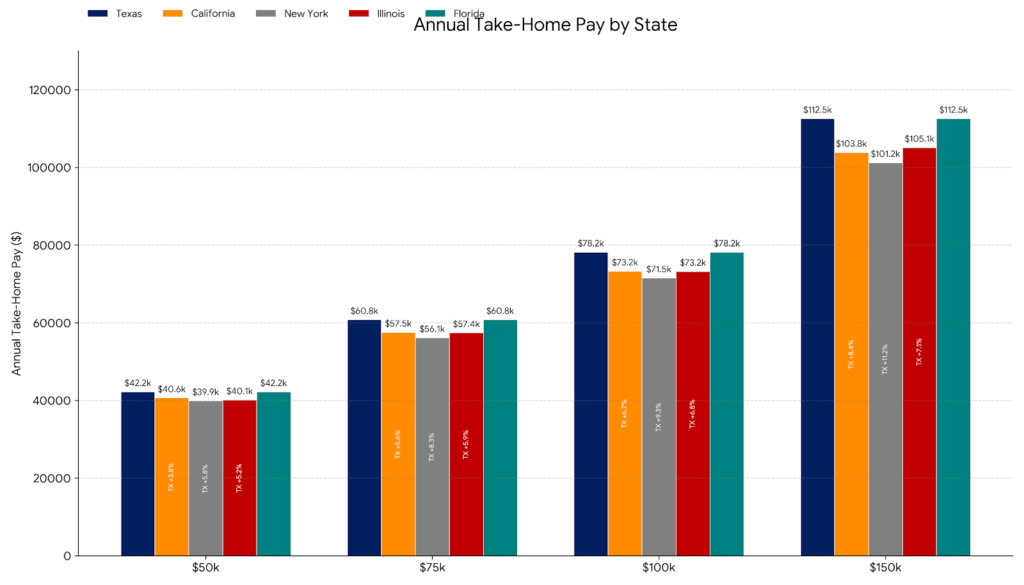
Total Tax Burden Rankings (% of median household income):
| State | Median Income | Total State/Local Tax | Effective Rate | vs Texas |
|---|---|---|---|---|
| Texas | $63,826 | $8,850 | 13.9% | Baseline |
| Florida | $59,227 | $7,670 | 12.9% | Lower |
| California | $78,672 | $12,571 | 16.0% | +2.1% |
| New York | $72,108 | $11,952 | 16.6% | +2.7% |
| Illinois | $68,428 | $10,980 | 16.0% | +2.1% |
| Washington | $77,006 | $9,470 | 12.3% | Lower |
| Nevada | $63,276 | $9,275 | 14.7% | +0.8% |
Analysis:
- Texas ranks 44th in state/local tax burden (7th lowest)
- Only no-income-tax states (FL, WA, NV) rank lower
- California/NY workers pay 2-3% more of income in state/local taxes
- Over career earning $60k average: $36,000-$54,000 more kept in Texas
Hidden Tax Benefits in Texas
Beyond obvious income tax savings, Texas provides additional financial benefits:
1. Simplified Tax Filing:
- No state return required (save $150-$300 if using tax preparer)
- Faster federal refunds (no state coordination needed)
- Less recordkeeping burden
2. No Quarterly Estimated Payments:
- Self-employed/contractors only estimate federal
- Side income doesn’t trigger state estimated payments
- Simpler cash flow management for freelancers
3. Easier Multi-State Work:
- Remote workers for out-of-state companies owe no Texas income tax
- Simpler than states requiring apportionment
- California-based companies can hire TX remote workers who keep more pay
4. Retirement-Friendly:
- Social Security benefits not taxed by state
- 401(k)/IRA withdrawals not subject to state tax
- Military retirement pay not taxed
- Makes Texas attractive for retirees
5. Investment Income Benefits:
- Capital gains not taxed by state
- Dividend income not taxed by state
- Interest income not taxed by state
- Better for investors building wealth
When Texas Tax Structure Might Not Favor You
Honest assessment: Texas doesn’t benefit everyone equally.
You Might Pay More in Texas If:
- You own expensive property ($800k+) – High property tax (1.8%) exceeds income tax savings at lower incomes
- You’re very low income ($20k-30k) – Sales tax is regressive; income tax states offer more credits
- You spend heavily on taxable goods – High consumption = more sales tax
- You’re self-employed with high expenses – Can’t deduct state income tax (removed in 2017 federal tax law anyway)
Example Where California Wins: Renter earning $25,000 annually:
- Texas: Pays 8.25% sales tax on most purchases (regressive burden)
- California: Pays little/no state income tax due to low income, benefits from renter credits and CalFresh
- California net advantage: ~$500-800 annually at this income level
For 95% of workers earning $30k+, Texas provides tax advantages. But lowest-income workers may benefit more from income-tax states with robust social programs.
Texas Minimum Wage and Living Standards
Texas Minimum Wage: $7.25/Hour
Texas follows federal minimum wage without state increase. At $7.25/hour:
- Annual gross (full-time): $15,080
- Monthly gross: $1,257
- After taxes: ~$13,126 net annually ($1,094/month)
Historical Context:
- Federal minimum set at $7.25 in 2009
- No adjustment for inflation in 17 years
- Real value declined ~31% due to inflation
- Would need to be ~$10.50 to match 2009 purchasing power
Texas Minimum Wage in Perspective:
| Comparison | Amount | Notes |
|---|---|---|
| Texas minimum | $7.25/hour | Tied with 20 states |
| Federal minimum | $7.25/hour | Same |
| California minimum | $16.50/hour | 128% higher |
| Austin living wage | $21.82/hour | 201% higher |
| Texas median wage | $20.50/hour | 183% higher |
Who Earns Texas Minimum:
- About 2.2% of Texas hourly workers (down from 5% in 2010)
- Concentrated in food service, retail, hospitality
- Often receive tips (tipped minimum $2.13/hour)
- Many entry-level positions now pay $10-12/hour due to labor market
Why Texas Hasn’t Raised Minimum:
- Free-market philosophy
- Belief that market should set wages
- Fear of business flight to states with lower minimums
- View that higher minimums hurt small businesses
- Political conservatism
Texas Minimum Wage Survival Analysis
Can you survive on $7.25/hour in Texas?
Monthly Budget at Minimum Wage ($1,094 net):
| Expense Category | Amount | % of Income |
|---|---|---|
| Rent (shared/rural) | $600 | 55% |
| Food | $200 | 18% |
| Transportation | $150 | 14% |
| Utilities | $80 | 7% |
| Phone | $40 | 4% |
| Total | $1,070 | 98% |
| Remaining | $24 | 2% |
Reality:
- $24/month leaves no room for healthcare, clothing, emergencies
- Requires shared housing or living with family
- No car payments possible (must buy used outright)
- Qualifies for Medicaid, SNAP (food assistance)
- Often requires multiple jobs or significant overtime
- Not sustainable for independent living in any Texas city
Why People Accept $7.25:
- Entry point to gain experience
- Part-time work while student
- Supplemental to household income
- Tips (servers, bartenders effectively earn $15-25/hour)
- Stepping stone to higher-paying positions
Texas Living Wage by Metro Area
Living wage calculations estimate income needed for basic necessities without assistance.
Texas Living Wage for Single Adult (2026):
| Metro Area | Living Wage | Monthly Required | Annual Required | vs $7.25 Gap | Median 1BR Rent |
|---|---|---|---|---|---|
| Austin | $21.82/hour | $3,816 | $45,386 | +$14.57/hr | $1,700 |
| Dallas | $20.00/hour | $3,500 | $41,600 | +$12.75/hr | $1,500 |
| Houston | $19.20/hour | $3,360 | $39,936 | +$11.95/hr | $1,350 |
| San Antonio | $18.00/hour | $3,150 | $37,440 | +$10.75/hr | $1,200 |
| Fort Worth | $19.50/hour | $3,413 | $40,560 | +$12.25/hr | $1,400 |
| El Paso | $16.50/hour | $2,888 | $34,320 | +$9.25/hr | $950 |
| Corpus Christi | $17.25/hour | $3,019 | $35,880 | +$10.00/hr | $1,100 |
| Arlington | $19.75/hour | $3,456 | $41,080 | +$12.50/hr | $1,450 |
| Plano | $20.50/hour | $3,588 | $42,640 | +$13.25/hr | $1,550 |
| Lubbock | $16.00/hour | $2,800 | $33,280 | +$8.75/hr | $900 |
Living Wage Components (Austin Example at $21.82/hour):
| Expense | Monthly | Annual | % of Income |
|---|---|---|---|
| Housing | $1,400 | $16,800 | 37% |
| Food | $400 | $4,800 | 11% |
| Transportation | $650 | $7,800 | 17% |
| Healthcare | $350 | $4,200 | 9% |
| Other (clothing, personal) | $300 | $3,600 | 8% |
| Taxes | $716 | $8,592 | 19% |
| Total | $3,816 | $45,792 | 100% |
Key Insights:
- Texas minimum wage covers only 33-48% of living wage
- Even $15/hour falls short of living wage in major metros
- Housing dominates budget (35-40% of living wage)
- Transportation costs higher than walkable cities (car-dependent state)
- Healthcare significant expense (Texas rejected Medicaid expansion)
Family Living Wage Requirements
Living wage dramatically increases with dependents.
Texas Family Living Wage (Two Working Adults + Two Children):
| Metro | Per Adult Required | Combined Family Required | Annual Family Income |
|---|---|---|---|
| Austin | $24.50/hour each | $49/hour total | $101,920 |
| Dallas | $22.75/hour each | $45.50/hour total | $94,640 |
| Houston | $21.80/hour each | $43.60/hour total | $90,688 |
| San Antonio | $20.25/hour each | $40.50/hour total | $84,240 |
| El Paso | $18.50/hour each | $37/hour total | $76,960 |
Single Parent + One Child:
| Metro | Required Hourly | Annual Required | Challenge |
|---|---|---|---|
| Austin | $42/hour | $87,360 | Extremely difficult |
| Dallas | $38/hour | $79,040 | Very difficult |
| Houston | $36/hour | $74,880 | Very difficult |
| San Antonio | $33/hour | $68,640 | Difficult |
Single parent minimum wage ($7.25) vs need ($33-42): Impossible without substantial assistance (childcare subsidies, SNAP, Medicaid, housing assistance).
Texas Cost of Living Regional Breakdown

Cost of Living Index (Texas Average = 100, National Average = 100):
| Region | Overall COL | Housing | Groceries | Transportation | Healthcare | Utilities |
|---|---|---|---|---|---|---|
| Austin | 119 | 145 | 102 | 108 | 98 | 105 |
| Dallas-Fort Worth | 107 | 120 | 98 | 105 | 96 | 102 |
| Houston | 103 | 110 | 96 | 103 | 95 | 98 |
| San Antonio | 99 | 105 | 94 | 100 | 93 | 95 |
| El Paso | 89 | 85 | 91 | 95 | 90 | 90 |
| Corpus Christi | 92 | 90 | 92 | 97 | 91 | 92 |
| Rural Texas | 83 | 70 | 90 | 95 | 88 | 88 |
Insights:
- Austin housing costs 45% above Texas average (tech boom impact)
- Dallas-Fort Worth housing 20% above average
- Houston relatively affordable for major metro
- San Antonio near Texas average
- El Paso and rural areas significantly cheaper
- Non-housing costs fairly consistent statewide
Texas Median Wages by Industry
Major Texas Industries and Typical Wages:
| Industry | Median Hourly | Annual | % of TX Workforce |
|---|---|---|---|
| Oil & Gas Extraction | $38.50 | $80,080 | 2.1% |
| Computer/IT | $42.00 | $87,360 | 3.8% |
| Healthcare Practitioners | $36.75 | $76,440 | 5.2% |
| Construction Trades | $22.50 | $46,800 | 8.4% |
| Manufacturing | $19.25 | $40,040 | 9.1% |
| Retail Sales | $13.50 | $28,080 | 12.3% |
| Food Service | $11.00 (+ tips) | $22,880 + tips | 8.7% |
| Education | $24.50 | $50,960 | 7.9% |
| Transportation/Warehousing | $18.50 | $38,480 | 7.2% |
| Business/Financial | $28.00 | $58,240 | 6.5% |
Texas Job Market Characteristics:
- Energy sector pays highest average wages
- Tech sector growing (especially Austin)
- Healthcare strong due to population growth
- Construction booming (population influx)
- Retail/food service pays near minimum + tips
- Manufacturing competitive with living wage in most areas
Texas vs National Median Wages:
- Texas overall median: $20.50/hour
- National median: $22.00/hour
- Texas 6.8% below national average
- BUT: Texas COL 8% below national average
- Net effect: Similar purchasing power
Texas Overtime Laws and Calculations
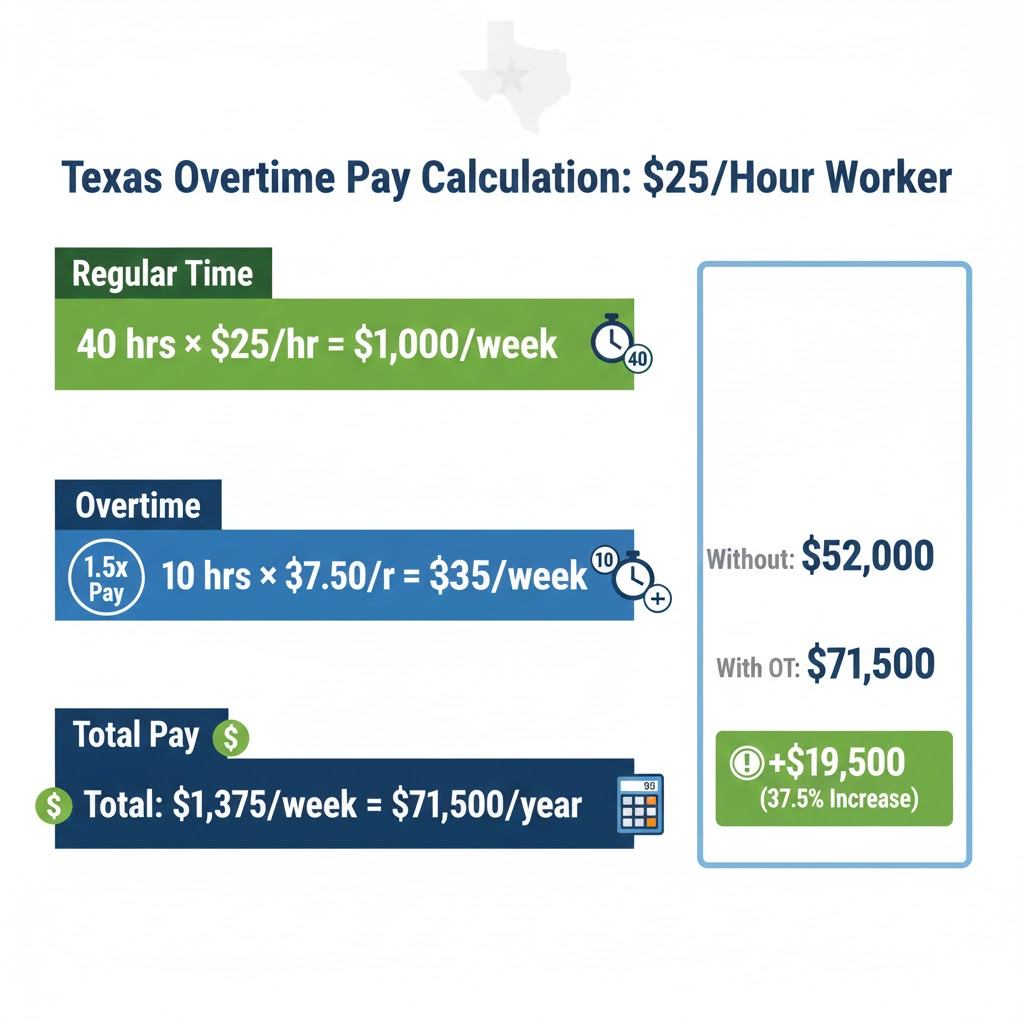
Texas follows federal Fair Labor Standards Act (FLSA) overtime regulations without additional state requirements. Understanding Texas overtime rules helps maximize earnings, especially in industries with regular extended hours.
Federal FLSA Overtime Rules in Texas
Basic Texas Overtime Requirements:
- Overtime pay required after 40 hours in a workweek
- Rate: 1.5 times regular hourly rate (time-and-a-half)
- No daily overtime requirement (unlike California’s 8-hour rule)
- Workweek defined as seven consecutive 24-hour periods
- No limit on hours an employer can require (for adults)
What Counts as Hours Worked:
- All time employee is required to be on duty
- Time performing work-related activities
- Short breaks (5-20 minutes) count as hours worked
- Meal breaks (30+ minutes) don’t count if completely relieved of duties
- On-call time may count depending on restrictions
- Training time typically counts
Texas-Specific Considerations:
- No state overtime law means FLSA is the only protection
- Agricultural workers often exempt from overtime
- Oil and gas field workers have special exemptions
- No “comp time” in private sector (public sector only)
Texas Overtime Calculation Examples
$18/Hour Worker with 10 Hours Overtime
Regular Pay Calculation:
- Regular hours: 40 hours/week
- Regular rate: $18/hour
- Regular weekly pay: 40 × $18 = $720
Overtime Calculation:
- Overtime hours: 10 hours/week
- Overtime rate: $18 × 1.5 = $27/hour
- Overtime pay: 10 × $27 = $270
Total Weekly Earnings:
- Regular pay: $720
- Overtime pay: $270
- Total weekly: $990
- Annual with consistent OT: $51,480
- vs standard 40-hour annual: $37,440
- Overtime earnings add: $14,040 annually (37.5% increase)
Annual Net Pay with Overtime:
- Gross annual: $51,480
- Federal income tax: ~$5,100 (9.9% effective)
- FICA: $3,938 (7.65%)
- Texas state tax: $0
- Annual net: $42,442
- Monthly net: $3,537
- Take-home percentage: 82.4%
Texas Advantage: Compare to California worker at same gross ($51,480):
- CA state tax: ~$1,800
- CA SDI: ~$618
- CA net pay: $40,024
- Texas nets $2,418 more annually ($201/month)
$25/Hour Nurse with Variable Overtime
Texas nurses often work overtime due to staffing shortages, especially in Houston’s medical center and Dallas-Fort Worth hospital systems.
Scenario: 50-hour work weeks
- Regular: 40 × $25 = $1,000
- Overtime: 10 × $37.50 = $375
- Weekly total: $1,375
- Annual: $71,500
Scenario: 55-hour work weeks
- Regular: 40 × $25 = $1,000
- Overtime: 15 × $37.50 = $562.50
- Weekly total: $1,562.50
- Annual: $81,250
Impact Analysis:
- Base 40-hour salary: $52,000
- 50-hour weeks: +$19,500 (37.5% increase)
- 55-hour weeks: +$29,250 (56.3% increase)
Net Pay at 55-Hour Weeks ($81,250 gross):
- Federal tax: ~$11,400 (14% effective)
- FICA: $6,216 (7.65%)
- Texas state tax: $0
- Net annual: $63,634
- Monthly net: $5,303
- Take-home: 78.3%
$30/Hour Oil Field Worker with Heavy Overtime
Texas oil and gas workers often work extended shifts during drilling operations or maintenance shutdowns.
Typical Schedule: 60-hour weeks (common in Permian Basin)
- Regular: 40 × $30 = $1,200
- Overtime: 20 × $45 = $900
- Weekly: $2,100
- Annual: $109,200
Breakdown:
- Base 40-hour salary: $62,400
- Overtime earnings: $46,800
- Overtime adds 75% to base income
Annual Net Pay:
- Federal tax: ~$17,800 (16.3% effective)
- FICA: $8,354 (7.65%)
- Texas state tax: $0
- Net annual: $83,046
- Monthly net: $6,921
- Take-home: 76.0%
Real-World Context:
- Permian Basin (Midland/Odessa) workers regularly earn $90k-120k
- Many work 7-on/7-off or 14-on/14-off schedules
- Housing costs lower in oil patch ($900-1,200/month)
- Cyclical industry requires saving during boom periods
- Texas tax advantage helps build emergency funds
Texas Overtime Exemptions
Not all Texas workers receive overtime. Understanding exemptions prevents wage theft and helps in job selection.
Common FLSA Exempt Categories:
1. Executive Exemption
- Primary duty: Managing enterprise or department
- Supervises two or more employees
- Authority to hire/fire or recommendations given weight
- Salary basis: $844/week minimum ($43,888 annually)
- No overtime regardless of hours worked
2. Administrative Exemption
- Office/non-manual work
- Primary duty: Discretion and independent judgment on significant matters
- Related to management or business operations
- Salary basis: $844/week minimum
- Examples: HR managers, marketing directors, finance analysts
3. Professional Exemption
- Advanced knowledge in field of science or learning
- Acquired through prolonged specialized instruction
- Salary basis: $844/week minimum
- Examples: Lawyers, doctors, engineers, accountants, teachers
4. Computer Employee Exemption
- Systems analyst, programmer, software engineer
- Salary basis: $844/week OR $27.63/hour
- Specific duties: System design, analysis, programming
- Does not include help desk or routine troubleshooting
Texas-Specific Exemptions:
Oil and Gas Exemptions:
- Section 13(b)(3) exempts certain oil and gas employees
- Field workers at well sites often exempt
- Applies to those engaged in production for interstate commerce
- Controversial exemption; some workers misclassified
Agricultural Exemptions:
- Workers employed by small farms (less than 500 man-days of labor in previous quarter)
- Immediate family members of farm owner
- Range workers primarily on the range
- Texas has significant agricultural workforce affected
Part-Time Work and Texas Hourly Calculations
Part-time employment is common in Texas, especially in retail, food service, and healthcare sectors. Understanding part-time pay helps workers budget and compare opportunities.
Part-Time Pay Calculations
20 Hours/Week at $15/Hour
Weekly and Annual Gross:
- Weekly: 20 × $15 = $300
- Annual: $300 × 52 = $15,600
Monthly Breakdown:
- Bi-weekly gross: $600
- Monthly gross: $1,300
Annual Net Pay:
- Federal income tax: ~$750 (4.8% effective – low due to standard deduction)
- FICA: $1,193 (7.65%)
- Texas state tax: $0
- Net annual: $13,657
- Monthly net: $1,138
- Take-home: 87.5%
Budget Reality: Monthly net of $1,138 in San Antonio:
- Rent (shared): $500-600
- Food: $250
- Transportation: $150
- Phone: $50
- Utilities: $60
- Total minimum: $1,010-1,110
- Remaining: $28-128/month
30 Hours/Week at $20/Hour
Gross Calculations:
- Weekly: 30 × $20 = $600
- Annual: $31,200
Net Pay:
- Federal tax: ~$2,200 (7.1% effective)
- FICA: $2,387 (7.65%)
- Net annual: $26,613
- Monthly net: $2,218
- Take-home: 85.3%
Key Threshold: 30 hours/week often triggers benefit eligibility:
- Health insurance (if company has 50+ employees)
- Retirement plan participation
- Higher PTO accrual
- More job security
Budget Analysis: $2,218/month in Dallas:
- Rent (1BR): $1,200-1,400
- Remaining: $818-1,018
- Can afford independent living
- Tight budget but viable
Variable Hours Part-Time Work
Many Texas part-time jobs have fluctuating schedules, making budgeting difficult.
Retail Example: 15-30 Hours/Week at $13/Hour
Low Week (15 hours):
- Weekly gross: $195
- Monthly net: ~$866
Average Week (22 hours):
- Weekly gross: $286
- Monthly net: ~$1,270
Busy Week (30 hours):
- Weekly gross: $390
- Monthly net: ~$1,734
Reality of Variable Schedules:
- Income swings from $866 to $1,734/month
- Difficult to budget for fixed expenses (rent)
- Many retail workers need second job to stabilize income
- Holiday season provides more hours (November-December)
Self-Employment and 1099 Contract Work in Texas
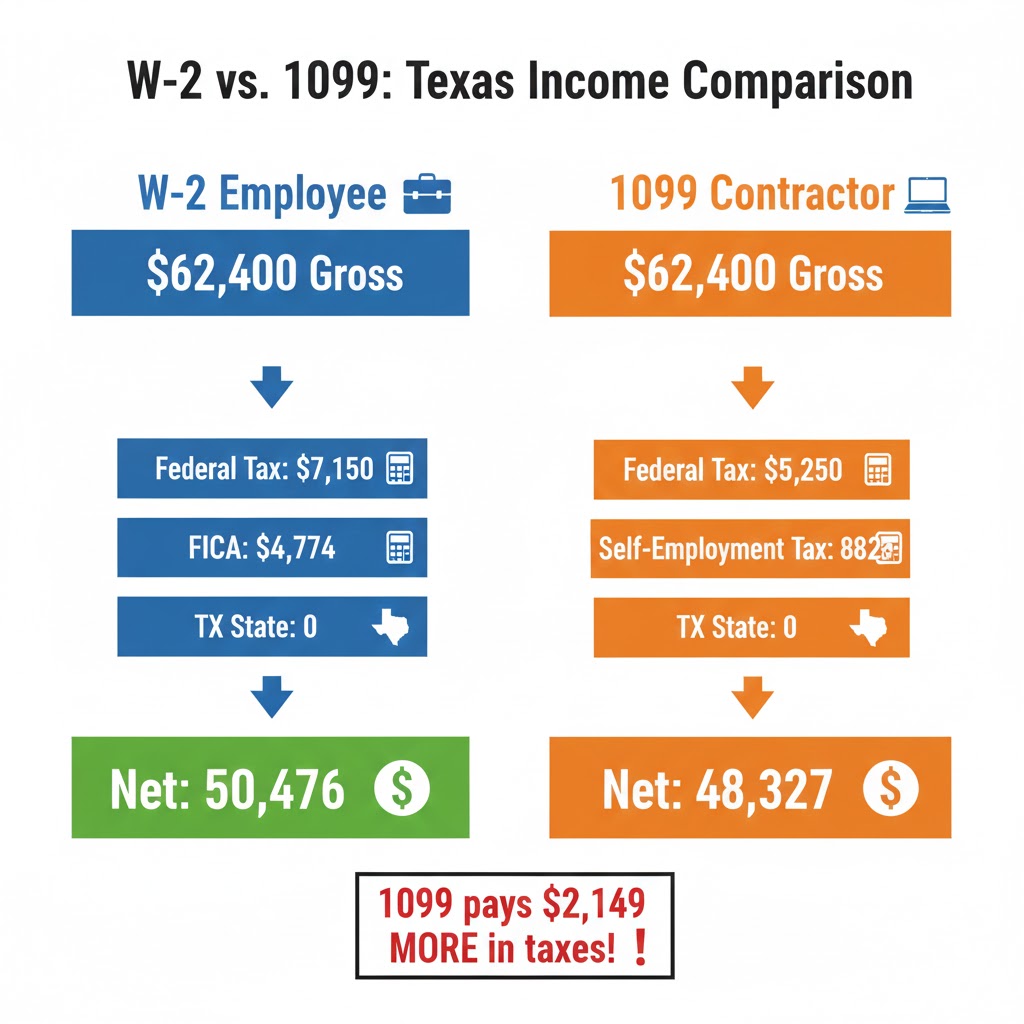
Texas’s business-friendly environment and zero state income tax make it attractive for freelancers and contractors. However, self-employment brings additional tax obligations.
Self-Employment Tax in Texas
Federal Self-Employment Tax:
- Rate: 15.3% on net self-employment income
- Breakdown: 12.4% Social Security + 2.9% Medicare
- Applies to net earnings over $400
- This is in ADDITION to federal income tax
- Texas charges no state-level self-employment tax
Why 15.3% Instead of 7.65%? W-2 employees pay 7.65% FICA, employer pays matching 7.65%. Self-employed individuals pay both halves, totaling 15.3%.
Deduction: You can deduct half of self-employment tax (7.65%) when calculating income tax, slightly reducing the burden.
1099 Contractor Calculation Examples
$30/Hour 1099 Contractor vs W-2 Employee
1099 Contractor Gross Income:
- Hourly billing: $30
- Hours per week: 40
- Annual gross: $62,400
Self-Employment Tax:
- Net self-employment income: $62,400
- Self-employment tax: $62,400 × 92.35% × 15.3% = $8,823
- Deductible portion: $4,412
Federal Income Tax:
- Adjusted gross income: $62,400 – $4,412 = $57,988
- Standard deduction: $14,600
- Taxable income: $43,388
- Federal tax: ~$5,250
Total Tax:
- Self-employment tax: $8,823
- Federal income tax: $5,250
- Texas state tax: $0
- Total: $14,073
Net Income:
- Gross: $62,400
- Taxes: $14,073
- Net: $48,327
- Monthly: $4,027
- Take-home: 77.4%
Compare W-2 Employee at $30/Hour:
- Gross: $62,400 (same)
- Federal income tax: ~$7,150
- FICA (employee): $4,774
- Texas state tax: $0
- Total worker pays: $11,924
- Net: $50,476
- Monthly: $4,206
- Take-home: 80.9%
1099 vs W-2 Comparison:
- W-2 nets $2,149 more annually ($179/month)
- 1099 pays $2,149 more in taxes (employer tax now on contractor)
- 1099 contractor needs $33/hour to equal $30/hour W-2 net pay
$50/Hour Freelance Developer (1099)
Annual Gross:
- Billable hours: 1,800 (allowing for non-billable time)
- Annual gross: $90,000
Business Expenses (Deductible):
- Home office: $3,000
- Computer/software: $2,500
- Internet/phone: $1,200
- Professional development: $1,500
- Marketing: $1,000
- Accounting/legal: $800
- Total expenses: $10,000
Net Self-Employment Income:
- Gross: $90,000
- Expenses: $10,000
- Net: $80,000
Self-Employment Tax:
- $80,000 × 92.35% × 15.3% = $11,304
- Deductible: $5,652
Federal Income Tax:
- AGI: $80,000 – $5,652 = $74,348
- Standard deduction: $14,600
- Taxable: $59,748
- Federal tax: ~$9,150
Total Tax Burden:
- Self-employment tax: $11,304
- Federal income tax: $9,150
- Texas state tax: $0
- Total: $20,454
Net Income:
- Gross: $90,000
- Expenses: $10,000
- Taxes: $20,454
- Net: $59,546
- Monthly: $4,962
- Take-home: 66.2% (of gross) or 74.4% (of net income after expenses)
Texas Gig Economy Earnings
Rideshare Driver (Uber/Lyft)
Example: 30 Hours/Week Average $22/Hour
- Weekly gross: $660
- Annual gross: $34,320
Business Expenses:
- Mileage: 20,000 miles × $0.67 = $13,400
- Car washes: $400
- Phone: $600
- Snacks/water: $300
- Total: $14,700
Net Self-Employment Income:
- Gross: $34,320
- Expenses: $14,700
- Net: $19,620
Taxes:
- Self-employment tax: $2,780
- Federal income tax: ~$1,000
- Total tax: $3,780
Net Income After All Costs:
- Net income: $19,620
- Taxes: $3,780
- Take-home: $15,840
- Monthly: $1,320
- Effective hourly rate: $10.16/hour
Reality Check: $22/hour gross becomes $10.16/hour net after expenses and taxes. Still viable for flexibility and supplemental income, but not comparable to $22/hour W-2 job netting $19/hour.
Texas Payroll Deductions Deep Dive
Understanding every deduction helps verify paychecks and plan finances accurately in Texas’s simplified tax environment.
Federal Income Tax Withholding
How Federal Withholding Works:
Your employer withholds federal income tax based on:
- Filing status (Single, Married Filing Jointly, Married Filing Separately, Head of Household)
- Number of dependents claimed
- Additional withholding requested
- W-4 form information
2026 Federal Tax Brackets (Single Filers):
| Taxable Income | Tax Rate | Tax Owed |
|---|---|---|
| $0 – $11,925 | 10% | 10% of income |
| $11,926 – $48,475 | 12% | $1,193 + 12% of amount over $11,925 |
| $48,476 – $103,350 | 22% | $5,579 + 22% of amount over $48,475 |
| $103,351 – $197,300 | 24% | $17,651 + 24% of amount over $103,350 |
| $197,301 – $250,525 | 32% | $40,219 + 32% of amount over $197,300 |
| $250,526 – $626,350 | 35% | $57,271 + 35% of amount over $250,525 |
| $626,351+ | 37% | $188,860 + 37% of amount over $626,350 |
Standard Deduction 2026:
- Single: $14,600
- Married Filing Jointly: $29,200
- Head of Household: $21,900
Texas-Specific W-4 Consideration: Since Texas has no state income tax, you never fill out a state W-4. This simplifies onboarding and reduces errors compared to states requiring both federal and state forms.
FICA Taxes Breakdown
FICA (Federal Insurance Contributions Act) taxes fund Social Security and Medicare. All Texas workers pay FICA regardless of employment type.
FICA Components:
1. Social Security Tax
- Rate: 6.2% (employee) + 6.2% (employer) = 12.4% total
- Wage base limit: $176,100 (2026)
- Maximum employee contribution: $10,918 annually
- Earnings above $176,100 not subject to Social Security tax
2. Medicare Tax
- Rate: 1.45% (employee) + 1.45% (employer) = 2.9% total
- No wage limit (all earnings taxed)
- Unlimited maximum contribution
3. Additional Medicare Tax
- Rate: 0.9% on earnings above threshold
- Thresholds: $200,000 (single), $250,000 (married filing jointly)
- Employee pays only (no employer match)
Total FICA for Most Workers: 7.65% (6.2% Social Security + 1.45% Medicare)
FICA Calculation Examples:
$40,000 Annual Salary:
- Social Security: $40,000 × 6.2% = $2,480
- Medicare: $40,000 × 1.45% = $580
- Total FICA: $3,060 (7.65%)
$100,000 Annual Salary:
- Social Security: $100,000 × 6.2% = $6,200
- Medicare: $100,000 × 1.45% = $1,450
- Total FICA: $7,650 (7.65%)
$250,000 Annual Salary:
- Social Security: $176,100 × 6.2% = $10,918 (capped)
- Medicare: $250,000 × 1.45% = $3,625
- Additional Medicare: $50,000 × 0.9% = $450
- Total FICA: $14,993 (6.0% effective)
Pre-Tax Deductions
Pre-tax deductions reduce taxable income, lowering federal income tax and FICA (for some deductions).
1. 401(k) / 403(b) Retirement Contributions
Limits (2026):
- Employee contribution: $23,500
- Age 50+ catch-up: Additional $7,500
Example: $70,000 Salary Contributing $10,000
Without 401(k):
- Gross: $70,000
- Federal tax: ~$8,200
- FICA: $5,355
- Take-home: $56,445
With $10,000 401(k):
- Gross: $70,000
- 401(k) contribution: $10,000
- Taxable income: $60,000
- Federal tax: ~$6,000
- FICA: $5,355 (same)
- Take-home: $48,645
- Plus $10,000 in retirement account
- Total wealth: $58,645 (vs $56,445)
Tax Savings: $2,200 federal tax saved. Effective cost of $10,000 contribution: $7,800.
2. Health Savings Account (HSA)
Contribution Limits (2026):
- Individual: $4,300
- Family: $8,550
- Age 55+ catch-up: $1,000
Triple Tax Advantage:
- Contributions pre-tax (reduce federal income tax and FICA)
- Growth tax-free
- Withdrawals tax-free for qualified medical expenses
3. Health Insurance Premiums
Example: $50,000 Salary, $200/Month Premium
Annual Premium Cost: $2,400
Tax Savings:
- Federal tax savings (22% bracket): ~$528
- FICA savings (7.65%): ~$184
- Total savings: $712
- Effective premium cost: $1,688
Texas Health Insurance Costs: Average monthly premiums (employer-sponsored):
- Individual: $150-250
- Family: $500-800
4. Flexible Spending Account (FSA)
Healthcare FSA:
- 2026 limit: $3,200
- Use-it-or-lose-it (must spend within plan year)
- Pre-tax for federal income tax and FICA
Dependent Care FSA:
- 2026 limit: $5,000 per household
- Covers childcare, preschool, summer camp
- Pre-tax advantage significant for Texas families
Post-Tax Deductions
Post-tax deductions come out after federal income tax and FICA calculated. No immediate tax benefit.
Common Post-Tax Deductions:
- Roth 401(k) contributions
- Life insurance premiums (coverage over $50,000)
- Disability insurance
- Union dues
- Wage garnishments (child support, tax liens)
Benefits Valuation and Total Compensation
Hourly rate or salary is only part of compensation. Benefits add significant value in Texas’s zero-income-tax environment.
How to Value Benefits Packages
Common Benefits and Estimated Values:
1. Health Insurance
- Employer contribution: $400-800/month individual, $1,000-1,500/month family
- Annual value: $5,000-18,000
2. Retirement Match
- Common: 50% match up to 6% of salary
- $50,000 salary: 6% = $3,000, match = $1,500
- Annual value: $1,000-5,000+
3. Paid Time Off (PTO)
- 2 weeks: Worth 4% of salary
- 3 weeks: Worth 6% of salary
- 4 weeks: Worth 8% of salary
4. Paid Holidays
- Typical: 8-10 days
- Worth 3-4% of salary
Total Compensation Calculation Examples
$55,000 Salary with Standard Benefits
Base Compensation:
- Annual salary: $55,000
Benefits Package:
- Health insurance: $5,400
- 401(k) match: $1,650
- 2 weeks PTO: $2,115
- 8 paid holidays: $1,692
- Life insurance: $300
- Total benefits value: $11,157
Total Compensation: $55,000 + $11,157 = $66,157
True hourly value: $31.81/hour
Benefits add 20.3% to base salary
Comparing Two Job Offers
Offer A: Tech Startup
- Salary: $85,000
- Benefits value: ~$8,500
- Total comp: $93,500
Offer B: Established Company
- Salary: $78,000
- Benefits value: ~$22,000
- Total comp: $100,000
Analysis: Offer B provides $6,500 more in total comp despite $7,000 lower salary. Better insurance, extra PTO, and higher 401(k) match make the difference.
Texas Job Market and Wage Trends (2026)
Understanding current Texas employment landscape helps contextualize your salary and identify growth opportunities.
Fastest-Growing Texas Industries
1. Technology
- Austin “Silicon Hills” boom continues
- Average tech salaries: $70,000-$150,000
- Growth rate: 15-20% annually
2. Healthcare
- Aging population driving demand
- Average salaries: $45,000-120,000
- Growth rate: 12-15% annually
3. Renewable Energy
- Wind and solar investment surging
- Average salaries: $50,000-95,000
- Growth rate: 18-22% annually
4. Oil and Gas (Cyclical)
- Permian Basin activity high
- Average salaries: $60,000-130,000
- Growth rate: Variable
5. Logistics and Distribution
- E-commerce warehouses expanding
- Average salaries: $35,000-75,000
- Growth rate: 10-12% annually
Texas Metro Area Wage Trends
Austin:
- Median household income: $85,000 (highest in Texas)
- Tech sector driving wages up 8-12% annually
- Cost of living index: 119
Dallas-Fort Worth:
- Median household income: $72,000
- Corporate relocations boosting professional salaries
- Cost of living index: 107
Houston:
- Median household income: $64,000
- Energy sector stabilizing
- Cost of living index: 103
San Antonio:
- Median household income: $58,000
- Military, healthcare, tourism base
- Cost of living index: 99
El Paso:
- Median household income: $51,000
- Border economy, logistics, military
- Cost of living index: 89
Best Texas Cities for Different Careers
Tech Professionals:
- Austin (highest salaries, most opportunities)
- Dallas (growing sector, lower COL)
- Houston (emerging tech hub)
Healthcare Workers:
- Houston (Texas Medical Center)
- Dallas (major hospital systems)
- San Antonio (Military medicine)
Oil and Gas:
- Houston (headquarters)
- Midland/Odessa (field work)
- Dallas (corporate offices)
Finance/Business:
- Dallas (corporate headquarters hub)
- Houston (energy finance)
- Austin (venture capital, fintech)
Trades:
- Austin (highest pay due to boom)
- Dallas-Fort Worth (steady work)
- Houston (large market)
Negotiating Salary in Texas
Texas’s zero-income-tax structure provides unique negotiating leverage.
Using Texas Tax Advantage in Negotiations
Scenario: Relocating from California to Texas
Example Negotiation:
Initial Offer: $95,000 (Texas tech role)
Your analysis:
- TX net at $95k: ~$71,500
- CA net at $115k: ~$79,000 (comparable role)
- CA worker nets $7,500 more despite lower gross
Counter: “I appreciate the offer. Given my experience and the value I’ll bring, I was hoping for $108,000. This would put me at the higher end of the Texas market while still representing savings compared to hiring in California. At that level, my take-home in Texas would be approximately $79,000, which feels appropriate for my skill level.”
Outcome: Likely settle at $100,000-105,000, still saving company money vs CA hire while improving your position.
Comparing Offers Across States
Framework for Multi-State Job Comparison:
- Calculate net pay (after all taxes)
- Calculate total comp (net pay + benefits value)
- Adjust for cost of living
- Compare purchasing power equivalent
Example: Three Offers
Texas Offer:
- Salary: $90,000
- Benefits: $18,000
- Net pay: $67,950
- COL index: 103
- Adjusted value: $65,971
California Offer:
- Salary: $115,000
- Benefits: $22,000
- Net pay: $81,200
- COL index: 149 (SF Bay Area)
- Adjusted value: $54,497
Florida Offer:
- Salary: $88,000
- Benefits: $16,000
- Net pay: $66,550
- COL index: 101
- Adjusted value: $65,891
Analysis: Texas and Florida roughly equivalent in purchasing power. California offers higher absolute dollars but significantly lower real value after taxes and COL.
When to Negotiate Hourly vs Salary
Favor Hourly When:
- Overtime is regular and expected
- You want schedule flexibility
- Industry norm is hourly (retail, trades, food service)
- You’re early career
Favor Salary When:
- Predictable income needed for budgeting/mortgage
- Career advancement path (management roles)
- Better total comp package typically included
- You’ll work variable hours
Negotiation Scripts for Texas Workers
Script 1: Salary Increase Request
“Thank you for the offer of $65,000. Based on my research of the Texas market for [role] with my experience level, I’m seeing ranges of $70,000-$80,000. Given my [specific achievement/skill], I was hoping we could meet at $72,000. I’m excited about this opportunity and believe I can deliver significant value.”
Script 2: Benefits Negotiation
“I’m excited about this role. The salary of $60,000 is in line with my expectations. However, I noticed the benefits package includes only 2 weeks of PTO. Given my [years of experience/specialized skills], would it be possible to start with 3 weeks? I believe this would allow me to maintain the work-life balance that helps me perform at my best.”
Script 3: 1099 vs W-2 Rate
“Thank you for offering the 1099 contractor position at $45/hour. I’ve calculated my costs – self-employment tax, health insurance, lack of PTO, and equipment – and these add approximately 30% to my overhead. To make this equivalent to a W-2 position, I’d need to be at $58/hour. Could we discuss that rate?”
Bottom Line: Maximizing Your Texas Earnings
Texas’s zero-income-tax structure provides real financial advantages, but maximizing your earnings requires strategic thinking beyond just the hourly rate or salary number.
Key Takeaways for Texas Workers
1. Know Your True Hourly Value
Don’t just compare gross wages between states. Calculate net take-home after all taxes, factor in cost of living for true purchasing power, and include benefits in total compensation analysis. A $60,000 salary in Texas nets approximately $49,000 – the same gross in California nets about $46,200. That $2,800 annual difference compounds to $84,000+ over a 30-year career.
2. Leverage Texas Tax Advantage Strategically
Use Texas’s zero state income tax in salary negotiations when relocating. A higher gross salary in California or New York may equal lower net pay than a Texas position. Save the difference (2-8% of income) for wealth building. Over a career, this can mean $50,000-$250,000+ in additional wealth accumulation.
3. Understand Overtime Economics
Texas follows federal rules requiring time-and-a-half after 40 hours weekly (no daily overtime like California). Overtime can boost annual income by 30-75% in industries with regular extended hours. Factor overtime potential when comparing job offers – a $25/hour position with consistent 10-hour weekly overtime ($71,500 annually) significantly outearns a $30/hour straight-time role ($62,400 annually).
4. Optimize Pre-Tax Deductions
Maximize 401(k), HSA, and FSA contributions. These reduce federal tax burden (though Texas state tax is already zero). At $75,000 salary, contributing $10,000 to 401(k) plus $3,000 to HSA saves approximately $3,000 in federal taxes annually. Take full advantage of employer matches – it’s free money that immediately boosts your compensation.
5. Value Benefits Properly
Benefits packages can add 20-35% to base compensation. Health insurance employer contributions, 401(k) matches, PTO, and paid holidays have real dollar values. A company offering $70,000 with excellent benefits may provide better total compensation than $80,000 with minimal benefits. Always calculate total compensation when comparing offers.
6. Understand 1099 vs W-2 Economics
Independent contractors (1099) need 25-30% higher gross income to equal W-2 employee net pay due to self-employment tax (15.3%). However, deductible business expenses can offset this if tracked properly. 1099 work makes most financial sense when you can charge premium rates ($60+/hour) or have substantial deductible expenses.
7. Choose Your Metro Strategically
Austin offers highest wages but highest costs (especially housing). Dallas provides good wage-to-cost balance. Houston offers moderate wages with affordable living and a large job market. San Antonio has lower wages but lowest major-metro costs. Rural Texas offers significant cost savings but limited career advancement opportunities. Match your career stage to the appropriate metro.
8. Plan for Limited Safety Nets
Texas offers minimal state-level support – no state-mandated sick leave, family leave, or disability insurance. Build a larger emergency fund (6+ months expenses minimum). Health insurance is critical since Texas didn’t expand Medicaid. Budget carefully even with higher take-home pay to cover gaps that state programs fill elsewhere.
9. Negotiate with Data and Confidence
Research Texas market rates by metro area before negotiations. Lead with your value, not your needs. Ask for 10-15% above initial offer if research shows you’re underpaid. Consider entire compensation package, not just salary. Use multiple offers for leverage when possible. The zero-state-tax talking point provides unique negotiating angles when relocating from high-tax states.
10. Track Your Financial Progress
Know your effective tax rate (total taxes divided by gross income), not just marginal rate. Understand your true hourly value after all taxes and expenses (especially important for 1099 contractors and gig workers). Monitor your take-home percentage – should typically be 75-85% for W-2 employees. Verify employer paycheck calculations regularly, as errors do occur.
The Texas Advantage in Practice
The mathematics clearly favor Texas for most workers. Consider a mid-career professional earning $75,000 annually:
Texas worker nets: ~$59,462 (79.3% take-home) California worker nets: ~$55,412 (73.9% take-home) Annual Texas advantage: $4,050
Over a 30-year career at this income level, the Texas worker accumulates an additional $121,500 in after-tax earnings compared to their California counterpart – and that’s before considering investment growth on those savings. For higher earners ($100,000-$150,000), the gap widens to $7,600-$12,000 annually, creating lifetime advantages of $228,000-$360,000.
Making the Right Financial Decision
While Texas’s tax structure provides clear advantages, the best financial decision balances multiple factors:
Compensation: Competitive pay for your skills and experience level Career Growth: Opportunities to increase long-term earning power through advancement and skill development Cost of Living: Actual expenses for housing, transportation, healthcare in your specific metro Life Quality: Work-life balance, family proximity, personal happiness, cultural fit Long-Term Trajectory: Where this position leads you in 5-10 years professionally
Texas excels in the first three categories for most workers. The zero-income-tax environment means higher take-home pay. Growing industries (tech, healthcare, renewable energy, logistics) provide career advancement paths. Major metros offer big-city amenities at costs 30-50% below comparable cities in California or New York.
Your Action Plan
Whether you’re currently working in Texas or considering relocation, use these strategies to optimize your financial position:
If you’re job searching: Calculate net pay (not just gross) for every offer. Factor in total compensation including benefits. Adjust for cost of living if comparing cities. Negotiate confidently using market data.
If you’re currently employed: Verify you’re paid competitively using salary research tools. Maximize employer benefits (especially free money like 401(k) matches). Build that Texas take-home advantage into wealth through consistent saving and investing. Consider strategic job changes every 2-3 years if current employer won’t match market rates.
If you’re self-employed: Track all business expenses meticulously for tax deductions. Make quarterly estimated tax payments to avoid penalties. Charge rates that account for 15.3% self-employment tax plus lack of benefits. Consider S-Corp election if netting $60,000+ to reduce self-employment tax burden.
If you’re relocating to Texas: Negotiate salary using your research and the tax advantage talking point. Establish Texas residency immediately (license, registration, voter) to avoid prior-state tax claims. Build new professional networks quickly. Take advantage of lower housing costs to buy sooner if that aligns with your goals.
Final Thoughts
Texas provides a tax-efficient environment where workers keep more of their earnings. The absence of state income tax isn’t just a talking point – it’s a real advantage that compounds over time. A worker earning $60,000 annually keeps approximately $3,000 more per year in Texas than in California. That difference, invested consistently over a career, grows to six figures.
However, money isn’t everything. The best career decisions balance financial advantage with professional growth, personal fulfillment, and life circumstances. Texas offers strong financial fundamentals through its tax structure, growing economy, and reasonable living costs. Whether those advantages align with your broader life goals is a decision only you can make.
Use the calculators, examples, and strategies in this comprehensive guide to make informed decisions about your Texas earnings. Understand the full picture from gross to net, hourly to annual, base salary to total compensation. Knowledge is power, and in Texas’s worker-friendly tax environment, that knowledge translates directly to keeping more of your hard-earned money.
The Lone Star State’s economic opportunity is real. Whether you’re earning $15/hour starting out or $50/hour as an experienced professional, Texas’s zero-income-tax structure means your paycheck goes further. Make strategic choices about where you work, how you negotiate, and how you manage that take-home advantage. Your financial future depends not just on what you earn, but on what you keep – and in Texas, you keep more.