Calculate your Ontario annual salary from hourly wage instantly, including combined federal (14%-33%) and Ontario provincial tax (5.05%-13.16%), CPP contributions, EI premiums, and Ontario Health Premium. Our free hourly to yearly salary calculator Ontario shows your exact take-home pay after all Canadian deductions.
Hourly Rate $24.04 Based on $50,000/yr · 40 hrs/wk Est. Net/hr $17.82 after tax & deductions Gross Annual $50,000.00 Federal Tax −$7,579.80 Ontario Tax −$2,810.29 CPP −$2,867.78 EI −$830.00 Ontario Health Premium −$300.00 Net Annual Take-Home $35,612.13 Gross Monthly $4,166.67 Total Deductions/mo −$1,198.99 Net Monthly Take-Home $2,967.68 Federal Income Tax −$7,579.8015.2% Ontario Provincial Tax −$2,810.295.6% CPP Contributions −$2,867.785.7% EI Premiums −$830.001.7% Ontario Health Premium −$300.000.6% Marginal Federal Rate 20.5% Marginal Ontario Rate 9.15% Combined Marginal Rate 29.65% Effective Total Rate 28.8% $ $ 🍁 Ontario Deductions (2026) Canada Pension Plan (CPP) 5.95% · max $3,867.50/yr Employment Insurance (EI) 1.66% · max $1,049.12/yr Ontario Health Premium (OHP) $0–$900/yr based on income ℹ️ Estimates use 2026 federal and Ontario provincial tax brackets, CPP, EI, and Ontario Health Premium rates. Results are gross-to-net approximations. Consult a tax professional for precise figures.Working in the US? Our main calculator covers all 50 states with US-specific tax rates.
🇺🇸 US Calculator →Whether you earn Ontario’s minimum wage of $17.60 per hour or $60+ per hour in Toronto, this calculator provides accurate results based on Canada’s progressive tax system and Ontario-specific deductions. You can also convert Ontario annual salary to hourly rate using the reverse calculator.
Ontario workers benefit from Canada’s universal healthcare but face combined federal and provincial taxes ranging from 20% to 53.53% depending on income. Understanding your true earnings helps with budgeting, job comparisons, and financial planning across Ontario’s diverse regions from Greater Toronto Area to Ottawa, Hamilton, London, and Northern Ontario communities.
Hourly to Yearly Salary Calculator Ontario (Interactive Tool)
Calculate your Ontario salary using our homepage 2-in-1 hourly wage to salary calculator with advanced location settings. Input your hourly rate (ON minimum: $17.20 province wide), add overtime, and instantly see your take-home pay after Ontario’s progressive provincial tax (5.05%-13.16%), CPP (5.95%), EI (1.66%), and all federal deductions.
How to Use This Ontario Calculator
Step 1: Enter your Ontario hourly wage Input your current or expected hourly rate. Ontario’s minimum wage is $17.60/hour as of October 1, 2025 (effective until September 30, 2026), with annual inflation adjustments each October 1st.
Step 2: Input your working hours Enter hours per week (40 for full-time) and weeks per year (52 standard, or adjust for vacation time).
Step 3: Add overtime if applicable Ontario follows federal overtime rules requiring time-and-a-half after 44 hours per week (note: 44 hours, not 40 like most provinces). Input your typical overtime hours for accurate calculations.
Step 4: Review your Ontario results The calculator displays your gross salary plus all Canadian deductions including federal tax, Ontario provincial tax, CPP (5.95% first tier + 4% second tier), EI (1.63%), and Ontario Health Premium (up to $900), showing your net take-home pay.
Your Results Breakdown
Once you enter your information, the calculator shows:
Gross Income:
- Hourly rate
- Daily earnings (8-hour day)
- Weekly gross pay
- Bi-weekly gross pay (most common in Ontario)
- Monthly gross pay
- Annual salary
Federal Deductions (apply to all Canadians):
- Federal income tax (14%, 20.5%, 26%, 29%, 33% brackets)
- Canada Pension Plan (CPP): 5.95% up to $74,600 + 4% on $74,600-$85,000
- Employment Insurance (EI): 1.63% up to $68,900
Ontario Provincial Deductions:
- Ontario income tax (5.05%, 9.15%, 11.16%, 12.16%, 13.16% brackets)
- Ontario surtax (20% on tax over $5,710 + additional 36% on tax over $7,307)
- Ontario Health Premium ($0-$900 based on taxable income)
Net Take-Home Pay:
- After all federal and Ontario deductions
- Monthly take-home amount
- Actual spending power in Ontario dollars
Ontario vs. Other Provinces:
- How your Ontario take-home compares to Alberta (lower provincial tax) or Quebec (higher taxes but different system)
- Combined effective tax rate in Ontario
- True hourly rate after all Canadian and Ontario taxes
HOW TO CALCULATE HOURLY TO YEARLY SALARY IN ONTARIO
Understanding Ontario salary calculations helps you verify results and make informed decisions for job offers or salary negotiations in Canada’s most populous province.
Ontario Health Premium Calculation Formula (2026)
The Ontario Health Premium is calculated based on your taxable income using a bracket formula. Find your income bracket below and apply the formula to get your exact premium.
| $20,000 or less | No premium | $0 |
| $20,001 – $36,000 | 6% of income over $20,000 | Up to $300 |
| $36,001 – $48,000 | $300 + 6% of income over $36,000 | Up to $450 |
| $48,001 – $72,000 | $450 + 25% of income over $48,000 | Up to $600 |
| $72,001 – $200,600 | $600 + 25% of income over $72,000 | Up to $750 |
| Over $200,600 | Flat rate | $900 |
Quick examples:
- $37,752 income → $300 + ($1,752 × 6%) = $405
- $45,000 income → $300 + ($9,000 × 6%) = $840, capped at $450
- $65,000 income → $450 + ($17,000 × 25%) = $4,700, capped at $600
- $85,000 income → $600 + ($13,000 × 25%) = $3,850, capped at $750
The premium is paid through your annual T1 tax return, not deducted from your paycheck.
Hourly to Yearly Salary Calculator Ontario: Real Examples
The core formula is straightforward, but Canada’s federal-provincial tax system significantly impacts take-home pay:
Gross Annual Salary = Hourly Rate × Hours Per Week × Weeks Per Year
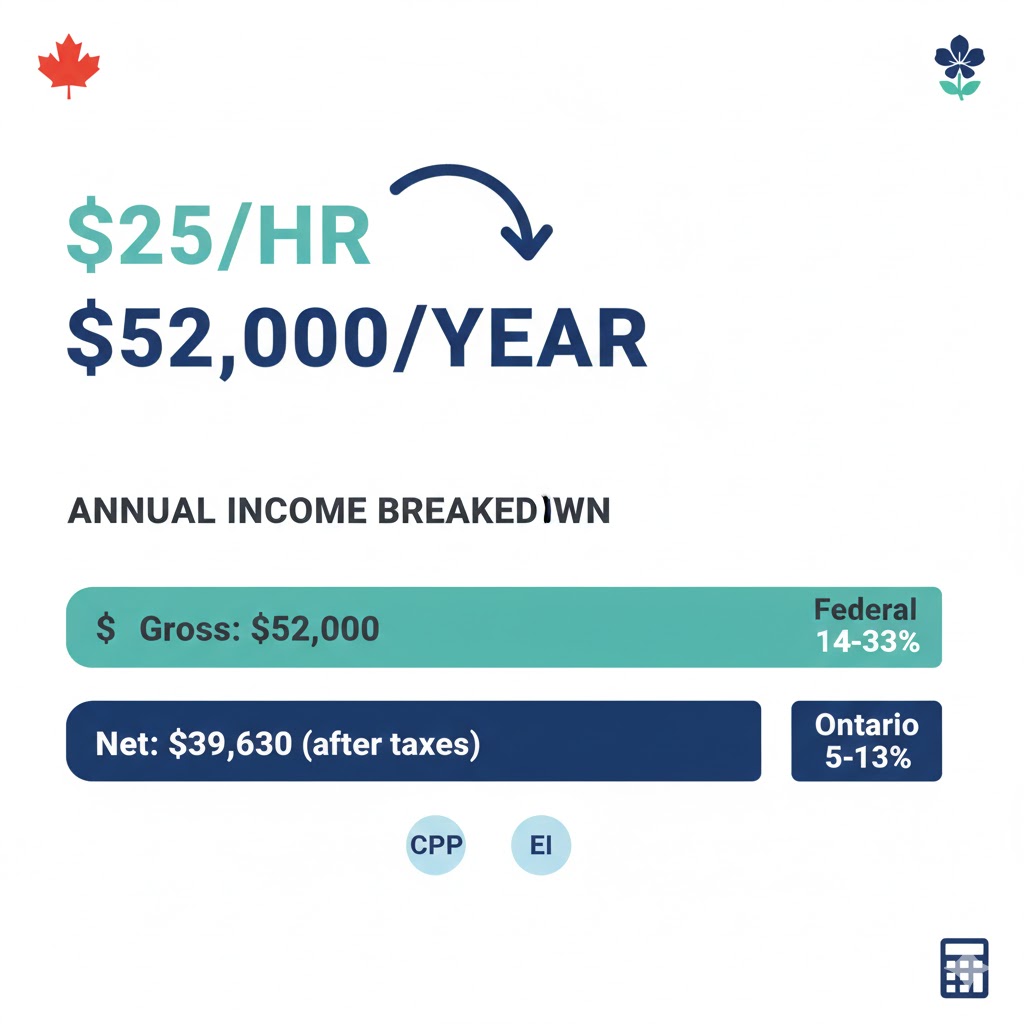
For Ontario workers at $25/hour, 40 hours/week, 52 weeks/year: $25 × 40 × 52 = $52,000 gross annual salary
However, Ontario net pay calculation requires subtracting:
- Federal income tax (~12% effective at $52k)
- Ontario provincial tax (~6.5% effective at $52k)
- CPP contributions: $3,097
- EI premiums: $832
- Ontario Health Premium: $600
Net annual pay: ~$36,600 (70% of gross)
In comparison, the same $52,000 salary in Alberta yields ~$38,200 net pay (73.5% of gross), a difference of $1,600 annually or $133 per month, primarily due to Alberta’s lower provincial tax rates (10%-15% vs Ontario’s 5.05%-13.16%).
Step-by-Step Calculation for Ontario Workers
Step 1: Calculate gross salary Multiply your Ontario hourly rate by hours and weeks worked. Example: $20/hour × 40 hours × 52 weeks = $41,600
Step 2: Determine federal tax Canada uses progressive federal brackets:
- First $58,523 at 14% = $5,812 (max)
- At $41,600 income with $16,452 basic personal amount = $25,148 taxable
- Federal tax: $3,521
Step 3: Calculate Ontario provincial tax For single filer earning $41,600 in Ontario:
- First $11,865 at 5.05% = $599
- Next $11,861 ($23,726 – $11,865) at 9.15% = $1,085
- Remaining $7,462 ($31,188 – $23,726) at 11.16% = $833
- Subtotal: $2,517
- After basic personal amount credit ($11,865 × 5.05% = $599): $1,918
- Ontario surtax: $0 (basic tax under $5,710 threshold)
- Total Ontario tax: $1,918
Step 4: Calculate CPP contributions Ontario workers pay enhanced CPP with two tiers:
- Base CPP (5.95%) on earnings between $3,500-$74,600
- At $41,600: ($41,600 – $3,500) × 5.95% = $2,267
- CPP2 (4%) only applies to earnings over $74,600, so $0 for this example
Step 5: Calculate EI premiums
- EI rate: 1.63% on insurable earnings up to $68,900
- At $41,600: $41,600 × 1.63% = $678
Step 6: Calculate Ontario Health Premium Based on taxable income of $41,600:
- Over $36,000 but under $48,000
- Premium: $300 + 6% of income over $36,000
- ($41,600 – $36,000) × 6% = $336
- Premium capped at $450 in this bracket
- Ontario Health Premium: $336 + $300 = $636 (but actually $450 maximum, using the formula’s lesser of calculation)
- Actual premium: $450
Step 7: Calculate Ontario net pay $41,600 – $3,521 (Federal) – $1,918 (Ontario) – $2,267 (CPP) – $678 (EI) – $450 (Health Premium) = $32,766 net pay
Your Ontario take-home pay is 79% of gross at this income level.
Ontario-Specific Calculation Examples
Example 1: $20/hour in Toronto
Gross Calculation:
- Hourly rate: $20.00
- Hours per week: 40
- Weeks per year: 52
- Annual gross salary: $41,600
Canadian Federal Deductions:
- Federal income tax: $3,521 (8.5% effective)
- CPP: $2,267 (5.4%)
- EI: $678 (1.6%)
- Federal total: $6,466
Ontario Provincial Deductions:
- Ontario provincial tax: $1,918 (4.6% effective)
- Ontario Health Premium: $450
- Ontario total: $2,368
Total Deductions: $8,834 (21.2%)
Net Pay:
- Annual net: $32,766
- Monthly net: $2,731
- Bi-weekly net: $1,260
- Take-home percentage: 79%
Toronto Context: At $20/hour in Toronto, you’re earning above Ontario minimum wage ($17.60) but below Toronto’s estimated living wage of $25-27/hour. Toronto average 1-bedroom rent is $2,200-$2,500/month, consuming 81-92% of your take-home pay, making this salary challenging for independent living in Canada’s most expensive city.
Example 2: $30/hour in Ottawa
Gross Calculation:
- Hourly rate: $30.00
- Hours per week: 40
- Weeks per year: 52
- Annual gross salary: $62,400
Canadian Federal Deductions:
- Federal income tax: $7,192 (11.5% effective)
- CPP: $3,519 (5.6%)
- EI: $1,017 (1.6%)
- Federal total: $11,728
Ontario Provincial Deductions:
- Ontario provincial tax: $4,213 (6.8% effective)
- Ontario Health Premium: $600
- Ontario total: $4,813
Total Deductions: $16,541 (26.5%)
Net Pay:
- Annual net: $45,859
- Monthly net: $3,822
- Bi-weekly net: $1,764
- Take-home percentage: 73.5%
Ottawa Cost of Living Context: At $30/hour in Ottawa, you’re earning a comfortable middle-class income in Canada’s capital. Ottawa median 1-bedroom rent is $1,700-$2,000/month, consuming 44-52% of your take-home pay. Ottawa’s living wage for single adults is estimated at $22-24/hour, making $30/hour a sustainable wage for the region.
Example 3: $17.60/hour at Ontario Minimum Wage
Gross Calculation:
- Hourly rate: $17.60 (Ontario minimum wage Oct 2025-Sept 2026)
- Hours per week: 40
- Weeks per year: 52
- Annual gross salary: $36,608
Canadian Federal Deductions:
- Federal income tax: $2,822 (7.7% effective – lower bracket)
- CPP: $1,971 (5.4%)
- EI: $597 (1.6%)
- Federal total: $5,390
Ontario Provincial Deductions:
- Ontario provincial tax: $1,413 (3.9% effective)
- Ontario Health Premium: $300 (income $36,608 falls in $36,000-$48,000 bracket)
- Ontario total: $1,713
Total Deductions: $7,103 (19.4%)
Net Pay:
- Annual net: $29,505
- Monthly net: $2,459
- Bi-weekly net: $1,135
- Take-home percentage: 80.6%
Ontario Minimum Wage Context: At Ontario’s $17.60 minimum wage, workers face lower tax rates due to progressive brackets but still struggle with Ontario’s cost of living. Even in more affordable cities like Windsor or Thunder Bay, living wage is $19-21/hour. Many minimum wage workers qualify for federal GST/HST credit, Canada Workers Benefit, and provincial tax credits.
Example 4: $25/hour with Regular Overtime in Ontario
Gross Calculation:
- Regular hourly rate: $25.00
- Regular hours: 44 per week (Ontario overtime threshold)
- Overtime hours: 6 per week (at time-and-a-half)
- Overtime rate: $37.50
Weekly Breakdown:
- Regular pay: $25 × 44 = $1,100
- Overtime pay: $37.50 × 6 = $225
- Total weekly: $1,325
- Annual gross: $68,900
Canadian Federal Deductions:
- Federal income tax: $9,538 (13.8% effective)
- CPP: $3,519 (max contribution reached at $74,600)
- EI: $1,123 (max premium reached at $68,900)
- Federal total: $14,180
Ontario Provincial Deductions:
- Ontario provincial tax: $5,413 (7.9% effective)
- Ontario Health Premium: $750 (income $68,900 in $72,000 threshold bracket)
- Ontario total: $6,163
Total Deductions: $20,343 (29.5%)
Net Pay:
- Annual net: $48,557
- Monthly net: $4,046
- Bi-weekly net: $1,868
- Take-home percentage: 70.5%
Example 5: $18.15 an Hour Annual Salary Ontario
$18.15 per hour × 40 hours × 52 weeks = $37,752 gross annual salary
| Hourly | $18.15 |
| Daily (8 hrs) | $145.20 |
| Weekly (40 hrs) | $726.00 |
| Biweekly | $1,452.00 |
| Monthly | $3,146.00 |
| Annual | $37,752.00 |
$18.15/hour Ontario take-home pay after deductions (2026):
| Federal income tax | $3,243 |
| Ontario provincial tax | $1,307 |
| CPP contributions | $2,038 |
| EI premiums | $627 |
| Ontario Health Premium | $405 |
| Total deductions | $7,620 |
| Net annual take-home | $30,131 |
| Net monthly take-home | $2,511 |
| Effective hourly rate after tax | $14.49 |
| Take-home percentage | 79.8% |
Note: $18.15/hour is the expected Ontario minimum wage increase for October 1, 2026, based on CPI indexing.
Example 6: $17.60 Quick Math Block
| 1 hour | $17.60 |
| 1 day (8 hours) | $140.80 |
| 1 week (40 hours) | $704.00 |
| 2 weeks / biweekly | $1,408.00 |
| 1 month (approx.) | $3,050.67 |
| 1 year (2,080 hours) | $36,608.00 |
17.60 x 9 = $158.40 | 17.60 x 10 = $176.00 | 17.60 x 20 = $352.00 | 17.60 x 24 = $422.40 | 17.60 x 30 = $528.00 | 17.60 x 40 = $704.00
$17.60 per hour annual salary in Ontario = $36,608 gross. After all Ontario deductions (CPP, EI, federal tax, Ontario tax, Health Premium), your net take-home is approximately $29,373 per year ($2,448/month).
Ontario Overtime Impact: The 6 hours of weekly overtime adds $11,700 to your annual gross income (44 hours/week at $25 = $57,200). Canada’s progressive federal-provincial tax system means you keep wikipedia on ontario about 68% of that overtime income after taxes, netting an additional $7,956 annually. Ontario follows federal overtime rules requiring time-and-a-half after 44 hours/week (not 40 like most provinces or 8/day like some U.S. states).
REVERSE CALCULATOR – ONTARIO ANNUAL SALARY TO HOURLY RATE
Converting Ontario annual salaries to hourly rates helps you compare salaried positions with hourly jobs and understand your true per-hour earnings after Canada’s federal-provincial tax system.
How to Convert Ontario Salary to Hourly Wage
The reverse calculation divides annual salary by total hours worked, but understanding Ontario take-home requires factoring in both federal and provincial taxes.
Basic Formula: Hourly Rate = Annual Salary ÷ 2,080 hours (40 hours × 52 weeks)
Ontario Take-Home Hourly Rate: Effective Hourly Rate = (Annual Salary – Federal tax – Ontario tax – CPP – EI – Health Premium) ÷ 2,080
This “effective hourly rate” shows what you actually earn per hour after Canada’s combined federal-provincial tax burden, which ranges from 20% to 45% depending on your income level in Ontario.
Salary to Hourly Formula for Ontario
Step 1: Divide annual salary by 2,080 This gives you gross hourly rate before any Canadian or Ontario deductions.
Step 2: Calculate federal tax impact Estimate 10-20% of annual salary for federal income tax (varies by income bracket).
Step 3: Calculate Ontario provincial tax impact Estimate 4-10% of annual salary for Ontario provincial tax (varies by income bracket, plus surtax on higher incomes).
Step 4: Calculate CPP and EI
- CPP: ~5.6-6.6% (depending on income level and CPP2)
- EI: 1.63% up to maximum
Step 5: Calculate Ontario Health Premium
- Ranges from $0 (under $20,000) to $900 (over $200,600)
Step 6: Determine effective hourly rate Subtract all taxes and contributions from annual salary, then divide by 2,080.
Example: $60,000 Ontario salary:
- Gross hourly: $60,000 ÷ 2,080 = $28.85/hour
- Federal tax (~$7,900): -$3.80/hour
- Ontario tax (~$4,000): -$1.92/hour
- CPP ($3,373): -$1.62/hour
- EI ($978): -$0.47/hour
- Health Premium ($600): -$0.29/hour
- Effective hourly: $20.75/hour
Your Ontario take-home is $20.75/hour on a $60,000 salary, which is 72% of your gross hourly rate.
Ontario Salary Conversion Examples
Example: $50,000 salary to hourly in Ontario
Gross Calculation:
- Annual salary: $50,000
- Standard hours: 2,080 per year
- Gross hourly rate: $24.04/hour
Canadian Tax Impact:
- Federal income tax: $5,258 (10.5% effective)
- Ontario provincial tax: $2,618 (5.2% effective)
- CPP: $2,767
- EI: $815
- Ontario Health Premium: $450
- Total annual deductions: $11,908
Net Ontario Earnings:
- Annual net: $38,092
- Effective hourly rate: $18.31/hour
- Take-home percentage: 76%
Ontario vs. Alberta Comparison: The same $50,000 salary in Alberta (lower provincial tax):
- Annual net: ~$39,500
- Effective hourly: $18.99/hour
- Difference: $0.68/hour more in Alberta (about $1,408 annually)
Example: $75,000 salary to hourly in Ontario
Gross Calculation:
- Annual salary: $75,000
- Standard hours: 2,080 per year
- Gross hourly rate: $36.06/hour
Canadian Tax Impact:
- Federal income tax: $11,892 (15.9% effective)
- Ontario provincial tax: $6,413 (8.5% effective)
- CPP: $3,519 (max first tier contribution)
- EI: $1,123 (max premium)
- Ontario Health Premium: $750
- Total annual deductions: $23,697
Net Ontario Earnings:
- Annual net: $51,303
- Effective hourly rate: $24.67/hour
- Take-home percentage: 68.4%
Ontario Middle-Income Tax Impact: At $75,000 in Ontario, you lose 31.6% to taxes and contributions compared to ~27% in Alberta. This higher earner pays $6,413 in Ontario provincial tax alone, reducing effective hourly rate by $3.08/hour compared to Alberta’s lower provincial rates.
Example: $100,000 salary to hourly in Ontario
Gross Calculation:
- Annual salary: $100,000
- Standard hours: 2,080 per year
- Gross hourly rate: $48.08/hour
Canadian Tax Impact:
- Federal income tax: $18,392 (18.4% effective)
- Ontario provincial tax: $9,713 (9.7% effective including surtax)
- CPP: $4,647 (includes CPP2 on income over $74,600)
- EI: $1,123 (max premium)
- Ontario Health Premium: $900 (max)
- Total annual deductions: $34,775
Net Ontario Earnings:
- Annual net: $65,225
- Effective hourly rate: $31.36/hour
- Take-home percentage: 65.2%
Six-Figure Ontario Reality: At $100,000 in Ontario, you’re subject to Ontario’s surtax (20% on basic provincial tax over $5,710) and approaching the upper provincial brackets. Combined with federal taxes and enhanced CPP contributions, you lose 34.8% to taxes. In comparison, the same salary in Alberta yields ~$68,500 net (68.5%), a difference of $3,275 annually or $1.57/hour.
High-Earner Ontario Tax Comparison
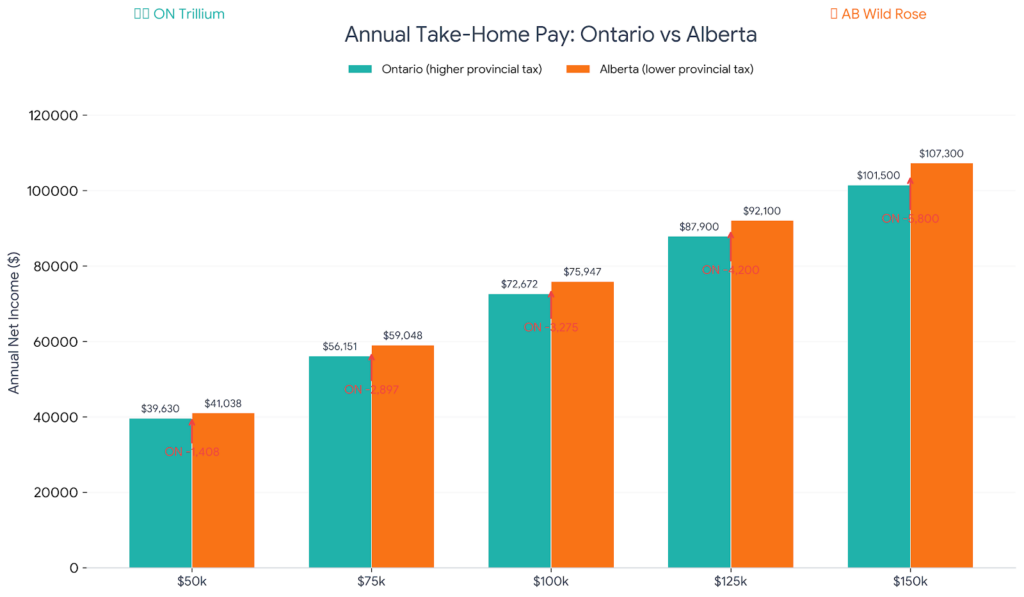
Annual Take-Home Pay Comparison at Various Salaries:
| Annual Salary | ON Net Pay | AB Net Pay | Annual Difference | Hourly Difference |
|---|---|---|---|---|
| $50,000 | $38,092 | $39,500 | -$1,408 | -$0.68/hour |
| $75,000 | $51,303 | $54,200 | -$2,897 | -$1.39/hour |
| $100,000 | $65,225 | $68,500 | -$3,275 | -$1.57/hour |
| $125,000 | $78,800 | $83,200 | -$4,400 | -$2.12/hour |
| $150,000 | $92,100 | $97,500 | -$5,400 | -$2.60/hour |
Ontario’s progressive tax system combined with provincial surtaxes means higher earners pay proportionally more in provincial taxes, with those earning $100,000+ paying effective combined rates of 35-45% compared to 28-32% in Alberta.
ONTARIO TAXES, BENEFITS, AND YOUR PAYCHECK
Ontario State Income Tax Rates (2026)
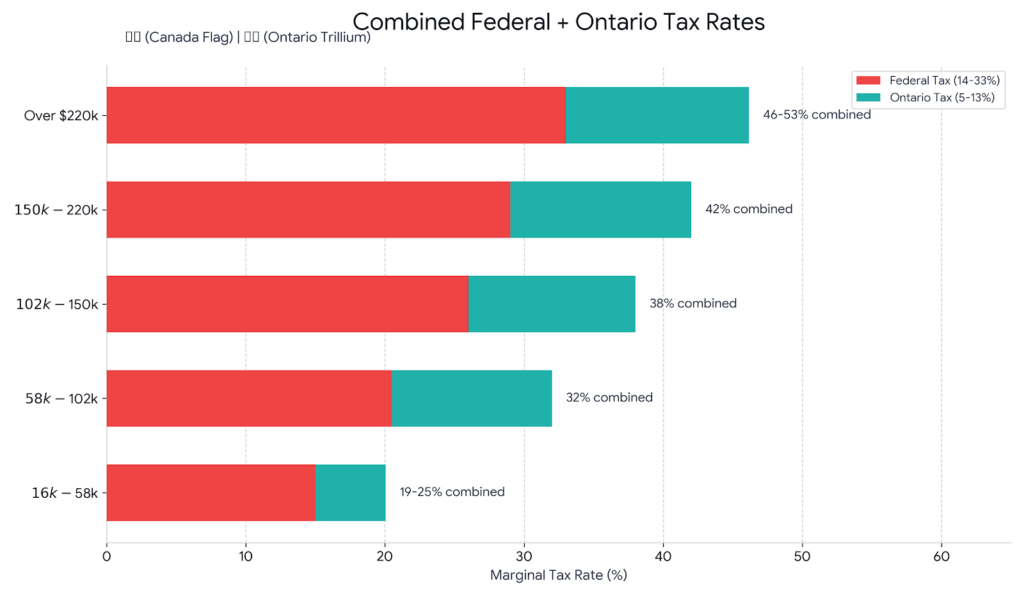
Ontario uses a progressive tax system working alongside federal taxes. You pay both federal and provincial taxes, calculated separately on the same income.
Combined Federal and Ontario Tax Brackets (2026)
For Single Filers – Combined Rates:
| Taxable Income Range | Federal Rate | Ontario Rate | Combined Rate | On This Income Bracket |
|---|---|---|---|---|
| $0 – $11,865 | 0%* | 0%* | 0% | First $11,865 |
| $11,866 – $16,452 | 14% | 5.05% | 19.05% | Next $4,587 |
| $16,453 – $23,726 | 14% | 5.05% | 19.05% | Next $7,274 |
| $23,727 – $51,446 | 14% | 9.15% | 23.15% | Next $27,720 |
| $51,447 – $58,523 | 14% | 11.16% | 25.16% | Next $7,077 |
| $58,524 – $102,894 | 20.5% | 11.16% | 31.66% | Next $44,371 |
| $102,895 – $117,045 | 20.5% | 12.16% | 32.66% | Next $14,151 |
| $117,046 – $150,000 | 26% | 12.16% | 38.16% | Next $32,955 |
| $150,001 – $177,540 | 26% | 13.16% | 39.16% | Next $27,540 |
| $177,541 – $181,440 | 26% | 13.16% | 39.16% | Next $3,900 |
| $181,441 – $220,000 | 29% | 13.16% | 42.16% | Next $38,560 |
| $220,001 – $258,482 | 29% | 13.16% | 42.16% | Next $38,482 |
| Over $258,482 | 33% | 13.16% | 46.16% | All income over |
*After basic personal amount deductions
Key Insights:
- Ontario’s top provincial rate of 13.16% applies to income over $220,000
- Combined federal-Ontario rates reach 46.16% (before surtax)
- Ontario surtax adds 20% on provincial tax over $5,710 and additional 36% over $7,307
- With surtax, top combined rate reaches 53.53% for highest earners
- Most Ontario workers (earning $40k-$100k) pay combined rates of 25-35%
How Ontario’s Progressive Tax System Works
Both federal and provincial taxes are calculated on the same taxable income using separate bracket systems.
Example: Single filer earning $80,000
Federal Tax Calculation:
- First $16,452 at 0% (after basic personal amount) = $0
- Next $42,071 ($58,523 – $16,452) at 14% = $5,890
- Remaining $21,477 ($80,000 – $58,523) at 20.5% = $4,403
- Federal tax: $10,293
Ontario Tax Calculation:
- First $11,865 at 0% (after basic personal amount) = $0
- Next $11,861 ($23,726 – $11,865) at 5.05% = $599
- Next $27,720 ($51,446 – $23,726) at 9.15% = $2,536
- Next $7,077 ($58,523 – $51,446) at 11.16% = $790
- Remaining $21,477 ($80,000 – $58,523) at 11.16% = $2,397
- Subtotal: $6,322
- Surtax calculation: $6,322 > $5,710, so 20% surtax on excess
- ($6,322 – $5,710) × 20% = $122
- Total Ontario tax: $6,444
Total Tax Burden:
- Federal + Ontario: $16,737
- CPP: $3,519
- EI: $1,123
- Health Premium: $750
- Total deductions: $22,129 (27.7%)
- Net pay: $57,871 (72.3%)
Ontario Surtax System
Ontario applies surtaxes on top of provincial tax, making the effective rate higher for middle and upper-income earners.
Ontario Surtax Structure:
- 20% surtax on basic Ontario tax over $5,710
- Additional 36% surtax on basic Ontario tax over $7,307
Surtax Example at $100,000 income:
- Basic Ontario tax: ~$9,000
- First surtax: ($9,000 – $5,710) × 20% = $658
- Second surtax: ($9,000 – $7,307) × 36% = $609
- Total surtax: $1,267
- Total Ontario tax with surtax: $10,267
The surtax system means Ontario’s effective top rate exceeds the nominal 13.16%, reaching approximately 14.3% for very high earners.
Ontario Health Premium (2026)
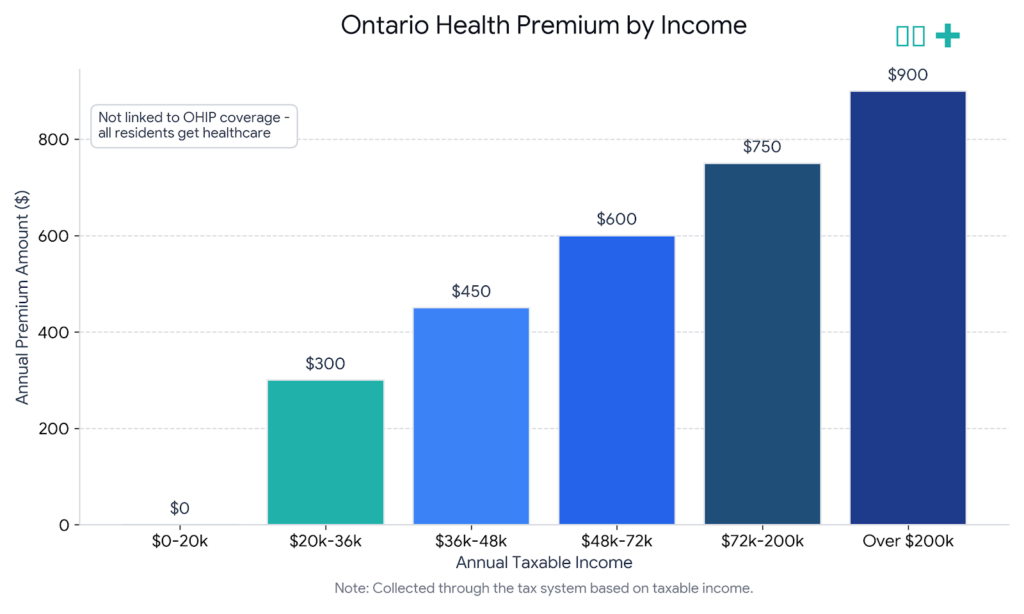
The Ontario Health Premium is a flat tax based on taxable income, collected through the income tax system but not linked to OHIP eligibility.
Ontario Health Premium Rates (2026):
| Taxable Income | Annual Premium |
|---|---|
| $20,000 or less | $0 |
| $20,001 – $36,000 | Lesser of $300 or 6% of income over $20,000 |
| $36,001 – $48,000 | Lesser of $450 or $300 + 6% of income over $36,000 |
| $48,001 – $72,000 | Lesser of $600 or $450 + 25% of income over $48,000 |
| $72,001 – $200,600 | Lesser of $750 or $600 + 25% of income over $72,000 |
| Over $200,600 | $900 (maximum) |
Health Premium Examples:
- $25,000 income: ($25,000 – $20,000) × 6% = $300
- $40,000 income: $300 + ($40,000 – $36,000) × 6% = $540, capped at $450 = $450
- $60,000 income: $450 + ($60,000 – $48,000) × 25% = $450 + $3,000, capped at $600 = $600
- $80,000 income: $600 + ($80,000 – $72,000) × 25% = $600 + $2,000, capped at $750 = $750
- $250,000 income: $900 (maximum reached)
Key Points:
- Not linked to OHIP coverage (all Ontario residents get healthcare regardless)
- Funds general healthcare services
- Deducted through payroll or paid when filing taxes
- Cannot be avoided by higher earners
Canada Pension Plan (CPP) Contributions (2026)
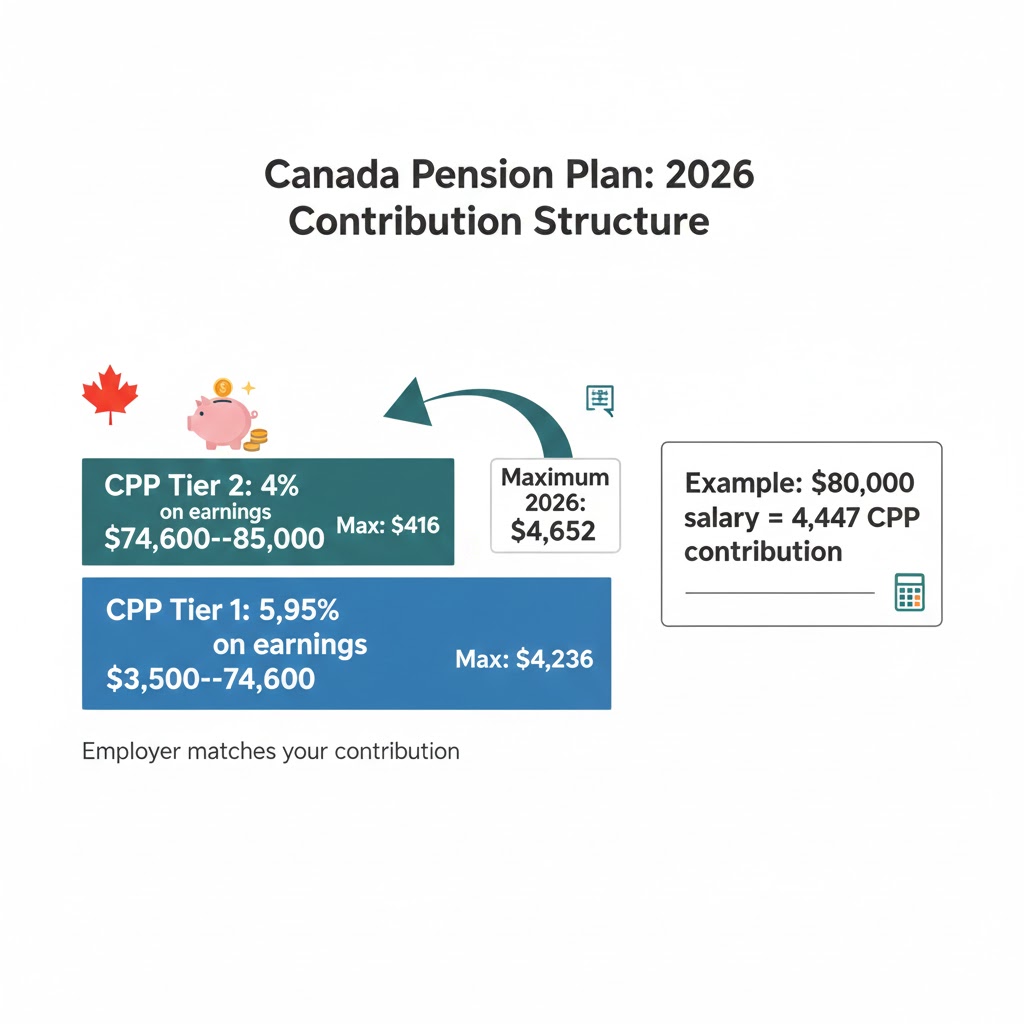
CPP is a federal mandatory retirement savings program with enhanced contributions introduced in 2019, now including two contribution tiers.
CPP Contribution Rates (2026):
Tier 1 (Base CPP):
- Rate: 5.95% on pensionable earnings
- Earnings range: $3,500 (basic exemption) to $74,600
- Maximum employee contribution: $4,235.80
- Maximum employer contribution: $4,235.80 (matched)
Tier 2 (Enhanced CPP or “CPP2”):
- Rate: 4% on pensionable earnings
- Earnings range: $74,600 to $85,000
- Maximum employee contribution: $416
- Maximum employer contribution: $416 (matched)
Total Maximum CPP Contribution (2026):
- Employee: $4,651.80 ($4,235.80 + $416)
- Employer: $4,651.80 (matched)
- Self-employed: $9,303.60 (pays both portions)
CPP Examples:
- $40,000 income: ($40,000 – $3,500) × 5.95% = $2,172
- $60,000 income: ($60,000 – $3,500) × 5.95% = $3,362
- $80,000 income: ($74,600 – $3,500) × 5.95% + ($80,000 – $74,600) × 4% = $4,231 + $216 = $4,447
- $100,000 income: $4,652 (maximum reached)
Tax Treatment of CPP:
- Base CPP (5.95% rate): Generates federal and provincial non-refundable tax credits
- Enhanced CPP (additional 1% from old 4.95% + new CPP2 4%): Deductible from income
- This means CPP contributions reduce your taxable income for the enhanced portions
Employment Insurance (EI) Premiums (2026)
EI is a federal program providing temporary income support for unemployed workers, parental leave, sickness benefits, and other situations.
EI Premium Rate (2026):
- Employee rate: 1.63% of insurable earnings
- Maximum insurable earnings: $68,900
- Maximum employee premium: $1,123.07
- Employer rate: 2.282% (1.4× employee rate)
- Maximum employer premium: $1,572.30
EI Premium Examples:
- $30,000 income: $30,000 × 1.63% = $489
- $50,000 income: $50,000 × 1.63% = $815
- $68,900 income: $1,123 (maximum reached)
- $100,000 income: $1,123 (maximum, only paid on first $68,900)
EI Coverage:
- Regular benefits: Up to 55% of average insurable weekly earnings (max $729/week in 2026)
- Parental benefits: Up to 55% (or 33% for extended)
- Sickness benefits: Up to 15 weeks
- Family caregiver benefits: Up to 26 weeks
Ontario Minimum Wage (2026)
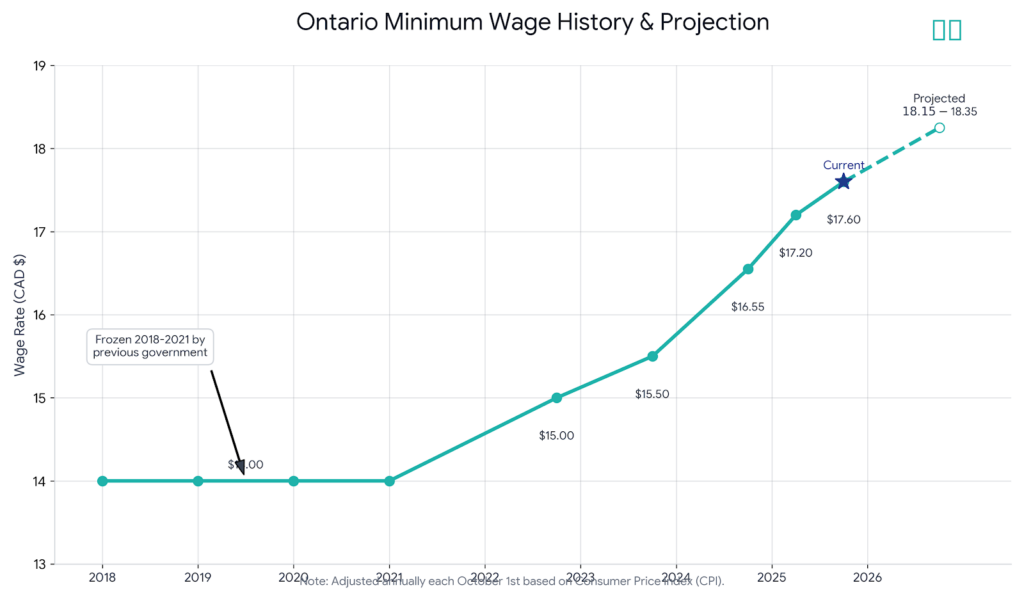
Ontario’s minimum wage is adjusted annually on October 1st based on the provincial Consumer Price Index.
Current Ontario Minimum Wage:
- General minimum wage: $17.60/hour (October 1, 2025 – September 30, 2026)
- Students (under 18, working 28 hours/week or less): $16.60/hour
- Homeworkers (doing paid work from their own homes): $19.45/hour
- Hunting and fishing guides: $88.00 per day (less than 5 consecutive hours) or $176.05 per day (5+ consecutive hours)
Annual Earnings at Minimum Wage:
- Hourly rate: $17.60
- Full-time (40 hours/week, 52 weeks): $36,608 gross
- After all taxes and deductions: ~$29,500 net
- Monthly net: ~$2,458
Ontario Minimum Wage History:
- 2018: $14.00 (frozen by previous government)
- 2019-2021: $14.00 (remained frozen)
- 2022: $15.00 (October 1, 2022)
- 2023: $15.50 (October 1, 2023)
- 2024: $16.55 (October 1, 2024)
- 2025: $17.20 (April 1, 2025 interim increase)
- 2025: $17.60 (October 1, 2025 – current)
- 2026: Expected ~$18.15-$18.35 (based on inflation, October 1, 2026)
Ontario vs. Other Canadian Provinces (2026):
| Province | Minimum Wage | vs Ontario |
|---|---|---|
| British Columbia | $17.40/hour | -$0.20 |
| Ontario | $17.60/hour | Baseline |
| Yukon | $17.59/hour | -$0.01 |
| Alberta | $15.00/hour | -$2.60 |
| Manitoba | $15.80/hour | -$1.80 |
| Saskatchewan | $15.00/hour | -$2.60 |
| Quebec | $15.75/hour | -$1.85 |
| Nova Scotia | $15.20/hour | -$2.40 |
| New Brunswick | $15.30/hour | -$2.30 |
Ontario has the second-highest minimum wage among Canadian provinces, behind only British Columbia and nearly tied with Yukon.
Ontario Overtime Pay Rules
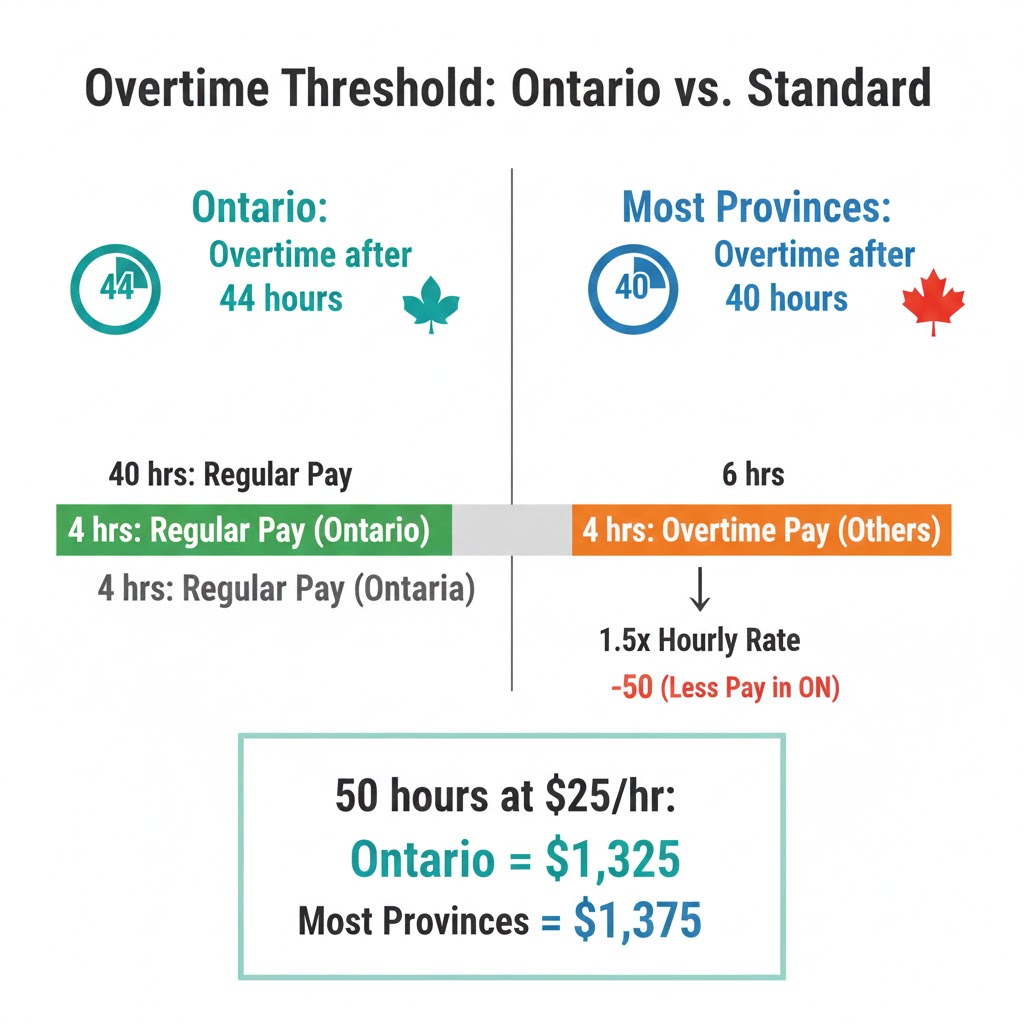
Ontario follows the Employment Standards Act (ESA) for overtime, which differs from most other provinces and U.S. states.
Ontario Overtime Rules:
- Overtime required after 44 hours in a workweek (not 40 like most jurisdictions)
- Rate: Time-and-a-half (1.5× regular rate)
- No daily overtime requirements
- No double-time requirements
- Overtime calculated weekly, not bi-weekly or monthly
Key Differences from Other Jurisdictions:
- Federal Canada: Overtime after 40 hours/week or 8 hours/day
- Most U.S. states: Overtime after 40 hours/week
- California: Overtime after 8 hours/day or 40 hours/week, double-time after 12 hours/day
- Ontario is one of few jurisdictions with 44-hour threshold
Example: Ontario Overtime Calculation
Scenario: Work 50 hours in one week at $25/hour
- First 44 hours: $25 × 44 = $1,100 (regular time)
- Next 6 hours: $37.50 × 6 = $225 (overtime)
- Total weekly pay: $1,325
Compare to 40-hour overtime jurisdiction:
- First 40 hours: $25 × 40 = $1,000
- Next 10 hours: $37.50 × 10 = $375
- Total: $1,375 (Ontario worker earns $50 less for same hours)
Annual Impact of 44-Hour Threshold:
If working 50 hours weekly year-round at $25/hour:
- Ontario (44-hour threshold): 6 OT hours/week = $11,700 OT pay annually
- 40-hour threshold jurisdiction: 10 OT hours/week = $19,500 OT pay annually
- Difference: $7,800 less annually in Ontario
Ontario Overtime Exemptions
Many Ontario workers are exempt from overtime requirements under the ESA.
Common ESA Overtime Exemptions:
- Managers and supervisors
- Professionals (lawyers, accountants, engineers, etc.)
- Information technology professionals earning over threshold
- Farm workers
- Certain commissioned salespeople
- Truck drivers and road transport workers
- Taxi and limousine drivers
- Residential building superintendents
IT Professional Exemption Threshold:
- Must earn at least $111,733.70 annually (2026)
- Primary duties must be IT-related
- Below this salary, IT workers entitled to overtime
No salary test for most exemptions: Unlike U.S. FLSA, Ontario doesn’t require minimum salary for most exemptions (except IT professionals). A manager earning $40,000 can still be exempt if duties meet the test.
Ontario Living Wage by City (2026)
The “living wage” represents the hourly rate needed to cover basic necessities without government assistance. Ontario’s living wages are among Canada’s highest due to housing costs.
Living Wage Estimates for Ontario Cities (2026):
| City/Region | Living Wage/Hour | Annual Living Wage | vs Min Wage Gap |
|---|---|---|---|
| Toronto | $27.00/hour | $56,160 | -$9.40/hour |
| Ottawa | $24.00/hour | $49,920 | -$6.40/hour |
| Hamilton | $21.95/hour | $45,656 | -$4.35/hour |
| Waterloo Region | $22.75/hour | $47,320 | -$5.15/hour |
| London | $20.85/hour | $43,368 | -$3.25/hour |
| Peterborough | $21.45/hour | $44,616 | -$3.85/hour |
| Thunder Bay | $19.50/hour | $40,560 | -$1.90/hour |
| Windsor | $19.25/hour | $40,040 | -$1.65/hour |
Key Insight: Even at Ontario’s $17.60 minimum wage, workers earn only 65-90% of the living wage depending on location. The gap is most severe in expensive Greater Toronto Area where minimum wage covers just 65% of living wage requirements.
Toronto Cost of Living and Living Wage
Toronto Living Wage Breakdown ($27/hour for single adult):
Monthly expenses at $27/hour ($56,160 annually):
- Take-home pay: ~$3,700/month (after taxes)
- Housing (1-BR): $2,200-$2,500 (59-68% of income)
- Food: $450 (12%)
- Transportation (TTC): $156 (4%)
- Healthcare (supplemental): $100 (3%)
- Other necessities: $500 (14%)
- Savings/emergency: Minimal
Reality at Toronto minimum wage ($17.60/hour):
- Take-home: ~$2,458/month
- Shortfall: $1,242/month vs. living wage
- Must make compromises: roommates, reduced food budget, no savings
Toronto Housing Crisis Impact:
- Average 1-BR rent: $2,200-$2,500/month
- Minimum wage earner needs to spend 90-102% of take-home on rent alone
- Realistically requires roommates or living outside Toronto core
- Many minimum wage workers commute 1-2 hours from suburbs
Ontario Pay Frequency Requirements
Ontario’s ESA sets minimum standards for when employees must be paid.
Ontario Pay Frequency Rules:
- Regular pay period must be established
- Most common: Bi-weekly (every 2 weeks) – 26 pay periods annually
- Also common: Semi-monthly (twice per month) – 24 pay periods annually
- Weekly also permitted – 52 pay periods annually
- Monthly permitted in some cases
- Wages must be paid within specific timeframes after pay period ends
Payment Timing Requirements:
- Bi-weekly: Within 5 days after end of pay period
- Monthly: Within 5 days after end of month
- Termination pay: Within 7 days of termination OR next regular pay date, whichever is later
Example: Bi-weekly Pay Cycle
- Pay period: January 1-14
- Payday: Must be by January 19 (5 days after period end)
- Most Ontario employers pay on specific day (e.g., every other Friday)
Ontario Vacation Pay and Entitlements
Ontario mandates minimum vacation entitlements based on length of employment.
Ontario Vacation Entitlements:
- Less than 5 years service: 2 weeks vacation (4% vacation pay)
- 5+ years service: 3 weeks vacation (6% vacation pay)
Vacation Pay Calculation:
- Calculated as percentage of gross wages
- Can be paid out with each paycheck or held until vacation taken
- Must be paid before vacation begins or on next regular pay date
Examples:
- Earning $50,000/year (under 5 years): $50,000 × 4% = $2,000 vacation pay
- Earning $50,000/year (5+ years): $50,000 × 6% = $3,000 vacation pay
Vacation Pay on Every Paycheck: Many Ontario employers include vacation pay with each paycheck rather than holding it:
- $25/hour × 4% = $26/hour with vacation pay included
- $1,000 bi-weekly paycheck becomes $1,040 with vacation pay
Ontario Public Holidays and Pay
Ontario has 9 statutory public holidays where eligible employees receive holiday pay or premium pay if working.
Ontario Public Holidays (2026):
- New Year’s Day (January 1)
- Family Day (third Monday in February – February 17, 2026)
- Good Friday (April 10, 2026)
- Victoria Day (Monday before May 25 – May 18, 2026)
- Canada Day (July 1)
- Labour Day (first Monday in September – September 7, 2026)
- Thanksgiving Day (second Monday in October – October 12, 2026)
- Christmas Day (December 25)
- Boxing Day (December 26)
Public Holiday Pay Rules:
- Eligible employees get holiday pay even if not working
- If working on holiday: Regular day’s pay + premium pay (1.5× regular rate) OR substitute day off with premium pay
- Eligibility: Must have worked last scheduled day before and first scheduled day after the holiday
Public Holiday Pay Calculation: For regular full-time employee earning $25/hour:
- Holiday pay (not working): Regular day’s pay = 8 hours × $25 = $200
- Working the holiday: $200 holiday pay + (8 hours × $37.50 premium) = $200 + $300 = $500 total
Ontario Cost of Living by City
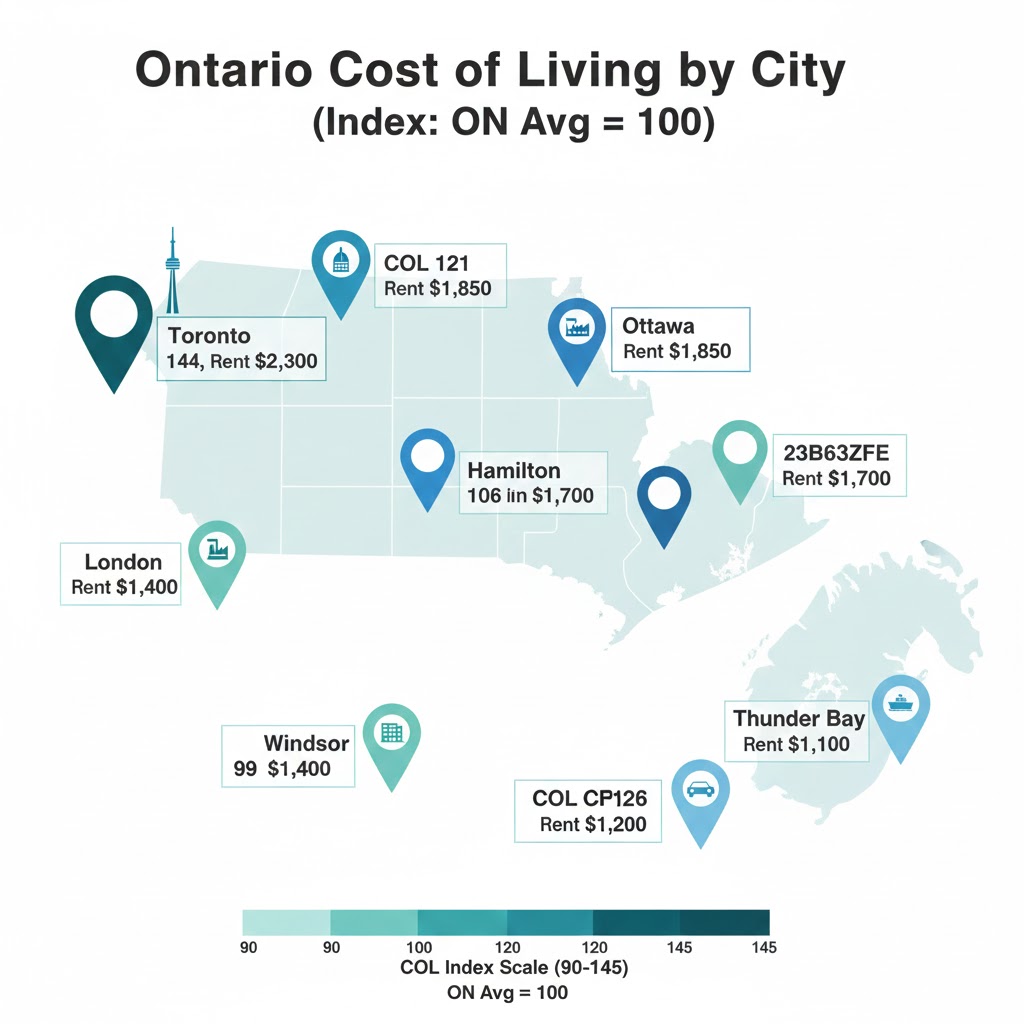
Ontario’s cost of living varies dramatically from expensive GTA to more affordable mid-sized cities and northern communities.
Ontario Cost of Living Index by City (Ontario Average = 100):
| City/Region | Overall COL Index | Housing Index | Key Factor |
|---|---|---|---|
| Toronto | 144 | 195 | Housing crisis |
| Oakville | 138 | 185 | GTA proximity |
| Mississauga | 131 | 170 | GTA suburb |
| Ottawa | 121 | 150 | Capital city |
| Vaughan | 129 | 168 | GTA suburb |
| Hamilton | 116 | 142 | Growing city |
| Waterloo | 118 | 145 | Tech hub |
| London | 108 | 125 | Mid-sized |
| Kingston | 111 | 130 | University city |
| Windsor | 99 | 105 | Border city |
| Thunder Bay | 94 | 95 | Northern Ontario |
| Sudbury | 97 | 100 | Northern Ontario |
Toronto vs. Other Ontario Cities:
To match purchasing power of $50,000 in other cities, you need in Toronto:
- $72,000 in Toronto (44% more than Windsor)
- $68,000 in Toronto (36% more than London)
- $60,500 in Toronto (21% more than Ottawa)
Example: $60,000 Salary Purchasing Power
- Windsor: Comfortable living, can save
- London: Comfortable middle-class lifestyle
- Hamilton: Moderate living, some financial pressure
- Ottawa: Tight but manageable budget
- Toronto: Challenging, likely need roommate or long commute
Ontario Health Premium vs. OHIP Coverage
Important Distinction:
- Ontario Health Premium: Tax paid based on income, funds general healthcare
- OHIP (Ontario Health Insurance Plan): Universal coverage for all Ontario residents
OHIP Coverage (Free for Ontario Residents):
- Doctor visits and hospital care
- Emergency services
- Diagnostic tests
- Surgeries and procedures
- Maternity care
NOT Covered by OHIP:
- Prescription drugs (outside hospital)
- Dental care
- Vision care (routine eye exams for adults 20-64)
- Physiotherapy (outside hospital)
- Ambulance services (partially covered, $45-$240 fees)
- Cosmetic procedures
Private Insurance Gap: Many Ontario workers get supplemental coverage through employer benefits for:
- Prescription drugs (80-100% coverage typical)
- Dental care ($1,000-$2,000 annual limits)
- Vision care ($200-$400 every 2 years)
- Paramedical services (physio, massage, etc.)
Employer Benefit Value: Comprehensive employer health benefits worth $3,000-$6,000 annually in coverage, significantly increasing total compensation value beyond base salary.
Ontario Employer Costs
Understanding total employment costs helps both employers budget and employees recognize their full compensation value.
Total Cost of Ontario Employee ($60,000 salary example):
| Cost Component | Annual Amount | % of Salary |
|---|---|---|
| Base Salary | $60,000 | 100.0% |
| Employer CPP (5.95% + 4%) | $3,373 | 5.6% |
| Employer EI (2.282%) | $1,369 | 2.3% |
| WSIB (avg 1.5%) | $900 | 1.5% |
| Employer Health Tax (1.95%) | $1,170 | 2.0% |
| Health Benefits | $4,000 | 6.7% |
| Pension Match (3%) | $1,800 | 3.0% |
| Vacation Pay (4%) | $2,400 | 4.0% |
| Statutory Holidays (3.5%) | $2,100 | 3.5% |
| Other Benefits | $800 | 1.3% |
| Total Cost | $77,912 | 129.9% |
Ontario vs. Other Provinces:
- Quebec: Higher (~132% due to QPP/QPIP)
- Alberta: Lower (~127% due to lower provincial requirements)
- Ontario position: Mid-range among Canadian provinces
Ontario Employer Health Tax (EHT)
Ontario employers pay EHT to help fund healthcare, separate from employee’s Health Premium.
EHT Rates (2026):
- Payroll under $200,000: Exempt
- Payroll $200,000-$400,000: Reduced rate (0.98% average)
- Payroll over $400,000: 1.95% on all payroll
- Payroll over $5,000,000: 1.95% (no exemption)
Small Business Advantage: Small Ontario employers with payroll under $200,000 pay zero EHT, reducing employment costs compared to larger competitors.
Example EHT Costs:
- 10 employees averaging $60,000 ($600,000 payroll): $11,700 EHT annually ($1,170 per employee)
- 3 employees averaging $50,000 ($150,000 payroll): $0 EHT (below threshold)
Workplace Safety and Insurance Board (WSIB)
WSIB provides workplace injury insurance similar to workers’ compensation in other jurisdictions.
WSIB Rates:
- Vary by industry classification
- Range from 0.10 to over 8.00 per $100 of insurable payroll
- Average across all industries: ~$1.50 per $100 (1.5%)
Industry Examples:
- Office/professional services: 0.10-0.40 per $100
- Retail: 0.80-1.50 per $100
- Manufacturing: 1.50-4.00 per $100
- Construction: 3.00-8.00+ per $100
Annual WSIB Cost Examples ($60,000 employee):
- Office worker: $60-$240 (0.1-0.4%)
- Retail worker: $480-$900 (0.8-1.5%)
- Manufacturing: $900-$2,400 (1.5-4%)
- Construction: $1,800-$4,800+ (3-8%+)
Popular Ontario Hourly to Yearly Conversions
Quick reference showing exact Ontario take-home pay after all federal and provincial deductions.
Common Ontario Hourly Rates to Annual Salary:
| Hourly Rate | Annual Gross | Federal Tax | ON Tax | CPP | EI | Health Premium | Total Deductions | Annual Net | Monthly Net | % Take-Home |
|---|---|---|---|---|---|---|---|---|---|---|
| $17.60 (min) | $36,608 | $2,822 | $1,413 | $1,971 | $597 | $300 | $7,103 | $29,505 | $2,459 | 80.6% |
| $20/hour | $41,600 | $3,521 | $1,918 | $2,267 | $678 | $450 | $8,834 | $32,766 | $2,731 | 78.8% |
| $25/hour | $52,000 | $5,010 | $3,026 | $2,886 | $848 | $600 | $12,370 | $39,630 | $3,303 | 76.2% |
| $30/hour | $62,400 | $7,192 | $4,213 | $3,519 | $1,017 | $600 | $16,541 | $45,859 | $3,822 | 73.5% |
| $35/hour | $72,800 | $9,518 | $5,569 | $3,519 | $1,123 | $750 | $20,479 | $52,321 | $4,360 | 71.9% |
| $40/hour | $83,200 | $12,208 | $7,256 | $4,218 | $1,123 | $750 | $25,555 | $57,645 | $4,804 | 69.3% |
| $50/hour | $104,000 | $17,950 | $10,396 | $4,652 | $1,123 | $900 | $35,021 | $68,979 | $5,748 | 66.3% |
Key Takeaways:
- Ontario minimum wage workers keep 80.6% (lowest tax burden)
- Middle earners ($25-35/hour) keep 72-76%
- Higher earners ($40-50/hour) keep 66-69%
- Combined federal-provincial-CPP-EI-Health Premium: 19-34% total burden
Common Ontario Annual Salaries to Hourly Rate:
| Annual Salary | Gross Hourly | Federal Tax | ON Tax | CPP | EI | Health Prem | Annual Net | Net Monthly | Effective Hourly |
|---|---|---|---|---|---|---|---|---|---|
| $40,000 | $19.23/hr | $3,221 | $1,613 | $2,172 | $652 | $450 | $31,892 | $2,658 | $15.33/hr |
| $50,000 | $24.04/hr | $5,258 | $2,618 | $2,767 | $815 | $450 | $38,092 | $3,174 | $18.31/hr |
| $60,000 | $28.85/hr | $7,516 | $3,813 | $3,373 | $978 | $600 | $43,720 | $3,643 | $21.02/hr |
| $75,000 | $36.06/hr | $11,892 | $6,413 | $3,519 | $1,123 | $750 | $51,303 | $4,275 | $24.67/hr |
| $100,000 | $48.08/hr | $18,392 | $9,713 | $4,647 | $1,123 | $900 | $65,225 | $5,435 | $31.36/hr |
| $125,000 | $60.10/hr | $25,642 | $13,713 | $4,652 | $1,123 | $900 | $78,970 | $6,581 | $37.97/hr |
Summary: Hourly to Yearly Salary Calculator
Converting hourly wages to annual salary in Ontario requires understanding Canada’s federal-provincial tax system, enhanced CPP contributions, and Ontario-specific charges like the Health Premium.
Key Takeaways:
Ontario workers face combined federal-provincial taxes reaching 20-45% depending on income, with federal (14-33%) and Ontario (5.05-13.16% plus surtax) taxes calculated on the same income. The Ontario Health Premium adds $0-$900 annually based purely on income level, while enhanced CPP now includes two contribution tiers totaling up to $4,652 annually.
Ontario’s $17.60 minimum wage is among Canada’s highest but covers only 65-90% of living wage requirements across the province, with Toronto’s gap being most severe. The province’s unique 44-hour overtime threshold (not 40) means Ontario workers receive less overtime pay than counterparts in most other jurisdictions working identical hours.
Use this calculator for comparing Ontario job offers, understanding take-home pay across Toronto/Ottawa/Hamilton and other cities, negotiating salaries with Ontario cost-of-living context, planning budgets based on actual net income after all federal and provincial deductions, and evaluating Ontario opportunities versus other provinces (especially lower-tax Alberta or no-PST Alberta).
🍁 Also Available
Province-Specific Calculators
Get more accurate results with tax rates specific to your province.
🏙️ Most Popular Ontario Hourly to Salary CalculatorIncludes Ontario provincial tax, CPP, EI, Ontario Health Premium and surtax for 2026.
Calculate for Ontario →
🏔️ 2026 Rates BC Hourly to Salary CalculatorBritish Columbia provincial tax rates, BC minimum wage, and accurate take-home pay for 2026.
Calculate for BC →
Need a US salary calculator? We cover all 50 states.
🇺🇸 US Salary Calculator →