A $125,000 annual salary calculator breaks down to $60.10 per hour when you work a standard 40-hour week for 52 weeks. This calculation divides your yearly pay by 2,080 total work hours (40 hours × 52 weeks).
Many people want to know their hourly rate for several reasons: comparing job offers, setting freelance rates, or understanding what they really earn for each hour of work. This guide walks you through every aspect of converting your $125,000 salary to an hourly wage.
Quick Answer: $125,000 Salary Conversion
How Much Is $125,000 a Year Per Hour?
Your $125,000 annual salary equals:
- $60.10 per hour (standard 40-hour week, 52 weeks)
- $62.50 per hour (with 2 weeks unpaid vacation)
- $61.76 per hour (with 8 paid holidays)
The exact hourly rate changes based on how many hours you actually work each year. The 2,080-hour calculation assumes you work every single week without any time off.
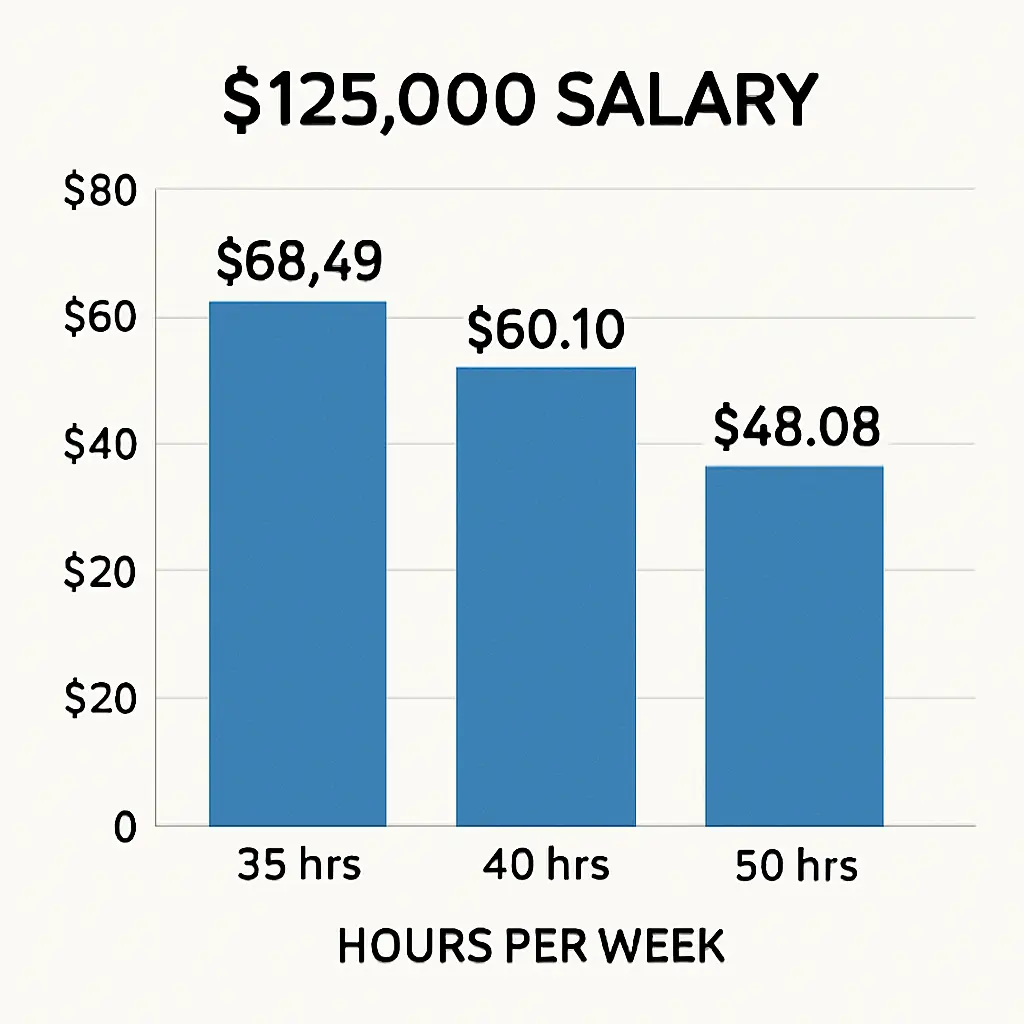
$125,000 Salary Breakdown at a Glance
Here’s how your $125,000 salary looks across different time periods:
Time Period | Amount | Calculation Method
- Hourly: $60.10 | $125,000 ÷ 2,080 hours
- Daily: $480.77 | $60.10 × 8 hours
- Weekly: $2,403.85 | $480.77 × 5 days
- Bi-Weekly: $4,807.69 | $2,403.85 × 2 weeks
- Monthly: $10,416.67 | $125,000 ÷ 12 months
- Quarterly: $31,250.00 | $125,000 ÷ 4 quarters
How to Calculate $125,000 Salary to Hourly
Standard Calculation Formula
The basic formula to convert any annual salary to hourly pay:
Hourly Rate = Annual Salary ÷ Total Work Hours Per Year
For a $125,000 salary: $125,000 ÷ 2,080 hours = $60.10 per hour
This assumes you work 40 hours each week for all 52 weeks in a year.
Step-by-Step Calculation Process
Follow these steps to calculate your exact hourly rate:
Step 1: Determine Your Weekly Hours Count how many hours you work each week. Most full-time jobs use 40 hours, but your actual schedule might differ.
Step 2: Calculate Yearly Work Hours Multiply your weekly hours by 52 weeks: 40 hours × 52 weeks = 2,080 hours per year
Step 3: Subtract Time Off If you take unpaid vacation or leave, subtract those hours: 2 weeks off = 80 hours 2,080 – 80 = 2,000 work hours
Step 4: Divide Salary by Hours $125,000 ÷ 2,000 hours = $62.50 per hour
Key Assumptions in the Conversion
Standard salary-to-hourly calculations make several assumptions:
Work Schedule: 40 hours per week, 5 days per week, 8 hours per day
Weeks Worked: 52 weeks annually with no extended breaks
Consistent Pay: Your salary stays the same throughout the year
No Overtime: Calculations don’t include overtime, bonuses, or commissions
Gross Pay: All numbers represent pre-tax income before deductions
Real-world situations often vary from these assumptions, which is why your actual hourly rate might differ.
Complete $125,000 Salary Breakdown by Time Period
$125,000 Per Year to Hourly Rate
At $125,000 annually, your hourly wage changes based on your actual work schedule:
Weekly Hours | Hourly Rate
- 35 hours: $68.49
- 37.5 hours: $64.10
- 40 hours: $60.10
- 42.5 hours: $56.47
- 45 hours: $53.42
Working fewer hours each week increases your hourly rate, while working more hours lowers it.
$125,000 Per Year to Daily Rate
Your daily earnings depend on whether you work a standard 8-hour day:
Scenario | Daily Pay
- Standard 8-hour day: $480.77
- 10-hour day: $384.62
- 12-hour day (compressed schedule): $320.51
To calculate: Hourly rate × hours worked per day
$125,000 Per Year to Weekly Rate
Most workers receive their pay weekly, bi-weekly, or semi-monthly. Here’s what $125,000 breaks down to:
Pay Frequency | Amount Per Paycheck
- Weekly (52 payments): $2,403.85
- Bi-weekly (26 payments): $4,807.69
- Semi-monthly (24 payments): $5,208.33
- Monthly (12 payments): $10,416.67
$125,000 Per Year to Bi-Weekly Rate
Bi-weekly pay means you get paid every two weeks, resulting in 26 paychecks per year (not 24).
Gross bi-weekly pay: $4,807.69 After estimated federal taxes (24%): $3,653.85
Some months you’ll receive three paychecks instead of two, which helps with budgeting for larger expenses.
$125,000 Per Year to Monthly Rate
Your monthly gross income: $10,416.67
Breaking this down further:
- Per week: $2,403.85 (approximately 4.33 weeks per month)
- Per day: $480.77 (based on 21-22 working days monthly)
- Per hour: $60.10 (approximately 173 work hours monthly)
$125,000 Per Year to Quarterly Rate
Each quarter (3 months), you earn $31,250 before taxes.
This matters for:
- Quarterly tax payments (self-employed workers)
- Performance bonuses tied to quarters
- Budget planning by quarter
- Investment goals
Factors That Affect Your $125,000 Hourly Rate
Standard 40-Hour Work Week vs Part-Time Hours
Your hourly rate changes dramatically Salary Calculator California based on how many hours you work:
30-hour work week: $80.13 per hour 35-hour work week: $68.49 per hour 40-hour work week: $60.10 per hour 45-hour work week: $53.42 per hour 50-hour work week: $48.08 per hour
Someone working 30 hours weekly at $125,000 annual salary earns a much higher hourly rate than someone working 50 hours for the same yearly pay.
Paid Time Off (PTO) and Vacation Days
Paid time off doesn’t change your annual salary, but it does affect your effective hourly rate:
With 2 weeks (10 days) PTO:
- Work hours: 2,000 per year
- Hourly rate: $62.50
With 3 weeks (15 days) PTO:
- Work hours: 1,960 per year
- Hourly rate: $63.78
With 4 weeks (20 days) PTO:
- Work hours: 1,920 per year
- Hourly rate: $65.10
More vacation time means you earn the same $125,000 while working fewer hours, which increases your effective hourly wage.
Unpaid Leave and Sabbaticals
Taking unpaid time off reduces both your annual income and changes your hourly calculation:
1 month unpaid leave:
- Actual annual pay: $114,583
- Work hours: 1,907
- Hourly rate: $60.10 (unchanged)
3 months unpaid leave:
- Actual annual pay: $93,750
- Work hours: 1,560
- Hourly rate: $60.10 (unchanged)
Your hourly rate stays the same, but your total yearly income drops.
Overtime and Extra Hours Impact
Salaried employees at $125,000 typically don’t receive overtime pay. If you work 50 hours per week instead of 40, your effective hourly rate drops:
No overtime pay:
- 50 hours/week × 52 weeks = 2,600 hours
- $125,000 ÷ 2,600 = $48.08 per hour
You’re working 560 extra hours annually without additional compensation, which reduces your per-hour earnings by $12.02.
Holiday Pay Calculations
Most companies offer 8-10 paid holidays per year. This affects your actual work hours:
With 8 paid holidays:
- Total hours: 2,080 (holidays don’t reduce hours since they’re paid)
- Days actually worked: 253 days
- Hourly rate: $61.76 (based on actual work time)
You still earn $125,000, but you work fewer days, effectively increasing your hourly rate.
Leap Year Considerations
Leap years add one extra day (February 29), which can affect hourly calculations:
Regular year (365 days):
- 261 weekdays
- 2,088 work hours
- Hourly rate: $59.87
Leap year (366 days):
- 262 weekdays
- 2,096 work hours
- Hourly rate: $59.64
The difference is small ($0.23 per hour) but matters for precise calculations.

$125,000 Take-Home Pay After Taxes
Federal Income Tax on $125,000 Salary
According to IRS tax brackets for 2026, here’s how federal taxes affect your $125,000 income:
Tax Bracket | Income Range | Rate | Tax Owed
- 10% | $0 – $11,925 | 10% | $1,192.50
- 12% | $11,926 – $48,475 | 12% | $4,386.00
- 22% | $48,476 – $103,350 | 22% | $12,072.50
- 24% | $103,351 – $125,000 | 24% | $5,196.00
Total federal income tax: Approximately $22,847 After federal tax: $102,153 annually ($49.11/hour)
This calculation assumes single filer status with standard deduction.
State Tax Variations by Location
Your take-home pay varies significantly by state. Here’s what you keep after state taxes:
States With No Income Tax:
- Texas: $94,710 annually ($45.53/hour)
- Florida: $94,710 annually
- Washington: $94,710 annually
- Nevada: $94,710 annually
States With Moderate Income Tax:
- North Carolina: $90,348 annually ($43.43/hour)
- Pennsylvania: $91,037 annually ($43.77/hour)
- Colorado: $89,575 annually ($43.06/hour)
States With High Income Tax:
- California: $87,023 annually ($41.84/hour)
- New York: $87,169 annually ($41.91/hour)
- New Jersey: $86,542 annually ($41.61/hour)
The difference between Texas and California is $7,687 annually ($3.69/hour).
FICA (Social Security and Medicare) Deductions
Everyone who earns wages pays FICA taxes, regardless of state:
Social Security Tax:
- Rate: 6.2%
- Your portion: $7,750 (capped at $125,000)
- Employer match: $7,750
Medicare Tax:
- Rate: 1.45%
- Your portion: $1,812.50
- Employer match: $1,812.50
Total FICA: $9,562.50 annually ($4.60/hour)
Your Actual Hourly Rate After Taxes
Here’s what you really take home per hour in different states:
Location | Gross Hourly | Net Hourly | Take-Home %
- Texas (no state tax): $60.10 | $45.53 | 75.8%
- Colorado: $60.10 | $43.06 | 71.7%
- California: $60.10 | $41.84 | 69.6%
- New York: $60.10 | $41.91 | 69.7%
Your actual hourly earnings are 24-30% lower than your gross rate after taxes.
Net Pay Calculator for $125,000 Salary
To find your exact take-home pay, you need to account for:
- Federal income tax (10-24% marginal rates)
- State income tax (0-13% depending on state)
- FICA taxes (7.65% total)
- Pre-tax deductions (401k, HSA, health insurance)
- Post-tax deductions (Roth IRA, life insurance, garnishments)
Example calculation for a single filer in Texas:
- Gross annual: $125,000
- Federal tax: -$22,847
- FICA: -$9,562.50
- 401(k) (6%): -$7,500
- Health insurance: -$2,400
- Net take-home: $82,690 ($39.76/hour)
Benefits and Deductions Impact on $125,000 Salary
Pre-Tax vs Post-Tax Deductions
Pre-tax deductions reduce your taxable income, saving you money:
Benefit | Annual Cost | Tax Savings (24% bracket)
- 401(k) max: $23,500 | $5,640 saved
- HSA max: $4,300 | $1,032 saved
- Health insurance: $3,000 | $720 saved
- FSA: $3,200 | $768 saved
Total tax savings: $8,160
Post-tax deductions don’t provide tax benefits:
- Roth IRA contributions
- Life insurance premiums
- Disability insurance
- Union dues
- Charitable giving via payroll
Health Insurance Premiums
Typical employer-sponsored health insurance costs for 2026:
Coverage Level | Monthly Cost | Annual Cost | After-Tax Impact
- Individual: $200 | $2,400 | $1,824 (saves $576 in taxes)
- Individual + Spouse: $450 | $5,400 | $4,104 (saves $1,296)
- Family: $600 | $7,200 | $5,472 (saves $1,728)
Your actual hourly rate with family coverage: $125,000 – $7,200 = $117,800 ÷ 2,080 = $56.63 per hour
401(k) and Retirement Contributions
Contributing to a 401(k) reduces your taxable income:
Contribution Amount | Taxable Income | Effective Hourly After 401(k)
- $0: $125,000 | $60.10/hour
- 6% ($7,500): $117,500 | $56.49/hour
- 10% ($12,500): $112,500 | $54.09/hour
- Max ($23,500): $101,500 | $48.80/hour
While your paycheck shrinks, you’re building retirement savings and paying less tax.
HSA and FSA Contributions
Health Savings Account (HSA):
- 2026 limit: $4,300 (individual) | $8,550 (family)
- Tax benefit: Triple tax advantage (deduct, grow, withdraw tax-free)
- Annual tax savings at 24% bracket: $1,032
Flexible Spending Account (FSA):
- 2026 limit: $3,200 (healthcare) | $5,000 (dependent care)
- Tax benefit: Pre-tax deductions
- Use-it-or-lose-it rule applies
Example with maxed HSA: $125,000 – $4,300 = $120,700 taxable income Saves approximately $1,032 in federal taxes
How Benefits Affect Your Effective Hourly Rate
When you factor in employer-provided benefits, your true compensation exceeds $125,000:
Benefit | Employer Contribution | Annual Value
- Health insurance: 75% of premium | $4,500
- 401(k) match: 6% | $7,500
- Social Security: 6.2% | $7,750
- Medicare: 1.45% | $1,812
- Paid time off: 15 days | $4,808
- Paid holidays: 10 days | $3,206
Total compensation: $154,576 Effective hourly rate: $74.32
Your real value to the company is 24% higher than your salary shows.
Is $125,000 a Year a Good Salary?
$125,000 vs US Median Household Income
According to U.S. Census Bureau data:
US median household income (2024): $83,730 Your $125,000 salary: 49% above median
You earn more than approximately 75% of U.S. households. This puts you in the upper-middle class income bracket.
Percentile Breakdown:
- Top 25% threshold: $102,000
- Top 20% threshold: $115,000
- Top 15% threshold: $130,000
Your $125,000 salary places you in the top 20% of earners nationwide.
Cost of Living Considerations by State
$125,000 buys different lifestyles depending on where you live:
Low Cost of Living States: In Mississippi, Arkansas, or Oklahoma, $125,000 feels like $165,000 in purchasing power. You can afford:
- 3,000 sq ft home
- Two new cars
- Save $2,500+ monthly
- Live very comfortably
Medium Cost of Living States: In Texas, Florida, or Arizona, $125,000 provides a solid middle-class lifestyle:
- 2,000 sq ft home
- Comfortable lifestyle
- Save $1,500-2,000 monthly
- Few financial worries
High Cost of Living States: In California, New York, or Massachusetts, $125,000 feels like $80,000-90,000:
- Small 1-2 bedroom apartment
- Public transportation
- Save $500-1,000 monthly
- Budget carefully
$125,000 Salary in High-Cost vs Low-Cost Areas
Cost of living index comparison (national average = 100):
City | COL Index | Equivalent Salary Needed | Your Buying Power
- San Francisco, CA | 194 | $242,500 | $64,433
- New York, NY | 187 | $233,750 | $66,845
- Los Angeles, CA | 151 | $188,750 | $82,781
- Seattle, WA | 172 | $215,000 | $72,674
- Austin, TX | 117 | $146,250 | $106,838
- Atlanta, GA | 107 | $133,750 | $116,822
- Phoenix, AZ | 103 | $128,750 | $121,359
- Dallas, TX | 101 | $126,250 | $123,762
- Tampa, FL | 97 | $121,250 | $128,866
- Memphis, TN | 85 | $106,250 | $147,059
In Memphis, your $125,000 has the buying power of $147,059. In San Francisco, it feels like making only $64,433.
Purchasing Power of $125,000 in Major Cities
What your $125,000 salary affords in different metros:
San Francisco Bay Area:
- Rent: $3,200/month (1-bedroom)
- After taxes & rent: $2,100/month remaining
- Lifestyle: Modest, roommates common
- Savings potential: Low
New York City:
- Rent: $2,800/month (1-bedroom, outer boroughs)
- After taxes & rent: $2,300/month remaining
- Lifestyle: Middle class, budgeting required
- Savings potential: Moderate
Austin, Texas:
- Rent: $1,600/month (1-bedroom)
- After taxes & rent: $4,100/month remaining
- Lifestyle: Comfortable, some luxuries
- Savings potential: High
Nashville, Tennessee:
- Rent: $1,400/month (1-bedroom)
- After taxes & rent: $4,500/month remaining
- Lifestyle: Upper-middle class
- Savings potential: Very high
Comparing $125,000 Salary: Hourly vs Salaried Positions

Key Differences Between Hourly and Salaried Jobs
Payment Structure:
- Hourly: Paid for each hour worked, tracked via timecards
- Salaried: Fixed annual amount regardless of hours worked
Overtime Eligibility:
- Hourly: Eligible for time-and-a-half (1.5x) over 40 hours/week
- Salaried (exempt): No overtime pay for extra hours
Work Schedule Flexibility:
- Hourly: Fixed schedules, must clock in/out
- Salaried: More flexible schedules, focus on results
Job Security:
- Hourly: Hours can be cut, less job stability
- Salaried: More stable, predictable income
Benefits:
- Hourly: Often limited benefits, less comprehensive
- Salaried: Full benefits package, retirement plans, more PTO
Pros and Cons of Hourly Work at $60/Hour
Advantages of Hourly Positions
Overtime Pay Potential Work 50 hours weekly at $60/hour with time-and-a-half:
- Regular 40 hours: $2,400
- Overtime 10 hours × $90: $900
- Weekly total: $3,300
- Annual with overtime: $171,600
Clear Work-Life Boundaries When your shift ends, you’re done. No expectation to check emails at home or work extra hours without compensation.
Precise Pay for Hours Worked You get paid exactly for the time you work. No unpaid extra hours eating into your effective hourly rate.
Flexibility to Work More or Less Pick up extra shifts when you need money or reduce hours when you need time off.
Disadvantages of Hourly Positions
Income Instability Hours can be cut during slow periods, reducing your paycheck unpredictably.
Limited Benefits Fewer employers offer full benefits, retirement plans, or paid time off to hourly workers.
Less Career Advancement Hourly positions often have fewer promotion opportunities compared to salaried management tracks.
No Pay During Time Off Sick days, vacation, or personal days mean no paycheck unless you have paid leave.
Pros and Cons of $125K Salaried Positions
Advantages of Salaried Positions
Predictable Income Same paycheck every period regardless of exact hours worked. Makes budgeting and planning easier.
Comprehensive Benefits Typically includes health insurance, 401(k) matching, paid vacation, sick leave, and professional development.
Career Growth Opportunities Salaried roles often lead to management positions, promotions, and higher earning potential.
Professional Status Salaried positions often carry more prestige and respect in professional settings.
Paid Time Off Vacation days, sick time, and holidays don’t reduce your paycheck.
Disadvantages of Salaried Positions
No Overtime Pay Work 50-60 hours weekly? You still earn the same $125,000, lowering your effective hourly rate to $48-42/hour.
Less Clear Boundaries Expected to finish projects even if it requires evening or weekend work.
Higher Expectations More responsibility, accountability, and pressure to meet goals and deadlines.
Difficult to Leave Work at Work Emails, calls, and work concerns follow you home.
Which Employment Type Is Better for You?
Choose hourly at $60/hour if you:
- Want to maximize earnings through overtime
- Prefer clear work-life separation
- Need scheduling flexibility
- Value being paid for every minute worked
- Don’t need extensive benefits
Choose salary at $125,000 if you:
- Value income stability and predictability
- Want comprehensive benefits and retirement plans
- Seek career advancement opportunities
- Prefer professional status and respect
- Don’t mind occasional extra hours
- Want paid vacation and sick time
Break-Even Analysis: At 40 hours/week with no overtime: Both equal $125,000 At 45 hours/week: Hourly wins ($140,400 vs $125,000) At 50 hours/week: Hourly wins ($156,000 vs $125,000)
If you regularly work over 42 hours weekly, hourly pay with overtime provides better compensation.
Using Your $125,000 Hourly Rate for Financial Planning
Budgeting with Your Hourly Rate
Thinking in hourly terms helps you make smarter spending decisions:
Purchase | Cost | Hours of Work Required
- Morning coffee ($6 daily): $1,560/year | 26 hours
- Gym membership ($50/month): $600/year | 10 hours
- Streaming services ($45/month): $540/year | 9 hours
- New iPhone ($1,200): 20 hours
- Weekend trip ($800): 13.3 hours
- Car payment ($550/month): $6,600/year | 110 hours
This perspective shows you’re trading 13 hours of your life for that weekend trip. Is it worth it?
Calculating Your True Cost Per Hour
Your actual cost per hour includes hidden expenses:
Direct Work Costs:
- Commute (1 hour daily): 250 hours/year
- Work clothes: $1,200/year (20 hours)
- Dry cleaning: $600/year (10 hours)
- Professional dues: $300/year (5 hours)
- Lunch out: $2,600/year (43 hours)
Total: 328 hours and $4,700 spent
Effective Hourly Calculation:
- Total hours including commute: 2,080 + 250 = 2,330
- Net income after work expenses: $125,000 – $4,700 = $120,300
- True hourly rate: $51.63
Your real hourly rate is $8.47 lower than the basic calculation shows.
Setting Freelance or Consulting Rates
If you leave your $125,000 salary to freelance, you need to charge more to match your income:
Costs You Now Pay:
- Self-employment tax (15.3%): $19,125
- Health insurance (no employer subsidy): $8,400
- Retirement (no employer match): Must save more
- Paid time off: Zero income during vacation
- Equipment and supplies: $2,000
- Professional insurance: $1,500
- Accounting/legal: $2,000
Total Additional Costs: $33,025
Billable Hours Calculation:
- Total hours: 2,080
- Minus admin time (20%): -416 hours
- Minus business development (15%): -312 hours
- Minus unpaid vacation (3 weeks): -120 hours
- Actual billable hours: 1,232
Required Freelance Rate: ($125,000 + $33,025) ÷ 1,232 hours = $128.25/hour
You need to charge $128/hour to match your $60.10 salaried hourly rate.
Negotiating Job Offers and Raises
Use your hourly rate as a negotiation tool:
Current Situation:
- Salary: $125,000
- Hours: 40/week (2,080/year)
- Hourly: $60.10
New Offer:
- Salary: $135,000 (8% raise)
- Expected hours: 50/week (2,600/year)
- Actual hourly: $51.92
Despite the $10,000 raise, your hourly rate dropped by $8.18 due to increased hours. You’re actually earning less per hour.
Negotiation Strategy: “The new role increases my hours by 25% (from 40 to 50 hours weekly). To maintain my current $60.10 hourly rate, I’d need $156,260 annually. Can we discuss $145,000 to split the difference?”
Comparing Multiple Job Offers Effectively
Offer Comparison Matrix:
Company A:
- Base salary: $125,000
- Weekly hours: 40
- 401(k) match: 6%
- PTO: 20 days
- Bonus potential: 10%
- Total comp: $145,000
- Effective hourly: $66.95
Company B:
- Base salary: $135,000
- Weekly hours: 50
- 401(k) match: 3%
- PTO: 15 days
- Bonus potential: 5%
- Total comp: $147,800
- Effective hourly: $57.66
Company A offers better work-life balance and higher hourly compensation despite the lower base salary.
$125,000 Salary Conversion Table
Hours Worked Per Week Comparison
Weekly Hours | Annual Salary | Hourly Rate | Monthly Income
- 30 hours: $125,000 | $80.13 | $10,416.67
- 32 hours: $125,000 | $75.12 | $10,416.67
- 35 hours: $125,000 | $68.49 | $10,416.67
- 37.5 hours: $125,000 | $64.10 | $10,416.67
- 40 hours: $125,000 | $60.10 | $10,416.67
- 42.5 hours: $125,000 | $56.47 | $10,416.67
- 45 hours: $125,000 | $53.42 | $10,416.67
- 47.5 hours: $125,000 | $50.51 | $10,416.67
- 50 hours: $125,000 | $48.08 | $10,416.67
With vs Without Vacation Time
Vacation Weeks | Work Hours | Hourly Rate | Effective Value
- 0 weeks PTO: 2,080 hours | $60.10 | Baseline
- 2 weeks PTO: 2,000 hours | $62.50 | $2.40 more/hour
- 3 weeks PTO: 1,960 hours | $63.78 | $3.68 more/hour
- 4 weeks PTO: 1,920 hours | $65.10 | $5.00 more/hour
- 5 weeks PTO: 1,880 hours | $66.49 | $6.39 more/hour
Including Paid Holidays Impact
Paid Holidays | Working Days | Work Hours | Hourly Rate
- 0 holidays: 261 days | 2,088 hours | $59.87
- 5 holidays: 256 days | 2,048 hours | $61.04
- 8 holidays: 253 days | 2,024 hours | $61.76
- 10 holidays:
251 days | 2,008 hours | $62.25
- 12 holidays: 249 days | 1,992 hours | $62.75
- 15 holidays: 246 days | 1,968 hours | $63.51
Related Salary Conversions
Salary Comparison Table
Annual Salary | Hourly Rate | Daily Rate | Weekly Rate | Monthly Rate
- $100,000 | $48.08 | $384.62 | $1,923.08 | $8,333.33
- $110,000 | $52.88 | $423.08 | $2,115.38 | $9,166.67
- $115,000 | $55.29 | $442.31 | $2,211.54 | $9,583.33
- $120,000 | $57.69 | $461.54 | $2,307.69 | $10,000.00
- $125,000 | $60.10 | $480.77 | $2,403.85 | $10,416.67
- $130,000 | $62.50 | $500.00 | $2,500.00 | $10,833.33
- $135,000 | $64.90 | $519.23 | $2,596.15 | $11,250.00
- $140,000 | $67.31 | $538.46 | $2,692.31 | $11,666.67
- $145,000 | $69.71 | $557.69 | $2,788.46 | $12,083.33
- $150,000 | $72.12 | $576.92 | $2,884.62 | $12,500.00
conclusion
A $125,000 annual salary converts to an approximate hourly rate of **$60.10**, assuming a standard 40-hour workweek across 52 weeks. This is a pre-tax figure that provides a useful baseline for comparing compensation structures or contract work. It reflects a strong, professional income level well above national averages.
To understand your true take-home value, remember this calculation does not account for taxes, benefits, or paid time off. A salaried role typically includes these deductions and perks, which an equivalent hourly contract would need to factor in separately. Therefore, this hourly rate is a starting point for financial planning, not a direct exchange.