Calculate your California annual salary from hourly wage instantly, including California state income tax (1%-13.3%), State Disability Insurance (SDI), Paid Family Leave (PFL), and federal taxes. Our free hourly to salary calculator California shows your exact take-home pay after all California-specific deductions.
Whether you earn California’s minimum wage of $16.50 per hour or $50+ per hour in San Francisco, this calculator provides accurate results based on California’s unique tax structure, overtime rules, and payroll deductions. You can also convert California annual salary to hourly rate using the reverse calculator.
California workers face the highest state income taxes in the nation, but understanding your true earnings helps with budgeting, job comparisons, and financial planning across California’s diverse regions from San Francisco Bay Area to Los Angeles, San Diego, and the Central Valley.
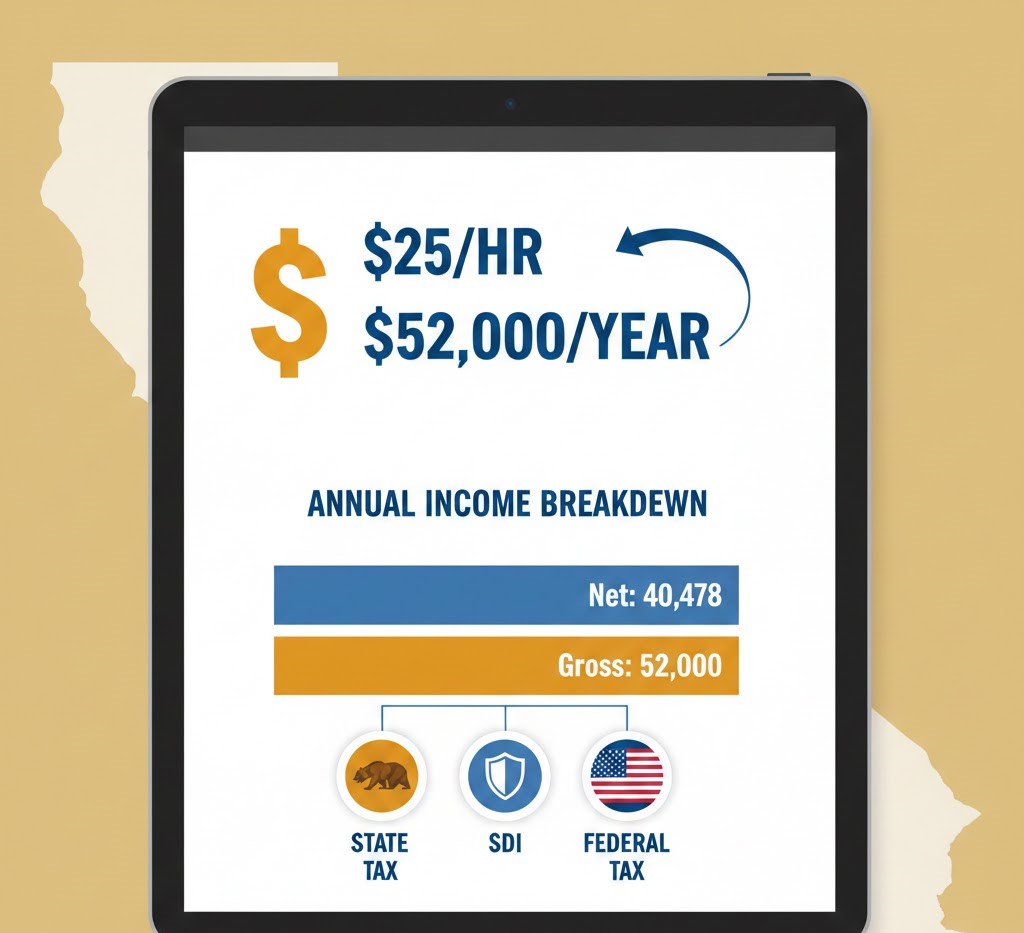
California Hourly to Salary Calculator (Interactive Tool)
Calculate your California salary using our homepage 2-in-1 salary to hourly calculator with advanced location settings. Input your hourly rate (CA minimum: $16.50 statewide, $18.67 in Emeryville), add overtime, and instantly see your take-home pay after California’s progressive state tax (1%-13.3%), SDI (1.2%), and all federal deductions.
How to Use This California Calculator
Step 1: Enter your California hourly wage Input your current or expected hourly rate. If you’re at California minimum wage, it’s $16.50 as of 2026 (higher in many cities like San Francisco at $18.07).
Step 2: Select your California location Choose your city or region to apply correct local minimum wage and cost-of-living adjustments. Major California metros have their own minimum wage laws.
Step 3: Input your working hours Enter hours per week (40 for full-time) and weeks per year (52 standard, or adjust for unpaid time off).
Step 4: Add California overtime if applicable California requires overtime after 8 hours in one day or 40 hours per week, and double-time after 12 hours in one day. Input your typical overtime hours for accurate calculations.
Step 5: Review your California results The calculator displays your gross salary plus California-specific deductions including state income tax, SDI (1.2%), PFL, federal taxes, FICA, and your net take-home pay.
Your Results Breakdown
Once you enter your information, the calculator shows:
Gross Income:
- Hourly rate
- Daily earnings (8-hour day)
- Weekly gross pay
- Bi-weekly gross pay (most common in California)
- Monthly gross pay
- Annual salary
California State Deductions:
- California state income tax (1% to 13.3% based on income)
- California SDI (State Disability Insurance): 1.2% of wages up to $153,164
- California PFL (Paid Family Leave): Included in SDI rate
- California ETT (Employment Training Tax): Employer-paid, not deducted from wages
Federal Deductions:
- Federal income tax withholding
- Social Security (6.2% up to $176,100)
- Medicare (1.45% on all wages)
- Additional Medicare tax (0.9% over $200k single / $250k married)
Net Take-Home Pay:
- After all California and federal deductions
- Monthly take-home amount
- Actual spending power in California dollars
California vs. National Comparison:
- How your California take-home compares to same salary in Texas (no state tax)
- Effective tax rate in California
- True hourly rate after all California taxes
How to Calculate Hourly to Salary in California
Understanding the California salary calculation process helps you verify results and make quick conversions for job offers or salary negotiations in California’s competitive job market.
Basic California Salary Calculation Formula
The core formula remains the same as other states, but California’s unique deductions significantly impact take-home pay:
Gross Annual Salary = Hourly Rate × Hours Per Week × Weeks Per Year
For California workers at $25/hour, 40 hours/week, 52 weeks/year: $25 × 40 × 52 = $52,000 gross annual salary
However, California net pay calculation requires subtracting:
- California state income tax (~6.5% effective rate at $52k)
- California SDI (1.2%): $624
- Federal income tax (~12% effective): $6,240
- FICA taxes (7.65%): $3,978
- Net annual pay: ~$37,500 (72% of gross)
In comparison, the same $52,000 salary in Texas (no state tax) yields ~$39,500 net pay (76% of gross), a difference of $2,000 annually or $167 per month.
Step-by-Step Calculation for California Workers
Step 1: Calculate gross salary Multiply your California hourly rate by hours and weeks worked. Example: $20/hour × 40 hours × 52 weeks = $41,600
Step 2: Determine California state tax bracket For single filer earning $41,600 in California:
- First $10,412 taxed at 1% = $104
- Next $14,287 ($24,699 – $10,412) taxed at 2% = $286
- Next $14,287 ($38,986 – $24,699) taxed at 4% = $571
- Remaining $2,614 ($41,600 – $38,986) taxed at 6% = $157
- Total California state tax: $1,118 annually
Step 3: Calculate California SDI California SDI rate is 1.2% on wages up to $153,164: $41,600 × 1.2% = $499 annually
Step 4: Calculate federal taxes Federal income tax for single filer at $41,600:
- Using standard deduction of $14,600
- Taxable income: $27,000
- Federal tax: ~$3,100
Step 5: Calculate FICA
- Social Security: $41,600 × 6.2% = $2,579
- Medicare: $41,600 × 1.45% = $603
- Total FICA: $3,182
Step 6: Calculate California net pay $41,600 – $1,118 (CA tax) – $499 (SDI) – $3,100 (Fed) – $3,182 (FICA) = $33,701 net pay
Your California take-home pay is 81% of gross at this income level.
California-Specific Calculation Examples
Example 1: $20/hour in Los Angeles
Gross Calculation:
- Hourly rate: $20.00
- Hours per week: 40
- Weeks per year: 52
- Annual gross salary: $41,600
California Deductions:
- CA state income tax: $1,118 (2.69% effective rate)
- CA SDI: $499 (1.2%)
- Federal income tax: $3,100 (7.45% effective rate)
- FICA: $3,182 (7.65%)
- Total deductions: $7,899
Net Pay:
- Annual net: $33,701
- Monthly net: $2,808
- Bi-weekly net: $1,296
- Take-home percentage: 81%
Los Angeles Cost of Living Context: At $20/hour in Los Angeles, you’re earning above California minimum wage but below the living wage for LA County (estimated $24-$26/hour for single adult). Rent for a 1-bedroom apartment in LA averages $2,400-$2,800 monthly, consuming 85-100% of your take-home pay.
Example 2: $30/hour in San Francisco
Gross Calculation:
- Hourly rate: $30.00
- Hours per week: 40
- Weeks per year: 52
- Annual gross salary: $62,400
California Deductions:
- CA state income tax: $2,244 (3.6% effective rate)
- CA SDI: $749 (1.2%)
- Federal income tax: $6,850 (11% effective rate)
- FICA: $4,774 (7.65%)
- Total deductions: $14,617
Net Pay:
- Annual net: $47,783
- Monthly net: $3,982
- Bi-weekly net: $1,838
- Take-home percentage: 77%
San Francisco Cost of Living Context: At $30/hour in San Francisco, you’re earning well above SF minimum wage ($18.07) but still face significant cost-of-living challenges. SF median 1-bedroom rent is $3,200-$3,500 monthly, consuming 80-88% of your take-home pay. San Francisco’s living wage is estimated at $35-$40/hour for single adults.
Example 3: $16.50/hour at California Minimum Wage
Gross Calculation:
- Hourly rate: $16.50 (California minimum wage 2026)
- Hours per week: 40
- Weeks per year: 52
- Annual gross salary: $34,320
California Deductions:
- CA state income tax: $475 (1.38% effective rate – lower bracket)
- CA SDI: $412 (1.2%)
- Federal income tax: $2,200 (6.4% effective rate)
- FICA: $2,625 (7.65%)
- Total deductions: $5,712
Net Pay:
- Annual net: $28,608
- Monthly net: $2,384
- Bi-weekly net: $1,100
- Take-home percentage: 83%
California Minimum Wage Context: At California’s $16.50 minimum wage, workers face lower tax rates but insufficient income for California’s high cost of living. Even in lower-cost Central Valley cities, living wage is $18-$20/hour. Many minimum wage workers in California qualify for earned income tax credits and assistance programs.
Example 4: $25/hour with Overtime in California
Gross Calculation:
- Regular hourly rate: $25.00
- Regular hours: 40 per week
- Overtime hours: 5 per week
- Overtime rate: $37.50 (time-and-a-half)
- Double-time hours: 0 (for this example)
Weekly Breakdown:
- Regular pay: $25 × 40 = $1,000
- Overtime pay: $37.50 × 5 = $187.50
- Total weekly: $1,187.50
- Annual gross: $61,750
California Deductions:
- CA state income tax: $2,180 (3.53% effective rate)
- CA SDI: $741 (1.2%)
- Federal income tax: $6,750 (10.93% effective rate)
- FICA: $4,724 (7.65%)
- Total deductions: $14,395
Net Pay:
- Annual net: $47,355
- Monthly net: $3,946
- Bi-weekly net: $1,821
- Take-home percentage: 77%
California Overtime Impact: The 5 hours of weekly overtime adds $9,750 to your annual gross income (regular 40 hours = $52,000). However, California’s progressive tax system and federal taxes mean you keep about 73% of that overtime income after taxes, netting an additional $7,100 annually. California’s daily overtime rules (after 8 hours) can further increase earnings for many workers.
Reverse Calculator: Salary to Hourly Calculator California
Converting California annual salaries to hourly rates helps you compare salaried positions with hourly jobs and understand your true per-hour earnings after considering California’s unique tax burden.
How to Convert California Salary to Hourly Wage
The reverse calculation divides annual salary by total hours worked, but understanding California take-home requires factoring in the state’s higher tax burden.
Basic Formula: Hourly Rate = Annual Salary ÷ 2,080 hours (40 hours × 52 weeks)
California Take-Home Hourly Rate: Effective Hourly Rate = (Annual Salary – CA taxes – Federal taxes – FICA) ÷ 2,080
This “effective hourly rate” shows what you actually earn per hour after California’s combined tax burden, which ranges from 25-35% depending on your income level.
Salary to Hourly Formula for California
Step 1: Divide annual salary by 2,080 This gives you gross hourly rate before any California or federal deductions.
Step 2: Calculate California state tax impact Estimate 3-8% of annual salary for California state income tax (varies by income bracket).
Step 3: Calculate total tax burden Add California state tax + federal tax + FICA + SDI (typically 25-35% combined).
Step 4: Determine effective hourly rate Subtract total taxes from annual salary, then divide by 2,080.
Example: $60,000 California salary:
- Gross hourly: $60,000 ÷ 2,080 = $28.85/hour
- CA state tax (~$2,100): -$1.01/hour
- Federal + FICA (~$10,500): -$5.05/hour
- CA SDI ($720): -$0.35/hour
- Effective hourly: $22.44/hour
Your California take-home is $22.44/hour on a $60,000 salary, which is 78% of your gross hourly rate.
California Salary Conversion Examples
Example: $50,000 salary to hourly in California
Gross Calculation:
- Annual salary: $50,000
- Standard hours: 2,080 per year
- Gross hourly rate: $24.04/hour
California Tax Impact:
- CA state income tax: $1,450 (2.9% effective)
- CA SDI: $600 (1.2%)
- Federal income tax: $4,800 (9.6% effective)
- FICA: $3,825 (7.65%)
- Total annual deductions: $10,675
Net California Earnings:
- Annual net: $39,325
- Effective hourly rate: $18.91/hour
- Take-home percentage: 79%
California vs. Texas Comparison: The same $50,000 salary in Texas (no state income tax):
- Annual net: ~$41,400
- Effective hourly: $19.90/hour
- Difference: $0.99/hour less in California (about $2,075 annually)
Example: $75,000 salary to hourly in California
Gross Calculation:
- Annual salary: $75,000
- Standard hours: 2,080 per year
- Gross hourly rate: $36.06/hour
California Tax Impact:
- CA state income tax: $3,150 (4.2% effective)
- CA SDI: $900 (1.2%)
- Federal income tax: $9,800 (13.1% effective)
- FICA: $5,738 (7.65%)
- Total annual deductions: $19,588
Net California Earnings:
- Annual net: $55,412
- Effective hourly rate: $26.64/hour
- Take-home percentage: 74%
California High-Tax Impact: At $75,000 in California, you lose 26% to taxes compared to ~21% in a low-tax state. This higher earner pays $3,150 in California state tax alone, reducing effective hourly rate by $1.51/hour compared to no-tax states.
Example: $100,000 salary to hourly in California
Gross Calculation:
- Annual salary: $100,000
- Standard hours: 2,080 per year
- Gross hourly rate: $48.08/hour
California Tax Impact:
- CA state income tax: $5,400 (5.4% effective)
- CA SDI: $1,200 (1.2%)
- Federal income tax: $16,500 (16.5% effective)
- FICA: $7,650 (7.65%)
- Total annual deductions: $30,750
Net California Earnings:
- Annual net: $69,250
- Effective hourly rate: $33.29/hour
- Take-home percentage: 69%
Six-Figure California Reality: At $100,000 in California, you’re in the 9.3% state tax bracket (marginal rate), though your effective rate is 5.4%. Combined with federal taxes, you lose 31% to taxes. In comparison, the same salary in Texas yields ~$73,500 net (73.5%), a difference of $4,250 annually or $2.05/hour.
High-Earner California Tax Comparison:
| Annual Salary | CA Net Pay | TX Net Pay | Annual Difference | Hourly Difference |
|---|---|---|---|---|
| $50,000 | $39,325 | $41,400 | -$2,075 | -$1.00/hour |
| $75,000 | $55,412 | $59,000 | -$3,588 | -$1.73/hour |
| $100,000 | $69,250 | $73,500 | -$4,250 | -$2.04/hour |
| $150,000 | $97,500 | $105,000 | -$7,500 | -$3.61/hour |
| $200,000 | $124,000 | $136,000 | -$12,000 | -$5.77/hour |
California’s progressive tax system means higher earners pay disproportionately more in state taxes, with those earning $200,000+ paying effective state rates of 8-10% compared to 2-3% for those earning $40,000.
California State Taxes and Your Paycheck
California has the most complex and highest state income tax system in the United States, with rates ranging from 1% to 13.3%. Understanding how California taxes impact your paycheck is crucial for accurate salary planning.
California State Income Tax Rates (2026)
California uses a progressive tax system with 10 tax brackets. You pay different rates on different portions of your income, not one flat rate on all income.
California Tax Brackets for Single Filers (2026)
| Tax Rate | Income Range | Tax Owed on Range | Cumulative Tax |
|---|---|---|---|
| 1% | $0 – $10,412 | Up to $104 | $104 |
| 2% | $10,413 – $24,699 | Up to $286 | $390 |
| 4% | $24,700 – $38,986 | Up to $571 | $961 |
| 6% | $38,987 – $54,081 | Up to $906 | $1,867 |
| 8% | $54,082 – $68,350 | Up to $1,142 | $3,009 |
| 9.3% | $68,351 – $349,137 | Up to $26,121 | $29,130 |
| 10.3% | $349,138 – $418,961 | Up to $7,192 | $36,322 |
| 11.3% | $418,962 – $698,271 | Up to $31,554 | $67,876 |
| 12.3% | $698,272 – $1,000,000 | Up to $37,103 | $104,979 |
| 13.3% | Over $1,000,000 | 13.3% of excess | $104,979 + 13.3% |
Key Insights:
- California’s top rate of 13.3% is the highest in the nation
- The 13.3% bracket only applies to income over $1 million
- Most California workers (earning $40k-$100k) pay effective rates of 3-6%
- First $10,412 is only taxed at 1%
California Tax Brackets for Married Filing Jointly (2026)
| Tax Rate | Income Range | Tax Owed on Range | Cumulative Tax |
|---|---|---|---|
| 1% | $0 – $20,824 | Up to $208 | $208 |
| 2% | $20,825 – $49,398 | Up to $571 | $779 |
| 4% | $49,399 – $77,972 | Up to $1,143 | $1,922 |
| 6% | $77,973 – $108,162 | Up to $1,811 | $3,733 |
| 8% | $108,163 – $136,700 | Up to $2,283 | $6,016 |
| 9.3% | $136,701 – $698,274 | Up to $52,236 | $58,252 |
| 10.3% | $698,275 – $837,922 | Up to $14,380 | $72,632 |
| 11.3% | $837,923 – $1,000,000 | Up to $18,315 | $90,947 |
| 12.3% | $1,000,001 – $1,396,542 | Up to $48,775 | $139,722 |
| 13.3% | Over $1,396,542 | 13.3% of excess | $139,722 + 13.3% |
Married Filing Impact:
- Brackets are exactly double those for single filers
- Married couples benefit from doubled income thresholds
- A couple earning $100,000 combined pays less effective rate than two singles earning $50,000 each
How California’s Progressive Tax System Works
California’s progressive system means you pay different rates on different “chunks” of your income, not one rate on all of it.
Example: Single filer earning $60,000
Income is taxed in layers:
- First $10,412 at 1% = $104
- Next $14,287 ($10,413-$24,699) at 2% = $286
- Next $14,287 ($24,700-$38,986) at 4% = $571
- Next $15,095 ($38,987-$54,081) at 6% = $906
- Remaining $5,919 ($54,082-$60,000) at 8% = $474
- Total California tax: $2,341
- Effective tax rate: 3.9% (much lower than 8% marginal rate)
Common Misconception: Many people think earning $60,000 means paying 8% on all income. In reality, only the last $5,919 is taxed at 8%. Your effective rate is 3.9%, not 8%.
California Effective Tax Rates by Income:
| Annual Income | Marginal Rate | Effective Rate | Annual CA Tax |
|---|---|---|---|
| $30,000 | 4% | 1.8% | $540 |
| $40,000 | 6% | 2.4% | $960 |
| $50,000 | 6% | 2.9% | $1,450 |
| $60,000 | 8% | 3.9% | $2,340 |
| $75,000 | 9.3% | 4.2% | $3,150 |
| $100,000 | 9.3% | 5.4% | $5,400 |
| $150,000 | 9.3% | 6.8% | $10,200 |
| $200,000 | 9.3% | 7.9% | $15,800 |
The gap between marginal and effective rates shows why California’s system is more progressive than it appears. Someone earning $100,000 pays 5.4% effective rate, not the 9.3% marginal rate.
California State Disability Insurance (SDI)
California State Disability Insurance is a mandatory payroll deduction unique to California that provides partial wage replacement for workers unable to work due to non-work-related illness, injury, or pregnancy.
What is California SDI?
California SDI is a state-run insurance program that provides:
- Short-term disability benefits: Up to 52 weeks of partial wage replacement
- Paid Family Leave (PFL): Up to 8 weeks of benefits to care for family members
- Pregnancy disability: Coverage for pregnancy-related conditions
Unlike most states where disability insurance is optional or employer-provided, California requires all employees to contribute to SDI through payroll deductions. This makes California one of only five states (along with Hawaii, New Jersey, New York, and Rhode Island) with mandatory state disability insurance.
SDI Coverage:
- Covers approximately 60-70% of wages during disability
- Maximum weekly benefit in 2026: $1,620
- No waiting period for hospitalization
- 7-day waiting period for non-hospitalized disabilities
- Protects your job while on disability leave (combined with other laws)
SDI Tax Rate for 2026
California SDI Rate: 1.2% of gross wages
This rate is set annually by the California Employment Development Department (EDD) based on the fund’s financial health. The rate has ranged from 0.9% to 1.2% over the past decade.
Monthly SDI Deduction Examples:
| Monthly Gross | SDI Deduction (1.2%) |
|---|---|
| $3,000 | $36 |
| $4,000 | $48 |
| $5,000 | $60 |
| $6,000 | $72 |
| $8,000 | $96 |
| $10,000 | $120 |
SDI Wage Base Limit
2026 SDI Wage Base: $153,164
California SDI only applies to the first $153,164 of your annual wages. Any income above this amount is not subject to SDI tax.
Impact for high earners:
- Earning $153,164 or more: Maximum annual SDI = $1,838
- Earning $100,000: Annual SDI = $1,200
- Earning $60,000: Annual SDI = $720
Once your year-to-date wages reach $153,164, SDI deductions stop for the remainder of the calendar year, giving you a small increase in take-home pay for those final paychecks.
California Paid Family Leave (PFL)
Paid Family Leave is funded through the SDI program and provides wage replacement when you take time off to:
- Bond with a new child (birth, adoption, or foster placement)
- Care for a seriously ill family member
- Participate in a qualifying event related to a family member’s military deployment
PFL Contribution Rate
PFL is included in the 1.2% SDI rate—there’s no separate deduction. The SDI deduction covers both disability insurance and paid family leave benefits.
How PFL Affects Your Paycheck
PFL doesn’t add an extra deduction to your California paycheck; it’s built into SDI. However, understanding PFL helps you value your total compensation package:
PFL Benefits in 2026:
- Up to 8 weeks of benefits per year
- Pays 60-70% of wages (higher percentage for lower earners)
- Maximum weekly benefit: $1,620
- No waiting period
- Can be taken intermittently
Value to employees: If you earn $5,000 monthly and use 8 weeks of PFL:
- Benefit payment: ~$3,240 (8 weeks × 60-70% of weekly wages)
- Job protection through California Family Rights Act
- Continued health insurance (if employer-provided)
The $60/month you pay in SDI ($5,000 × 1.2%) provides access to both disability and family leave benefits worth thousands if needed.
California Employment Training Tax (ETT)
Who Pays ETT in California?
The Employment Training Tax is paid by employers only, not deducted from employee paychecks. However, understanding ETT helps you comprehend total California payroll costs.
ETT funds:
- Job training programs
- Workforce development
- Employment services
- Apprenticeship programs
ETT Rate and Wage Base
California ETT Rate: 0.1% of first $7,000 of each employee’s wages
Maximum ETT per employee: $7 annually
This relatively small tax supports California’s workforce development system and doesn’t impact your take-home pay as an employee.
Total California Tax Burden
Understanding your complete California tax burden helps with accurate salary calculations and financial planning.
Combined State Tax Rate Calculator
Your total California state tax burden combines multiple deductions:
California State Deductions:
- State income tax: 1% to 13.3% (progressive)
- SDI: 1.2% (up to $153,164)
- ETT: $0 (employer-paid)
Federal Deductions (same nationwide): 4. Federal income tax: 10% to 37% (progressive) 5. Social Security: 6.2% (up to $176,100) 6. Medicare: 1.45% (all wages) 7. Additional Medicare: 0.9% (over $200k/$250k)
Combined Tax Burden Examples:
| Annual Income | CA Income Tax | CA SDI | Fed Income Tax | FICA | Total Deductions | Take-Home | Effective Rate |
|---|---|---|---|---|---|---|---|
| $40,000 | $960 (2.4%) | $480 | $3,000 | $3,060 | $7,500 | $32,500 | 18.8% |
| $60,000 | $2,340 (3.9%) | $720 | $6,850 | $4,590 | $14,500 | $45,500 | 24.2% |
| $80,000 | $4,080 (5.1%) | $960 | $10,900 | $6,120 | $22,060 | $57,940 | 27.6% |
| $100,000 | $5,400 (5.4%) | $1,200 | $16,500 | $7,650 | $30,750 | $69,250 | 30.8% |
| $150,000 | $10,200 (6.8%) | $1,800 | $28,500 | $10,968 | $51,468 | $98,532 | 34.3% |
Key Insights:
- California workers pay 3-7% more in total taxes than Texas workers at same income
- Combined effective tax rates range from 19% (lower income) to 35% (higher income)
- SDI adds 1.2% to California’s tax burden versus zero-tax states
- California’s progressive system means effective rates are lower than marginal rates
California vs Other States Tax Comparison
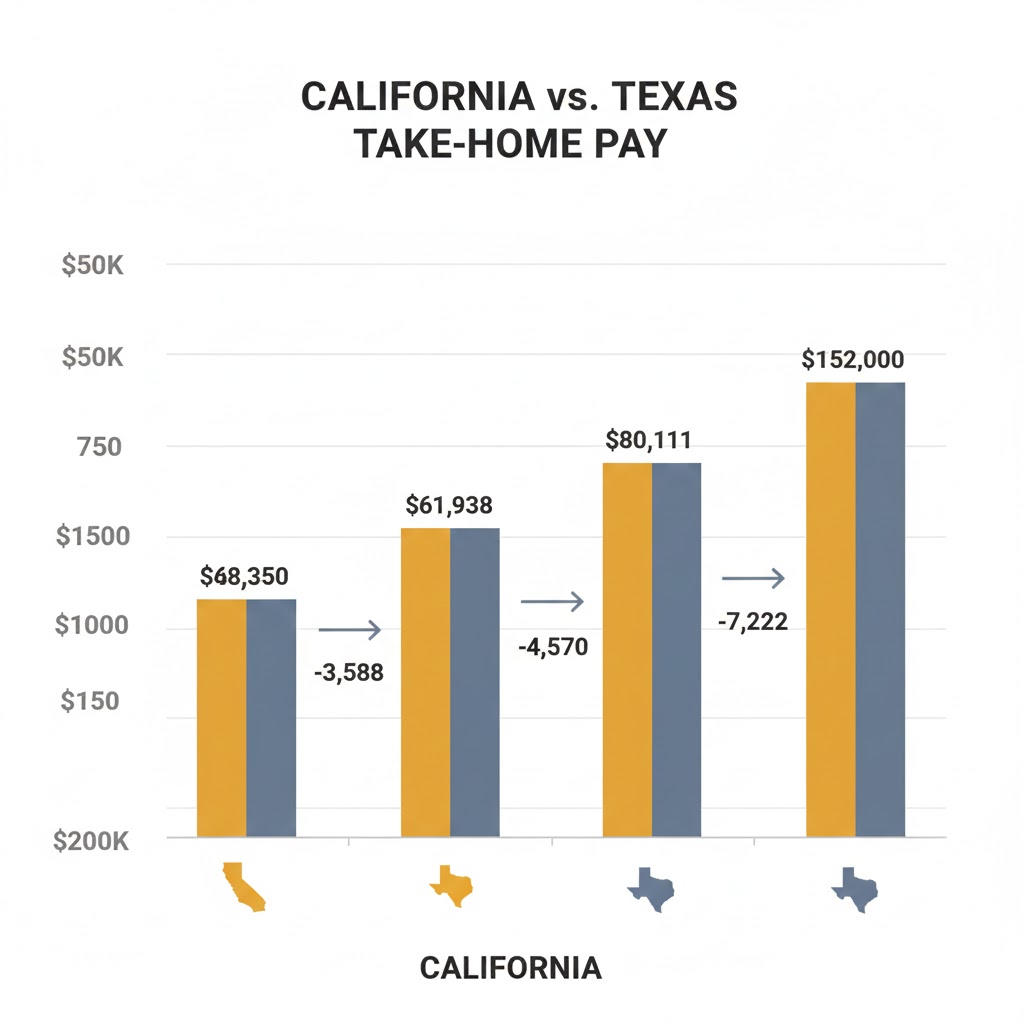
Annual Take-Home Pay Comparison at $75,000 Salary:
| State | State Income Tax | Total Deductions | Net Take-Home | vs California |
|---|---|---|---|---|
| California | $3,150 (4.2%) | $19,588 | $55,412 | Baseline |
| Texas | $0 | $16,438 | $58,562 | +$3,150 (+5.7%) |
| Florida | $0 | $16,438 | $58,562 | +$3,150 (+5.7%) |
| New York | $4,200 (5.6%) | $20,638 | $54,362 | -$1,050 (-1.9%) |
| Washington | $0 | $16,438 | $58,562 | +$3,150 (+5.7%) |
| Oregon | $5,250 (7.0%) | $21,688 | $53,312 | -$2,100 (-3.8%) |
| Nevada | $0 | $16,438 | $58,562 | +$3,150 (+5.7%) |
| Arizona | $1,875 (2.5%) | $18,313 | $56,687 | +$1,275 (+2.3%) |
California’s Tax Position:
- 4th highest tax burden among all states
- Significantly higher than no-tax states (TX, FL, NV, WA)
- Similar to other high-tax states (NY, OR, NJ)
- The trade-off: California offers strong worker protections, paid family leave, and disability insurance
Federal Taxes for California Workers
While federal taxes are the same nationwide, California workers should understand how federal deductions interact with California’s tax system.
Federal Income Tax Withholding
Federal income tax withholding from your California paycheck follows the same progressive bracket system as other states, but your withholding may differ based on your W-4 elections.
2026 Federal Tax Brackets
For Single Filers:
| Tax Rate | Income Range | Calculation |
|---|---|---|
| 10% | $0 – $11,925 | 10% of income |
| 12% | $11,926 – $48,475 | $1,193 + 12% over $11,925 |
| 22% | $48,476 – $103,350 | $5,579 + 22% over $48,475 |
| 24% | $103,351 – $197,300 | $17,651 + 24% over $103,350 |
| 32% | $197,301 – $250,525 | $40,199 + 32% over $197,300 |
| 35% | $250,526 – $626,350 | $57,231 + 35% over $250,525 |
| 37% | Over $626,350 | $188,771 + 37% over $626,350 |
California Context: Federal taxes are the same whether you live in California or Texas, but California workers face combined federal + state + FICA + SDI rates of 25-40% depending on income, compared to 18-30% for Texas workers who don’t pay state income tax.
W-4 Form Impact on California Paychecks
Your W-4 form determines federal withholding but doesn’t affect California state tax withholding. California uses its own state W-4 form (DE 4).
Key W-4 considerations for California workers:
- Higher California taxes mean you need accurate federal withholding too
- Claiming too many allowances can result in large tax bills for California workers
- California’s high cost of living doesn’t affect federal tax brackets
- Consider increasing federal withholding if you have side income
FICA Taxes in California
FICA (Federal Insurance Contributions Act) taxes are the same in California as all other states, but it’s important to understand how they combine with California’s unique deductions.
Social Security Tax (6.2%)
Rate: 6.2% on wages up to $176,100 (2026 limit) Maximum annual tax: $10,918
Examples for California workers:
- $50,000 salary: $3,100 in Social Security tax
- $100,000 salary: $6,200 in Social Security tax
- $180,000 salary: $10,918 (max reached, no more SS tax after $176,100)
California workers pay Social Security tax plus California SDI (1.2%), effectively paying 7.4% for social insurance programs compared to 6.2% in states without SDI.
Medicare Tax (1.45%)
Rate: 1.45% on all wages (no limit)
Medicare tax applies to all income regardless of amount, unlike Social Security which caps at $176,100.
Annual Medicare tax examples:
- $50,000 salary: $725
- $100,000 salary: $1,450
- $200,000 salary: $2,900 + additional Medicare tax
Additional Medicare Tax for High Earners
High-earning California workers pay an extra 0.9% Medicare tax:
- Single filers: On wages over $200,000
- Married filing jointly: On wages over $250,000
Example for California high earner: $300,000 salary:
- Regular Medicare (1.45%): $4,350
- Additional Medicare on $100,000 (0.9%): $900
- Total Medicare tax: $5,250
- Combined with CA income tax (8-9%): Very high total burden
California tech workers and professionals earning $200k+ face combined marginal rates of 40-45% (federal + state + FICA + SDI).
California Minimum Wage and Living Wage (2026)
California’s minimum wage laws are among the most progressive in the nation, with the state minimum wage significantly higher than federal minimum wage and many cities implementing even higher local minimums.
California State Minimum Wage
Current California Minimum Wage: $16.50/hour
As of January 1, 2026, California’s statewide minimum wage is $16.50 per hour for all employers regardless of size. This is more than double the federal minimum wage of $7.25/hour.
Annual income at California minimum wage:
- Hourly rate: $16.50
- Full-time (40 hours/week, 52 weeks): $34,320 gross annually
- Monthly gross: $2,860
- After CA and federal taxes: ~$28,600 net annually ($2,383/month)
California Minimum Wage Comparison:
| Year | CA Minimum Wage | Federal Minimum | CA Advantage |
|---|---|---|---|
| 2020 | $13.00 | $7.25 | +$5.75 (+79%) |
| 2021 | $14.00 | $7.25 | +$6.75 (+93%) |
| 2022 | $15.00 | $7.25 | +$7.75 (+107%) |
| 2023 | $15.50 | $7.25 | +$8.25 (+114%) |
| 2024 | $16.00 | $7.25 | +$8.75 (+121%) |
| 2025 | $16.25 | $7.25 | +$9.00 (+124%) |
| 2026 | $16.50 | $7.25 | +$9.25 (+128%) |
California Minimum Wage History
California has consistently increased its minimum wage over the past decade:
Historical Increases:
- 2016: $10.00 (enacted SB 3)
- 2017: $10.50
- 2018: $11.00 (small employers), $11.00 (large employers)
- 2019: $12.00 (large employers 26+)
- 2020: $13.00
- 2021: $14.00
- 2022: $15.00 (goal reached)
- 2023-2026: Adjusted for inflation annually
Future Projections: California minimum wage will continue adjusting annually based on inflation (Consumer Price Index) to maintain purchasing power. Expected to reach $17-18/hour by 2028.
City-Specific Minimum Wages in California
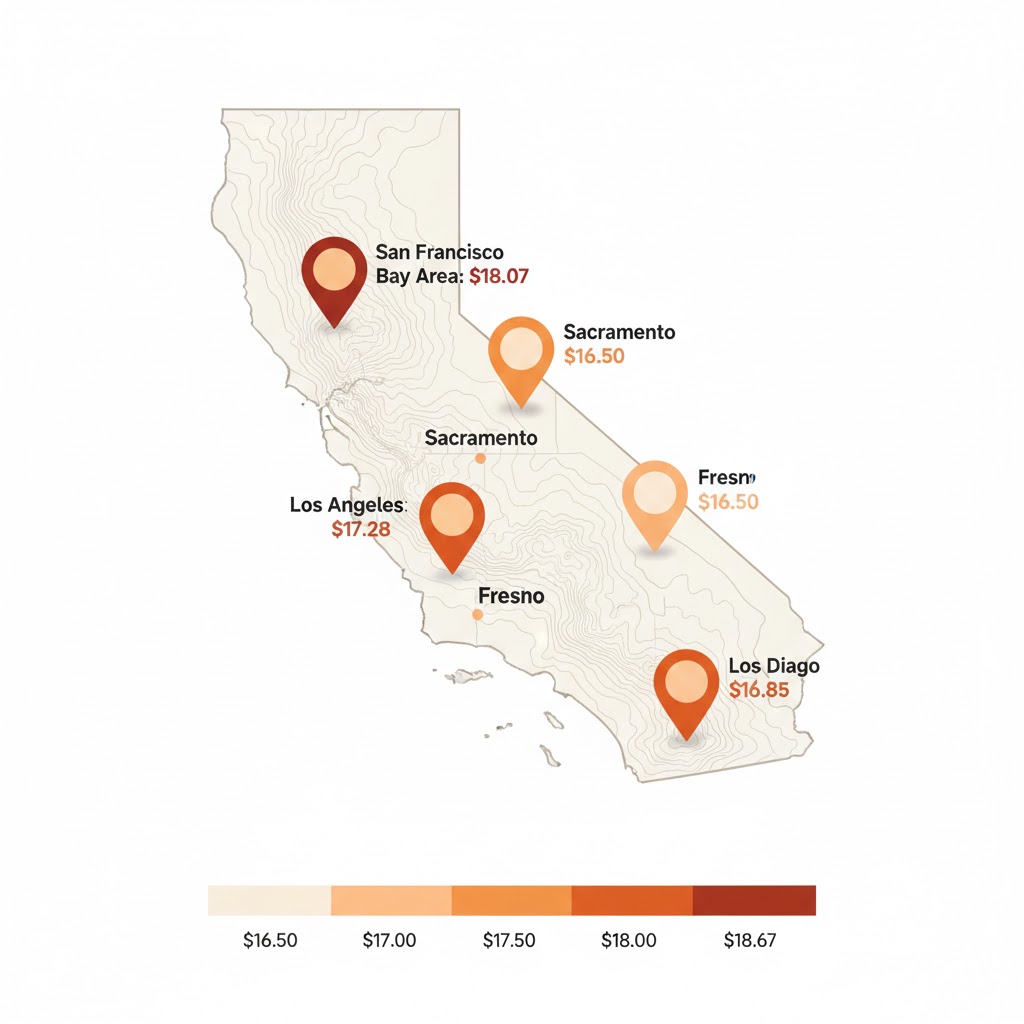
Many California cities have implemented local minimum wages higher than the state minimum, reflecting their higher costs of living.
California City Minimum Wages (2026):
| City/Region | Minimum Wage | Full-Time Annual | vs State Minimum |
|---|---|---|---|
| San Francisco | $18.07/hour | $37,586 | +$1.57/hour (+9.5%) |
| Berkeley | $18.07/hour | $37,586 | +$1.57/hour (+9.5%) |
| Mountain View | $18.15/hour | $37,752 | +$1.65/hour (+10%) |
| Palo Alto | $17.80/hour | $37,024 | +$1.30/hour (+7.9%) |
| Los Angeles (city) | $17.28/hour | $35,942 | +$0.78/hour (+4.7%) |
| Santa Monica | $17.27/hour | $35,922 | +$0.77/hour (+4.7%) |
| Pasadena | $17.50/hour | $36,400 | +$1.00/hour (+6.1%) |
| San Diego | $16.85/hour | $35,048 | +$0.35/hour (+2.1%) |
| Oakland | $16.50/hour | $34,320 | Same as state |
| Sacramento | $16.50/hour | $34,320 | Same as state |
San Francisco Minimum Wage ($18.07/hour)
San Francisco has the highest citywide minimum wage in California and one of the highest in the nation.
SF Minimum Wage Details:
- Rate: $18.07/hour (effective July 1, 2026)
- Adjusted annually based on Consumer Price Index
- Applies to all employees working in SF (even if employer based elsewhere)
- No size exemptions (all employers must pay this rate)
Annual earnings at SF minimum:
- Gross annual: $37,586 (40 hours × 52 weeks)
- After taxes: ~$30,500 net
- Monthly net: ~$2,542
SF Living Wage Context: Despite earning $18.07/hour, San Francisco’s high cost of living means minimum wage workers still struggle:
- Median 1-BR rent in SF: $3,200-$3,500/month
- Living wage for single adult: $35-38/hour
- Minimum wage covers only 47-52% of living wage
Los Angeles Minimum Wage
Los Angeles County has varying minimum wages depending on location and employer size.
LA Minimum Wage Structure (2026):
- City of LA: $17.28/hour
- LA County unincorporated areas: $17.27/hour
- Many LA cities: Follow state minimum of $16.50/hour
LA Context:
- At $17.28/hour: $35,942 annually gross
- After taxes: ~$29,500 net annually
- LA median 1-BR rent: $2,400-$2,800/month
- Living wage estimate: $24-26/hour for single adult
San Diego Minimum Wage
San Diego’s minimum wage is slightly above the state minimum.
SD Minimum: $16.85/hour
- Annual gross: $35,048
- Monthly gross: $2,921
- After taxes: ~$28,600 net annually
San Diego Cost of Living:
- Median 1-BR rent: $2,200-$2,500
- Living wage: $22-24/hour
- More affordable than SF/LA but still challenging at minimum wage
Berkeley Minimum Wage
Berkeley matches San Francisco with one of the highest minimum wages in California.
Berkeley Minimum: $18.07/hour
- Same as San Francisco
- Reflects Berkeley’s high cost of living
- Annual gross: $37,586
Other California Cities with Local Minimums
Additional Cities Above State Minimum:
| City | 2026 Minimum Wage |
|---|---|
| Alameda | $16.52/hour |
| Belmont | $17.35/hour |
| Cupertino | $17.75/hour |
| Daly City | $16.62/hour |
| El Cerrito | $17.39/hour |
| Emeryville | $18.67/hour (highest in CA) |
| Fremont | $16.80/hour |
| Los Altos | $17.75/hour |
| Malibu | $17.27/hour |
| Milpitas | $17.70/hour |
| Novato | $16.78/hour |
| Petaluma | $17.45/hour |
| Redwood City | $17.70/hour |
| Richmond | $16.17/hour |
| San Jose | $17.55/hour |
| San Mateo | $17.35/hour |
| Santa Clara | $17.75/hour |
| Sonoma | $17.60/hour |
| South San Francisco | $17.25/hour |
| Sunnyvale | $18.00/hour |
| West Hollywood | $19.08/hour (effective July 2026) |
Emeryville currently holds the title of highest minimum wage in California at $18.67/hour.
Living Wage in California
The “living wage” represents the hourly rate needed to cover basic necessities without government assistance. California’s living wages are among the highest in the nation due to housing costs.
Living Wage Calculator for California Cities
Living Wage Estimates for Single Adults (2026):
| California Region | Living Wage/Hour | Annual Living Wage | vs Min Wage Gap |
|---|---|---|---|
| San Francisco | $35.00/hour | $72,800 | -$16.93/hour |
| San Jose | $32.00/hour | $66,560 | -$14.45/hour |
| Oakland | $29.00/hour | $60,320 | -$12.50/hour |
| Los Angeles | $26.00/hour | $54,080 | -$8.72/hour |
| San Diego | $24.00/hour | $49,920 | -$7.15/hour |
| Sacramento | $22.00/hour | $45,760 | -$5.50/hour |
| Riverside | $20.00/hour | $41,600 | -$3.50/hour |
| Fresno | $19.00/hour | $39,520 | -$2.50/hour |
| Bakersfield | $18.00/hour | $37,440 | -$1.50/hour |
Living Wage for Families (2026):
| Household Type | SF Bay Area | Los Angeles | Sacramento | Fresno |
|---|---|---|---|---|
| Single Adult | $35/hour | $26/hour | $22/hour | $19/hour |
| 1 Adult + 1 Child | $55/hour | $42/hour | $35/hour | $30/hour |
| 2 Adults (both working) | $25/hour each | $19/hour each | $16/hour each | $14/hour each |
| 2 Adults + 2 Children | $35/hour each | $27/hour each | $23/hour each | $20/hour each |
Key Insight: Even at California’s $16.50/hour minimum wage, workers earn only 47-87% of the living wage depending on location. The gap is most severe in high-cost coastal cities.
Cost of Living Adjustments by Region
California’s cost of living varies dramatically by region, with coastal urban areas 50-100% more expensive than inland regions.
Regional Cost of Living Index (California Average = 100):
| Region | Overall COL Index | Housing Index | Biggest Driver |
|---|---|---|---|
| San Francisco | 197 | 380 | Housing costs |
| San Jose | 185 | 340 | Housing costs |
| Oakland | 172 | 298 | Housing costs |
| Los Angeles | 152 | 250 | Housing costs |
| San Diego | 148 | 242 | Housing costs |
| Sacramento | 116 | 140 | More affordable |
| Riverside | 108 | 125 | Inland location |
| Fresno | 98 | 105 | Central Valley |
| Bakersfield | 94 | 98 | Affordable option |
Salary Equivalencies Across California: A $60,000 salary has vastly different purchasing power depending on location:
| Location | Salary Needed | Equivalent Hourly | vs $60k in Fresno |
|---|---|---|---|
| Fresno (baseline) | $60,000 | $28.85/hour | 100% |
| Sacramento | $71,000 | $34.13/hour | 118% |
| Riverside | $66,000 | $31.73/hour | 110% |
| San Diego | $91,000 | $43.75/hour | 152% |
| Los Angeles | $93,000 | $44.71/hour | 155% |
| Oakland | $105,000 | $50.48/hour | 175% |
| San Jose | $113,000 | $54.33/hour | 188% |
| San Francisco | $120,000 | $57.69/hour | 200% |
Example: $60,000 in Fresno provides the same standard of living as $120,000 in San Francisco. A job offer at $80,000 in SF is equivalent to just $40,000 in Fresno after cost-of-living adjustments.
California Overtime Pay Rules
California has some of the most employee-friendly overtime laws in the United States, requiring overtime pay in situations where federal law doesn’t mandate it.
California Overtime Laws (Different from Federal)
California overtime law differs significantly from federal Fair Labor Standards Act (FLSA) rules, providing greater protections and earning potential for non-exempt workers.
Key California Differences:
- Daily overtime (after 8 hours in one day)
- Double-time requirements (after 12 hours in one day)
- Seventh consecutive day rules
- No averaging over multiple weeks
Overtime After 8 Hours in One Day
California Rule: Overtime required after 8 hours worked in a single workday
Federal law only requires overtime after 40 hours in a week. California goes further by mandating overtime after 8 hours in a single day, even if you work less than 40 hours that week.
Example: Monday-Thursday: 10 hours each day (40 hours total) Friday: Day off
- Federal overtime: 0 hours (only 40 hours worked that week)
- California overtime: 8 hours (2 hours each day beyond 8)
- Extra earnings in California: 8 hours × (hourly rate × 0.5)
Calculation at $20/hour:
- Federal: $20 × 40 = $800
- California: ($20 × 32) + ($30 × 8) = $640 + $240 = $880
- California advantage: $80 extra per week
Overtime After 40 Hours in One Week
California Rule: Overtime required after 40 hours in a workweek (same as federal)
This rule applies in addition to the daily overtime rule. If you don’t trigger daily overtime but exceed 40 weekly hours, you still get overtime.
Example: Monday-Friday: 8.5 hours each day (42.5 hours total)
- Daily overtime: 2.5 hours (0.5 hours × 5 days)
- Weekly overtime beyond daily: 0 hours (already counted)
- Total overtime: 2.5 hours at time-and-a-half
Double Time After 12 Hours in One Day
California Rule: Double-time (2× regular rate) required after 12 hours in a single workday
This is unique to California. Most states only have time-and-a-half overtime.
Calculation example at $25/hour: Work 14 hours in one day:
- First 8 hours: $25 × 8 = $200 (regular time)
- Hours 9-12 (4 hours): $37.50 × 4 = $150 (time-and-a-half)
- Hours 13-14 (2 hours): $50 × 2 = $100 (double-time)
- Total daily pay: $450 (average of $32.14/hour for the 14-hour day)
Compare to federal-only rules:
- 14 hours at regular rate: $25 × 14 = $350
- California advantage: $100 extra
7th Consecutive Day Overtime Rules
California Rule: Special overtime rates for seventh consecutive day of work
If you work seven consecutive days in a workweek:
- First 8 hours on 7th day: Time-and-a-half
- Over 8 hours on 7th day: Double-time
Example at $20/hour: Work Monday-Sunday (7 days), 8 hours each day
- Days 1-6: Regular pay + any daily overtime
- Day 7, first 8 hours: $30/hour (time-and-a-half)
- Day 7, hours 9+: $40/hour (double-time)
If you work 10 hours on the 7th day:
- First 8 hours: $30 × 8 = $240
- Next 2 hours: $40 × 2 = $80
- Total for 7th day: $320 (vs $200 at regular rate)
Calculating Overtime Pay in California
California overtime calculations can be complex due to multiple rules applying simultaneously.
Time-and-a-Half Calculation
Formula: Regular hourly rate × 1.5
Common California scenarios requiring time-and-a-half:
- Hours 9-12 in a single workday
- Hours 41-XX in a workweek (if not already counted as daily OT)
- First 8 hours on 7th consecutive day
Calculation table:
| Regular Rate | Time-and-a-Half Rate | 4 Hours OT Pay |
|---|---|---|
| $15/hour | $22.50/hour | $90 |
| $18/hour | $27.00/hour | $108 |
| $20/hour | $30.00/hour | $120 |
| $25/hour | $37.50/hour | $150 |
| $30/hour | $45.00/hour | $180 |
| $40/hour | $60.00/hour | $240 |
Double-Time Calculation
Formula: Regular hourly rate × 2
California scenarios requiring double-time:
- Over 12 hours in a single workday
- Over 8 hours on 7th consecutive day
Calculation table:
| Regular Rate | Double-Time Rate | 4 Hours DT Pay |
|---|---|---|
| $15/hour | $30/hour | $120 |
| $18/hour | $36/hour | $144 |
| $20/hour | $40/hour | $160 |
| $25/hour | $50/hour | $200 |
| $30/hour | $60/hour | $240 |
| $40/hour | $80/hour | $320 |
Annual Salary with Regular California Overtime
Example: $22/hour with consistent California overtime
Weekly schedule:
- Monday-Thursday: 10 hours each (40 hours total)
- 8 hours daily overtime (2 hours × 4 days)
- Friday: 8 hours regular
- Total: 48 hours worked, 8 hours at overtime rate
Weekly earnings:
- Regular time: $22 × 40 = $880
- Overtime: $33 × 8 = $264
- Total weekly: $1,144
- Annual: $59,488
Without California daily OT rule:
- Would earn: $22 × 40 + $33 × 8 = $1,144 (same, because exceeds 40/week)
Better example showing CA advantage:
- Monday-Wednesday: 11 hours each (33 hours)
- Thursday-Friday: Off
- Under federal: 0 overtime (less than 40 hours/week)
- Under California: 9 hours overtime (3 hours × 3 days)
- Weekly difference: 9 hours × $11 (OT premium at $22/hour) = $99
- Annual California advantage: $5,148
Who is Exempt from California Overtime?
California has stricter exemption requirements than federal law, meaning more workers qualify for overtime in California than in other states.
California Salary Threshold for Exemption
2026 California Minimum Salary for Exemption:
- Employers with 26+ employees: $66,560 annually ($1,280/week)
- Employers with 25 or fewer: $62,400 annually ($1,200/week)
This is higher than the federal threshold and adjusted annually based on California minimum wage.
Comparison:
- Federal minimum: ~$684/week ($35,568 annually)
- California minimum: $1,280/week ($66,560 annually)
- California requires 87% higher salary for exemption
Impact: Many workers classified as exempt in other states are non-exempt (overtime-eligible) in California due to higher salary thresholds.
Computer Professional Exemption in California
California has special rules for computer professionals that differ from federal exemptions.
California Computer Professional Requirements:
- Must earn at least $55.58/hour OR $115,763.35 annually (2026 rates)
- Primary duties must involve systems analysis, programming, software engineering
- Must exercise discretion and independent judgment
California vs Federal:
- Federal: $27.63/hour minimum
- California: $55.58/hour minimum (101% higher)
Many computer professionals exempt under federal law are non-exempt in California and entitled to overtime.
California Overtime Exemption Tests
To be exempt from California overtime, employees must meet ALL three tests:
1. Salary Basis Test:
- Guaranteed minimum salary of $66,560+ annually
- Paid same amount regardless of quality/quantity of work
- Cannot be reduced for variations in work
2. Salary Level Test:
- Must earn at least $1,280/week ($66,560 annually)
- Higher for computer professionals
- No maximum income test
3. Duties Test:
- Executive: Manage enterprise or department, direct 2+ employees
- Administrative: Office work related to management/business operations
- Professional: Work requiring advanced knowledge, prolonged specialized training
- Must primarily perform exempt duties (>50% of work time)
Common California Misclassifications:
- Assistant managers who spend most time on non-management tasks
- “Administrative” workers who follow set procedures without discretion
- Computer workers earning under $55.58/hour
- Workers paid salary but primarily performing non-exempt duties
Your Rights: If misclassified as exempt in California, you may be entitled to:
- Back pay for all overtime worked (up to 4 years)
- Waiting time penalties
- Meal and rest break premiums
- Attorney fees
Contact California Labor Commissioner if you believe you’re misclassified.
Popular California Hourly to Salary Conversions
Quick reference tables showing exact California take-home pay after all state and federal deductions.
Common California Hourly Rates to Annual Salary
Comprehensive California Conversion Table:
| Hourly Rate | Annual Gross | Monthly Gross | CA State Tax | CA SDI | Federal Tax | FICA | Total Deductions | Annual Net | Monthly Net | % Take-Home |
|---|---|---|---|---|---|---|---|---|---|---|
| $16.50 (CA min) | $34,320 | $2,860 | $475 | $412 | $2,200 | $2,625 | $5,712 | $28,608 | $2,384 | 83.4% |
| $18/hour | $37,440 | $3,120 | $675 | $449 | $2,680 | $2,864 | $6,668 | $30,772 | $2,564 | 82.2% |
| $20/hour | $41,600 | $3,467 | $960 | $499 | $3,280 | $3,182 | $7,921 | $33,679 | $2,807 | 80.9% |
| $22/hour | $45,760 | $3,813 | $1,240 | $549 | $3,950 | $3,501 | $9,240 | $36,520 | $3,043 | 79.8% |
| $25/hour | $52,000 | $4,333 | $1,720 | $624 | $5,200 | $3,978 | $11,522 | $40,478 | $3,373 | 77.8% |
| $28/hour | $58,240 | $4,853 | $2,215 | $699 | $6,450 | $4,455 | $13,819 | $44,421 | $3,702 | 76.3% |
| $30/hour | $62,400 | $5,200 | $2,540 | $749 | $7,150 | $4,774 | $15,213 | $47,187 | $3,932 | 75.6% |
| $35/hour | $72,800 | $6,067 | $3,420 | $874 | $9,200 | $5,569 | $19,063 | $53,737 | $4,478 | 73.8% |
| $40/hour | $83,200 | $6,933 | $4,480 | $998 | $11,600 | $6,365 | $23,443 | $59,757 | $4,980 | 71.8% |
| $45/hour | $93,600 | $7,800 | $5,620 | $1,123 | $14,200 | $7,160 | $28,103 | $65,497 | $5,458 | 70.0% |
| $50/hour | $104,000 | $8,667 | $6,880 | $1,248 | $17,000 | $7,956 | $33,084 | $70,916 | $5,910 | 68.2% |
Key Insights from Table:
- California minimum wage workers keep 83% of gross pay (lowest tax burden)
- Middle earners ($25-30/hour) keep 76-78% of gross pay
- Higher earners ($40-50/hour) keep only 68-72% of gross pay
- California SDI adds consistent 1.2% burden across all income levels
- Combined California + federal effective rate: 17-32% depending on income
Common California Annual Salaries to Hourly Rate
California Salary to Hourly Conversion Table:
| Annual Salary | Hourly Rate | Monthly Gross | CA State Tax | CA SDI | Federal Tax | Total Deductions | Monthly Net | Effective Hourly |
|---|---|---|---|---|---|---|---|---|
| $35,000 | $16.83/hour | $2,917 | $510 | $420 | $2,300 | $5,908 | $2,424 | $13.98/hour |
| $40,000 | $19.23/hour | $3,333 | $750 | $480 | $2,850 | $6,990 | $2,751 | $15.87/hour |
| $45,000 | $21.63/hour | $3,750 | $1,020 | $540 | $3,500 | $8,503 | $3,042 | $17.54/hour |
| $50,000 | $24.04/hour | $4,167 | $1,350 | $600 | $4,350 | $10,125 | $3,323 | $19.16/hour |
| $60,000 | $28.85/hour | $5,000 | $2,100 | $720 | $6,400 | $13,770 | $3,852 | $22.21/hour |
| $70,000 | $33.65/hour | $5,833 | $2,940 | $840 | $8,650 | $17,680 | $4,360 | $25.14/hour |
| $80,000 | $38.46/hour | $6,667 | $3,900 | $960 | $11,150 | $22,135 | $4,821 | $27.80/hour |
| $90,000 | $43.27/hour | $7,500 | $4,950 | $1,080 | $13,800 | $27,005 | $5,250 | $30.26/hour |
| $100,000 | $48.08/hour | $8,333 | $6,100 | $1,200 | $16,600 | $32,550 | $5,621 | $32.41/hour |
| $125,000 | $60.10/hour | $10,417 | $9,000 | $1,500 | $23,000 | $44,063 | $6,745 | $38.88/hour |
| $150,000 | $72.12/hour | $12,500 | $12,300 | $1,800 | $30,500 | $57,225 | $7,731 | $44.57/hour |
Effective Hourly Rate Analysis: The “effective hourly rate” shows your actual earning power after California and federal taxes:
- $50k salary: Lose $4.88/hour to taxes (20.3% reduction)
- $75k salary: Lose $8.45/hour to taxes (23.4% reduction)
- $100k salary: Lose $15.67/hour to taxes (32.6% reduction)
- $150k salary: Lose $27.55/hour to taxes (38.2% reduction)
California’s progressive system means high earners lose proportionally more per hour worked.
California Pay Frequency and Paycheck Schedule
California has specific requirements for when and how often employees must be paid, with penalties for late payment.
California Pay Frequency Requirements
California Labor Code requires employees be paid at least twice per month (semi-monthly), with some exceptions.
California Pay Frequency Options:
| Pay Frequency | Periods/Year | Requirements | Common Industries |
|---|---|---|---|
| Weekly | 52 | Allowed | Manufacturing, retail |
| Bi-weekly | 26 | Allowed (most common) | Most industries |
| Semi-monthly | 24 | Minimum required | Professional services |
| Monthly | 12 | Only for exempt employees | Executive, professional |
California Rules:
- Non-exempt (hourly) workers: Must be paid at least semi-monthly
- Exempt (salaried) workers: May be paid monthly
- Agricultural workers: May be paid weekly
- Pay dates must be established and consistent
Weekly Pay in California
Requirements:
- 52 pay periods annually
- Common in manufacturing and retail
- More frequent processing for employers
- Better cash flow for employees
Example at $20/hour:
- Weekly hours: 40
- Weekly gross: $800
- After CA taxes: ~$640 net
- More consistent budgeting for workers
Bi-Weekly Pay in California (Most Common)
Requirements:
- 26 pay periods annually
- Most popular frequency in California
- Employees paid every two weeks (e.g., every other Friday)
- Two “bonus” months with 3 paychecks
Example at $25/hour:
- Bi-weekly hours: 80
- Bi-weekly gross: $2,000
- After CA taxes: ~$1,550 net
- Monthly income varies (2-3 paychecks)
California Advantage: Bi-weekly workers receive 26 paychecks vs. 24 for semi-monthly, which can help with budgeting despite irregular monthly income.
Semi-Monthly Pay in California
Requirements:
- 24 pay periods annually
- Typically 1st-15th and 16th-end of month
- Consistent monthly income
- Required minimum for non-exempt workers
Example at $30/hour:
- Hours per pay period: ~86.67 (173.33/2)
- Semi-monthly gross: $2,600
- After CA taxes: ~$1,980 net
- Exactly 2 paychecks every month
California Payday Requirements
Timing Requirements:
- Pay wages earned during first half of month: By 26th of same month
- Pay wages earned during second half of month: By 10th of following month
- If payday falls on non-working day: Pay on preceding working day
Paycheck Delivery:
- Direct deposit (most common in California)
- Paper check
- Payroll card (with restrictions)
Employee Rights:
- Must receive pay stub with each payment
- Can choose payment method (direct deposit vs. check)
- Cannot be charged fees for receiving wages
California Final Paycheck Laws
California has the strictest final paycheck requirements in the nation, with severe penalties for late payment.
Immediate Payment for Terminated Employees
California Rule: Immediate payment when employee is terminated/fired
When an employer terminates an employee (for cause or layoff):
- Final paycheck must be provided immediately at time of termination
- Includes all wages, accrued vacation, and other compensation owed
- Payment must be at the termination location
- Cannot wait until next regular payday
What “immediate” means:
- At the moment of termination
- Before employee leaves the premises
- No exceptions (including weekends/holidays)
Penalty for late payment: If employer fails to pay immediately, employee entitled to “waiting time penalty”:
- One full day’s wages for each day payment is late
- Up to maximum of 30 days
- Based on employee’s daily wage rate
Example penalty: Employee earning $25/hour ($200/day) terminated on Monday:
- Employer pays final check on Friday (4 days late)
- Penalty: $200 × 4 = $800
- Total owed: Final wages + $800 penalty
72-Hour Rule for Resignations
California Rule: 72 hours to pay employees who resign without notice
When employee resigns/quits:
- With less than 72 hours notice: Final paycheck due within 72 hours
- With 72+ hours notice: Final paycheck due on last day of work
Examples:
- Employee gives 2 weeks notice: Pay on last day worked
- Employee quits effective immediately: Pay within 72 hours
- Employee gives notice Friday, last day Monday: Pay Monday (72+ hours)
Waiting Time Penalties in California
Penalty Structure:
- Daily wage × days late (up to 30 days maximum)
- Applies to both terminations and resignations
- Employee entitled to full penalty even if payment only 1 day late
Calculation: Daily wage = (Annual salary ÷ 260 working days) OR (Hourly rate × daily hours)
Example Scenarios:
| Situation | Penalty Period | Daily Wage | Total Penalty |
|---|---|---|---|
| Fired, paid 5 days late | 5 days | $160 | $800 |
| Quit, paid 10 days late | 10 days | $200 | $2,000 |
| Laid off, paid 30+ days late | 30 days (max) | $240 | $7,200 |
Additional Rights:
- Employee can file wage claim with California Labor Commissioner
- May recover attorney’s fees if lawsuit needed
- Employer cannot retaliate for filing claim
California Employer Payroll Costs
Understanding the full cost of California employees helps employers budget and helps employees understand their total value.
Total Cost of California Employee
California employers face higher payroll costs than most states due to mandatory insurance programs and higher minimum wage.
Full California Employee Cost Breakdown ($60,000 salary example):
| Cost Component | Annual Amount | % of Salary |
|---|---|---|
| Base Salary | $60,000 | 100.0% |
| Employer FICA (7.65%) | $4,590 | 7.7% |
| Federal Unemployment (FUTA 0.6%) | $42 | 0.1% |
| CA Unemployment Insurance (3.4% avg) | $1,631 | 2.7% |
| CA Employment Training Tax (0.1%) | $7 | 0.01% |
| CA Workers’ Compensation (2% avg) | $1,200 | 2.0% |
| Health Insurance (employer share) | $8,000 | 13.3% |
| 401(k) Match (3%) | $1,800 | 3.0% |
| Paid Time Off (15 days) | $3,462 | 5.8% |
| Other Benefits | $1,000 | 1.7% |
| Total Cost | $81,732 | 136.2% |
California vs. Other States:
- Same $60k employee in Texas: ~$78,000 total cost (no state UI tax, lower WC)
- Same $60k employee in Florida: ~$77,500 total cost
- California premium: $3,000-$4,000 per employee annually
California Employer Taxes
California employers pay several state-specific taxes beyond federal requirements.
California Unemployment Insurance (UI)
Purpose: Funds unemployment benefits for laid-off workers
Rate Structure:
- New employers: 3.4% on first $7,000 of wages
- Experience-rated employers: 1.5% to 6.2% based on layoff history
- Additional factors: Reserve account balance, benefit charges
2026 Wage Base: $7,000 per employee Maximum UI tax per employee: $434 annually (at 6.2%)
Experience Rating: Employers with:
- Low layoff history: 1.5-2.5% rate
- Moderate layoffs: 2.5-4.0% rate
- High layoff history: 4.0-6.2% rate
California vs. Other States:
- California wage base: $7,000 (one of lowest)
- Washington wage base: $67,600 (highest)
- Most states: $10,000-$15,000
California Employment Training Tax (ETT)
Purpose: Funds workforce training programs
Rate: 0.1% on first $7,000 of wages per employee Maximum per employee: $7 annually
Key Points:
- Employer-only tax (not deducted from wages)
- All employers subject to UI must pay ETT
- Lowest of California employer taxes
California Workers’ Compensation
Purpose: Covers work-related injuries and illnesses
Rate: Varies by industry risk classification
- Low-risk industries (office work): 0.5-1.5%
- Medium-risk (retail, hospitality): 1.5-3.5%
- High-risk (construction, manufacturing): 3.5-8.0%
- Very high-risk (roofing, logging): 8.0-20.0%
Average California Rate: ~2.5% of payroll (2026)
California WC Costs:
- Among highest in nation
- $1.50-$3.00 per $100 of payroll (average)
- Construction: $3.00-$8.00 per $100
- Office work: $0.50-$1.50 per $100
Example Costs:
| Industry | $60k Employee WC Cost |
|---|---|
| Office/Professional | $600 (1%) |
| Retail | $1,200 (2%) |
| Restaurant | $1,800 (3%) |
| Manufacturing | $2,400 (4%) |
| Construction | $4,200 (7%) |
California Labor Law Compliance
California has extensive labor laws protecting workers, creating compliance obligations for employers.
California Wage Theft Prevention Act
Requirements:
- Provide written notice of pay rates at hire
- Notify employees of changes to pay or employment status
- Maintain accurate time records
- Provide itemized pay stubs
- Pay all wages owed (including vacation) at termination
Penalties for violations:
- $50 per employee per pay period (first violation)
- $100 per employee per pay period (subsequent violations)
- Plus damages and attorney fees
- Possible criminal charges for willful violations
California Meal and Rest Break Requirements
Meal Breaks (30 minutes):
- Required after 5 hours of work
- Must be duty-free (completely relieved of duties)
- Second meal break after 10 hours
- Penalty: 1 hour of pay per violation
Rest Breaks (10 minutes):
- Required for every 4 hours worked (or major fraction thereof)
- Must be paid time
- Should be in middle of work period
- Penalty: 1 hour of pay per violation
Daily Penalty Example: Employee works 9 hours without breaks:
- Missed meal break: 1 hour wages
- Missed 2 rest breaks: 2 hours wages
- Total penalty: 3 hours pay ($75 at $25/hour)
- Annual if repeated: $19,500 in penalties
California Sick Leave Requirements
Minimum Required: 40 hours (5 days) paid sick leave annually
Accrual:
- Employees accrue 1 hour per 30 hours worked
- Begins on first day of employment
- Can be used after 90 days of employment
Employer Options:
- Accrual method: 1 hour per 30 worked
- Front-loading: Provide all 40 hours at start of year
- Unlimited PTO: Satisfies sick leave requirement
Usage:
- Employee’s own illness
- Family member care
- Domestic violence/sexual assault/stalking situations
Penalties for Denial:
- Employee entitled to sick pay
- Additional penalties and damages
- Cannot retaliate for using sick leave
California Payroll Resources and Tools
Related California Calculators
California-Specific Tools:
- California paycheck calculator (with state tax & SDI)
- California overtime calculator (daily + weekly rules)
- California net pay calculator
- California cost of living calculator by city
- California living wage calculator
- California minimum wage tracker by city
- California meal/rest break premium calculator
Federal Tools:
- Federal tax calculator
- FICA calculator
- W-4 withholding calculator
California Labor Law Resources
California Department of Industrial Relations (DIR):
- Website: dir.ca.gov
- Wage and hour information
- Workplace safety standards
- Workers’ compensation info
California Labor Commissioner’s Office:
- File wage claims
- Report labor law violations
- Get unpaid wages
- Office locations statewide
California Employment Development Department (EDD):
- Unemployment insurance claims
- Disability insurance (SDI)
- Paid Family Leave (PFL)
- Employer tax information
California Division of Workers’ Compensation:
- Workers’ comp claim information
- Find medical providers
- Understand benefits
California Tax Resources
California Franchise Tax Board (FTB):
- Website: ftb.ca.gov
- State tax filing
- Tax brackets and rates
- Withholding calculators
- Estimated tax payments
California SDI Information:
- EDD Disability Insurance: edd.ca.gov/disability
- SDI rates and benefit amounts
- How to file SDI claim
- Eligibility requirements
California PFL Program:
- Paid Family Leave: edd.ca.gov/paid_family_leave
- Filing PFL claims
- Benefit calculators
- Required documentation
Summary: hourly to yearly salary calculator california
Converting hourly wages to annual salary in California requires understanding the state’s unique tax structure, mandatory insurance programs, and worker protections that make it different from every other state.
Key Takeaways for California Workers:
- Highest State Taxes: California’s 1-13.3% progressive income tax is the highest in the nation, significantly reducing take-home pay compared to no-tax states like Texas, Florida, and Nevada.
- Mandatory SDI: The 1.2% State Disability Insurance deduction is unique to California (and four other states), providing disability and paid family leave benefits worth thousands if needed.
- Superior Overtime Rules: California’s daily overtime (after 8 hours/day), double-time (after 12 hours/day), and 7th-day rules mean more earning potential than federal-only overtime laws.
- Higher Minimum Wage: At $16.50 statewide (and up to $18.67 in Emeryville), California minimum wage workers earn 128% more than federal minimum, though still below living wage in expensive areas.
- No Tip Credit: Unlike many states, California requires full minimum wage plus tips for tipped workers, significantly increasing restaurant server earnings.
- City Variations: Local minimum wages in SF, LA, San Jose and 30+ other cities create complex compliance but higher earnings for workers in those areas.
- Cost of Living: California’s high taxes are offset by higher wages, but cost of living (especially housing) remains a major challenge, particularly in coastal metros.
- Strong Protections: California workers benefit from strict final paycheck rules (immediate payment when terminated), mandatory sick leave, meal/rest breaks, and extensive labor law protections.
- Take-Home Reality: California workers keep 65-83% of gross pay depending on income, compared to 70-85% in low-tax states. The difference is $2,000-$10,000 annually depending on salary level.
- Total Value: When considering SDI benefits, paid family leave, higher minimum wage, overtime protections, and mandatory sick leave, California’s total worker compensation package often exceeds the nominal tax burden.
Use this calculator as your starting point for:
- Comparing California job offers
- Understanding true take-home pay in different CA cities
- Negotiating salaries with California cost-of-living context
- Planning budgets based on actual California net income
- Evaluating California vs. out-of-state opportunities