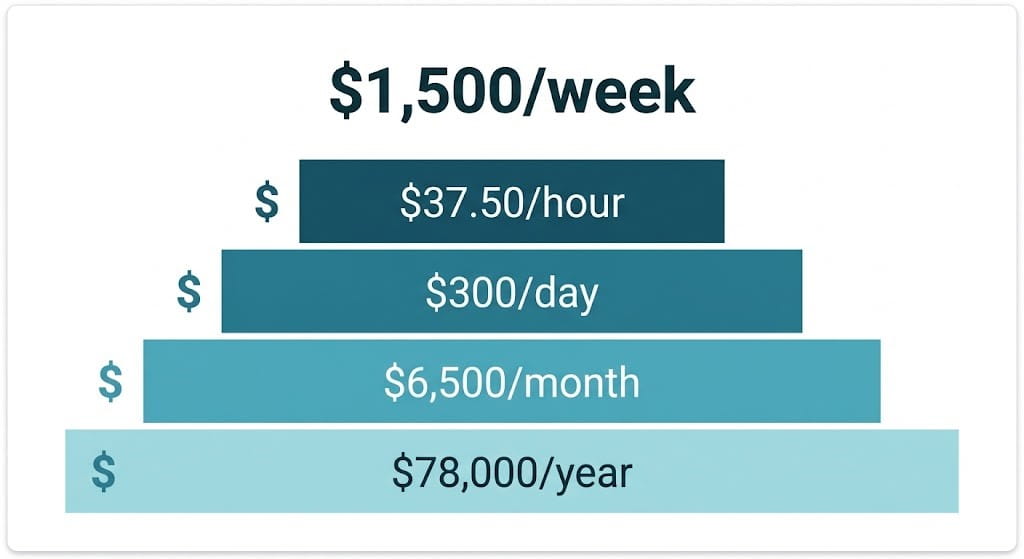
$1500 a week is how much an hour? At a standard 40-hour workweek, your hourly rate comes out to $37.50 per hour, which equals $78,000 per year in gross income. This guide breaks down every figure you need, from your daily and monthly earnings to your real take-home pay after taxes, so you can budget, evaluate job offers, and plan your finances with confidence.
Every number here uses current IRS tax brackets, Bureau of Labor Statistics (BLS) benchmarks, and U.S. Census Bureau data. Nothing is estimated loosely. You get the full picture.
Use our free Salary to Hourly Calculator to instantly convert any weekly, monthly, or annual pay into an exact hourly rate.
How to Convert $1,500 a Week to an Hourly Rate
The calculation is direct. Divide your weekly salary by the number of hours you work.
Formula: $1,500 weekly pay divided by 40 hours = $37.50 per hour
The 40-hour workweek is the standard used by the Fair Labor Standards Act (FLSA) and most U.S. payroll systems. However, your actual hours change your real effective hourly rate. The table below shows what you actually earn at every common schedule
A salaried worker logging 50 hours a week on a flat weekly pay of $1,500 earns only $30.00 per hour in real terms. That is a 20% pay cut from the advertised rate. This gap matters most when you compare a salaried position against a straight hourly wage offer.
Complete Salary Breakdown: Hourly, Daily, Monthly, and Annual
Your weekly pay of $1,500 maps to different amounts depending on the pay period. Every figure below is gross pay before payroll deductions, taxes, or benefits come out
Bi-weekly and semi-monthly are not the same thing. Bi-weekly gives you 26 paychecks per year worth $3,000 each. Semi-monthly gives you 24 paychecks worth $3,250 each. Budgeting with the wrong figure throws off every monthly calculation you make.
Your annual salary of $78,000 is the number that appears on your job offer. What you actually bring home depends on your state, your W-4 withholding elections, and your pre-tax benefit deductions.
If 1500 a Week is How Much an Hour Before Tax, What Is It After?
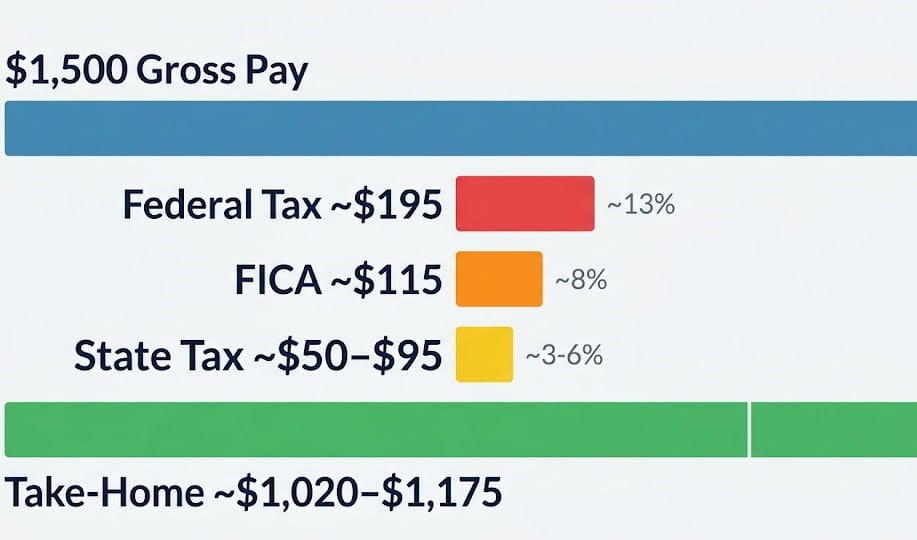
Three separate deductions reduce your gross pay before you see a cent. Federal income tax, FICA taxes, and state income tax all come out of every paycheck.
Federal Income Tax
At $78,000 per year, a single filer falls inside the 22% federal tax bracket for 2026. The effective tax rate lands closer to 17-18% once the standard deduction of $14,600 (2024 figure, adjusted annually by the IRS) reduces your taxable income. Married filers filing jointly face a lower effective rate at this income level.
FICA Taxes
Every U.S. employee pays FICA taxes on every paycheck. That breaks into 6.2% for Social Security and 1.45% for Medicare, a combined 7.65%. On $78,000 in annual gross income, FICA costs you roughly $5,967 per year, or about $115 every week.
State Income Tax
State taxes vary by a wide margin. Texas, Florida, and Washington charge no state income tax. California taxes this income near 6.0%. New York sits around 6.25%. Your take-home pay shifts meaningfully based on where you live and work
All estimates assume a single filer using the standard deduction with no additional income. Pre-tax deductions like 401(k) contributions or employer health insurance premiums reduce your taxable income further and increase your net pay. The IRS Tax Withholding Estimator at irs.gov gives you the most accurate figure for your specific situation.
1500 a Week is How Much an Hour for Variable and Part-Time Workers?
The standard 40-hour formula does not work for everyone. Registered nurses rotate between 36-hour and 48-hour weeks. Managers routinely log 50 or more hours on a flat salaried rate. Freelancers track uneven hours every single week. In every one of these cases, the textbook answer misleads you.
Use the two-week averaging method instead:
Step 1: Add total hours worked across two weeks.
Step 2: Divide by two to get your average weekly hours.
Step 3: Divide $1,500 by that average.
Example A: Week 1 = 44 hours, Week 2 = 36 hours. Average = 40 hours. Hourly rate = $37.50.
Example B: Week 1 = 52 hours, Week 2 = 48 hours. Average = 50 hours. Hourly rate = $30.00.
Example B represents a common reality for exempt salaried employees. The FLSA does not require overtime pay for exempt workers regardless of how many hours they log. Knowing your true effective hourly rate before you accept a job offer is not just smart math. It is the difference between a good deal and a bad one.
Is $1,500 a Week a Good Salary in 2026?
At $78,000 per year, this salary beats the U.S. median by a clear margin. According to the Bureau of Labor Statistics, median weekly earnings for full-time U.S. workers sat near $1,165 in 2024, putting a $1,500 weekly salary 29% above the national midpoint. Earning $1,500 puts you 29% above that midpoint. For a closer look at the $1,000/week benchmark, see our $1,000 a week to hourly breakdown.
Whether it feels good depends on your location and cost of living. The U.S. Census Bureau reported median household income at $80,610 in 2023. A single earner bringing in $78,000 nearly matches a two-income household median, which puts this salary in solid middle-class territory by national standards
MIT’s Living Wage Calculator puts the national average living wage for a single adult at roughly $21.00 per hour in 2024. At $37.50, you earn 78% above that threshold. In most U.S. cities outside the top-tier expensive markets, this salary supports a comfortable life with consistent savings.
Fidelity recommends saving 15% of gross income toward retirement. At $78,000, that equals $225 per week. The $115 allocated to 401(k) contributions above falls short of that goal, but it forms a starting point you build on as fixed expenses shrink or income grows.
The CFPB advises keeping three to six months of living expenses in a liquid emergency fund. On this take-home pay, your target sits between $13,800 and $27,600. Consistent weekly deposits of $115 build a three-month emergency fund in under two years.
Apply the 30% rule for housing. At $6,500 per month in gross income, your housing ceiling sits near $1,950 per month. In most U.S. markets outside New York and California, that buys you real options.
$1,500 a Week Compared to National Benchmarks
Hard numbers give your salary real context. Here is how $37.50 per hour and $78,000 per year stand against verified U.S. benchmarks
The comparison to the federal minimum wage matters most for workers evaluating their worth. At 5.2 times the federal floor, a weekly salary of $1,500 reflects skilled, professional-grade work. The BLS data confirms this sits comfortably above median pay for full-time employment across the U.S.
Jobs That Pay Around $1,500 a Week
These roles commonly land near the $78,000 annual benchmark according to BLS Occupational Employment and Wage Statistics data for 2024
Regional pay shifts these figures significantly. A registered nurse in California earns close to $124,000 annually. The same role in Mississippi pays around $62,000. Always check BLS state-level data at bls.gov/oes before accepting or comparing any offer.
How to Earn More Than $1,500 a Week
$1,500 a week is a strong base. These strategies move you beyond it.
Negotiate during the offer window. Research from LinkedIn Salary and Glassdoor consistently shows that workers who negotiate during a new job offer earn 10 to 20% more than those who accept the first number. This single action adds more to your income than most raises or bonuses combined.
Target certifications with direct pay impact. A Project Management Professional (PMP) certification adds $15,000 to $25,000 in annual salary for eligible roles. AWS cloud and cybersecurity certifications push tech salaries into the $90,000 to $120,000 range. A master electrician or plumber license can drive your hourly wage past $45.
Leverage overtime as a short-term income booster. At a base rate of $37.50 per hour, overtime pay under the FLSA reaches $56.25 per hour for non-exempt employees. Just five overtime hours per week adds $281 to your weekly income, or roughly $14,600 per year. Use this strategically during high-demand periods rather than as a permanent crutch.
Add freelance income on the side. Platforms like Upwork, Toptal, and Fiverr give skilled professionals direct access to clients who pay project or hourly rates that often exceed what full-time employment pays. Writers, developers, designers, and consultants regularly add $500 to $1,500 per week in freelance work.
Use geographic arbitrage. Remote work lets you hold a high-cost city salary while living where costs run lower. A $78,000 income in Austin or Raleigh delivers substantially more purchasing power than the same number in San Francisco or Manhattan without any change in your pay period or job title.
Switch jobs intentionally. Internal raises at most companies average 3 to 5% annually. Workers who change employers every two to three years regularly earn 10 to 20% more each move, which compounds dramatically over a career.
Frequently Asked Questions: $1500 a Week is How Much an Hour?
How much is $1,500 a week per year?
Multiply $1,500 by 52 weeks. Your total annual salary equals $78,000 in gross income before taxes.
How much is $1,500 a week after taxes?
After federal income tax and FICA deductions, most single filers take home between $1,020 and $1,175 per week depending on their state and filing status.
How much is $1,500 a week monthly?
$1,500 multiplied by 52 weeks divided by 12 months equals $6,500 per month in gross pay.
Is $1,500 a week a good salary?
Yes. At $78,000 per year, it beats the U.S. median weekly earnings of $1,165 by 29% and matches the national household income median for 2023
What jobs pay $1,500 a week?
Registered nurses, project managers, mid-level software developers, experienced electricians, dental hygienists, and junior financial analysts all commonly earn in this range.
How do I calculate my hourly rate from weekly pay?
Divide your weekly salary by your weekly hours. $1,500 divided by 40 equals $37.50. If you work more or fewer hours, use your actual number for an accurate effective hourly rate.
How much is $37.50 an hour annually?
$37.50 multiplied by 40 hours multiplied by 52 weeks equals $78,000 per year in gross pay before any tax or benefit deductions.
How does $1,500 a week compare to minimum wage?
The federal minimum wage sits at $7.25 per hour. At $37.50, this hourly wage runs 5.2 times higher than the federal floor and well above most state minimums.
Conclusion
A weekly salary of $1,500 equals $37.50 per hour and $78,000 per year in gross pay. After federal income tax, FICA taxes, and state deductions, most single filers take home between $1,020 and $1,175 each week. That range puts your annual take-home pay between roughly $53,000 and $61,000 depending on where you live. Understanding the gap between gross income and net pay is the foundation of every smart financial decision you make. Use our complete annual salary conversion guide to compare every common pay rate side by side.
Use the breakdowns and benchmarks in this guide to evaluate every job offer, negotiate from a position of real knowledge, and build a budget that fits your actual life. Whether you work a clean 40 hours or an uneven 50, knowing your true effective hourly rate puts the numbers on your side.