At a standard 40-hour workweek, $160,000 a year breaks down to $76.92 per hour. That figure comes from dividing $160,000 by 2,080, the total number of working hours in a 52-week year. But that single number tells only part of the story. Your real hourly wage shifts depending on how many weeks you actually work, whether your employer offers paid vacation, and what state you live in. This guide covers every angle—from the raw conversion to your after-tax take-home pay—so you get the full picture in one place.
How to Calculate $160,000 a Year to an Hourly Rate
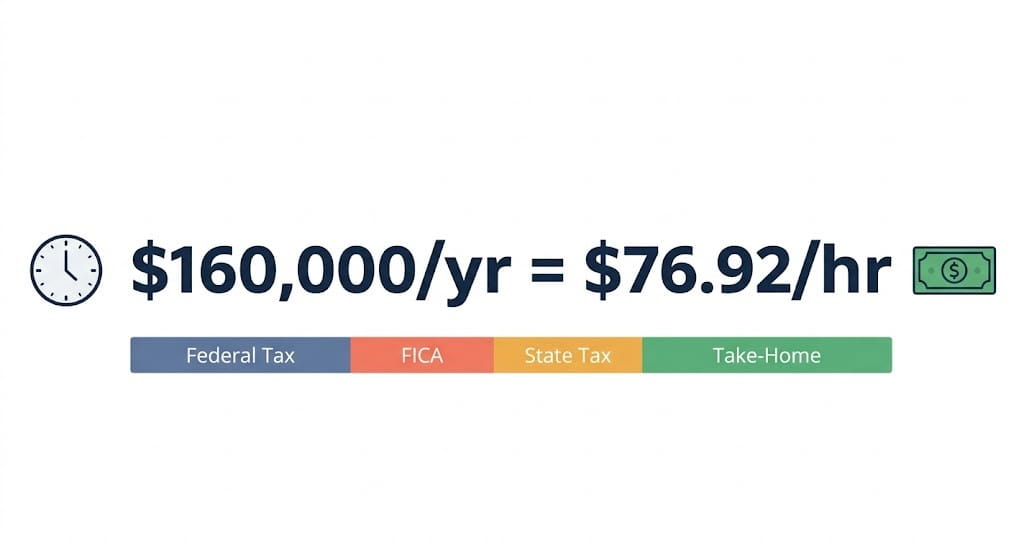
The math behind the annual salary to hourly wage conversion is straightforward. You divide your gross income by the total hours you work each year. The number of hours you use changes the result, and that is exactly why you see different figures across different salary sites.
The formula:
Hourly Rate = Annual Salary ÷ Total Annual Working Hours
Three scenarios apply to most workers:
| Calculation Scenario | Annual Hours | Hourly Rate |
| 52 weeks × 40 hrs (standard full year) | 2,080 hours | $76.92 |
| 50 weeks × 40 hrs (2 weeks unpaid leave) | 2,000 hours | $80.00 |
| 2026 exact workdays (261 days × 8 hrs) | 2,088 hours | $76.63 |
Use the 2,080-hour figure when comparing salaried job offers. Use the 2,000-hour figure if you take unpaid time off. Use the 2,088-hour figure for the most precise 2026 calculation. All three figures above represent gross pay, before any tax deductions hit your paycheck.
According to the IRS, 2026 follows a standard calendar with 261 weekdays. Federal holidays reduce actual paid workdays further for government employees and many corporate roles, which can push the effective hourly rate slightly higher.
160 000 a Year Is How Much an Hour – Complete Pay Period Breakdown
Every pay period looks different on paper. Here is exactly what $160,000 a year translates to across every pay schedule:
| Pay Period | Gross Amount |
| Hourly | $76.92 |
| Daily (8-hour day) | $615.38 |
| Weekly | $3,076.92 |
| Biweekly (every 2 weeks) | $6,153.85 |
| Semi-Monthly (twice a month) | $6,666.67 |
| Monthly | $13,333.33 |
| Annual | $160,000.00 |
Notice the difference between biweekly and semi-monthly. Biweekly workers receive 26 paychecks per year. Semi-monthly workers receive exactly 24. The biweekly schedule produces two months each year where you receive three paychecks instead of two — a genuine cash flow advantage worth planning around.
Your daily rate of $615.38 assumes a standard 8-hour workday. If your role regularly runs 9 or 10 hours, your effective daily output exceeds that figure, but your hourly rate drops below $76.92 unless your employer pays overtime.
Use your monthly gross of $13,333 as your anchor for rent calculations, loan applications, and debt-to-income ratio assessments. Most mortgage lenders apply a 28% front-end ratio, which means your maximum recommended housing cost sits around $3,733 per month on this salary.
What Is $160,000 a Year After Taxes?
This is the question most salary sites ignore or bury. Gross pay and take-home pay are two very different numbers, and the gap between them at $160,000 surprises most people.
Federal Income Tax on $160,000
The U.S. federal income tax system uses progressive tax brackets. You do not pay one flat rate on your entire salary. For a single filer in 2026, $160,000 falls primarily in the 24% marginal tax bracket, but your effective federal tax rate—the actual percentage paid across all brackets—lands closer to 17–18%.
The IRS 2026 standard deduction for single filers is $16,100, which reduces your taxable income to approximately $143,900. Federal income tax on that taxable amount comes to roughly $27,134, based on iCalculator’s 2026 federal tax tables.
FICA: Social Security and Medicare
FICA taxes come directly off your gross paycheck and never hit your bank account. At $160,000:
- Social Security tax (6.2%): $9,920—note the 2026 wage base cap sits at $184,500, so your full $160,000 is subject to this tax.
- Medicare tax (1.45%): $2,320
- Total FICA: $12,240
The additional 0.9% Medicare surtax does not apply until income exceeds $200,000 for single filers, so you avoid that threshold at $160K.
$160,000 a Year Is How Much an Hour After Taxes
Here is the state-by-state comparison that no competitor shows you in one place. These figures reflect a single filer taking the standard deduction with no additional pre-tax deductions:
| State | Est. Annual Take-Home | Monthly Net | Net Hourly Rate |
| Texas / Florida / Nevada (no state income tax) | ~$120,626 | ~$10,052 | ~$58.00 |
| North Carolina / Georgia (mid-rate states) | ~$112,000 | ~$9,333 | ~$53.85 |
| Illinois (flat 4.95%) | ~$113,500 | ~$9,458 | ~$54.57 |
| New York (state + NYC tax) | ~$104,000 | ~$8,667 | ~$50.00 |
| California (top state tax rate) | ~$106,000 | ~$8,833 | ~$50.96 |
Your actual take-home pay shifts further based on your W-4 filing status, 401(k) contributions, HSA deductions, and employer-sponsored health insurance premiums. A single person maximizing their 401(k) at the 2026 limit of $23,500 cuts their taxable income to approximately $120,400, dropping their federal tax bill significantly.
Reference: IRS Publication 15-T (2026), SmartAsset Paycheck Calculator, ADP Salary Paycheck Calculator.
Is $160,000 a Year a Good Salary?
Yes—objectively. But context determines whether it feels that way in your daily life.
National Income Context
The U.S. Census Bureau pegs the 2024 median household income at approximately $80,000. At $160,000, a single earner makes double the national household median and lands in roughly the top 10–12% of individual earners in the United States. The Economic Policy Institute’s wage tracker places $160K well above the 88th percentile for full-time U.S. workers.
Purchasing Power by City
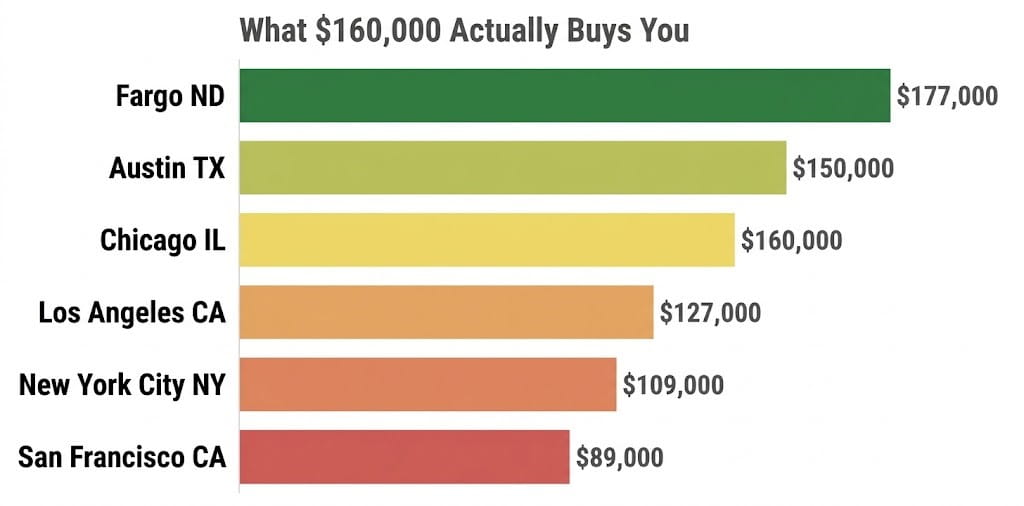
The same $160,000 gross salary delivers very different purchasing power depending on where you live. Cost of living erodes or amplifies your income:
| City | Cost of Living vs. National Avg. | $160K Effective Purchasing Power |
| Fargo, ND | 10% below average | ~$177,000 |
| Austin, TX | 5% above average | ~$152,000 |
| Chicago, IL | 7% above average | ~$149,000 |
| Los Angeles, CA | 43% above average | ~$112,000 |
| New York City, NY | 68% above average | ~$95,000 |
| San Francisco, CA | 79% above average | ~$89,000 |
A $160K salary in Fargo, North Dakota funds a lifestyle that $89,000 cannot replicate in San Francisco. This is not a small difference—it reshapes every financial decision from housing to retirement savings pace.
$160000 a Year Is How Much an Hour? Careers at This Salary Level
The following roles commonly reach this annual salary range in the United States, according to the U.S. Bureau of Labor Statistics and LinkedIn Salary data:
- Senior Software Engineer (5–10 years experience)
- Physician Assistant or Nurse Practitioner (clinical settings)
- Financial Manager or Senior Financial Analyst
- Corporate Attorney (mid-level associate)
- Senior Marketing Director or VP of Marketing
- Airline Pilot (major carriers, 5+ years)
- Engineering Manager (tech or manufacturing)
Most of these roles require 5 to 15 years of experience or advanced credentials. Entry-level workers rarely reach $160K without specialized technical skills or high-demand certifications.
Salaried at $160K vs. Hourly – Which Pays More?
This question matters most when you compare a full-time salaried position against a freelance or contract role. The answer depends on what you include in the comparison.
The Hidden Value of a Salaried Role
A $160,000 salaried position typically includes benefits that carry real dollar value:
- Employer-sponsored health insurance: $6,000–$15,000 per year in employer contributions
- 401(k) employer match: often 3–6% of salary = $4,800–$9,600 per year
- Paid time off (10–20 days): $6,153–$12,307 in paid hours you do not work
- Total compensation value: $160,000 salary + $16,000–$36,000 in benefits = $176,000–$196,000 total compensation
What Hourly Rate Matches $160,000 Salaried?
A freelancer or independent contractor must account for self-employment tax (an additional 7.65% employer-side FICA), no employer benefits, and unpaid gaps between contracts. To truly match a $160K salaried package, a contractor needs to charge:
$100–$115 per hour to break even on total compensation
Most salary comparison tools skip this entirely. If someone offers you $90/hr as a contractor to replace a $160K salaried role, you come out behind — not ahead.
The Fair Labor Standards Act (FLSA) classifies most salaried workers earning above $684/week as exempt employees, meaning they receive no overtime pay regardless of hours worked. A salaried worker who regularly works 50 hours per week on a $160K salary earns an effective hourly rate of $61.54, not $76.92.
How to Budget on a $160,000 Salary
Numbers on a pay stub mean little without a plan behind them. Apply the 50/30/20 budgeting rule to your monthly net income—not your gross. Using a mid-state take-home of approximately $9,333 per month:
| Category | Percentage | Monthly Amount | Annual Total |
| Needs (rent, groceries, utilities, transport) | 50% | $4,667 | $56,004 |
| Wants (dining, travel, subscriptions, lifestyle) | 30% | $2,800 | $33,600 |
| Savings and Debt Repayment | 20% | $1,866 | $22,392 |
Key Financial Benchmarks at $160K
Emergency fund: Three to six months of expenses equals $14,000–$28,000. Build this before aggressive investing.
Retirement savings: The 2026 401(k) contribution limit is $23,500 for workers under 50. Max this out and your taxable income drops to $136,500, reducing your federal tax bill by roughly $5,640 annually. The Roth IRA income phase-out begins at $150,000 for single filers in 2026—at $160K, you must use a backdoor Roth IRA strategy to contribute.
Mortgage affordability: At $160K gross, lenders typically approve home loans up to $400,000–$500,000 depending on your debt-to-income ratio, credit score, and down payment. A 20% down payment on a $480,000 home requires $96,000 upfront, leaving you with a monthly principal and interest payment of roughly $2,400–$2,600 at current rates — comfortably within the 28% housing ratio.
Student loan repayment: On an income-driven repayment plan, a $160,000 annual income triggers higher monthly payments. Borrowers with large balances should evaluate refinancing or aggressive payoff strategies at this salary level.
According to Vanguard’s How America Saves report, workers earning $150,000–$200,000 who participate in their employer 401(k) save an average of 9.8% of income annually. Matching that rate on $160K means saving $15,680 per year toward retirement.
Conclusion
So 160000 a Year Is How Much an Hour? The simple answer is $160,000 a year equals $76.92 per hour on a standard 40-hour, 52-week schedule. After federal taxes, FICA, and state income tax, most single earners take home between $104,000 and $121,000 annually—the exact figure depends heavily on their state and pre-tax deductions. This salary places you in the top 10–12% of U.S. earners, but purchasing power varies dramatically between cities like Fargo and San Francisco.
Understanding your gross pay vs. net income, planning around your biweekly paycheck, and maximizing pre-tax benefits like a 401(k) and HSA turns a strong salary into long-term financial stability. The numbers above give you the framework—how you allocate them determines the outcome.