When you work for $12 per hour, Salary to Hourly Calculator Texas you earn $24,960 per year before taxes. This calculation assumes you work 40 hours weekly for all 52 weeks in a year (2,080 total hours). Your actual take-home pay drops to around $21,000-$22,000 after federal and state taxes eat into your paycheck.
Many workers across America earn this hourly rate in retail stores, restaurants, warehouses, and customer service centers. Understanding how this wage translates into monthly bills, rent payments, and grocery budgets helps you plan your finances and decide if this income meets your needs.

$12/Hour Annual Salary Calculator
Instant Calculation Results
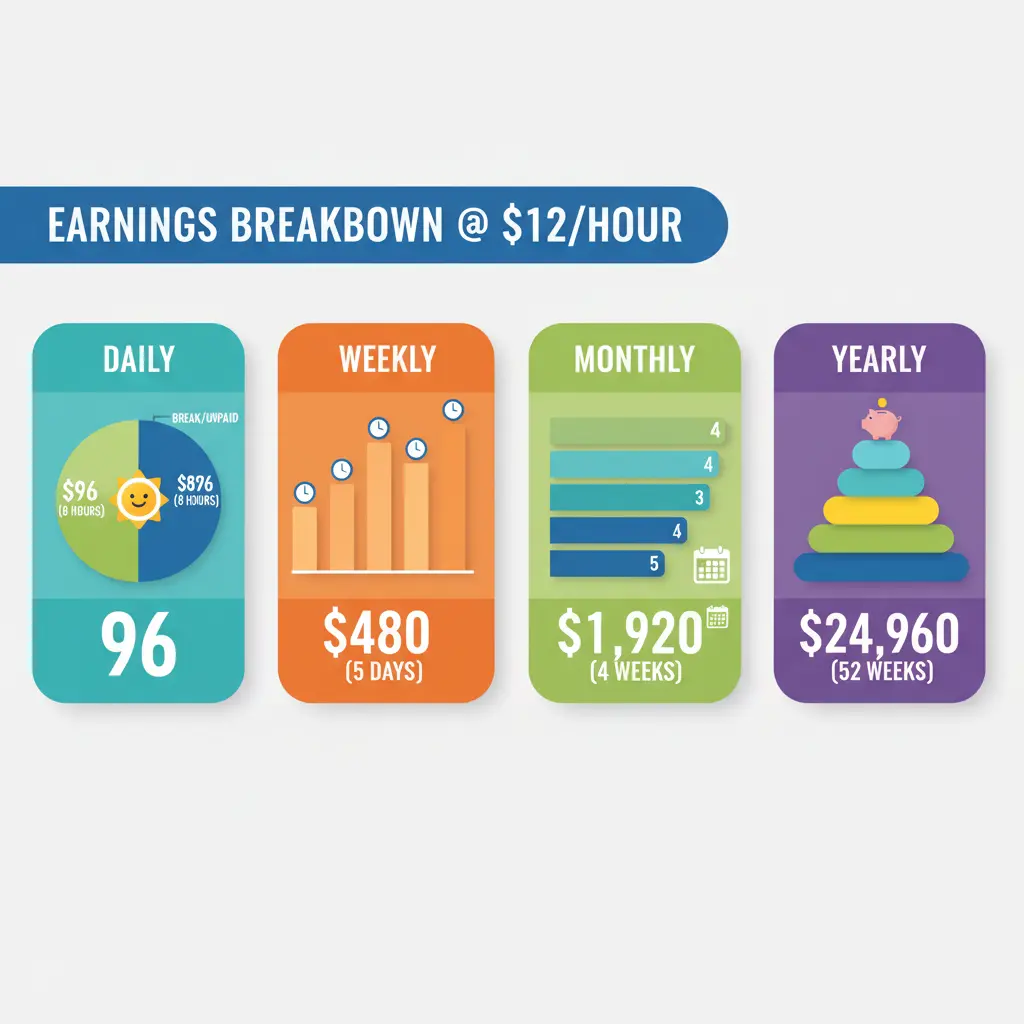
$12 per hour equals $24,960 annually when you work full-time (40 hours weekly). Here’s how this breaks down:
- Hourly: $12.00
- Daily (8 hours): $96.00
- Weekly (40 hours): $480.00
- Bi-weekly: $960.00
- Monthly: $2,080.00
- Annually: $24,960.00
These numbers represent your gross income before any deductions. The federal government, your state, Social Security, and Medicare all take their share before the money hits your bank account.
Key Takeaways at a Glance
You bring home roughly 84-87% of your gross pay after taxes. For most single filers with no dependents, this means $1,750-$1,850 monthly in actual spending money. Your exact take-home pay depends on where you live, your tax filing status, and any benefits your employer deducts from your paycheck.
This wage sits 65% higher than the federal minimum of $7.25 per hour but falls below the living wage in most American cities, according to MIT’s Living Wage Calculator.
$12 an Hour Breakdown: All Time Periods
How Much is $12 an Hour Annually? ($24,960)
Multiply your hourly rate by the hours you work each week, then multiply that number by 52 weeks:
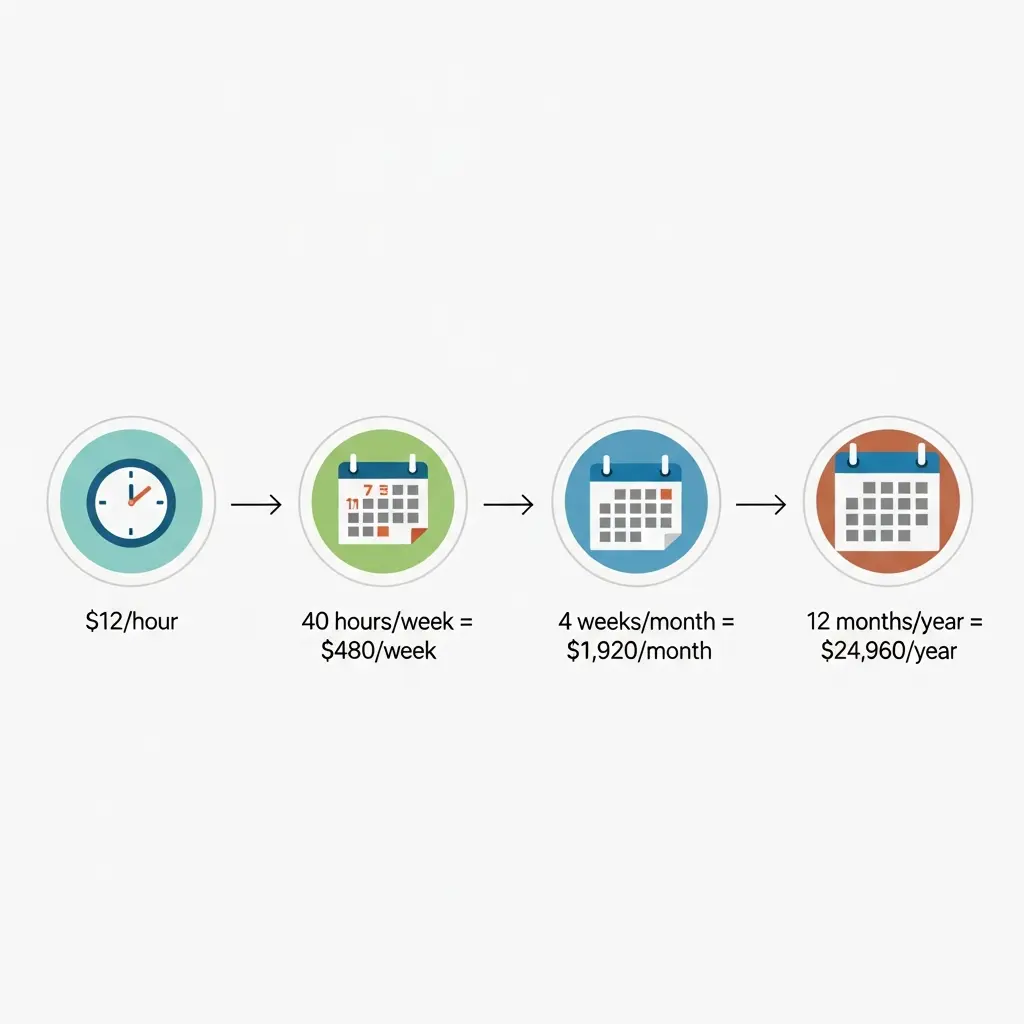
$12 × 40 hours × 52 weeks = $24,960
This figure assumes you never miss a day of work. If you take two weeks of unpaid vacation, your annual income drops to $24,000 (50 weeks × 40 hours × $12).
The U.S. Census Bureau reports that the median household income sits at $67,521, making $24,960 about 37% of the typical American household’s earnings. This comparison shows where your income stands relative to national averages.
How Much is $12 an Hour Monthly? ($2,080)
Your monthly gross income equals $2,080 when you divide your annual salary by 12 months. Most people actually receive this amount twice monthly (bi-weekly paychecks of $960 each), which means 26 paychecks per year instead of 24.
After taxes, your monthly take-home pay ranges from $1,750 to $1,850 depending on your state’s tax rate. States like Texas and Florida (no state income tax) let you keep more money, while states like California and New York take bigger tax bites.
How Much is $12 an Hour Bi-Weekly? ($960)
Most employers pay every two weeks, giving you 26 paychecks annually. Each paycheck shows $960 in gross pay before deductions. After taxes and other withholdings, expect around $750-$800 to actually deposit into your account.
Bi-weekly pay can complicate budgeting because you receive three paychecks during two months each year. These “extra” paychecks give you opportunities to tackle debt, build emergency savings, or handle irregular expenses like car insurance or holiday gifts.
How Much is $12 an Hour Weekly? ($480)
Working 40 hours weekly at $12 per hour generates $480 in gross weekly income. This breaks down to $96 daily when you divide by five workdays.
Weekly pay gives you faster access to your earnings but requires careful money management. You need to set aside portions for monthly bills like rent (due once monthly) and utilities (also monthly) from multiple weekly paychecks.
How Much is $12 an Hour Daily? ($96)
An eight-hour workday earns you $96 before taxes. This daily rate helps you calculate earnings for partial weeks or irregular schedules. If you work five days this week and three days next week, you can quickly multiply days by $96 to estimate your pay.
Part-time workers who don’t hit 40 hours weekly find daily calculations more useful than monthly or annual figures. Someone working 25 hours weekly ($12 × 25 = $300 per week) earns $15,600 annually—a significant drop from full-time pay.
How Much is $12 an Hour After Taxes?
Federal taxes, state taxes, Social Security (6.2%), and Medicare (1.45%) reduce your $24,960 gross income by approximately 13-18% depending on your state and filing status.
After-tax annual income: $21,000-$22,000
Monthly take-home: $1,750-$1,850
Bi-weekly net pay: $750-$800
Single filers with no dependents typically face:
- Federal income tax: $886 (using 2026 standard deduction of $16,100)
- Social Security: $1,548 (6.2% of gross)
- Medicare: $362 (1.45% of gross)
- State income tax: $0-$1,500 (varies by state)
According to the IRS tax calculator, someone earning $24,960 in Pennsylvania takes home approximately $21,033 annually (15.7% total tax rate). Your rate changes based on state tax laws and personal deductions.
Is $12 an Hour a Good Wage in 2026?
Comparing $12/Hour to Federal Minimum Wage
The federal minimum wage remains stuck at $7.25 per hour—unchanged since 2009. At $12 hourly, you earn 65% more than this federal floor. Working minimum wage generates only $15,080 annually, putting you below the federal poverty line if you support anyone besides yourself.
However, 30 states now enforce minimum wages above the federal rate. According to the National Employment Law Project, 68 jurisdictions raised their minimum wages in January 2026. Washington state leads with $17.13 per hour, making $12 look less competitive in high-wage states.
$12/Hour vs. Living Wage by State
MIT’s Living Wage Calculator determines the minimum income needed to cover basic needs without government assistance. For a single adult in 2026:
States where $12/hour falls short:
- Massachusetts: Needs $19.91/hour ($41,416 annually)
- New York: Requires $20.05/hour ($41,700 annually)
- California: Needs $18.50/hour ($38,480 annually)
- Hawaii: Requires $25.65/hour ($53,352 annually)
States where $12/hour barely works:
- Mississippi: Needs $14.20/hour ($29,542 annually)
- Arkansas: Requires $14.18/hour ($29,491 annually)
- Tennessee: Needs $14.38/hour ($29,905 annually)
- Kentucky: Requires $14.15/hour ($29,432 annually)
Your $12 hourly wage provides a living wage only in the cheapest states, and even then, you have zero margin for emergencies, healthcare costs beyond basic insurance, or any lifestyle extras.
Cost of Living Analysis: Where Can You Live Comfortably?
“Comfortably” means covering necessities while saving money and enjoying occasional discretionary spending. Research from SmartAsset shows single adults need $80,000-$124,000 annually to live comfortably depending on location.
Most affordable states for $12/hour workers:
Mississippi (Cost of Living Index: 83.3)
- Average rent (2-bedroom): $991/month
- Living wage for singles: $14.20/hour
- Your shortfall: $2.20/hour ($4,576 annually)
Kansas (Cost of Living Index: 85.0)
- Average rent (2-bedroom): $862/month
- Living wage for singles: $14.50/hour
- Your shortfall: $2.50/hour ($5,200 annually)
Oklahoma (Cost of Living Index: 86.1)
- Average rent (2-bedroom): $850/month
- Living wage for singles: $14.32/hour
- Your shortfall: $2.32/hour ($4,826 annually)
Even in cheap states, $12 hourly barely covers basics. You’ll skip restaurant meals, drive an older car, avoid entertainment subscriptions, and worry about unexpected car repairs or medical bills.
$12/Hour Compared to US Median Wage
The Bureau of Labor Statistics reports the median weekly earnings for full-time wage and salary workers at $1,196 (as of 2026 data). This translates to $62,192 annually—2.5 times higher than your $24,960 income.
Put differently: the typical American worker earns in six months what you earn all year at $12 hourly. This gap grows wider when you compare $12/hour jobs (often no benefits) against median-wage positions that include health insurance, retirement matching, and paid time off.
How to Calculate Your Annual Salary from Hourly Wage
The Simple Formula: Hourly Rate × Hours × Weeks
Annual Salary = Hourly Wage × Hours per Week × Weeks per Year
For full-time work: $12 × 40 hours × 52 weeks = $24,960
This formula works for any hourly rate. Want to know what $15/hour pays annually? $15 × 40 × 52 = $31,200.
Step-by-Step Calculation Example
Let’s walk through calculating annual income for someone earning $12.50 hourly:
Step 1: Identify your hourly rate
- Hourly rate: $12.50
Step 2: Determine weekly hours
- Standard full-time: 40 hours/week
Step 3: Calculate weekly gross pay
- $12.50 × 40 = $500/week
Step 4: Multiply by weeks worked annually
- $500 × 52 weeks = $26,000/year
Step 5: Adjust for unpaid time off
- If taking 2 weeks unpaid vacation: $500 × 50 = $25,000/year
Full-Time vs. Part-Time Calculations
Full-time (40 hours/week): $12 × 40 × 52 = $24,960/year
Part-time (30 hours/week): $12 × 30 × 52 = $18,720/year
Part-time (25 hours/week): $12 × 25 × 52 = $15,600/year
Part-time (20 hours/week): $12 × 20 × 52 = $12,480/year
The Fair Labor Standards Act defines full-time as 30+ hours weekly for health benefits purposes, but most employers consider 35-40 hours full-time for other benefits. Part-time workers usually receive fewer (or zero) benefits, making the actual compensation gap larger than hourly rates suggest.
Interactive Hourly to Salary Calculator Tool
[Tool would be embedded here – Interactive calculator where users input their hourly rate, weekly hours, and weeks worked to get instant annual, monthly, weekly, and daily pay calculations]
Factors That Affect Your Actual Take-Home Pay

Federal and State Tax Impact on $12/Hour
Your tax burden depends on three main factors: federal income tax, FICA taxes (Social Security + Medicare), and state income tax.
Federal Income Tax (2026 rates): For single filers, your $24,960 income puts you in the 10-12% tax brackets after the standard deduction:
- Standard deduction: $16,100
- Taxable income: $8,860 ($24,960 – $16,100)
- Federal tax owed: ~$886
FICA Taxes (mandatory):
- Social Security: 6.2% = $1,548
- Medicare: 1.45% = $362
- Total FICA: $1,910
State Income Tax (varies):
- No state income tax: Alaska, Florida, Nevada, South Dakota, Tennessee, Texas, Washington, Wyoming
- Low tax states: Pennsylvania ($766), Indiana ($787)
- High tax states: California ($1,200+), New York ($1,300+)
Total tax paid: $2,796-$4,658 depending on state
Effective tax rate: 11.2-18.7%
The Tax Policy Center notes that households earning under $30,000 pay an average effective federal tax rate of 1.6%, but FICA taxes add another 7.65% that you cannot avoid.
How Overtime Changes Your Annual Income
The Fair Labor Standards Act requires employers pay 1.5× your regular rate for hours beyond 40 weekly. At $12/hour, overtime pays $18/hour.
Scenario: 5 hours weekly overtime
- Regular pay: $12 × 40 = $480
- Overtime pay: $18 × 5 = $90
- Weekly total: $570
- Annual income: $570 × 52 = $29,640
That’s $4,680 extra annually—a 19% income boost. However, overtime isn’t guaranteed. Employers can eliminate overtime hours whenever they choose, making this income unreliable for long-term budgeting.
Common overtime scenarios:
- 2 hours weekly: Adds $1,872 annually (total: $26,832)
- 5 hours weekly: Adds $4,680 annually (total: $29,640)
- 10 hours weekly: Adds $9,360 annually (total: $34,320)
Benefits and Their Cash Value (Health Insurance, PTO, etc.)
Benefits represent real compensation even though they don’t appear in your paycheck. According to the Bureau of Labor Statistics, benefits average 29.6% of total compensation for all workers.
Common benefits and their value:
Health Insurance: $500-$800/month ($6,000-$9,600 annually)
- Employer typically covers 70-80% of premiums
- Your contribution: $150-$250/month
- Employer’s contribution: $350-$550/month
Paid Time Off: Worth $960-$1,920 annually
- 1 week (5 days): $480 value
- 2 weeks (10 days): $960 value
- 3 weeks (15 days): $1,440 value
Retirement Matching: Up to $1,248 annually
- If employer matches 50% up to 5% of salary
- You contribute: $1,248 (5% of $24,960)
- Employer adds: $624
Total benefits package value: $7,000-$12,000 annually
This means your real compensation might be $32,000-$37,000 when including benefits—but only if your employer offers them. Many $12/hour positions provide no benefits at all.
Holiday Pay and Unpaid Time Off Considerations
Federal law doesn’t require private employers to provide paid holidays or vacation time. Whether you get paid for Thanksgiving depends entirely on your employer’s policies.
Typical paid holidays (if offered): 6-10 days yearly
- New Year’s Day
- Memorial Day
- Independence Day
- Labor Day
- Thanksgiving + day after
- Christmas
If holidays are unpaid: 10 unpaid holidays = 80 hours = $960 lost income
If you take 2 weeks unpaid vacation: 80 hours = $960 lost income
Combined impact:
- Potential annual loss: $1,920
- Effective annual pay: $23,040
Many retail and food service workers face this reality—no pay when the business closes for holidays.
Multiple Jobs: Calculating Combined Income
Taking a second job adds income but creates tax complications. Your second employer doesn’t know about your first job’s income, which can lead to under-withholding and a surprise tax bill in April.
Example: Two part-time jobs at $12/hour
- Job A: 25 hours/week = $15,600/year
- Job B: 15 hours/week = $9,360/year
- Combined income: $24,960/year
You’re earning the same total income as one full-time job but probably receiving no benefits from either employer since you’re part-time at both.
Tax consideration: Each employer withholds taxes assuming your income is lower than reality. With $24,960 total income, you should have ~$2,800-$3,900 withheld. But each employer might only withhold $800-$1,200, leaving you owing $800-$1,900 at tax time.
$12 an Hour Jobs: Industries and Opportunities
Common Jobs Paying $12 per Hour
Retail Sales Associate
- Average wage: $12.00-$13.50/hour
- Responsibilities: Customer service, stocking shelves, operating cash registers
- Entry-level positions available
- Often includes employee discounts (10-30% off merchandise)
Food Service Worker
- Base wage: $12.00-$13.00/hour (plus tips in some roles)
- Positions: Fast food crew, restaurant server, line cook, dishwasher
- Flexible scheduling common
- May include free or discounted meals
Customer Service Representative
- Average wage: $12.00-$14.50/hour
- Work: Phone support, email responses, problem resolution
- Many remote positions available
- Requires good communication skills
Warehouse Associate
- Average wage: $12.00-$15.00/hour
- Tasks: Picking orders, packing shipments, inventory management
- Physical demands: Lifting 50+ pounds, standing all day
- Overtime opportunities common
Data Entry Clerk
- Average wage: $12.00-$14.00/hour
- Skills needed: Typing speed (40+ WPM), attention to detail
- Often remote-friendly
- Entry-level positions available
According to ZipRecruiter, over 132,000 positions currently advertise wages of $12/hour across these industries, with the highest concentrations in retail (28%), food service (22%), and logistics/warehousing (18%).
Entry-Level Positions at $12/Hour
These jobs require minimal experience and provide entry into the workforce:
Retail Cashier
- No experience required
- On-the-job training provided
- Part-time and full-time options
- Starting wage: $12-$13/hour
Hotel Housekeeper
- Physical work required
- Consistent hours
- Starting wage: $12-$14/hour
- May include hotel discounts for personal travel
Bank Teller
- High school diploma required
- Training provided
- Professional environment
- Starting wage: $12-$15/hour
Delivery Driver
- Valid driver’s license required
- Use personal or company vehicle
- Flexible scheduling
- Base wage: $12/hour plus tips and mileage
Administrative Assistant
- Basic computer skills needed
- Professional office setting
- Starting wage: $12-$14/hour
- Potential for advancement
The advantage of entry-level positions: they provide experience and references for better-paying roles. The disadvantage: limited benefits and minimal advancement without additional training or education.
Industries Offering $12+ Hourly Wages
Healthcare Support (increasing to $14-$16/hour with certification)
- Certified Nursing Assistant (CNA)
- Medical Records Clerk
- Pharmacy Technician
- Home Health Aide
Manufacturing (often $13-$18/hour)
- Production Worker
- Assembly Line Operator
- Quality Control Inspector
- Machine Operator
Transportation ($12-$20/hour depending on vehicle)
- School Bus Driver
- Delivery Driver
- Warehouse Driver
- Package Handler
Hospitality ($12-$15/hour)
- Front Desk Agent
- Hotel Maintenance Worker
- Housekeeping Supervisor
- Restaurant Host/Hostess
The Bureau of Labor Statistics projects retail, food service, and healthcare support will add the most jobs through 2032, with many positions starting near $12/hour.
Career Advancement Paths from $12/Hour
Path 1: Retail to Management (18-36 months)
- Start: Sales Associate ($12/hour)
- Advance: Senior Associate ($13-$14/hour, 6-12 months)
- Promote: Assistant Manager ($15-$18/hour, 12-18 months)
- Lead: Store Manager ($45,000-$65,000 salary, 2-4 years total)
Path 2: Warehouse to Logistics (12-24 months)
- Start: Warehouse Associate ($12-$14/hour)
- Specialize: Forklift Operator ($15-$18/hour, requires certification)
- Advance: Warehouse Supervisor ($20-$24/hour)
- Manage: Logistics Coordinator ($50,000-$60,000 salary)
Path 3: Customer Service to Specialist (18-30 months)
- Start: CSR Level 1 ($12-$14/hour)
- Improve: CSR Level 2 ($15-$17/hour, strong metrics)
- Specialize: Technical Support ($18-$22/hour, product knowledge)
- Lead: Team Lead/Trainer ($24-$28/hour or $50,000+ salary)
Path 4: Healthcare Support to Licensed Professional (2-4 years)
- Start: Healthcare Support ($12/hour)
- Certify: CNA ($14-$16/hour, 4-6 weeks training)
- Educate: LPN ($22-$26/hour, 12-18 months schooling)
- License: RN ($30-$40/hour, 2-4 years degree)
Career advancement requires initiative—asking for additional training, accepting new responsibilities, and sometimes pursuing education or certifications during off-hours.
$12/Hour Salary by State (2026 Breakdown)
Top 10 Highest Paying States for $12/Hour Jobs
These rankings reflect where $12/hour has the most purchasing power relative to cost of living:
- Mississippi
- Cost of living index: 83.3
- Required living wage: $14.20/hour
- Buying power: $12 feels like $14.40 in average state
- Kansas
- Cost of living index: 85.0
- Required living wage: $14.50/hour
- Average rent (2-bed): $862/month
- Oklahoma
- Cost of living index: 86.1
- Required living wage: $14.32/hour
- Lower transportation costs
- Alabama
- Cost of living index: 87.9
- Required living wage: $14.24/hour
- Low housing costs
- Arkansas
- Cost of living index: 88.0
- Required living wage: $14.18/hour
- Affordable groceries and utilities
- Iowa
- Cost of living index: 89.2
- Required living wage: $15.10/hour
- Strong job market
- Nebraska
- Cost of living index: 89.5
- Required living wage: $15.20/hour
- Low unemployment
- Tennessee
- Cost of living index: 90.1
- Required living wage: $14.38/hour
- No state income tax
- Missouri
- Cost of living index: 90.2
- Required living wage: $14.65/hour
- Affordable housing
- Indiana
- Cost of living index: 90.4
- Required living wage: $14.80/hour
- Growing job market
State-by-State Cost of Living Comparison
Most Expensive States (where $12/hour fails):
Hawaii – Cost Index: 193.3
- $12/hour buys what $6.21/hour buys nationally
- Needs $25.65/hour for basic living
- Annual shortfall: $28,392
Massachusetts – Cost Index: 150.0
- $12/hour buys what $8.00/hour buys nationally
- Needs $19.91/hour for basic living
- Annual shortfall: $16,451
California – Cost Index: 142.2
- $12/hour buys what $8.44/hour buys nationally
- Needs $18.50/hour for basic living
- Annual shortfall: $13,520
New York – Cost Index: 139.1
- $12/hour buys what $8.63/hour buys nationally
- Needs $20.05/hour for basic living
- Annual shortfall: $16,744
Most Affordable States (where $12/hour goes furthest):
Mississippi – Cost Index: 83.3
- $12/hour buys what $14.40/hour buys nationally
- Needs $14.20/hour for basic living
- Annual shortfall: $4,576
Kansas – Cost Index: 85.0
- $12/hour buys what $14.12/hour buys nationally
- Needs $14.50/hour for basic living
- Annual shortfall: $5,200
Alabama – Cost Index: 87.9
- $12/hour buys what $13.65/hour buys nationally
- Needs $14.24/hour for basic living
- Annual shortfall: $4,659
The World Population Review’s 2026 cost of living data shows geographic location creates income gaps of 50-100% for the same hourly wage.
Best States to Live on $12 an Hour
Combining cost of living, job availability, and quality of life factors:
Best Overall: Tennessee
- No state income tax (saves ~$750 annually)
- Living wage: $14.38/hour (shortfall: only $4,950/year)
- Growing job market in Nashville, Memphis
- Affordable housing: median home $245,000
Runner-up: Texas
- No state income tax (saves ~$750 annually)
- Living wage varies: $14.50-$16.50/hour by city
- Abundant $12/hour jobs in major metros
- Lower cost of living outside Austin/Dallas
Third Place: Florida
- No state income tax (saves ~$750 annually)
- Living wage: $15.20-$17.50/hour depending on location
- Strong tourism/hospitality job market
- No winter heating costs
Honorable Mention: Iowa
- Low cost of living (index: 89.2)
- Strong job market with low unemployment
- Quality schools and low crime rates
- Required living wage: $15.10/hour
These rankings factor both tax burden and purchasing power. Saving $750 annually on state income tax effectively increases your hourly rate by $0.36.
Budgeting on $12 an Hour: A Practical Guide
Monthly Budget Breakdown for $12/Hour Earners
Based on $1,800 monthly take-home pay (after taxes):
Housing (35-40% = $630-$720)
- Rent for room in shared apartment: $500-$700
- Studio apartment in low-cost area: $600-$800
- Utilities: $80-$120 (shared housing)
- Reality: Finding housing under $720 monthly means roommates or living in low-income neighborhoods
Transportation (15-20% = $270-$360)
- Car payment (used): $200-$300
- Insurance: $100-$150
- Gas: $120-$180
- Maintenance fund: $50/month
- Alternative: Public transit ($70-$100/month)
Food (12-15% = $216-$270)
- Groceries: $200-$250
- Fast food/eating out: $50 or less
- Strategy: Meal prep, shop sales, avoid restaurants
Healthcare (5-8% = $90-$144)
- Insurance premiums: $50-$100
- Copays and medications: $40-$44
- Reality: Catastrophic coverage only; avoiding doctor visits
Utilities (5-7% = $90-$126)
- Phone: $30-$50
- Internet: $40-$60
- Streaming services: $10-$16 (limit to one service)
Debt/Savings (5-10% = $90-$180)
- Emergency fund: $50-$100
- Credit card minimum payments: $40-$80
- Reality: Most $12/hour workers carry $2,000-$5,000 in credit card debt
Personal/Clothing (3-5% = $54-$90)
- Clothing: $30-$50
- Personal care: $24-$40
Entertainment (2-3% = $36-$54)
- One streaming service: $15
- Occasional movie/activity: $20-$39
Total: $1,800
This budget leaves zero margin for car repairs, medical emergencies, or job loss. The Consumer Financial Protection Bureau finds that 40% of Americans cannot cover a $400 emergency expense without borrowing money.
Housing Affordability on $24,960 Annual Salary
The 30% rule says spend no more than 30% of gross income on housing. At $24,960 annually, that’s $624 monthly ($24,960 ÷ 12 × 0.30).
What $624/month gets you in 2026:
Major Cities (Usually Not Affordable):
- Los Angeles: Room in shared apartment ($700-$1,200)
- New York City: Nothing legal in most boroughs
- San Francisco: Impossible without roommates
- Chicago: Studio in rough neighborhood ($800-$1,000)
- Seattle: Room in shared space ($600-$900)
Smaller Cities/Towns (More Realistic):
- Memphis, TN: 1-bedroom apartment ($650-$800)
- Indianapolis, IN: Studio ($550-$700)
- Tulsa, OK: 1-bedroom ($500-$650)
- Little Rock, AR: 1-bedroom ($550-$700)
- Wichita, KS: 1-bedroom ($500-$650)
Your best options at $12/hour:
- Rent a room with roommates ($400-$600/month)
- Live with family (if possible)
- Find subsidized housing (often 2-3 year waitlists)
- House-sit or work as live-in help
- Relocate to lowest-cost areas
According to the National Low Income Housing Coalition, no state offers enough $12/hour work hours to afford a modest two-bedroom rental at market rate.
Saving Strategies for Low-Income Earners
Pay Yourself First (Even $25 Monthly) Set up automatic transfer of $25-$50 to savings the day your paycheck deposits. You won’t miss $25, but $25 monthly becomes $300 annually—enough to handle a minor emergency.
The 52-Week Savings Challenge Week 1: Save $1 Week 2: Save $2 Week 52: Save $52 Total saved: $1,378 annually
Use Free Banking Avoid banks with monthly fees. Chime, Ally Bank, and many credit unions offer free checking accounts. A $12 monthly bank fee costs you $144 yearly—half your weekly paycheck.
Buy Store Brands Name-brand cereal costs $4.50. Store brand costs $2.50. Save $2 on ten items weekly = $1,040 yearly savings.
Refinance or Consolidate Debt Credit cards charging 24% APR kill your budget. Consider:
- Balance transfer cards (0% intro APR for 12-18 months)
- Personal loans (9-15% fixed rate)
- Credit counseling (negotiate lower rates)
Increase Income (Even $1/Hour) Working 40 hours weekly at $13/hour instead of $12/hour adds $2,080 annually—enough for an emergency fund or to catch up on debt.
The Consumer Financial Protection Bureau’s research shows households earning under $30,000 can still save $1,000+ annually by avoiding bank fees, reducing subscription services, and cutting food waste.
Government Assistance Programs You May Qualify For
At $24,960 annually, you likely qualify for several assistance programs:
SNAP (Food Stamps)
- Eligibility: Gross income under 130% of poverty line
- For single person: Income under $18,347 qualifies
- You exceed this limit but may qualify with dependents
- With one dependent: Limit rises to $24,847
Medicaid
- Eligibility varies by state
- 40 states expanded Medicaid under ACA
- Income limit: 138% of federal poverty line
- For single adult: $20,783 ($24,960 exceeds this)
- With children, limits increase significantly
EITC (Earned Income Tax Credit)
- Refundable tax credit for low-income workers
- Single, no children, age 25-64: Up to $632
- With one child: Up to $4,213
- With two children: Up to $6,960
LIHEAP (Energy Assistance)
- Helps pay heating/cooling bills
- Eligibility: 150% of poverty line ($21,870 for singles)
- You qualify
- Average benefit: $400-$800 annually
Section 8 Housing Vouchers
- Helps pay rent
- Eligibility: Income below 50% of area median
- In most areas, you qualify
- Reality: Waitlists of 2-5 years in most cities
WIC (Women, Infants, Children)
- Pregnant women, new mothers, children under 5
- Income limit: 185% of poverty line
- Provides supplemental nutritious food
- You qualify if pregnant or with young children
ACP (Affordable Connectivity Program)
- Discounts internet service up to $30/month
- Eligibility: Income below 200% of poverty line
- You qualify ($24,960 < $29,160)
- Saves $360 annually
Visit Benefits.gov to check eligibility for dozens of federal and state assistance programs.
Hourly vs. Salary: What You Need to Know
Key Differences Between Hourly and Salaried Positions
Hourly Positions:
- Pay based on actual hours worked
- Eligible for overtime (time-and-a-half after 40 hours)
- No pay when absent (unless PTO available)
- Schedule can fluctuate week-to-week
- Typically non-exempt under FLSA
- Usually fewer benefits
Salaried Positions:
- Fixed annual compensation
- No overtime pay (most positions)
- Paid same amount regardless of hours worked
- More consistent schedule
- Often exempt from FLSA overtime rules
- Usually better benefits package
Example comparison:
- Hourly: $12/hour × 40 hours × 52 weeks = $24,960
- Salary: $25,000 annually (similar total pay)
Key difference: The hourly worker gets overtime pay for extra hours. The salaried worker might work 50 hours weekly but still earn only $25,000.
Pros and Cons of Hourly Work at $12/Hour
Advantages:
Overtime Compensation Work 45 hours? Get paid for 45 hours at premium rates (last 5 hours at $18/hour instead of $12).
Clear Boundaries Clock out at 5 PM, and work stops. No expectation to check emails at home or work unpaid hours.
Flexible Scheduling (Sometimes) Part-time options available. Work 30 hours some weeks, 40 others, based on personal needs.
Fair Pay for All Time Training meetings, staff meetings, even 15-minute tasks—all paid. Salaried workers often work “off the clock.”
Multiple Job Options Work two part-time jobs without overtime complications since neither employer reaches 40 hours.
Disadvantages:
Income Instability Slow business week means fewer hours means less pay. Budget planning becomes difficult.
No Paid Time Off Sick day? Vacation? You don’t get paid. Miss one week yearly = lose $480 income.
Limited Benefits Most hourly positions at $12 offer no health insurance, retirement matching, or other benefits.
No Advancement Path Many $12/hour jobs are entry-level with limited promotion opportunities within the organization.
Schedule Uncertainty Employers can change your schedule with little notice. Your hours next week might differ from this week.
Poverty-Level Income $24,960 annually keeps you near the poverty line, unable to build savings or financial security.
When Salaried Positions Make More Sense
Salary becomes advantageous when:
You Earn Above $35,568 The FLSA overtime exemption threshold. Below this, you’re eligible for overtime even on salary. Above it, employers can require unlimited hours without overtime pay.
You Need Income Predictability Same paycheck every period helps with budgeting, mortgage applications, and financial planning.
Benefits Matter Salaried positions typically include:
- Health insurance (worth $6,000-$10,000 annually)
- Retirement matching (2-6% of salary)
- Paid vacation (10-20 days)
- Sick leave (5-10 days)
- Professional development
Career Growth Exists Salaried roles often provide clearer advancement paths, skills development, and networking opportunities.
Work-Life Balance Despite working some weeks beyond 40 hours, many salaried positions offer flexibility—leave early for appointments, work from home occasionally, adjust schedules as needed.
Bottom line: At $12/hour ($24,960 annually), hourly work makes more sense because you’re far below the overtime exemption threshold. Converting to a $25,000 salary would give you steady pay but eliminate overtime opportunities and probably not add meaningful benefits.
Employment Benefits Comparison
Typical $12/Hour Hourly Position:
- Hourly wage: $12.00
- Health insurance: None (must buy individual plan)
- Retirement: None
- PTO: None
- Sick leave: Unpaid
- Holidays: Unpaid
- Schedule flexibility: Very little
- Real hourly value: $12.00
Typical $25,000 Salary Position:
- Annual salary: $25,000 ($12.02/hour equivalent)
- Health insurance: Employer pays 70% = $5,600 value
- Retirement: 3% match = $750 value
- PTO: 10 days = $961 value
- Sick leave: 5 days = $481 value
- Holidays: 6 days = $577 value
- Schedule flexibility: Moderate
- Total compensation value: $33,369 ($16.04/hour equivalent)
This explains why a $25,000 salary often beats $12/hour despite similar base pay—the benefits add $8,000+ in real value.
How to Negotiate Higher Than $12 an Hour
Researching Market Rates for Your Position
Before negotiating, know what others earn:
Use Salary Research Tools:
- Glassdoor: Shows average pay by job title and location
- PayScale: Provides detailed salary reports based on experience, education, company size
- Bureau of Labor Statistics: Official government wage data by occupation
- Indeed Salary Search: Real-time job posting data
Example research results for Retail Sales Associate:
- National average: $12.50/hour
- Entry-level: $11.00-$12.50/hour
- Experienced (2+ years): $13.00-$15.00/hour
- Supervisor level: $15.00-$18.00/hour
Document your findings:
- Average rate in your area: $______
- Entry-level range: $-$
- Your experience justifies: $______
- Your request: $______ (aim 10-15% above current)
Proven Salary Negotiation Tactics
Timing Matters
- Best time: During job offer, before accepting
- Good time: Annual performance reviews
- Poor time: Random Tuesday when asking your manager
- Never: During company financial difficulties or layoffs
Frame Your Request Around Value
Poor approach: “I need $15/hour because my rent went up.”
Better approach: “Over the past six months, I’ve reduced checkout errors by 30%, received three customer service commendations, and trained four new employees. Based on market research, experienced associates with my performance record earn $14-$15/hour. I’d like to discuss bringing my pay to $14/hour.”
Use the “Range” Strategy Don’t ask for one number. Give a range where your target sits at the low end:
“Based on my research and performance, I believe $14-$16/hour reflects the market rate for someone with my experience.”
If they agree to “something in that range,” you’re likely getting $14-$15, not $12.50.
Practice the Pause After stating your desired rate, stop talking. Let silence work for you. The next person to speak often makes concessions.
Get Everything in Writing Verbal agreements mean nothing. Request an email or updated offer letter confirming your new wage and start date.
Know Your Walk-Away Number What’s the minimum you’ll accept? If they won’t meet it, you need to be prepared to decline or continue job searching.
When to Ask for a Raise
After 6-12 Months Once you’ve proven your value through consistent strong performance. Bring documentation:
- Above-average attendance
- Positive customer feedback
- Productivity metrics (if measurable)
- New skills/certifications acquired
After Taking Additional Responsibilities Manager asks you to train new employees? Close the store? Handle opening duties? That’s more responsibility worthy of more pay.
“I’ve taken on training duties over the past three months. This represents a 20% increase in my job responsibilities. I’d like to discuss a pay increase to reflect this.”
After Receiving Excellent Performance Review Strike while the iron is hot. Your manager just praised your work—now’s the time.
“Thank you for the positive review. Given my strong performance, I’d like to discuss moving my hourly rate to market level at $14/hour.”
When Coworkers Got Raises If new hires start at higher rates than you currently earn, you have leverage.
“I noticed the job posting lists $13-$14/hour for this position. I’ve been here 18 months with strong reviews. Can we discuss bringing my pay in line with new hire rates?”
When Never to Ask:
- First week on the job
- During company crisis/layoffs
- After poor performance review
- When manager is stressed/busy with crisis
Alternative Compensation Beyond Hourly Rate
If your employer won’t budge on base pay, negotiate other valuable benefits:
Guaranteed Hours “If you can’t increase my hourly rate, can you guarantee me 40 hours weekly instead of the current 30-35?” Value: $0 hourly increase but $1,560-$3,120 more annual income
Flexible Scheduling “Can I get set days off so I can take classes/work a second job/handle childcare?” Value: Ability to increase income through education or second job
Performance Bonuses “Would the company consider a $250 bonus for each quarter I meet these specific metrics?” Value: Up to $1,000 annually
Paid Training/Certification “Will the company pay for forklift certification/food safety training/customer service courses?” Value: $200-$1,000 cost savings plus higher future earning potential
Transportation Allowance “Can the company provide gas reimbursement or a transit pass?” Value: $50-$150 monthly savings ($600-$1,800 annually)
Promotion Timeline “If I can’t get a raise now, can we establish a timeline and goals for promotion to the next level?” Value: Clear path to higher earnings within 6-12 months
Additional PTO “Instead of a raise, could I receive three additional PTO days?” Value: $288 (3 days × 8 hours × $12)
Don’t accept “no” to more money without asking about these alternatives.
$12/Hour Salary Comparison Chart
$10/Hour vs. $12/Hour vs. $15/Hour Annual Comparison
| Metric | $10/Hour | $12/Hour | $15/Hour |
| Annual (Gross) | $20,800 | $24,960 | $31,200 |
| Monthly (Gross) | $1,733 | $2,080 | $2,600 |
| Bi-Weekly (Gross) | $800 | $960 | $1,200 |
| Weekly (Gross) | $400 | $480 | $600 |
| Daily (8 hours) | $80 | $96 | $120 |
| Annual (After Tax) | $17,700-$18,200 | $21,000-$22,000 | $26,400-$27,600 |
| Monthly (After Tax) | $1,475-$1,517 | $1,750-$1,833 | $2,200-$2,300 |
| Poverty Level (Single) | Above | Above | Above |
| Living Wage (Cheapest States) | Below | Below | Close |
| Living Wage (Average States) | Far Below | Below | Below |
| Living Wage (Expensive States) | Far Below | Far Below | Below |
Annual income difference:
- $12/hour earns $4,160 more than $10/hour (20% increase)
- $15/hour earns $6,240 more than $12/hour (25% increase)
Monthly spending power difference:
- $12/hour gives you $258-$316 more monthly than $10/hour
- $15/hour gives you $367-$467 more monthly than $12/hour
Real-world impact: The jump from $12 to $15/hour ($6,240 annually) covers:
- 6 months of car insurance ($100/month × 6)
- Annual health insurance deductible ($1,500)
- Emergency savings ($1,000)
- Remaining: $3,740 for debt payment or quality of life improvements
Hourly to Salary Conversion Table ($8-$25/Hour)
| Hourly Rate | Daily (8hrs) | Weekly (40hrs) | Bi-Weekly | Monthly | Annual |
| $8.00 | $64 | $320 | $640 | $1,387 | $16,640 |
| $9.00 | $72 | $360 | $720 | $1,560 | $18,720 |
| $10.00 | $80 | $400 | $800 | $1,733 | $20,800 |
| $11.00 | $88 | $440 | $880 | $1,907 | $22,880 |
| $12.00 | $96 | $480 | $960 | $2,080 | $24,960 |
| $13.00 | $104 | $520 | $1,040 | $2,253 | $27,040 |
| $14.00 | $112 | $560 | $1,120 | $2,427 | $29,120 |
| $15.00 | $120 | $600 | $1,200 | $2,600 | $31,200 |
| $16.00 | $128 | $640 | $1,280 | $2,773 | $33,280 |
| $17.00 | $136 | $680 | $1,360 | $2,947 | $35,360 |
| $18.00 | $144 | $720 | $1,440 | $3,120 | $37,440 |
| $19.00 | $152 | $760 | $1,520 | $3,293 | $39,520 |
| $20.00 | $160 | $800 | $1,600 | $3,467 | $41,600 |
| $22.00 | $176 | $880 | $1,760 | $3,813 | $45,760 |
| $25.00 | $200 | $1,000 | $2,000 | $4,333 | $52,000 |
Quick reference note: Each $1/hour increase adds $2,080 to annual income and $173 to monthly income.
Tools and Resources
Free Hourly to Annual Salary Calculator
[Interactive calculator tool would be embedded here]
Features:
- Enter any hourly wage
- Adjust hours worked per week (20-60 hours)
- Account for unpaid vacation weeks
- View daily, weekly, bi-weekly, monthly, and annual results
- Toggle between gross and net pay (after taxes)
- Compare multiple hourly rates side-by-side
Tax Calculator for $12/Hour Earners
[Tax calculator tool would be embedded here]
Calculate your take-home pay:
- Select your state
- Input hourly wage and hours worked
- Choose filing status (single, married, head of household)
- Add dependents
- See federal tax, state tax, FICA, and net pay
- View annual and monthly breakdowns
Estimated Results for $12/Hour (Single, No Dependents):
- Federal Income Tax: $886
- Social Security: $1,548
- Medicare: $362
- State Tax: $0-$1,500 (varies)
- Take-Home Pay: $21,000-$22,000 annually
Budget Planning Templates
[Downloadable budget template would be available here]
50/30/20 Budget Template for $1,800 Monthly Income:
Needs (50% = $900)
- Housing
- Transportation
- Food
- Utilities
- Insurance
- Minimum debt payments
Wants (30% = $540)
- Entertainment
- Dining out
- Hobbies
- Subscriptions
- Shopping
Savings/Extra Debt (20% = $360)
- Emergency fund
- Retirement contributions
- Extra debt payments
- Long-term goals
Zero-Based Budget Template: Track every dollar earned and assign it a purpose until income minus expenses equals zero. Includes categories for:
- Fixed expenses (rent, car, insurance)
- Variable expenses (groceries, gas, utilities)
- Discretionary spending
- Savings and debt goals
Additional Salary Calculators
Overtime Calculator
- Calculate time-and-a-half pay
- See annual income with consistent overtime
Salary Comparison Tool
- Compare hourly vs. salary positions
- Factor in benefits value
- Account for taxes in different scenarios
Raise Calculator
- Input current wage and desired increase
- See percentage increase required
- Calculate annual and monthly impact
Multiple Jobs Calculat
Frequently Asked Questions
Is $12 an hour good pay in 2026?
$12 per hour ($24,960 annually) is not good pay for most adults trying to support themselves in 2026. This wage falls below the living wage in 48 states according to MIT’s Living Wage Calculator.
You can survive on $12/hour in the cheapest states (Mississippi, Arkansas, Kentucky) if you:
- Rent a room with roommates (not your own apartment)
- Drive an older paid-off car
- Eat almost all meals at home
- Skip entertainment, travel, and restaurants
- Have no emergency savings cushion
- Hope you never face medical bills, car repairs, or job loss
For anyone supporting children, $12/hour creates serious financial hardship even with government assistance.
That said, $12/hour is 65% higher than federal minimum wage ($7.25) and may represent a starting point for building experience and advancing to better-paying positions.
How much is $12 an hour after taxes?
After federal taxes, FICA taxes (Social Security and Medicare), and state income taxes, $12/hour becomes:
Annual Take-Home Pay: $21,000-$22,000
Monthly Take-Home Pay: $1,750-$1,850
Bi-Weekly Take-Home Pay: $750-$800
Tax breakdown on $24,960 gross income:
- Federal income tax: ~$886 (3.5%)
- Social Security: $1,548 (6.2%)
- Medicare: $362 (1.45%)
- State income tax: $0-$1,500 (varies by state)
- Total taxes: $2,796-$4,296 (11.2-17.2%)
Your exact take-home pay depends on:
- Your state (nine states have no income tax)
- Filing status (single, married, head of household)
- Number of dependents
- Tax credits you qualify for (EITC, Child Tax Credit)
States with no income tax (Alaska, Florida, Nevada, South Dakota, Tennessee, Texas, Washington, Wyoming) let you keep an extra $750-$1,000 annually compared to high-tax states.
Can you live on $12 an hour?
You can survive on $12 an hour in low-cost states, but you cannot live comfortably. Here’s what “living” on $12/hour looks like:
Housing: Rent a room in shared housing ($400-$600/month), not your own apartment
Transportation: Drive a 10-15 year old car you bought for under $5,000 cash, or use public transit
Food: Cook every meal at home using store brands and sales. Budget: $200-$250/month
Healthcare: High-deductible insurance with $5,000-$7,500 deductible. Avoid doctors unless seriously ill.
Entertainment: Free activities only—parks, libraries, free community events
Savings: Little to none. Most $12/hour workers cannot save $1,000 for emergencies
What you can’t afford:
- Your own apartment in most cities
- New or reliable used car
- Vacations or travel
- Dining at restaurants regularly
- Children’s activities (sports, music lessons)
- Building retirement savings
- Major purchases without payment plans
Can you survive? Yes, in cheap states with sacrifices.
Can you thrive and build financial security? No.
What is $12 an hour biweekly after taxes?
Gross bi-weekly pay at $12/hour: $960 (40 hours × $12 × 2 weeks)
Net bi-weekly pay after taxes: $750-$800
Deductions from each paycheck:
- Federal income tax: $34
- Social Security: $59.52 (6.2% of gross)
- Medicare: $13.92 (1.45% of gross)
- State income tax: $0-$48 (varies by state)
- Total deducted: $107-$155
Most workers receive 26 bi-weekly paychecks per year (52 weeks ÷ 2), meaning 26 paychecks of $750-$800 each.
This differs from semi-monthly pay (twice monthly = 24 paychecks per year). Bi-weekly pay means two months yearly you’ll receive three paychecks instead of two—plan to use those “extra” paychecks for irregular expenses or emergency savings.
How many hours is full-time at $12/hour?
Standard full-time: 40 hours per week
Some employers consider 32-37 hours “full-time” for purposes of benefits eligibility, but 40 hours represents the traditional full-time schedule.
Annual hours breakdown:
- 40 hours/week: 2,080 hours yearly (52 weeks × 40 hours)
- 37.5 hours/week: 1,950 hours yearly
- 35 hours/week: 1,820 hours yearly
- 32 hours/week: 1,664 hours yearly
The Affordable Care Act defines full-time as averaging 30+ hours weekly for health insurance requirements. However, your employer can require 40 hours for other benefits like paid time off or retirement matching.
Important: Many $12/hour jobs keep workers at 28-32 hours specifically to avoid providing full-time benefits. If your employer schedules you for 38-39 hours weekly, they’re keeping you one hour under full-time status on purpose.
Does $12/hour include benefits?
No, $12/hour refers only to your hourly wage, not total compensation.
Benefits are separate and vary dramatically between employers:
Entry-level $12/hour positions typically offer:
- No health insurance
- No retirement matching
- No paid time off
- No sick leave
- No holiday pay
- No benefits at all
Better $12/hour positions might include:
- Health insurance (you pay $150-$250/month premium)
- 3-5 days PTO after 1 year
- Employee discounts (10-30% off merchandise)
To calculate total compensation: $12/hour base pay + benefits value = true hourly worth
Example:
- $12/hour = $24,960 annually
- Employer-provided health insurance value: $5,000
- 5 days PTO value: $480
- 3% retirement match: $749
- Total compensation: $31,189 ($15/hour equivalent)
Always ask about benefits during job interviews. Two jobs paying $12/hour aren’t equal if one provides health insurance and the other doesn’t—that’s a $5,000-$8,000 annual difference.
What jobs pay $12 per hour?
Retail and Sales:
- Retail sales associate
- Cashier
- Stock clerk
- Customer service representative
Food Service:
- Fast food crew member
- Restaurant server (base wage plus tips)
- Barista
- Line cook
- Dishwasher
Warehouse and Logistics:
- Warehouse associate
- Package handler
- Inventory specialist
- Shipping clerk
Healthcare Support:
- Healthcare support worker (uncertified)
- Medical records clerk
- Patient transporter
- Home health aide
Hospitality:
- Hotel front desk agent
- Housekeeper
- Bellhop
- Valet attendant
Administrative:
- Data entry clerk
- Office assistant
- Receptionist
- File clerk
Other:
- Bank teller
- Security guard
- Delivery driver
- Childcare worker
These positions typically require:
- High school diploma or equivalent
- No specialized training or certifications
- Minimal work experience
- Basic computer skills (some positions)
Important note: Many of these jobs start at $12/hour but offer opportunities to earn more through performance raises, shift differentials, or promotion to supervisor roles.
How do I calculate overtime at $12/hour?
The Fair Labor Standards Act requires employers pay 1.5× your regular rate for hours beyond 40 in a workweek.
Your overtime rate at $12/hour: $12 × 1.5 = $18 per hour
Example calculation: You work 47 hours this week.
- Regular pay (first 40 hours): 40 × $12 = $480
- Overtime pay (next 7 hours): 7 × $18 = $126
- Total weekly pay: $606
Annual income with consistent overtime:
5 hours weekly overtime:
- Regular annual: $24,960 (40 hours × 52 weeks × $12)
- Overtime annual: $4,680 (5 hours × 52 weeks × $18)
- Total: $29,640
10 hours weekly overtime:
- Regular annual: $24,960
- Overtime annual: $9,360 (10 hours × 52 weeks × $18)
- Total: $34,320
Important rules:
- Overtime calculated weekly, not bi-weekly or monthly
- Working 35 hours one week and 45 hours the next = 5 overtime hours (only the 45-hour week counts)
- Some states (California, Colorado) require daily overtime (over 8 hours in one day)
- Salaried employees earning above $35,568 annually are typically exempt from overtime
- You cannot “volunteer” to work off the clock—employers must pay all hours worked
Warning: Employers sometimes pressure workers to work off the clock or manipulate time records to avoid overtime. This is illegal. Contact your state’s labor department if this happens.
Is $12/hour considered minimum wage?
No, $12/hour is not minimum wage in most of the United States.
Federal minimum wage: $7.25/hour (unchanged since 2009) $12/hour is 65% higher than federal minimum
However, 30 states enforce higher minimum wages than the federal rate:
States where $12/hour exceeds minimum wage:
- Texas, Pennsylvania, Georgia: $7.25 minimum
- Florida: $13.00 minimum ($12/hour is below)
- Montana: $10.55 minimum
- Most southern and central states: $7.25-$11.00
States where $12/hour is below or near minimum wage:
- Washington: $17.13 minimum
- California: $16.50 minimum
- Massachusetts: $15.00 minimum
- Connecticut: $16.35 minimum
- New York: $16.50 minimum (NYC and surrounding areas higher)
As of January 2026, 22 states and 66 cities/counties have minimum wages at or above $15/hour according to the National Employment Law Project—making $12/hour below legal minimum in those jurisdictions.
Bottom line: $12/hour is above federal minimum but below or near minimum wage in many higher-cost states and cities.
How much is $12/hour with overtime?
Your overtime rate: $18/hour (time and a half)
Annual income depends on consistent overtime hours:
Scenario 1: 2 hours weekly overtime
- Weekly income: $516 (40 regular + 2 OT)
- Annual income: $26,832
- Increase over straight time: $1,872 (7% boost)
Scenario 2: 5 hours weekly overtime
- Weekly income: $570 (40 regular + 5 OT)
- Annual income: $29,640
- Increase over straight time: $4,680 (19% boost)
Scenario 3: 10 hours weekly overtime
- Weekly income: $660 (40 regular + 10 OT)
- Annual income: $34,320
- Increase over straight time: $9,360 (37% boost)
Scenario 4: 15 hours weekly overtime
- Weekly income: $750 (40 regular + 15 OT)
- Annual income: $39,000
- Increase over straight time: $14,040 (56% boost)
Important considerations:
- Overtime is voluntary in most cases—employers can require it, but you don’t have to accept extra hours beyond 40
- Consistent overtime is rarely guaranteed—rely on base 40-hour pay for budgeting
- Working 50-55 hours weekly causes burnout and leaves no time for family, second jobs, or education
- Overtime significantly increases tax withholding—expect 15-25% of OT pay taken for taxes
Tax impact on overtime: Your first $24,960 is taxed at 10-12% brackets. Additional income from overtime may be taxed at higher rates (22%), plus you still pay 7.65% FICA on all income. This means overtime dollars net you about $0.70-$0.75 per overtime dollar earned.
Conclusion:
Earning $12 per hour results in an annual income of $24,960 when calculated on a standard full-time schedule. This is based on working 40 hours each week for all 52 weeks of the year without any unpaid time off. It is important to note this is your gross pay, meaning the total amount before any deductions are taken out. Taxes, insurance, and other withholdings will reduce this final amount
When considering this salary, it provides a useful baseline for financial planning and comparing job offers. However, actual yearly earnings can vary significantly if your hours fluctuate, you work overtime, or you take unpaid leave. This annual figure also serves as a key metric for determining eligibility for certain assistance programs or tax credits, as it sits near common income thresholds.