$13/Hour Annual Salary
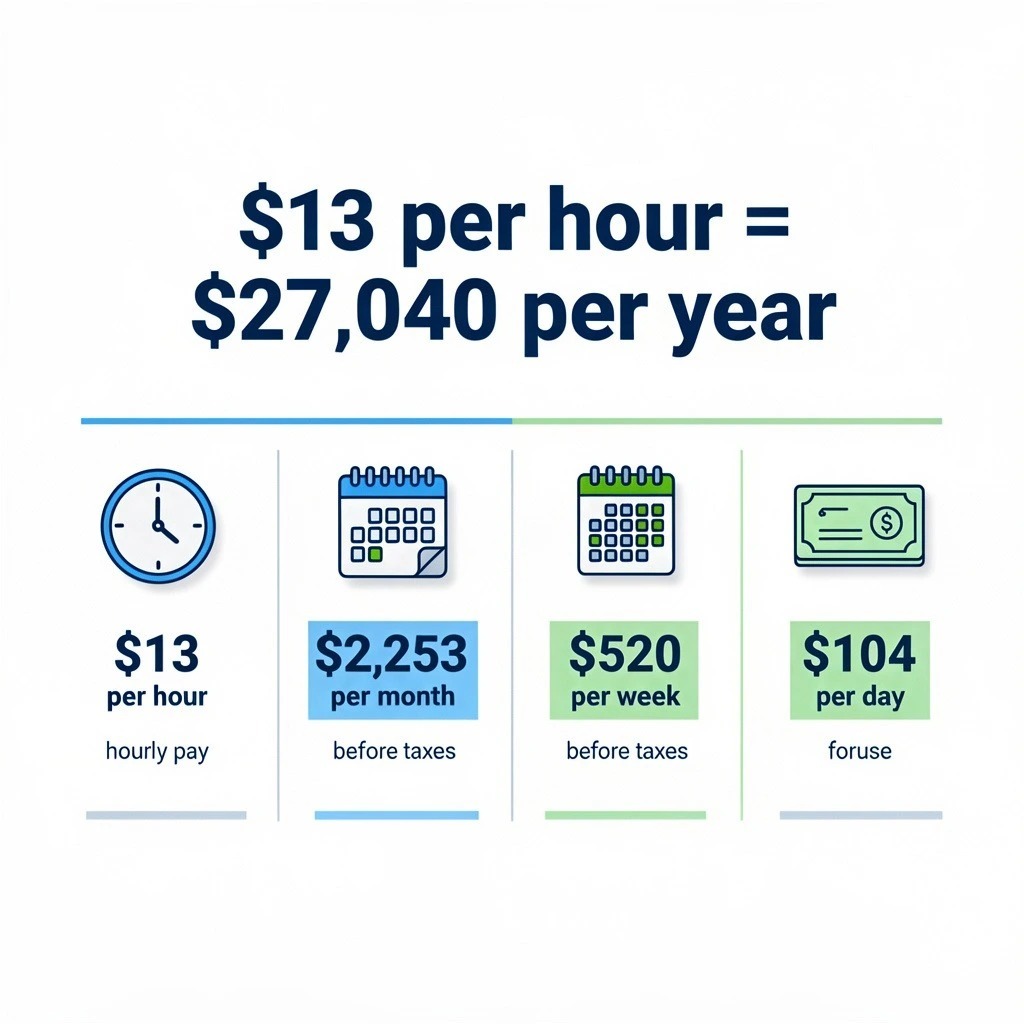
Working full-time at $13 an hour salary calculator utah gives you $27,040 per year before taxes. This calculation assumes you work 40 hours weekly for 52 weeks straight with no unpaid time off.
Your actual take-home pay drops to roughly $22,500 to $24,000 annually after federal and state taxes get deducted. The exact amount depends on where you live and your tax filing status.
Here’s what $13 an hour breaks down to across different pay periods:
- Yearly: $27,040 (gross)
- Monthly: $2,253 (gross)
- Bi-weekly: $1,040 (gross)
- Weekly: $520 (gross)
- Daily: $104 (gross, based on 8-hour workday)
Complete $13/Hour Salary Breakdown Calculator
How Much is $13 an Hour Annually?
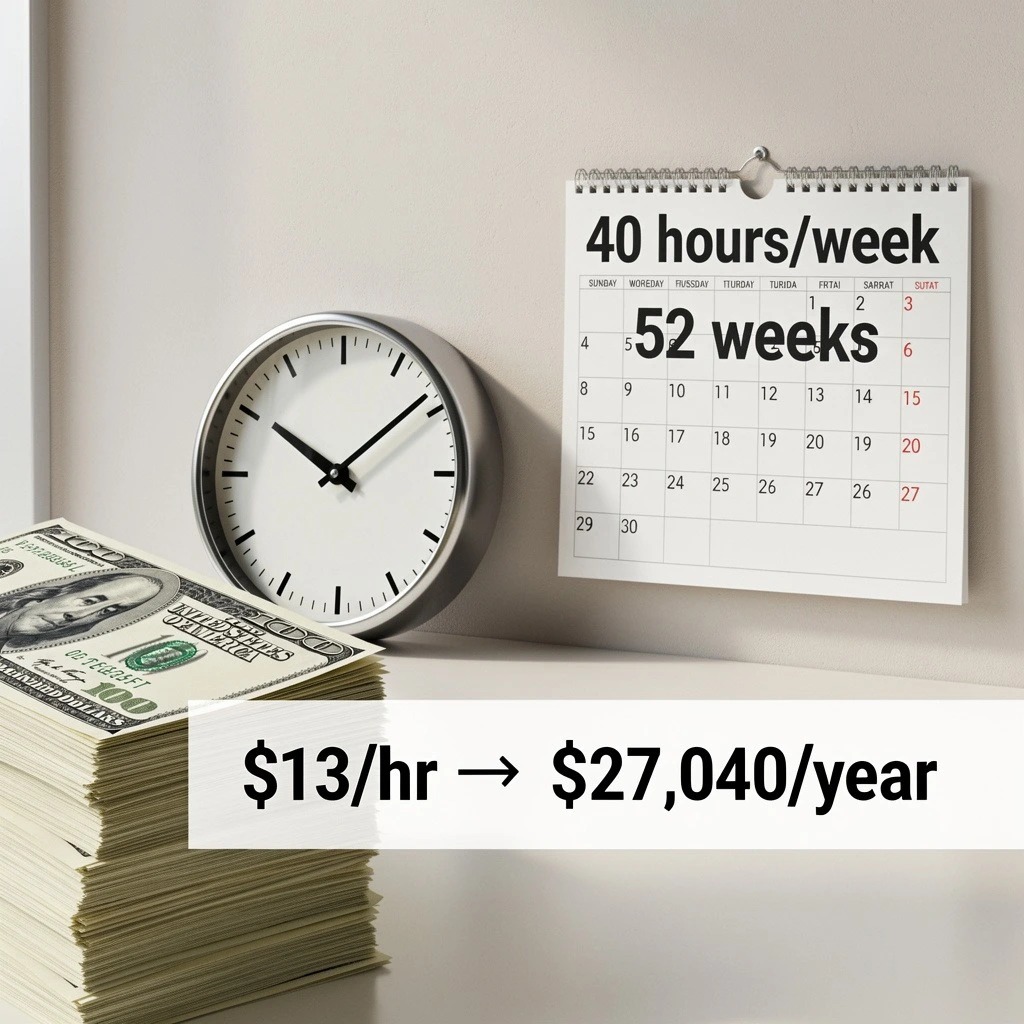
Take your hourly rate and multiply it by the hours you work each week, then multiply that by 52 weeks.
Formula: $13 × 40 hours × 52 weeks = $27,040 per year
This assumes full-time work with zero vacation time. Most workers don’t actually work every single week, so your real annual income might be lower if you take unpaid time off.
How Much is $13 an Hour Monthly?
Divide your annual salary by 12 months.
Calculation: $27,040 ÷ 12 = $2,253.33 per month
Some months you’ll get paid slightly more or less depending on how many pay periods fall in that month. If you’re paid bi-weekly, you’ll receive three illinois paychecks twice a year instead of two.
How Much is $13 an Hour Bi-Weekly?
Multiply your hourly rate by 80 hours (two weeks of full-time work).
Calculation: $13 × 80 hours = $1,040 every two weeks
Bi-weekly pay means you get 26 paychecks per year. This differs from semi-monthly pay (24 paychecks yearly).
How Much is $13 an Hour Weekly?
Multiply your hourly rate by 40 hours.
Calculation: $13 × 40 hours = $520 per week
Weekly paychecks give you 52 payments throughout the year, making budgeting more predictable since the amount stays consistent.
How Much is $13 an Hour Daily?
Multiply your hourly rate by 8 hours (standard workday).
Calculation: $13 × 8 hours = $104 per day
This daily rate helps you understand your earning power and compare job opportunities that might offer different pay structures.
$13/Hour After Taxes: What You Actually Take Home
Gross pay tells only part of the story. You need to know your net pay—what actually hits your bank account after deductions.
Federal Tax Breakdown on $27,040 Salary
The federal government takes a chunk of your paycheck through income tax. At $27,040 annually, you fall into the 12% tax bracket for single filers in 2026 (according to IRS tax tables).
However, you don’t pay 12% on everything. The tax system works in tiers:
- First $11,600: 10% = $1,160
- Remaining $15,440: 12% = $1,853
Total federal income tax: $3,013 per year
You also get the standard deduction of $14,600 (2026 rate), which lowers your taxable income significantly. After this deduction, your taxable income drops to $12,440, meaning you’ll pay roughly $1,244 in federal taxes.
FICA Taxes (Social Security & Medicare) Deductions
Every worker pays FICA taxes, no matter their income level. These mandatory deductions fund Social Security and Medicare programs.
Social Security tax: 6.2% of your gross pay
- $27,040 × 0.062 = $1,676.48
Medicare tax: 1.45% of your gross pay
- $27,040 × 0.0145 = $392.08
Total FICA taxes: $2,068.56 per year (about $79.56 per paycheck if paid bi-weekly)
These taxes come out before you see your paycheck. Your employer matches these contributions, effectively doubling what goes into the system.
State Income Tax Impact by State
State taxes vary wildly. Nine states charge no income tax at all: Alaska, Florida, Nevada, New Hampshire, South Dakota, Tennessee, Texas, Washington, and Wyoming.
Other states tax your income at different rates:
Low-tax states (under 4%):
- Arizona: 2.5%
- North Dakota: 2.9%
- Pennsylvania: 3.07%
Mid-range states (4-6%):
- Colorado: 4.4%
- Illinois: 4.95%
- Michigan: 4.25%
High-tax states (over 7%):
- California: 8-9% at this income level
- New York: 6.5%
- Minnesota: 6.8%
If you live in California, you’d pay roughly $2,160 in state taxes on $27,040. In Texas, you’d pay $0.
Estimated Take-Home Pay by State
Here’s what lands in your account after all taxes (federal, FICA, and state):
| State | Annual Take-Home | Monthly Take-Home |
| Texas (no state tax) | $23,707 | $1,976 |
| Florida (no state tax) | $23,707 | $1,976 |
| Pennsylvania | $22,877 | $1,906 |
| Colorado | $22,518 | $1,876 |
| California | $21,547 | $1,795 |
| New York | $22,109 | $1,842 |
These calculations assume single filing status with no additional deductions or credits.
Tax Filing Status Impact
Your filing status changes your tax burden significantly.
Single filers pay more taxes than married couples at the same income level because married couples get double the standard deduction.
Head of Household status (for single parents or those supporting dependents) gives you a higher standard deduction of $21,900, which could eliminate your federal income tax entirely at this income level.
Married Filing Jointly with both spouses working at $13/hour means household income of $54,080, which pushes you into needing more careful tax planning.
Can You Live on $13 an Hour? Real-Life Budget Analysis
The tough truth: $13 an hour puts you above federal minimum wage but below a comfortable living wage in most American cities.
$13/Hour vs. Living Wage by State
MIT’s Living Wage Calculator defines a living wage as the minimum income needed to cover basic expenses without public assistance. For a single adult with no children, the living wage varies dramatically by location.
States where $13/hour meets or exceeds living wage:
- Mississippi: Living wage $12.58/hour
- Arkansas: Living wage $12.89/hour
- West Virginia: Living wage $12.74/hour
States where $13/hour falls short:
- California: Living wage $19.41/hour (you’re $6.41 short)
- New York: Living wage $18.26/hour (you’re $5.26 short)
- Massachusetts: Living wage $20.01/hour (you’re $7.01 short)
- Hawaii: Living wage $20.61/hour (you’re $7.61 short)
$13/Hour vs. Federal Poverty Line
The federal poverty line for 2026 sits at $15,060 for a single person. At $27,040 annually, you earn 179% of the poverty line.
You’re not technically in poverty, but you’re not far above it either. Financial experts call this income range “working poor”—employed full-time yet struggling to afford basic needs.
For a family of four, the poverty line jumps to $31,200. A single parent making $13/hour with two kids falls below the poverty threshold, even working full-time.
Sample Monthly Budget on $13/Hour
Let’s look at realistic monthly expenses for someone making $13/hour in a mid-sized city, using take-home pay of approximately $1,900 per month after taxes.
Housing: $700 (shared apartment or room rental)
- Studios in mid-sized cities: $800-1,200
- Sharing a 2-bedroom: $600-800
- Living with roommates becomes necessary in most markets
Utilities: $80 (electric, water, internet split with roommate)
Food: $300
- Grocery shopping: $250
- Occasional meals out: $50
- This requires cooking most meals at home
Transportation: $250
- Car payment or public transit: $150
- Gas: $60
- Car insurance: $40
- No room for major repairs or Uber rides
Healthcare: $100
- Employer insurance premium contribution
- Co-pays and medications
- No comprehensive coverage possible
Phone: $50 (budget prepaid plan)
Debt/Savings: $150
- Student loans or credit card minimum payments
- Emergency savings (if possible)
Personal/Other: $270
- Clothing, toiletries, haircuts: $50
- Entertainment: $30
- Unexpected expenses buffer: $190
Total: $1,900
This budget leaves zero room for error. A car repair, medical emergency, or unexpected expense creates an immediate crisis. You can’t afford:
- Dental work beyond basic cleaning
- Travel or vacations
- Professional development courses
- Quality clothing for work
- Social activities that cost money
- Building substantial savings
Cities Where $13/Hour is Livable vs. Unaffordable
More affordable cities for $13/hour workers:
- Memphis, Tennessee
- Average rent: $850 (studio)
- No state income tax
- Lower food costs
- Take-home pay goes further
- Toledo, Ohio
- Average rent: $650 (studio)
- Affordable utilities
- Public transportation available
- Wichita, Kansas
- Average rent: $700 (studio)
- Low cost of living overall
- Cheaper healthcare
- Little Rock, Arkansas
- Average rent: $750 (studio)
- Affordable food and gas
- Lower overall expenses
Nearly impossible cities for $13/hour:
- San Francisco, California
- Average rent: $2,800 (studio)
- Would need $58/hour to afford average studio
- You’d need 3-4 roommates minimum
- New York City, New York
- Average rent: $2,400 (studio in outer boroughs)
- High taxes eat into paycheck
- Transportation costs add up fast
- Boston, Massachusetts
- Average rent: $2,200 (studio)
- Healthcare costs above national average
- Winter heating bills strain budget
- Los Angeles, California
- Average rent: $2,000 (studio)
- Car required (insurance expensive)
- State taxes reduce take-home pay
How to Calculate Hourly Wage to Annual Salary
Understanding the math behind wage conversions helps you evaluate job offers and plan your finances accurately.
Formula for Converting Hourly to Yearly Salary
The basic formula multiplies three numbers:
Hourly Rate × Hours per Week × Weeks per Year = Annual Salary
For full-time work: $13 × 40 × 52 = $27,040
This formula assumes:
- 40 hours each week (full-time status)
- 52 weeks per year (no unpaid time off)
- Regular hourly rate only (no overtime pay)
Standard Full-Time Hours Calculation
The Fair Labor Standards Act (FLSA) defines full-time as 40 hours weekly for overtime calculation purposes, though no federal law actually mandates this as the definition of full-time employment.
Weekly breakdown:
- Monday through Friday: 8 hours daily
- Total: 40 hours weekly
Annual breakdown:
- 40 hours × 52 weeks = 2,080 working hours per year
This becomes your baseline for comparing salaries. A $27,040 salary divided by 2,080 hours equals $13/hour. Use this to verify that salaried positions offer fair compensation compared to hourly rates.
Part-Time Hours Calculation Examples
Not everyone works 40 hours. Part-time work changes your annual income significantly.
20 Hours/Week at $13/Hour
Calculation: $13 × 20 hours × 52 weeks = $13,520 per year
This gives you:
- Monthly: $1,127
- Bi-weekly: $520
- Weekly: $260
At 20 hours weekly, you earn exactly half the full-time rate. Most employers don’t offer benefits at this level, meaning you’ll need to budget for your own health insurance (typically $300-500 monthly).
30 Hours/Week at $13/Hour
Calculation: $13 × 30 hours × 52 weeks = $20,280 per year
This gives you:
- Monthly: $1,690
- Bi-weekly: $780
- Weekly: $390
Some employers classify 30+ hours as full-time for benefits purposes, which could add significant value through health insurance, paid time off, and retirement matching.
How Overtime Affects Your Annual Income
Federal law requires overtime pay at 1.5 times your regular rate for hours worked beyond 40 in a week.
Your overtime rate at $13/hour: $19.50 per hour
Example 1: Five hours of overtime weekly
- Regular pay: $13 × 40 = $520
- Overtime pay: $19.50 × 5 = $97.50
- Weekly total: $617.50
- Annual income: $617.50 × 52 = $32,110 (that’s $5,070 more than base pay)
Example 2: Ten hours of overtime weekly
- Regular pay: $13 × 40 = $520
- Overtime pay: $19.50 × 10 = $195
- Weekly total: $715
- Annual income: $715 × 52 = $37,180 (that’s $10,140 more than base pay)
Overtime dramatically boosts your income, but it’s not guaranteed. Many workers can’t rely on consistent overtime hours for financial planning.
Some employers intentionally schedule workers for 39.5 hours to avoid paying overtime. Others offer “comp time” instead of overtime pay, which gives you paid time off rather than extra money (this practice is illegal for most private-sector hourly workers).
$13/Hour Salary Compared to National Averages
Context matters when evaluating wages. Let’s see how $13/hour stacks up against broader earning trends.
$13/Hour vs. US Median Hourly Wage
The U.S. Bureau of Labor Statistics reports the median hourly wage across all occupations in 2025 at $23.51 per hour.
At $13/hour, you earn 44.7% less than the median American worker. You’re making roughly 55 cents for every dollar the typical worker earns.
This places you in the bottom 25th percentile of wage earners nationwide. Three out of four American workers make more than you do.
$13/Hour vs. US Median Annual Salary
The median annual salary for full-time workers sits at approximately $48,900 according to the latest Census Bureau data.
Your $27,040 annual income represents 55% of the median salary. You’d need to nearly double your hourly rate to reach median income levels.
Income percentile: $27,040 puts you around the 30th percentile nationally, meaning 70% of full-time workers earn more than you.
Where Does $13/Hour Rank Nationally?
Looking at occupational wage data reveals where $13/hour typically falls:
Jobs that pay around $13/hour:
- Retail sales workers: $13.02/hour median
- Food preparation workers: $13.25/hour median
- Home health aides: $13.81/hour median
- Childcare workers: $13.22/hour median
Jobs that pay significantly more:
- Registered nurses: $38.74/hour median
- Electricians: $29.45/hour median
- Plumbers: $28.79/hour median
- Computer support specialists: $27.34/hour median
$13/hour typically represents entry-level positions requiring minimal formal education or training. These jobs often serve as stepping stones rather than careers.
Purchasing Power of $13/Hour Across Different States
A dollar in Mississippi buys more than a dollar in California. Regional price differences mean your $13/hour has vastly different purchasing power depending on location.
Using the Regional Price Parity index from the Bureau of Economic Analysis, we can compare real purchasing power:
States where $13/hour has highest purchasing power:
- Mississippi (RPP: 86.4)
- Adjusted value: $15.04/hour
- Your money goes 15.7% further
- Arkansas (RPP: 87.1)
- Adjusted value: $14.93/hour
- Your money goes 14.9% further
- Alabama (RPP: 88.3)
- Adjusted value: $14.72/hour
- Your money goes 13.2% further
States where $13/hour has lowest purchasing power:
- Hawaii (RPP: 112.6)
- Adjusted value: $11.54/hour
- Your money loses 11.2% of value
- California (RPP: 111.8)
- Adjusted value: $11.63/hour
- Your money loses 10.5% of value
- New York (RPP: 110.2)
- Adjusted value: $11.80/hour
- Your money loses 9.2% of value
This means $13/hour in Mississippi feels like earning $15/hour in an average-cost state, while $13/hour in California feels like earning $11.63/hour.
Jobs That Pay $13 an Hour in 2026
Many positions cluster around the $13/hour wage point. Understanding which industries and roles typically pay this rate helps you explore career options.
Common Entry-Level Jobs Paying $13/Hour
Retail sector:
- Cashiers
- Stock clerks
- Sales associates
- Customer service representatives
Food service:
- Servers (with tips potentially bringing total compensation higher)
- Fast food crew members
- Baristas
- Kitchen prep workers
Healthcare support:
- Nursing assistants (entry-level)
- Home health aides
- Medical assistants (starting positions)
- Dental assistants (entry-level)
Hospitality:
- Hotel front desk clerks
- Housekeepers
- Resort workers
- Event staff
Education support:
- Teacher’s aides
- After-school program staff
- Tutors (entry-level)
- Childcare workers
Warehouse and logistics:
- Order pickers
- Packers
- Shipping clerks
- Forklift operators (entry-level)
Industries with $13/Hour Starting Wages
Some industries consistently start workers around $13/hour:
Retail trade: Average starting wage $12.75-14.00/hour
- High turnover means constant openings
- Limited advancement without management track
- Irregular schedules common
Food service and accommodation: Average starting wage $12.50-13.50/hour
- Tips can supplement base pay significantly
- Evening and weekend work required
- Physical demands of standing all day
Healthcare support services: Average starting wage $13.00-14.50/hour
- Growing field with advancement potential
- Certification can boost pay quickly
- Emotionally and physically demanding
Personal care services: Average starting wage $12.75-13.75/hour
- Includes salons, spas, fitness centers
- Tips and commissions add to income
- Client-building takes time
Remote Jobs Paying $13/Hour
Remote work options at this wage level have expanded, though they remain competitive:
Customer service representatives:
- Answer calls, emails, and chats
- Requires quiet workspace and reliable internet
- Often includes evening/weekend shifts
- Companies hiring: Amazon, Apple, American Express
Data entry clerks:
- Input information into databases
- Accuracy more important than speed
- Often independent contractor positions
- Can be repetitive and monotonous
Virtual assistants:
- Schedule appointments, manage emails
- Varied tasks keep work interesting
- Need to be highly organized
- Often requires previous administrative experience
Online tutors:
- Help students with homework and test prep
- Subject matter expertise required
- Flexible scheduling
- Platforms: Tutor.com, Chegg, Wyzant
Social media moderators:
- Review and remove inappropriate content
- Can be psychologically challenging
- Often entry-level remote opportunity
- Regular breaks needed for mental health
Transcriptionists:
- Convert audio to text
- Medical and legal pay higher ($15-20/hour)
- Requires excellent typing and listening skills
- Companies: Rev, TranscribeMe, GoTranscript
Part-Time Jobs at $13/Hour
Part-time positions at this rate work well for students, parents, or those supplementing other income:
Grocery store workers: 15-25 hours weekly typical Bank tellers: Often part-time, flexible scheduling
Library assistants: Perfect for students Fitness instructors: Hourly rate plus potential tips Pet sitters/dog walkers: Set your own schedule through apps Delivery drivers: Independent contractor status (vehicle costs reduce net pay)
Highest Paying Cities for $13/Hour Jobs
Some cities where $13/hour is on the lower end because minimum wage exceeds this rate:
Cities where $13/hour is below minimum wage:
- Seattle, WA: Minimum wage $19.97/hour
- San Francisco, CA: Minimum wage $18.67/hour
- Washington, DC: Minimum wage $17.50/hour
- Denver, CO: Minimum wage $18.29/hour
- New York City, NY: Minimum wage $16.50/hour
In these cities, entry-level jobs actually start at $15-20/hour, but cost of living is so high that workers face similar financial strain as someone making $13/hour in cheaper areas.
Cities where $13/hour represents fair entry-level pay:
- Houston, TX
- Phoenix, AZ
- Philadelphia, PA
- San Antonio, TX
- Dallas, TX
Job Growth Outlook for $13/Hour Positions
The Bureau of Labor Statistics projects varied growth for occupations in this wage range:
Declining fields:
- Cashiers: -10% by 2032 (self-checkout automation)
- Data entry: -8% by 2032 (automation)
- Bank tellers: -12% by 2032 (online banking)
Growing fields:
- Home health aides: +22% by 2032 (aging population)
- Medical assistants: +14% by 2032 (healthcare demand)
- Solar panel installers: +27% by 2032 (clean energy)
- Wind turbine technicians: +45% by 2032 (renewable energy)
Smart workers in $13/hour positions look toward growing fields and get training in areas less vulnerable to automation.
Continuing Comprehensive Content…
$13/Hour Salary by State Comparison
Your location dramatically affects how far your $13/hour paycheck stretches. Some states boost your earnings through higher minimum wages, while others drain your wallet through hefty income taxes.
States Where $13/Hour Goes the Furthest
These states combine low living costs with zero or minimal state income tax, maximizing your purchasing power:
1. Tennessee
- Take-home pay: $1,976/month
- State income tax: 0%
- Average rent (1-bedroom): $950
- Rent as % of income: 48%
- Why it works: No state tax plus affordable housing in cities like Chattanooga and Knoxville
2. Texas
- Take-home pay: $1,976/month
- State income tax: 0%
- Average rent (1-bedroom): $1,100
- Rent as % of income: 56%
- Why it works: No state tax offsets higher housing costs in major cities. Smaller Texas cities like Amarillo and Lubbock offer rent under $800
3. Mississippi
- Take-home pay: $1,898/month
- State income tax: 4%
- Average rent (1-bedroom): $750
- Rent as % of income: 40%
- Why it works: Lowest housing costs in the nation. Your $13/hour has the highest purchasing power here
4. Arkansas
- Take-home pay: $1,912/month
- State income tax: 3.4% at this income level
- Average rent (1-bedroom): $725
- Rent as % of income: 38%
- Why it works: Rock-bottom living costs mean more money for savings
5. Alabama
- Take-home pay: $1,921/month
- State income tax: 2.75%
- Average rent (1-bedroom): $825
- Rent as % of income: 43%
- Why it works: Low taxes and affordable housing throughout the state
States Where $13/Hour is Below Minimum Wage
Twenty-three states have minimum wages that exceed $13/hour in 2026. Working for $13/hour in these states means you’re actually getting paid less than the legal minimum:
States with $15+ minimum wage:
- California: $16.50/hour minimum
- Connecticut: $16.35/hour minimum
- Massachusetts: $15.50/hour minimum
- New York: $16.50/hour minimum (NYC higher)
- Washington: $16.66/hour minimum
States with $13-15 minimum wage:
- Arizona: $14.70/hour minimum
- Colorado: $14.81/hour minimum
- Maine: $14.65/hour minimum
- Maryland: $15.00/hour minimum
- New Jersey: $15.49/hour minimum
- Oregon: $14.70/hour minimum
- Rhode Island: $15.00/hour minimum
- Vermont: $14.01/hour minimum
If someone offers you $13/hour in these states, they’re breaking the law. Report wage violations to your state’s Department of Labor.
Cost of Living Adjusted Value by State
Real wages account for regional price differences. Here’s what your $13/hour actually buys in each state after adjusting for local costs:
Top 10 states by adjusted purchasing power:
| State | Adjusted Hourly Value | Cost of Living Index |
| Mississippi | $15.04 | 86.4 |
| Arkansas | $14.93 | 87.1 |
| Oklahoma | $14.78 | 88.0 |
| Alabama | $14.72 | 88.3 |
| Kansas | $14.61 | 89.0 |
| Iowa | $14.53 | 89.5 |
| Missouri | $14.49 | 89.7 |
| Indiana | $14.44 | 90.0 |
| West Virginia | $14.41 | 90.2 |
| Tennessee | $14.29 | 91.0 |
Bottom 10 states by adjusted purchasing power:
| State | Adjusted Hourly Value | Cost of Living Index |
| Hawaii | $11.54 | 112.6 |
| California | $11.63 | 111.8 |
| New York | $11.80 | 110.2 |
| Massachusetts | $11.92 | 109.1 |
| New Jersey | $12.01 | 108.3 |
| Maryland | $12.11 | 107.4 |
| Connecticut | $12.15 | 107.0 |
| Oregon | $12.28 | 105.9 |
| Washington | $12.31 | 105.6 |
| Colorado | $12.40 | 104.8 |
Your $13/hour in Mississippi buys what $15.04/hour buys in an average-priced state. The same $13/hour in Hawaii only buys what $11.54/hour would purchase elsewhere.
Interactive State-by-State Salary Table
Here’s a complete breakdown of $13/hour across all states, showing take-home pay after federal and state taxes:
| State | State Tax Rate | Monthly Take-Home | Annual Take-Home | Notes |
| Alabama | 2.75% | $1,921 | $23,052 | Low cost of living |
| Alaska | 0% | $1,976 | $23,707 | High cost of living offsets tax benefit |
| Arizona | 2.5% | $1,927 | $23,124 | Minimum wage exceeds $13 |
| Arkansas | 3.4% | $1,912 | $22,944 | Very affordable housing |
| California | 8% | $1,795 | $21,540 | Minimum wage exceeds $13 |
| Colorado | 4.4% | $1,876 | $22,512 | Minimum wage exceeds $13 |
| Connecticut | 4.5% | $1,873 | $22,476 | High cost of living |
| Delaware | 4.75% | $1,866 | $22,392 | No sales tax |
| Florida | 0% | $1,976 | $23,707 | Growing cost of living |
| Georgia | 4.75% | $1,866 | $22,392 | Atlanta expensive, rest affordable |
| Hawaii | 7.2% | $1,818 | $21,816 | Highest cost of living in nation |
| Idaho | 5.8% | $1,845 | $22,140 | Rising housing costs |
| Illinois | 4.95% | $1,863 | $22,356 | Chicago expensive |
| Indiana | 3.15% | $1,917 | $23,004 | Affordable throughout |
| Iowa | 4.4% | $1,876 | $22,512 | Very affordable |
| Kansas | 4.6% | $1,873 | $22,476 | Low cost of living |
| Kentucky | 4.5% | $1,873 | $22,476 | Affordable housing |
| Louisiana | 3.5% | $1,911 | $22,932 | No minimum wage law |
| Maine | 6.75% | $1,826 | $21,912 | Minimum wage exceeds $13 |
| Maryland | 4.75% | $1,866 | $22,392 | High cost near DC |
| Massachusetts | 5% | $1,860 | $22,320 | Very expensive housing |
| Michigan | 4.25% | $1,878 | $22,536 | Affordable outside Detroit |
| Minnesota | 6.8% | $1,825 | $21,900 | Higher taxes, good services |
| Mississippi | 4% | $1,898 | $22,776 | Lowest cost of living |
| Missouri | 4.8% | $1,867 | $22,404 | Very affordable |
| Montana | 5.9% | $1,844 | $22,128 | Rising housing costs |
| Nebraska | 5.2% | $1,857 | $22,284 | Affordable overall |
| Nevada | 0% | $1,976 | $23,707 | No state tax, rising costs |
| New Hampshire | 0% | $1,976 | $23,707 | High property taxes instead |
| New Jersey | 3.5% | $1,911 | $22,932 | Very expensive housing |
| New Mexico | 4.9% | $1,864 | $22,368 | Affordable in most areas |
| New York | 6.5% | $1,842 | $22,104 | NYC extremely expensive |
| North Carolina | 4.5% | $1,873 | $22,476 | Affordable in most areas |
| North Dakota | 2.9% | $1,923 | $23,076 | Low population, affordable |
| Ohio | 3.75% | $1,904 | $22,848 | Very affordable |
| Oklahoma | 4.75% | $1,866 | $22,392 | Low cost of living |
| Oregon | 7.75% | $1,806 | $21,672 | No sales tax |
| Pennsylvania | 3.07% | $1,918 | $23,016 | Flat tax rate |
| Rhode Island | 4.75% | $1,866 | $22,392 | Small, expensive state |
| South Carolina | 6% | $1,842 | $22,104 | Affordable overall |
| South Dakota | 0% | $1,976 | $23,707 | Low population |
| Tennessee | 0% | $1,976 | $23,707 | No income tax |
| Texas | 0% | $1,976 | $23,707 | No income tax, high property tax |
| Utah | 4.65% | $1,871 | $22,452 | Growing fast, rising costs |
| Vermont | 6.6% | $1,830 | $21,960 | High taxes, small population |
| Virginia | 5.1% | $1,859 | $22,308 | Northern VA expensive |
| Washington | 0% | $1,976 | $23,707 | Seattle very expensive |
| West Virginia | 5.12% | $1,858 | $22,296 | Very affordable |
| Wisconsin | 5.3% | $1,856 | $22,272 | Affordable overall |
| Wyoming | 0% | $1,976 | $23,707 | Low population, affordable |
Notes on this table:
- Take-home calculations include federal income tax, FICA taxes, and state income tax
- Assumes single filer with standard deduction
- Does not include local taxes (some cities add additional income taxes)
- Based on 2026 tax rates and brackets
How to Increase Your Income Beyond $13/Hour
You don’t have to stay stuck at $13/hour. Strategic moves can boost your earning power significantly within months or years.
Skills That Can Boost Your Hourly Rate
Specific skills command higher wages across industries. Focus on learning what employers actually pay for:
Technical skills (6-12 months to learn):
Basic coding: $18-25/hour entry-level
- Learn Python, JavaScript, or SQL
- Free resources: Codecademy, freeCodeCamp, Khan Academy
- Entry jobs: Junior developer, QA tester
- Time investment: 3-6 months of daily practice
Data analysis: $20-28/hour entry-level
- Master Excel, Google Sheets, basic SQL
- Learn data visualization tools (Tableau, Power BI)
- Free courses: Google Data Analytics Certificate, Microsoft Learn
- Time investment: 4-6 months
Digital marketing: $17-23/hour entry-level
- SEO, social media management, email marketing
- Google Ads and Analytics certifications (free)
- Build portfolio by managing social media for local businesses
- Time investment: 3-4 months
Graphic design: $18-25/hour freelance
- Learn Adobe Creative Suite or free alternatives (Canva, GIMP)
- Build portfolio with spec work and personal projects
- Platforms: Fiverr, Upwork, 99designs
- Time investment: 6-12 months to build competitive portfolio
Trade skills (1-2 years to learn):
HVAC certification: $22-30/hour apprentice
- 6-month certificate programs available
- Demand grows as climate change increases AC needs
- Can start as helper while learning
- Full certification takes 2-3 years
Electrical work: $20-28/hour apprentice
- Apprenticeship programs pay while you learn
- 4-year path to journeyman electrician ($35-45/hour)
- Always in demand
Plumbing: $20-26/hour apprentice
- Similar apprenticeship model to electrical
- Can’t be automated or outsourced
- Good job security
Welding: $19-26/hour certified
- Certification programs take 6-12 months
- Manufacturing, construction, and repair industries all need welders
- Specialized welding (underwater, pipeline) pays $40-60/hour
Healthcare skills (6 months – 2 years):
Phlebotomy: $17-20/hour
- 4-8 week certification programs
- Fastest healthcare entry point
- Hospitals always hiring
Medical coding: $19-24/hour
- Self-paced online programs (6-12 months)
- Work from home opportunities
- AAPC or AHIMA certification required
Dental hygienist: $35-42/hour
- Requires 2-year associate degree
- Excellent job outlook
- Good work-life balance
Radiologic technologist: $28-35/hour
- 2-year associate degree
- Growing field due to aging population
- Can specialize further for higher pay
Certifications Worth Pursuing for Higher Pay
Certifications prove competence to employers and often lead to immediate raises:
IT certifications:
CompTIA A+: Entry-level IT support ($18-22/hour)
- Cost: $246 per exam (2 exams required)
- Study time: 3-4 months
- Opens door to help desk and support roles
Google IT Support Certificate: Help desk roles ($16-20/hour)
- Cost: $49/month on Coursera (typically 6 months)
- Completely online, self-paced
- Good starting point with no experience
AWS Cloud Practitioner: Cloud support roles ($20-25/hour entry)
- Cost: $100 exam fee
- Study time: 2-3 months
- Cloud skills in high demand
Business certifications:
Project Management Professional (PMP): $30-40/hour
- Cost: $555 exam fee
- Requires 3 years experience and 35 hours of PM education
- Significant salary boost for those who qualify
Certified Public Accountant (CPA): $28-35/hour entry
- Requires bachelor’s degree in accounting
- 4 difficult exams
- Long-term career path to $60-80/hour
Six Sigma Green Belt: Quality control roles ($24-30/hour)
- Cost: $200-500 depending on provider
- Manufacturing and process improvement focus
- Employers often pay for certification
Trade certifications:
OSHA 10 or 30-hour: Construction safety
- Cost: $60-150
- Required for many construction jobs
- Shows safety awareness to employers
Forklift certification: Warehouse operator ($15-18/hour)
- Cost: $50-150
- Takes 1 day
- Opens many warehouse opportunities
CDL (Commercial Driver’s License): Truck driver ($23-28/hour entry)
- Cost: $3,000-7,000 for training
- 3-6 week programs
- Chronic driver shortage means jobs everywhere
- Long-haul drivers can make $60,000-70,000 annually
Side Hustles to Supplement $13/Hour Income
Adding $500-1,500 monthly through side work transforms your financial situation:
Gig economy (flexible hours):
Food delivery, Uber Eats, Grubhub): $15-25/hour
- Work whenever you want
- Vehicle wear and gas costs reduce net pay
- Peak hours (dinner, weekends) pay best
- Realistic net after expenses: $12-18/hour
Rideshare (Uber, Lyft): $18-28/hour gross
- Requires newer vehicle, clean record
- Vehicle depreciation and maintenance costs significant
- Late nights and weekends earn most
- Realistic net after expenses: $13-20/hour
Grocery shopping (Instacart, Shipt): $14-22/hour
- Less vehicle wear than food delivery
- Tips vary widely by customer
- Must be efficient at shopping
- Can earn $300-600/week working 20 hours
Task services (TaskRabbit): $20-40/hour
- Furniture assembly, moving help, handyman work
- Set your own rates
- Need some basic skills
- Build reputation for consistent work
Online work (location independent):
Freelance writing: $20-100+ per article
- Start on Medium, Contently, or Upwork
- Build portfolio with free work initially
- Specialize in lucrative niches (finance, tech, healthcare)
- Realistic monthly addition: $300-800 part-time
Virtual assistant: $15-25/hour
- Schedule management, email handling, data entry
- Find clients on Upwork, Fiverr, or directly through networking
- Flexible hours
- Realistic monthly addition: $400-1,000 working 15-20 hours
Online tutoring: $18-40/hour
- Tutor.com, Wyzant, VIPKid (teaching English to Chinese students)
- Need expertise in specific subjects
- Flexible scheduling
- Realistic monthly addition: $500-1,200 working 10-15 hours
Sell on Etsy or eBay: Variable income
- Handmade crafts, vintage items, dropshipping
- Requires upfront inventory investment
- Time-consuming to build customer base
- Successful sellers earn $500-2,000/month
Local services (physical work):
Dog walking/pet sitting (Rover, Wag): $15-30 per walk
- Low barrier to entry
- Build trust with pet owners
- Can scale by walking multiple dogs
- Realistic monthly addition: $300-800
House cleaning: $25-40/hour
- High demand, low supply
- Physically demanding
- Can build regular client base
- Realistic monthly addition: $600-1,200 working 10-15 hours
Lawn care/snow removal: $30-50/hour
- Seasonal work
- Need basic equipment
- Can build route of regular customers
- Realistic monthly addition: $800-1,600 during peak season
Photography: $50-200 per session
- Events, portraits, real estate
- Need decent camera and editing skills
- Build portfolio through free/discounted work
- Realistic monthly addition: $400-1,000 with 4-8 sessions
Negotiation Tips for Hourly Workers
Many hourly workers never ask for raises. Those who do often get them.
When to ask for a raise:
- After 12 months at the same rate
- When you take on new responsibilities
- After completing certification or training
- When company has good financial quarter
- During annual review
How to ask effectively:
1. Document your value:
- List specific contributions: “Trained 5 new employees,” “Reduced waste by 15%”
- Quantify achievements with numbers
- Show how you’ve gone beyond job description
2. Research market rates:
- Check Glassdoor, Indeed, Salary.com for your role
- Know what competitors pay for similar positions
- Reference specific job postings at higher rates
3. Pick the right time:
- Request meeting (don’t ambush your boss)
- Choose slow period, not during crisis
- After completing major project successfully
4. Practice your pitch:
- “I’ve been here 18 months at $13/hour. I’ve taken on inventory management and trained three new hires. Market rate for my role is $15-16/hour. I’d like to discuss bringing my pay to $15/hour.”
- Be direct and confident
- Don’t apologize or be tentative
5. Have a number in mind:
- Ask for 10-20% more than current rate
- Be willing to negotiate
- Know your walk-away point
6. Be prepared for “no”:
- Ask what you need to do to earn a raise
- Request specific timeline for next review
- Get commitments in writing
- Consider looking elsewhere if repeatedly denied
What NOT to do:
- Don’t threaten to quit (unless you mean it)
- Don’t compare yourself to coworkers (focus on your value)
- Don’t cite personal financial needs (employer doesn’t care)
- Don’t accept vague promises without timeline
If they say yes:
- Get it in writing with effective date
- Confirm new rate on first paycheck
- Thank them professionally
If they say no:
- Ask for specific performance targets to earn raise
- Request 3-month review
- Start job searching if no path forward
Career Paths Starting at $13/Hour
Several careers begin at $13/hour but offer clear advancement:
Retail to management:
- Sales associate: $13/hour
- Senior sales associate: $15/hour (1-2 years)
- Assistant manager: $18-22/hour (2-3 years)
- Store manager: $50,000-65,000 salary (4-6 years)
Banking teller to relationship banker:
- Bank teller: $13-15/hour
- Senior teller: $16-18/hour (1-2 years)
- Personal banker: $20-25/hour (2-3 years)
- Relationship banker: $55,000-75,000 (4-5 years)
Nursing assistant to registered nurse:
- CNA: $13-16/hour
- LPN: $22-28/hour (1 year vocational program)
- RN: $35-45/hour (2-year associate or 4-year bachelor’s)
- Nurse practitioner: $55-70/hour (master’s degree)
Administrative assistant to executive assistant:
- Receptionist: $13-15/hour
- Administrative assistant: $17-21/hour (1-2 years)
- Executive assistant: $25-35/hour (4-6 years)
- Chief of staff: $75,000-120,000 (10+ years)
Restaurant server to restaurant manager:
- Host/busser: $13/hour plus tips
- Server: $13/hour plus $15-30/hour in tips (6 months-1 year)
- Shift supervisor: $16-19/hour (2-3 years)
- Restaurant manager: $45,000-60,000 (4-6 years)
The key is choosing employers who promote from within and being clear about your career goals from day one.
Hourly vs. Salary: What’s Better at the $27K Level?
The hourly versus salary debate matters at every income level. Each structure offers distinct advantages and drawbacks.
Pros and Cons of Hourly Employment at $13/Hour
Advantages of hourly work:
You get paid for every hour worked
- Overtime pay at time-and-a-half ($19.50/hour)
- No unpaid extra hours
- Clock out at the end of your shift without guilt
Schedule flexibility (sometimes)
- Easier to request specific days off
- Can pick up extra shifts when you need money
- Part-time options available
Clear boundaries
- Work time vs. personal time distinctly separated
- No expectation to answer emails at home
- Can’t be forced to work off the clock (illegal)
Easier to job hop
- Can work multiple part-time jobs
- Less pressure to stay long-term
- Easier to leave for better opportunity
Disadvantages of hourly work:
Income unpredictability
- Hours can be cut without notice
- Slow seasons mean less pay
- Hard to budget when income fluctuates
Fewer benefits
- Health insurance often unavailable
- No paid time off at many employers
- Retirement benefits rare
- No paid holidays at some places
Less job security
- First to be laid off during downturns
- Easier to fire hourly workers
- No severance packages typically
Schedule instability
- Last-minute shift changes
- Must work holidays and weekends
- Split shifts or clopening (closing then opening)
- On-call requirements
Stigma and respect issues
- Viewed as “less professional”
- Limited advancement opportunities
- Less autonomy in decision-making
- Micromanagement more common
Benefits Comparison: Hourly vs. Salaried Positions
At the $27,040 income level, benefit differences can equal thousands of dollars annually:
Typical hourly worker benefits ($13/hour):
- Health insurance: Rarely offered, or only after 90 days
- Paid time off: 0-5 days annually
- Sick leave: Often unpaid
- Retirement: No 401(k) match typically
- Life insurance: Not offered
- Dental/vision: Not offered
- Professional development: None
- Total benefits value: $0-2,000 annually
Typical salaried worker benefits ($27,000 salary):
- Health insurance: Usually offered (employer pays 60-80%)
- Paid time off: 10-15 days annually
- Sick leave: 5-7 days annually
- Retirement: 3% 401(k) match common
- Life insurance: Basic policy included
- Dental/vision: Often available
- Professional development: Some budget for training
- Total benefits value: $4,000-8,000 annually
A salaried position at the same base pay can be worth 15-30% more when benefits are included. Someone earning $27,000 salary with full benefits effectively makes $31,000-35,000 in total compensation.
Overtime Opportunities for Hourly Workers
Hourly status guarantees overtime pay—a major advantage when available:
Standard overtime (time-and-a-half): $13 regular rate × 1.5 = $19.50/hour for hours beyond 40 weekly
How overtime boosts annual income:
- 5 hours weekly OT: Additional $5,070 annually (total: $32,110)
- 10 hours weekly OT: Additional $10,140 annually (total: $37,180)
- 20 hours weekly OT: Additional $20,280 annually (total: $47,320)
Industries with consistent overtime:
- Manufacturing: Often mandatory 50-hour weeks
- Healthcare: Understaffing creates OT opportunities
- Warehousing: Peak seasons (holidays) mean lots of OT
- Security: Extra shifts frequently available
- Food processing: Production demands drive OT
The overtime trap: Many hourly workers become dependent on overtime income and can’t afford to lose it. Build your base budget on 40 hours, treat overtime as bonus money for savings or debt payoff.
Job Security and Stability Considerations
Neither hourly nor salary guarantees security, but patterns exist:
Hourly workers face:
- Hours cut before layoffs happen
- Seasonal unemployment
- Quick termination without much notice
- Easy to replace (in employer’s view)
Salaried workers typically get:
- Advance warning of layoffs
- Severance packages (1-2 weeks per year of service)
- More protection from arbitrary firing
- Perceived as more valuable investment
However, at the $27,000 level, “salaried” often means “salaried non-exempt,” which provides overtime protections like hourly workers but with fixed base pay. True “salaried exempt” status (no overtime) usually kicks in around $45,000-50,000.
Bottom line for $13/hour workers: Take hourly if overtime is available and you need maximum earning potential. Take salary if benefits are offered and you value predictable income and better work-life boundaries.
Financial Planning on $13 an Hour
Living on $13/hour requires careful financial management. Small mistakes create big problems at this income level.
Creating a Realistic Budget on $27,040/Year
Start with your actual take-home pay, not gross income. Using $1,900 monthly after taxes (varies by state):
The 50/30/20 budget doesn’t work here. That framework assumes 50% for needs, 30% for wants, 20% for savings. At $13/hour, you’ll spend 70-80% on needs alone.
Realistic $13/hour budget framework:
Needs (75-80% = $1,425-1,520):
- Housing: $700 (shared living required in most areas)
- Utilities: $80 (split with roommates)
- Food: $300 (cooking at home, minimal eating out)
- Transportation: $250 (car payment, insurance, gas OR transit pass)
- Healthcare: $100 (premium contribution, copays, medications)
- Phone: $50 (budget prepaid plan)
- Basic toiletries/household: $45
Debt payments (10-15% = $190-285):
- Minimum credit card payments
- Student loans
- Any other debt obligations
Discretionary/Savings (5-15% = $95-285):
- Entertainment: $30
- Clothing: $40
- Emergency savings: $100-200 (when possible)
- Buffer for unexpected expenses: Remaining
Budget categories to track closely:
Food ($300/month target):
- Week 1: $75
- Week 2: $75
- Week 3: $75
- Week 4: $75
Tips to stay within food budget:
- Meal prep on Sundays
- Buy store brands
- Shop at Aldi, Walmart, or discount grocers
- Use apps like Flipp for sale matching
- Buy meat on manager’s special (freeze immediately)
- Rice, beans, pasta, and eggs as staples
- No delivery fees (eat before grocery shopping)
Transportation ($250/month target):
If you have a car:
- Car payment: $150 (or paid off)
- Insurance: $60
- Gas: $40
Car alternatives at this income:
- Public transit pass: $80-120
- Bicycle: $0 after initial purchase
- Walking: $0
- Carpool/ride with coworkers: $50-100/month gas contribution
Cars become unaffordable if insurance exceeds $100/month or if you have car payment over $200. Consider selling and using cheaper transportation.
Unexpected expenses fund: At $13/hour, a $400 car repair or medical bill destroys your budget. You need a cushion:
- Month 1-3: Save $50/month = $150 buffer
- Month 4-6: Save $75/month = $225 more ($375 total)
- Month 7-12: Save $100/month = $600 more ($975 total)
Even $1,000 emergency fund prevents most financial disasters.
Savings Strategies for Low-Income Earners
Traditional savings advice (“save 20% of your income”) doesn’t apply when you’re already stretched thin. Focus on these realistic strategies:
Micro-savings ($5-10 per week):
- Round up transactions with apps like Acorns or Digit
- Save every $5 bill you receive
- Quit one small habit (daily coffee, vending machine)
- $10/week = $520 annually
Found money savings: Commit to saving 100% of windfalls:
- Tax refunds
- Birthday money
- Overtime pay
- Side hustle income
- Rebates and cash back
The 24-hour rule: Wait 24 hours before any non-essential purchase over $25. Half the time you’ll decide you don’t need it.
Cash envelope system: Withdraw cash for variable expenses:
- Food envelope: $300
- Entertainment envelope: $30
- Personal care envelope: $40
When the envelope is empty, you’re done spending in that category.
Automate savings: Set up automatic transfer of $25-50 to savings account on payday. Even small amounts add up:
- $25/month = $300/year
- $50/month = $600/year
- $100/month = $1,200/year
Bank separately: Keep savings at different bank than checking to reduce temptation. Online banks like Ally or Marcus often pay higher interest rates.
Savings milestones at $13/hour:
- First $500: Covers most common emergencies
- First $1,000: Major psychological victory
- First $2,500: Three months of major expenses covered
- First $5,000: Real financial security buffer
Emergency Fund Goals at $13/Hour
Traditional advice says save 3-6 months of expenses. That’s $5,700-11,400 for someone spending $1,900 monthly. This takes years at $13/hour.
More realistic emergency fund goals:
Starter emergency fund: $500
- Covers: Car repair, urgent care visit, broken appliance
- Timeline: 3-6 months saving $100/month
- Priority: Build this before paying extra on debt
Basic emergency fund: $1,000-1,500
- Covers: Most true emergencies, job loss for 2-3 weeks
- Timeline: 6-12 months
- Priority: Build this while making minimum debt payments
Full emergency fund: $3,000-5,000
- Covers: 1-2 months of full expenses if you lose job
- Timeline: 1-3 years
- Priority: Build this after paying off high-interest debt
Where to keep emergency money:
- High-yield savings account (1-2 day transfer time)
- NOT in checking (too easy to spend)
- NOT in locked CD (can’t access quickly)
- NOT in cash at home (risk of loss/theft)
Best banks for emergency funds:
- Ally Bank: 4.00% APY, no minimums
- Marcus by Goldman Sachs: 4.10% APY
- Capital One 360: 4.00% APY
- CIT Bank: 4.15% APY
Your $1,000 emergency fund earns $40-50 per year in these accounts vs. $0.50 in traditional bank.
Debt Management on a $13/Hour Salary
Debt feels overwhelming at this income level. Strategic approach makes it manageable:
Prioritize debts by interest rate:
Payday loans (300-400% APR):
- Pay these off first, whatever it takes
- Consider borrowing from family instead
- Never take another payday loan
Credit cards (18-29% APR):
- Make minimum payments on all
- Put every extra dollar toward highest rate card
- Once that’s paid, attack next highest rate
Personal loans (8-15% APR):
- Pay minimums while tackling credit cards
- Consider debt consolidation if credit improved
Student loans (4-7% APR):
- Pay minimums only at this income
- Look into income-driven repayment plans
- Forgiveness programs for public service work
Car loans (5-10% APR):
- Make regular payments
- Consider selling if payment over $250/month
Debt avalanche vs. snowball method:
Avalanche (math-based): Pay highest interest rate first regardless of balance. Saves most money long-term.
Example:
- Card A: $3,000 at 24% APR – Attack this first
- Card B: $5,000 at 18% APR – Pay minimum
- Card C: $1,000 at 15% APR – Pay minimum
Snowball (psychology-based): Pay smallest balance first for quick wins. Builds momentum.
Example:
- Card C: $1,000 at 15% APR – Attack this first (paid off in 5 months)
- Card A: $3,000 at 24% APR – Attack next
- Card B: $5,000 at 18% APR – Attack last
Choose avalanche if you’re disciplined and patient. Choose snowball if you need motivation and quick wins.
Realistic debt payoff timeline at $13/hour:
With $200/month to throw at debt:
- $2,000 credit card debt: 12 months
- $5,000 credit card debt: 30-36 months
- $10,000 mixed debt: 48-60 months
What to avoid:
- Debt consolidation loans from sketchy companies
- Home equity loans (risking your home)
- 401(k) loans (penalties and lost growth)
- Balance transfers with fees over 5%
Retirement Planning When Making $13/Hour
Retirement seems impossible at $13/hour, but small steps today matter enormously later.
Why you can’t ignore retirement:
- Social Security alone = $15,000-20,000/year
- That’s poverty-level income in retirement
- You’ll work until you die if you don’t save
How much to save: Even $25-50/month makes a difference over decades.
$50/month invested for 40 years at 7% return = $131,000 That’s enough to generate $5,000-6,000 annually in retirement income.
Where to save for retirement:
Employer 401(k) with match (BEST option): If your employer matches contributions, contribute enough to get full match. This is free money.
Example: Employer matches 50% up to 4% of salary
- You contribute 4% of $27,040 = $1,082/year ($90/month)
- Employer adds $541/year ($45/month)
- You’re actually saving $1,623/year ($135/month)
This is a 50% instant return on your money. No investment beats this.
Roth IRA (if no employer match):
- Contribute post-tax dollars
- Money grows tax-free forever
- Withdraw in retirement tax-free
- Can withdraw contributions anytime penalty-free (not earnings)
Where to open Roth IRA:
- Vanguard: Low-cost index funds
- Fidelity: No account minimums
- Charles Schwab: Great customer service
- Betterment: Automatic investing
What to invest in: At $13/hour, keep it simple with target-date funds:
- Vanguard Target Retirement 2060 Fund
- Fidelity Freedom 2060 Fund
- These automatically adjust as you age
Don’t try to pick individual stocks. You’ll lose money. Index funds give you piece of entire market.
Saver’s Credit (free money from government): If you make under $36,500 (single) or $73,000 (married), you get tax credit for retirement contributions.
At $27,040 income, you get 50% credit on first $2,000 contributed:
- You contribute $2,000 to Roth IRA
- Government gives you $1,000 tax credit
- Your actual cost: $1,000 for $2,000 in retirement
This is incredible deal. File for Saver’s Credit on Form 8880.
Realistic retirement expectations at $13/hour:
- Save $100/month for 35 years = $250,000-300,000 at retirement
- Plus Social Security = $18,000/year
- Your savings generate $10,000-12,000/year
- Total retirement income: $28,000-30,000/year
Not wealthy, but better than poverty.
Government Benefits and Assistance at $13/Hour
Making $27,040 annually qualifies you for several government programs. These benefits can add $3,000-8,000 to your effective annual income.
Do You Qualify for SNAP (Food Stamps) at $13/Hour?
SNAP (Supplemental Nutrition Assistance Program) provides money for groceries. Eligibility depends on household size and expenses.
Income limits for SNAP (2026):
- Single person: $2,266/month gross ($27,192/year) – You potentially qualify
- Two people: $3,052/month gross ($36,624/year)
- Three people: $3,838/month gross ($46,056/year)
- Four people: $4,625/month gross ($55,500/year)
At $27,040 annually ($2,253/month), a single person is just below the limit and may qualify.
Deductions that help you qualify: SNAP counts net income after deductions:
- 20% earned income deduction
- Standard deduction: $198 (single person)
- Housing costs over half your income
- Child care costs
- Medical expenses (for elderly/disabled)
Example for single person making $2,253/month:
- Gross income: $2,253
- 20% earned income deduction: -$451
- Standard deduction: -$198
- Net countable income: $1,604
If your housing costs exceed $802/month, you get excess shelter deduction, lowering countable income further.
How much SNAP provides: Maximum benefit for single person: $291/month ($3,492/year)
Most people don’t get the maximum. Average benefit for single adult: $150-200/month.
How to apply:
- Visit your state’s SNAP website
- Complete online application
- Provide proof of income, housing costs, and ID
- Phone interview within 7-30 days
- Benefits loaded on EBT card monthly
States with easiest SNAP enrollment:
- California: Online application, quick approval
- New York: Simplified process
- Massachusetts: Helpful caseworkers
Healthcare Subsidies and Medicaid Eligibility
Healthcare costs destroy budgets at $13/hour. Government help is available.
Medicaid (free health insurance):
Medicaid covers adults in expansion states who earn up to 138% of federal poverty level:
- Single person limit: $20,783 annually
At $27,040, you earn too much for Medicaid in expansion states. However, if you have children:
- Parent with one child in some states: Up to $30,000-35,000
Non-expansion states: Nineteen states didn’t expand Medicaid. In these states, adults without children rarely qualify regardless of income:
- Alabama, Florida, Georgia, Kansas, Mississippi, Missouri, North Carolina, South Carolina, South Dakota, Tennessee, Texas, Wisconsin, Wyoming
In these states, you fall into the “coverage gap”—make too much for Medicaid but too little to afford marketplace insurance comfortably.
Marketplace subsidies (reduced insurance costs):
If you don’t qualify for Medicaid, you get subsidies on Healthcare.gov for income between 100-400% of poverty level.
At $27,040 (180% of poverty level), you pay about $70-120/month for silver plan. Without subsidy, same plan costs $350-450/month.
How subsidy works: Government caps your premium at 3-4% of income. They pay the rest.
- 3.5% of $27,040 = $946 annually ($79/month)
- Silver plan costs $400/month ($4,800/year)
- Your cost: $79/month
- Government pays: $321/month
Additional cost-sharing reductions: At your income, you also get reduced deductibles and copays:
- Standard silver plan deductible: $7,000
- Your deductible with CSR: $1,000-2,000
- Copays: $10-15 instead of $40-50
How to enroll:
- Visit Healthcare.gov during open enrollment (Nov 1 – Jan 15)
- Enter income information
- System automatically calculates subsidy
- Choose plan and enroll
Special enrollment periods: Lost job, had baby, got married, moved—these trigger special enrollment outside normal period.
Housing Assistance Programs You May Qualify For
Housing eats most of your budget at $13/hour. Several programs help.
Section 8 Housing Choice Voucher:
Federal program that pays portion of your rent directly to landlord.
Income limits: Must earn less than 50% of area median income. This varies by location:
- Rural areas: $27,040 often qualifies
- Expensive cities: $27,040 almost always qualifies
How it works:
- You pay 30% of adjusted income toward rent
- Voucher pays the rest (up to payment standard)
- You find housing that accepts Section 8
- Can use voucher anywhere in US
Example:
- Your income: $27,040 ($2,253/month)
- 30% of income: $676/month
- Rent: $1,200/month
- Voucher pays: $524/month
The catch: Wait lists are 1-5 years long in most areas. Apply immediately even if you don’t need it yet.
How to apply:
- Contact local Public Housing Authority
- Get on wait list
- Provide income verification when called
- Voucher issued if you qualify
Public housing: Government-owned apartments with reduced rent.
- Rent = 30% of adjusted income
- No wait in some small towns
- Multi-year wait in cities
Low-Income Housing Tax Credit (LIHTC) properties: Private apartments that reserve units for low-income residents.
- Income limits: 50-60% of area median
- Below market rents
- Quality varies widely
- Shorter or no wait lists
Emergency rental assistance: If facing eviction or behind on rent:
- Local emergency assistance: $500-2,500 one-time
- Churches and charities: $200-500
- Government programs: Varies by location
Earned Income Tax Credit (EITC) Eligibility
EITC is refundable tax credit that can give you $600-7,400 depending on children and income.
EITC for workers without children:
At $27,040 with no kids, you qualify for small EITC:
- Maximum credit: $632
- Income phase-out begins at $12,000
- Credit eliminated at $18,591
Unfortunately, $27,040 exceeds the limit. You get $0 EITC without children.
EITC with children (game-changer):
One child:
- Income limit: $49,084
- Maximum credit: $4,213
- At $27,040 income: Full $4,213 credit
Two children:
- Income limit: $55,768
- Maximum credit: $6,960
- At $27,040 income: Full $6,960 credit
Three+ children:
- Income limit: $59,899
- Maximum credit: $7,830
- At $27,040 income: Full $7,830 credit
This credit is refundable—you get money even if you owe no taxes.
Example: Single parent, one child, $27,040 income:
- Federal tax owed: $1,244
- EITC: $4,213
- Refund: $2,969 (after paying the $1,244 owed)
This $2,969 refund equals 2.5 months of pay. Use it wisely:
- Build emergency fund
- Pay off debt
- Car repairs
- Security deposits
- NOT for vacation or new TV
How to claim EITC:
- File tax return (even if not required)
- Use free tax software: IRS Free File, FreeTaxUSA
- Answer questions about dependents
- Claim automatically calculates
Forty percent of eligible workers don’t claim EITC because they don’t file tax returns. Don’t miss this money.
Childcare Assistance for Low-Income Workers
Childcare costs $800-1,500/month—impossible at $13/hour. Government helps.
Child Care and Development Fund (CCDF):
Federal and state program that subsidizes childcare costs.
Income limits: Varies by state, typically 200% of poverty level or $60,000-70,000 for family of three.
At $27,040, you qualify in every state.
How it works:
- You pay sliding scale copayment
- State pays remainder directly to provider
- Use any licensed childcare facility
Example:
- Childcare costs: $1,000/month
- Your copay at $27,040 income: $100-200/month
- State pays: $800-900/month
- Your savings: $10,800 annually
How to apply:
- Contact state childcare assistance office
- Prove income and work schedule
- Choose licensed provider
- Copay deducted from paycheck or paid directly
Head Start (free preschool): For children ages 3-5 from low-income families.
- Income limit: 100% of poverty level ($31,200 for family of four)
- At $27,040 with kids, you likely qualify
- Full-day program including meals
- Educational curriculum
- Completely free
Universal Pre-K: Some states offer free preschool regardless of income:
- Florida, Georgia, Illinois, Iowa, Oklahoma, Wisconsin
- Reduces childcare costs significantly
Without childcare assistance, working at $13/hour with kids is nearly impossible. Apply for every program you qualify for.
Frequently Asked Questions About $13/Hour Salary
Is $13 an hour good pay in 2026?
$13/hour sits below the livable wage threshold in most American cities. Whether it’s “good” depends entirely on your location, living situation, and financial obligations.
Where $13/hour works:
- Small towns in Mississippi, Arkansas, Alabama, West Virginia
- Shared living situations in mid-sized cities
- Young adults with no dependents and minimal debt
- Households with two incomes (combined $54,080/year)
Where $13/hour fails:
- Any major city (rent alone exceeds budget)
- Supporting children as single parent
- Areas with high cost of living
- Anyone with significant debt or medical expenses
Nationally, $13/hour ranks in the bottom 30th percentile of wages. It’s $10.51 below the median hourly wage of $23.51. You’d need to increase your rate by 81% just to reach median earnings.
Twenty-three states have minimum wages exceeding $13/hour, meaning this rate is actually illegal to pay in nearly half the country.
The honest answer: $13/hour is survival pay, not thriving pay. It’s better than $10/hour but far from comfortable. Plan to increase your earning power through skills development, certification, or education.
Can you afford rent on $13 an hour?
Conventional wisdom says rent should not exceed 30% of gross income. At $13/hour:
- Monthly gross: $2,253
- 30% for rent: $676
Good luck finding housing for $676/month in 2026. Average US rent for a one-bedroom apartment is $1,400/month—more than double what you can afford.
What $676/month actually gets you:
- Room in shared house with 2-3 roommates
- Studio in very small town
- Subsidized housing (if you qualify and get off waitlist)
- Living with family
Reality at $13/hour: Most workers pay 40-60% of income on housing, violating the 30% rule. This leaves little for other essentials and creates financial stress.
Cities with most affordable rent for $13/hour workers:
- Toledo, OH – $650 average for studio
- Wichita, KS – $700 average for studio
- Memphis, TN – $750 average for studio
- Little Rock, AR – $700 average for studio
- Fort Wayne, IN – $725 average for studio
Cities where rent is completely unaffordable:
- San Francisco, CA – $2,800 average for studio (you’d need $55/hour)
- New York, NY – $2,400 average for studio (you’d need $47/hour)
- Boston, MA – $2,200 average for studio (you’d need $43/hour)
- San Diego, CA – $2,100 average for studio (you’d need $41/hour)
- Los Angeles, CA – $2,000 average for studio (you’d need $39/hour)
Solutions:
- Get roommates (split 2-bedroom = $600-800 each in mid-sized cities)
- Live with family if possible
- Move to more affordable area
- Find second job or increase income
- Apply for Section 8 housing voucher
How much is $13 an hour after taxes?
After federal income tax, FICA taxes, and state income tax, you take home approximately $22,500-24,000 annually, or $1,875-2,000 monthly.
Exact amount depends on your state:
Highest take-home states (no income tax):
- Florida, Texas, Nevada, Washington: $1,976/month ($23,707/year)
Mid-range take-home states:
- Pennsylvania: $1,906/month ($22,877/year)
- Ohio: $1,904/month ($22,848/year)
- Indiana: $1,918/month ($23,004/year)
Lowest take-home states (high income tax):
- California: $1,795/month ($21,540/year)
- New York: $1,842/month ($22,104/year)
- Minnesota: $1,825/month ($21,900/year)
Tax breakdown for single filer:
- Federal income tax: $1,244
- Social Security tax: $1,676
- Medicare tax: $392
- State income tax: $0-2,160 depending on state
Total taxes paid: $3,312-5,472 annually (12-20% of gross pay)
You lose roughly $4,000-5,000 per year to taxes, meaning your actual purchasing power is about 80-85% of your gross wage.
What is $13 an hour annually with overtime?
Base annual income at $13/hour with no overtime: $27,040
With overtime at time-and-a-half ($19.50/hour for hours over 40/week):
5 hours overtime weekly:
- Regular: $520/week
- Overtime: $97.50/week
- Total: $617.50/weekz
- Annual: $32,110 (+$5,070)
10 hours overtime weekly:
- Regular: $520/week
- Overtime: $195/week
- Total: $715/week
- Annual: $37,180 (+$10,140)
15 hours overtime weekly:
- Regular: $520/week
- Overtime: $292.50/week
- Total: $812.50/week
- Annual: $42,250 (+$15,210)
20 hours overtime weekly (60-hour weeks):
- Regular: $520/week
- Overtime: $390/week
- Total: $910/week
- Annual: $47,320 (+$20,280)
Consistent overtime can nearly double your income. However, relying on overtime is risky:
- Not guaranteed from week to week
- Can be eliminated during slow periods
- Causes burnout working 50-60 hour weeks
- Prevents time for education or skill building
Use overtime to build emergency fund and pay off debt, not to fund lifestyle you can’t maintain on base pay.
Is $13/hour enough to support a family?
Blunt answer: No, not comfortably.
Federal poverty line for family of four: $31,200 Your income at $13/hour: $27,040
A single parent making $13/hour with two children lives below the poverty line. Even a two-parent household with both earning $13/hour ($54,080 combined) faces significant financial strain.
What family of four needs annually (minimum):
- Housing: $12,000 ($1,000/month)
- Food: $9,600 ($800/month)
- Childcare: $12,000 ($1,000/month for one child)
- Transportation: $6,000 ($500/month)
- Healthcare: $3,600 ($300/month)
- Utilities: $2,400 ($200/month)
- Clothing/personal: $1,800 ($150/month)
- Other necessities: $2,600
Total minimum: $50,000/year
One parent at $13/hour covers only 54% of family needs. Two parents at $13/hour barely meet minimum at $54,080, leaving no room for savings, emergencies, or quality of life improvements.
Required hourly rate for single parent with two kids: Realistically need $24-28/hour ($50,000-58,000/year) to support family of three without government assistance.
Government assistance programs help:
- SNAP: $800-1,000/month for food
- EITC: $6,000-7,000 annual tax refund
- Childcare subsidies: $800-1,200/month
- Medicaid: Free healthcare for kids
- Section 8: Rent assistance
With full government support, $13/hour becomes survivable for families. Without it, you’re in poverty.
What jobs pay $13 an hour with no experience?
Many entry-level positions start at or near $13/hour:
Retail:
- Cashier
- Stock associate
- Sales floor associate
- Customer service representative
Food service:
- Fast food crew member
- Barista
- Dishwasher
- Food prep worker
Warehouse:
- Order picker
- Packer
- Shipping receiver
- Material handler
Healthcare support:
- Certified nursing assistant (CNA – requires brief training)
- Home health aide (minimal certification)
- Patient care technician
Hospitality:
- Hotel housekeeper
- Front desk clerk
- Laundry attendant
- Banquet server
General labor:
- Landscaping crew
- Construction laborer
- Delivery driver
- Warehouse worker
Office support:
- Receptionist
- Data entry clerk
- Mail clerk
- Filing clerk
Customer service:
- Call center representative
- Chat support agent
- Appointment scheduler
Most of these jobs require only high school diploma or GED. Some provide on-the-job training. Few offer advancement opportunities without additional skills or education.
How does $13/hour compare to minimum wage?
Federal minimum wage: $7.25/hour (unchanged since 2009)
$13/hour is 79% higher than federal minimum—sounds great until you realize federal minimum wage hasn’t kept pace with inflation.
State minimum wages (2026):
States where $13/hour exceeds minimum:
- Federal minimum states ($7.25): You make 79% more
- States with $10-12 minimum: You make 8-30% more
States where $13/hour equals or is below minimum:
- California: $16.50 minimum (you’d make 21% less at $13)
- Washington: $16.66 minimum (you’d make 22% less at $13)
- Massachusetts: $15.50 minimum (you’d make 16% less at $13)
- Connecticut: $16.35 minimum (you’d make 20.5% less at $13)
- New York: $16.50 minimum (you’d make 21% less at $13)
In 23 states, $13/hour is illegal to pay because minimum wage exceeds this rate.
Adjusted for inflation: If 1968’s minimum wage ($1.60) kept pace with inflation, it would be $13.95 today. So $13/hour barely matches what minimum wage should be based on historical standards.
Fight for $15: Labor movement pushing for $15/hour federal minimum. If passed, $13/hour would be below minimum wage nationally. Many economists argue $15 is still too low and should be $18-20 to represent true living wage.
Can I get health insurance making $13/hour?
Yes, through several routes:
Employer-sponsored insurance: Many employers offer health insurance to full-time workers, though you’ll pay $50-150/month in premiums from your paycheck. Coverage quality varies.
Healthcare marketplace with subsidies: At $27,040 income, you qualify for premium tax credits that reduce your monthly cost to $70-120/month for silver plan. Without subsidy, same plan costs $350-450/month.
Medicaid (if you qualify): Completely free health insurance if your state expanded Medicaid and you meet income requirements. Varies by state and family size.
Parent’s plan (if under 26): Stay on parent’s health insurance until age 26 under ACA rules, regardless of your income, marital status, or whether you live with parents.
Catastrophic plans: Low monthly premium ($50-100) but $9,100 deductible. Only covers major medical emergencies. Not a good choice for ongoing healthcare needs.
Community health centers: If you can’t afford insurance, federally qualified health centers (FQHCs) charge based on income. Medical visits cost $25-50. Dental and mental health services also available.
Worst option: No insurance Going uninsured means:
- No preventive care
- Can’t afford to see doctor
- Medical debt from emergencies
- Small health issues become major crises
At $13/hour, you likely qualify for marketplace subsidies that make insurance affordable. Don’t skip coverage.
What percentage of Americans make $13/hour or less?
Approximately 30-35% of American workers earn $13/hour or less.
Breaking this down:
- Workers at federal minimum wage ($7.25): 1.5%
- Workers making $7.26-$10/hour: 8%
- Workers making $10.01-$13/hour: 20-25%
Total earning $13/hour or less: 30-35% (roughly 48-53 million workers)
Demographics of sub-$13/hour workers:
- 60% are women
- 45% are under age 30
- 40% work in service industries
- 35% have some college education
- 25% are primary household earners
By industry:
- Leisure and hospitality: 60% make under $13/hour
- Retail trade: 45% make under $13/hour
- Food service: 55% make under $13/hour
- Healthcare support: 35% make under $13/hour
ond.
Step 6: Handle responses
If they say yes: “Thank you. When will this take effect? Can I get this in writing?”
If they say “We’ll think about it”: “I appreciate that. What timeline should I expect for a decision? Can we schedule a follow-up meeting in two weeks?”
If they say no: “I understand. Can you help me understand what I need to do to earn a raise? What specific goals or metrics should I focus on? Can we revisit this conversation in 3-6 months?”
If they say “We can only do $14”: “I appreciate the offer. Given my contributions and market rates, could we meet at $14.50? I’m also interested in discussing additional benefits like flexible scheduling or professional development opportunities.”
Step 7: Follow up Send email summarizing what was agreed upon. Get everything in writing.
Success rate: About 50-60% of workers who ask for raises receive them. Those who never ask never get them. Even if denied, you’ve planted seed for future increase and shown you’re serious about your value.
Is moving worth it for higher wages?
Depends on full financial picture, not just hourly rate.
When moving makes sense:
- New location has significantly lower cost of living
- You’re moving to no-income-tax state (save $2,000-3,000/year)
- Housing costs drop by $300-500/month
- Job opportunity in growth industry
- Higher wage actually leaves more money after expenses
Example of good move: Current: New York City at $15/hour
- Monthly take-home: $2,342
- Rent: $1,800
- After rent: $542
Move to: Nashville, TN at $14/hour
- Monthly take-home: $2,230 (no state tax)
- Rent: $900
- After rent: $1,330
Even earning $1/hour less, you have $788 more per month in Nashville due to lower housing costs and no state income tax.
When moving doesn’t make sense:
- Higher wage offset by higher living costs
- No support system in new location
- Moving expenses exceed savings for first year
- Leaving family who provide childcare or housing help
Calculate break-even:
- Moving costs: $2,000-4,000 (truck, deposits, time off)
- Time to break even: Moving costs ÷ monthly savings
If you save $400/month by moving, it takes 5-10 months to break even. If you save $100/month, it takes 20-40 months—not worth it.
Hidden costs of moving:
- Security deposit + first month’s rent: $1,500-2,500
- Moving truck: $500-1,500
- Time off work: $500-1,000 lost wages
- Setting up utilities: $200-400
- Replacing items that don’t fit/survive move: $300-700
Total: $3,000-6,000 to move
Only move if the financial improvement clearly outweighs these costs within 12 month
Conclusion
Working at $13 an hour gives you $27,040 per year before taxes, or about $1,875-2,000 monthly take-home pay after deductions. This income puts you well below the national median wage and requires careful budgeting to cover basic expenses. Your purchasing power varies dramatically by location—$13/hour works in low-cost states like Mississippi or Arkansas but falls short in expensive cities where minimum wage already exceeds this rate. Shared housing, government assistance programs, and strict financial discipline become necessary to make this wage work.
$13 an hour should be viewed as a starting point, not a final destination. Focus on building skills through certifications, training programs, or community college courses that lead to $18-25/hour positions within 1-2 years. Use this time to establish good financial habits, build a small emergency fund, and position yourself for better opportunities. With strategic planning and consistent effort to increase your earning power, you can move beyond survival mode toward genuine financial stability and security.