Quick Answer
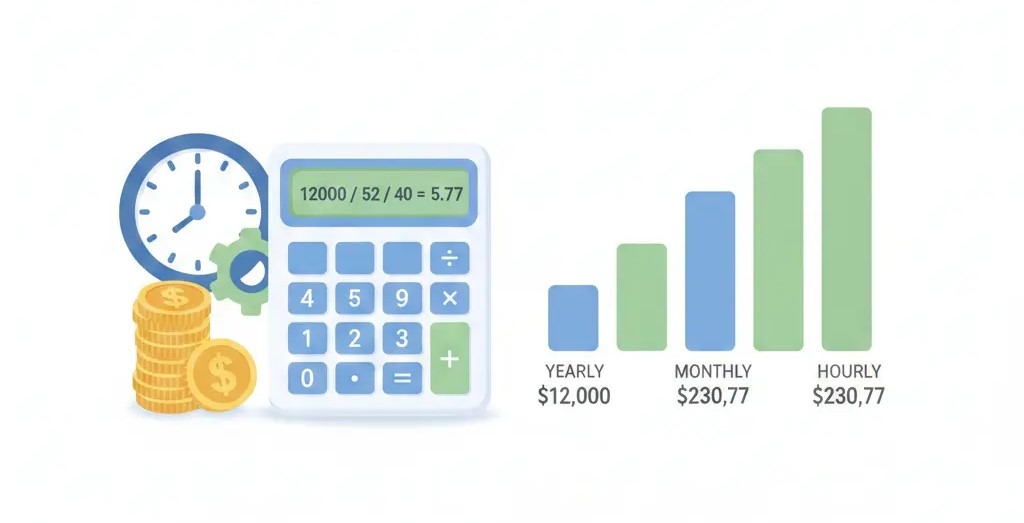
$12,000 a year equals $5.77 per hour (based on full-time 40 hours/week, 52 weeks/year).
Monthly: $1,000 (gross) | $900–$950 (take-home after minimal taxes).
Weekly: $231 (gross) | $208–$220 (take-home).
Biweekly: $462 (gross) | $415–$440 (take-home).
If you search 12 000 a year is how much an hour, you face real struggle. This guide speaks truth about life on this calculator income in 2026. You survive day-to-day, worry about bills, and seek ways out. You did not choose this—many jobs pay little. Learn exact numbers, daily reality, and proven steps forward.
The Brutal Reality: Your Take-Home Pay on $12,000 a Year
Job ads show $12,000 gross. Reality hits less.
Federal Taxes
At this level, single filers owe little or no federal income tax (standard deduction ~$15,000 in 2026 covers it).
FICA Taxes (Social Security + Medicare)
You pay 7.65%—about $918 yearly if employed. Self-employed pay double.
State Income Tax
No-tax states (Texas, Florida, Tennessee, Nevada, Washington, Wyoming, South Dakota, Alaska): Keep most.
Others: Minimal or zero at low income.
Your Real Annual Income
After deductions:
- Monthly take-home: $900–$950.
- Weekly: $208–$220.
- Biweekly: $415–$440.
This funds everything. Many qualify for refunds like EITC.
The Living Wage Gap: Why $12,000 Falls Short
MIT Living Wage Calculator shows single adult needs $35,000–$50,000+ yearly for basics (housing, food, transport, health)—no savings or extras.
$12,000 annually leaves you $20,000–$40,000 short most places.
Federal poverty line 2026: ~$15,650 single adult. You fall below. Family of four: ~$32,150—far below.
Federal minimum wage full-time: $15,080 ($7.25/hour). $12,000 signals part-time or below-minimum.
In rural low-cost areas: Barely covers shared basics.
In cities (Phoenix, Atlanta+): Impossible alone—need aid or multiple incomes.
Monthly Budget Reality: Living on $900–$950
Traditional advice fails here. 30% housing rule? Impossible.
Impossible Budget Example
Rent alone: $600–$800 cheapest areas. Add food $200, utilities $100, transport $100—exceeds income fast. No room for health or emergencies.
Survival Budget: What People Do
Housing ($300–$500):
- Live with family/parents.
- Share room in crowded house.
- Rent basement/garage spot. Food ($150–$200):
- Food banks/pantries weekly.
- Bulk cheap staples (rice, beans).
- Skip meals or eat minimal. Transport ($50–$100):
- Bus pass if available.
- Bike/walk.
- Borrow rides. Phone/Internet ($20–$40):
- Lifeline discount plans.
- Library for online needs. Healthcare ($0–$50):
- Medicaid if eligible.
- Free clinics.
- Skip care.
Total: $520–$890. Leaves tiny margin—one repair wipes it out.
The Poverty Trap: Why $12,000 Keeps You Stuck
Low income blocks escape.
Benefits Cliff
At $12,000, qualify for SNAP ($200–$300/month food), Medicaid (full coverage), EITC refund ($500–$1,000+). Raise to $15,000+ risks losing them—net worse off.
Time Poverty
Full-time leaves you exhausted—no energy for classes, better job search, or side work.
Debt Cycle
Emergencies hit credit cards, overdrafts ($35 fees), or payday loans (high interest). Interest eats future pay.
No Buffer
Can’t relocate, take unpaid training, or risk job gaps.
Common Situations Earning Around $12,000 in 2026
This income ties to:
- Part-time retail/cashier (15–20 hours minimum wage).
- Fast food/server (base pay, tips vary).
- Seasonal farm/event work.
- Student stipends/allowances.
- Disability supplements.
- Beginner gigs/internships.
- Home aides/childcare partial hours.
Often students, retirees, or supplements—not full careers.
Geographic Differences: Where $12,000 Stretches (Barely)
Rural low-cost (Mississippi, Arkansas, West Virginia): Shared housing $400–$500 possible. Basics tighter but doable with aid.
Mid-cost (parts Texas, Oklahoma): Struggle—need family support.
High-cost (California, New York, cities): Unlivable alone. Rent consumes all—require aid, roommates, or leave.
Side Hustles and Extra Income Reality
You need cash now—not long-term dreams. Realistic options:
Immediate:
- Plasma donation ($50–$100 twice weekly).
- Odd jobs (TaskRabbit, yard work). Quick:
- Babysitting/dog walking ($10–$15/hour).
- Thrift reselling small scale. Builds:
- More hours current job if possible.
- Gig apps flexible shifts.
Goal: Add $200–$500/month to bridge gaps.
Escaping $12,000: Proven Strategies
This is temporary—plan out.
Strategy 1: Job Hop to $15–$18/Hour
Apply warehouses (Amazon/UPS: $16+ start), grocery (Costco $15+), manufacturing. Emphasize reliability.
Strategy 2: Free/Low-Cost Training
- Forklift cert ($100–$300 → $15/hour warehouse).
- Phlebotomy/community programs → $16–$18 health.
- Workforce grants cover costs. Strategy 3: Apprenticeships/Unions Paid training: Electrician/plumber starts $15–$20, rises fast. No debt. Strategy 4: Employer Programs Big retailers (Walmart, Starbucks) offer free education—work part-time, study up. Strategy 5: Assistance First Maximize SNAP, Medicaid, EITC—frees money for training/savings.
Assistance You Qualify For: Use Every Resource
At $12,000:
SNAP (Food Stamps): $200–$300/month single. Covers groceries.
Medicaid: Full health in expansion states (most). Value $300+/month.
EITC: $600–$1,500 refund (more with kids).
Housing: Section 8 waitlists, local aid.
Utilities: LIHEAP discounts.
Others: Food banks, 211 hotline, free clinics.
Combined: Adds $400–$800 effective monthly. Apply now—you work and deserve support.
Mental and Health Toll of $12,000 Income
Constant worry drains you:
- Daily bank checks.
- Skipping needs.
- Isolation from costs.
- Higher stress, health risks.
Protect: Free clinics, crisis lines (741741 text), walks, library resources. Stress comes from situation—not you.
Long-Term Plan: From $12,000 to Stability
1-Year: Add income/side work → $18,000–$24,000. Build $500 emergency.
3-Year: Train/hop → $30,000–$40,000. Own basics, save small.
5-Year: Specialize → $40,000+. Buffer, retirement start.
Thousands escape yearly. View as start.
Frequently Asked Questions
How much is $12,000 a year monthly?
$1,000 gross. About $900–$950 after minimal taxes.
Is $12,000 a year livable?
Difficult alone. Possible with family support, aid programs, shared housing, and extreme budgeting. Not sustainable long-term without supplements.
What hourly rate matches $12,000 if part-time?
20 hours/week: $11.54/hour. 25 hours: $9.23/hour. More realistic for this income level.
Do you pay taxes on $12,000 a year?
Little or no federal income tax. FICA (7.65%) applies if employed—about $918 yearly.
Can you get government assistance on $12,000?
Yes—likely SNAP, Medicaid, EITC, housing help. Combined adds hundreds monthly.
What jobs pay around $12,000 a year?
Part-time minimum wage retail, food service, seasonal work, stipends, or disability supplements.
How to increase income from $12,000?
Add hours/gigs short-term. Long-term: Free certifications, job hop to warehouses/manufacturing, apprenticeships.
Is $12,000 below poverty line?
Yes—2026 federal guideline ~$15,650 single adult.
What if I work full-time at $12,000?
Effective $5.77/hour—below federal minimum $7.25. Often illegal unless exempt; check laws.
How much take-home if self-employed?
Lower—pay double FICA (~15.3%). Net closer to $10,000.
Final Thoughts
12 000 a year is how much an hour? $5.77 full-time gross—below poverty, minimums most places. Means tough choices, aid reliance, no margin.
But you contribute value. This wage reflects system gaps—not your worth.
Survive now: Budget extreme, claim assistance, add income. Plan escape: Train, hop jobs, build skills.
You can rise to breathing room, dignity, security. It takes effort and time—but possible. Thousands escape yearly. Start today. Data from BLS, HHS poverty guidelines (~$15,650 single 2026), MIT Living Wage, IRS (2026 updates).