Making $150 per hour puts you in the top income bracket in America. But what does this hourly rate actually mean for your annual earnings? This guide breaks down every aspect of a $150/hour salary, from gross income to take-home pay after taxes.
$150 Per Hour Annual Salary
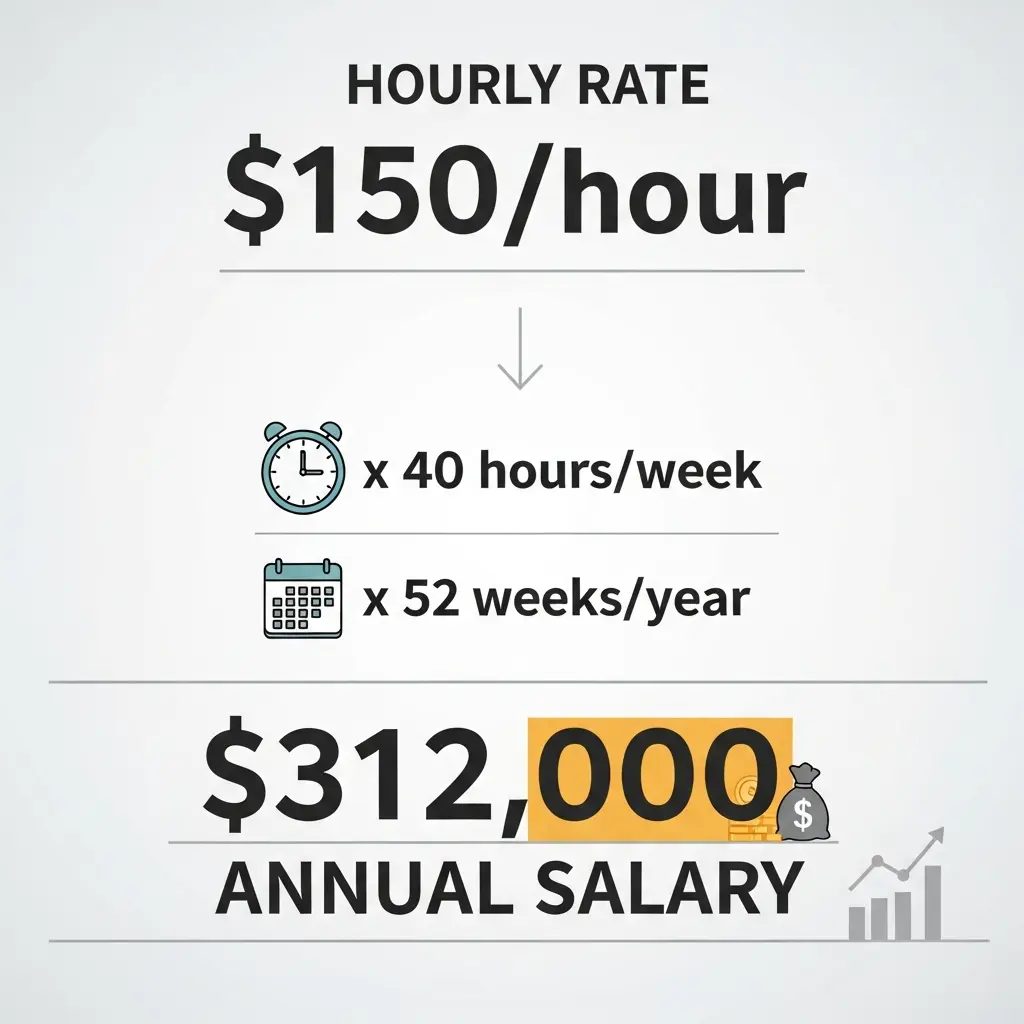
$150 an hour equals $312,000 per year when you work 40 hours per week for 52 weeks.
Here’s the simple math:
- $150 × 40 hours = $6,000 per week
- $6,000 × 52 weeks = $312,000 per year
This figure represents your gross income before any deductions. Your actual take-home pay will be lower after federal taxes, state taxes, and FICA contributions. Use our Utah salary calculator to see your exact after-tax pay.
How to Calculate $150 an Hour to Yearly Salary
Standard Full-Time Calculation
The standard work year contains 2,080 hours. Here’s how you arrive at that number:
- 40 hours per week × 52 weeks = 2,080 hours
- $150 × 2,080 hours = $312,000 per year
This method assumes you work every single week of the year without any time off.
Accounting for Unpaid Time Off
Most jobs don’t provide paid vacation to hourly workers. If you take two weeks of unpaid vacation:
- 50 weeks × 40 hours = 2,000 hours
- $150 × 2,000 hours = $300,000 per year
Three weeks of unpaid vacation drops your income even further:
- 49 weeks × 40 hours = 1,960 hours
- $150 × 1,960 hours = $294,000 per year
Including Paid Time Off and Holidays
If your employer provides paid vacation and holidays, your annual income stays at $312,000 even when you’re not working. Most professionals at this pay level receive:
- 10 paid holidays per year
- 2-4 weeks of paid vacation
- Paid sick days
This makes salaried positions or contract work with PTO far more valuable than straight hourly rates.
Calculating Actual Working Days in 2026
2026 contains 365 days. After removing weekends and typical holidays:
- Total days: 365
- Weekends: 104 days
- Federal holidays: 11 days
- Working days: 250 days
If you work 8 hours per day: 250 × 8 × $150 = $300,000
This real-world calculation accounts for the fact that you won’t work every single day of the year.
$150 Per Hour Breakdown by Pay Period
Daily Income
Working 8 hours per day at $150/hour gives you:
$1,200 per day
This daily rate helps you understand project-based work or freelance gigs. If someone hires you for a three-day project, you’ll earn $3,600.
Weekly Income
A standard 40-hour work week generates:
$6,000 per week
This weekly breakdown helps with short-term budgeting and cash flow planning.
Bi-Weekly Income
Most employers pay every two weeks. Your bi-weekly paycheck shows:
$12,000 per bi-weekly period
Remember, this represents gross pay. Your actual paycheck will be significantly lower after deductions.
Monthly Income
Monthly income varies slightly depending on the calculation method:
$26,000 per month (using 52 weeks ÷ 12 months)
Some calculators use 173.33 hours per month (2,080 hours ÷ 12 months), which also gives approximately $26,000.

Quarterly Income
For quarterly tax planning or contract work:
$78,000 per quarter
This figure helps self-employed professionals and contractors plan their estimated tax payments.
$150 an Hour After Taxes: Your Real Take-Home Pay
Federal Income Tax on $312,000
At $312,000 per year, you fall into the 35% federal tax bracket for 2026. Use our salary to hourly calculator to see your effective rate for any income level.
The U.S. uses a progressive tax system. For a single filer in 2026, federal taxes work like this:
- 10% on income up to $11,925
- 12% on income from $11,926 to $48,475
- 22% on income from $48,476 to $103,350
- 24% on income from $103,351 to $197,300
- 32% on income from $197,301 to $250,525
- 35% on income from $250,526 to $626,350
Your effective federal tax rate will be approximately 28-30%, not 35%.
Using the standard deduction of $16,100 for single filers in 2026, your taxable income drops to $295,900. Federal taxes on this amount equal roughly $83,000-$87,000, depending on your specific deductions.
FICA Taxes (Social Security and Medicare)
FICA taxes hit everyone who earns wages:
Social Security Tax:
- Rate: 6.2%
- 2026 wage cap: $184,500
- You pay: $11,439 (only on the first $184,500)
Medicare Tax:
- Rate: 1.45% on all income
- You pay: $4,524
Additional Medicare Tax:
- Rate: 0.9% on income over $200,000
- You pay: $1,008 (on the $112,000 above the threshold)
Total FICA: $16,971
State Income Tax Breakdown
State taxes vary dramatically. Here are examples from major states:
California
- Top state rate: 12.3% (plus 1% mental health tax over $1 million)
- Estimated state tax: $28,000-$32,000
- Total after-tax income: $190,000-$195,000
- Monthly take-home: $15,800-$16,250
New York
- Top state rate: 10.9%
- Estimated state tax: $24,000-$27,000
- Total after-tax income: $200,000-$205,000
- Monthly take-home: $16,600-$17,000
Texas (No State Income Tax)
- State tax: $0
- Total after-tax income: $212,000-$216,000
- Monthly take-home: $17,600-$18,000
Florida (No State Income Tax)
- State tax: $0
- Total after-tax income: $212,000-$216,000
- Monthly take-home: $17,600-$18,000
Illinois
- Flat state rate: 4.95%
- Estimated state tax: $14,600
- Total after-tax income: $210,000-$214,000
- Monthly take-home: $17,500-$17,800
Sample Take-Home Pay Calculation (Texas, Single Filer)
Let’s walk through a complete example:
- Gross annual income: $312,000
- Federal income tax: -$85,000
- Social Security tax: -$11,439
- Medicare tax: -$4,524
- Additional Medicare: -$1,008
- State income tax: $0
Net annual income: $210,029 Net monthly income: $17,502 Effective tax rate: 32.7%
$150/Hour Salary Comparison & Context
How Does $150/Hour Compare to Average US Wages?
The median hourly wage in the US is $15.35 in 2025. At $150 per hour, you earn nearly 10 times the median wage.
This places you well within the top 10% of all American earners. Any wage above $53.03 per hour puts you in the top 10% of U.S. workers.
What Percentile is $312,000 Annually?
According to recent income data, $312,000 per year puts you in approximately the top 2-3% of household incomes in America.
For perspective:
- Top 50%: $46,000+
- Top 25%: $85,000+
- Top 10%: $173,000+
- Top 5%: $250,000+
- Top 2%: $310,000+
Industries and Jobs Paying $150+ Per Hour
These fields commonly offer $150/hour or higher:
Medical Professionals:
- Anesthesiologists
- Surgeons
- Radiologists
- Specialized physicians
Legal Professionals:
- Senior partners at law firms
- Corporate attorneys
- Trial lawyers
Technology:
- Senior software architects
- Chief technology officers
- AI/machine learning specialists
- Cybersecurity consultants
Business Consultants:
- Management consultants
- Strategy consultants
- M&A advisors
Specialized Contractors:
- Underwater welders
- Oil rig specialists
- Aviation consultants
- Expert witnesses
Part-Time and Alternative Work Schedules
$150 an Hour at 30 Hours Per Week
Many high-earning professionals work reduced hours:
- 30 hours × $150 = $4,500 per week
- $4,500 × 52 weeks = $234,000 per year
This schedule gives you better work-life balance while still earning well above the national average.
$150 an Hour at 20 Hours Per Week
Part-time work at this rate still generates substantial income:
- 20 hours × $150 = $3,000 per week
- $3,000 × 52 weeks = $156,000 per year
This works well for semi-retired professionals or those balancing multiple ventures.
$150 an Hour with Overtime
If you earn overtime (time and a half), your rate jumps to $225/hour for overtime work.
Working 50 hours per week (10 hours overtime):
- Regular: 40 × $150 = $6,000
- Overtime: 10 × $225 = $2,250
- Weekly total: $8,250
- Annual total: $429,000
Budgeting on $150 an Hour
Monthly Budget Example (Texas, $17,500 Take-Home)
Here’s a realistic monthly budget using the 50/30/20 rule:
Needs (50% = $8,750):
- Housing: $3,500
- Utilities: $300
- Groceries: $800
- Transportation: $600
- Insurance (health, auto, life): $1,200
- Debt payments: $500
- Emergency fund contribution: $1,850
Wants (30% = $5,250):
- Dining out: $1,200
- Entertainment: $800
- Hobbies: $600
- Travel fund: $1,500
- Shopping: $650
- Subscriptions: $500
Savings & Investments (20% = $3,500):
- 401(k): $1,917 (to max out at $23,000/year)
- Roth IRA: $583 (to max out at $7,000/year)
- Taxable investments: $1,000
Housing Affordability at $312,000
Using the 28/36 rule (spend no more than 28% of gross income on housing):
- Maximum monthly housing cost: $7,280
- This supports a home price of $1.4-$1.6 million depending on your down payment and interest rates
At $312,000 annual income, you can comfortably afford:
- Monthly rent: $5,000-$7,000
- Monthly mortgage payment: $6,000-$7,000
Recommended Savings Rate
Financial experts recommend saving 20-30% of your income. At $17,500 monthly take-home:
- Minimum (20%): $3,500/month = $42,000/year
- Recommended (25%): $4,375/month = $52,500/year
- Aggressive (30%): $5,250/month = $63,000/year
Investment Strategies for $312,000 Earners
Tax-Advantaged Accounts:
- Max out 401(k): $23,000/year (2026 limit)
- Max out Roth IRA: $7,000/year
- HSA contributions: $4,300/year (if eligible)
- Total tax-advantaged: $34,300/year
Additional Investment Options:
- Taxable brokerage account
- Real estate investments
- 529 plans for children
- Backdoor Roth conversions
- Municipal bonds for tax efficiency
Wealth-Building Timeline:
Saving $50,000/year at 8% average returns:
- 5 years: $293,000
- 10 years: $724,000
- 15 years: $1.36 million
- 20 years: $2.29 million
Converting Similar Salaries to Annual Income
$125 Per Hour to Annual Salary
$125 × 2,080 hours = $260,000/year · Monthly: $21,667
$140 Per Hour to Annual Salary
$140 × 2,080 hours = $291,200/year…
$140 Per Hour to Annual Salary
- $140 × 2,080 hours = $291,200/year
- Monthly: $24,267
$145 Per Hour to Annual Salary
- $145 × 2,080 hours = $301,600/year
- Monthly: $25,133
$155 Per Hour to Annual Salary
- $155 × 2,080 hours = $322,400/year
- Monthly: $26,867
$160 Per Hour to Annual Salary
- $160 × 2,080 hours = $332,800/year
- Monthly: $27,733
$175 Per Hour to Annual Salary
- $175 × 2,080 hours = $364,000/year
- Monthly: $30,333
$200 Per Hour to Annual Salary
- $200 × 2,080 hours = $416,000/year
- Monthly: $34,667
Frequently Asked Questions
Is $150 an hour good pay?
Yes, $150 per hour represents excellent pay. This rate puts you in the top 2-3% of earners nationally and is nearly 10 times the median wage. You’ll earn more in a single year than most Americans earn in three years.
What is $150 per hour after taxes?
Your take-home pay depends on your state. In Texas or Florida (no state tax), expect $210,000-$216,000 annually ($17,500-$18,000 monthly). In California, expect $190,000-$195,000 annually ($15,800-$16,250 monthly). In New York, expect $200,000-$205,000 annually ($16,600-$17,000 monthly).
How much is $312,000 a year per month?
Before taxes, $312,000 divided by 12 months equals $26,000 per month. After taxes, expect $15,800-$18,000 per month depending on your state and filing status.
What careers pay $150 an hour or more?
Medical doctors (especially surgeons and anesthesiologists), senior attorneys, technology executives, management consultants, specialized engineers, and skilled contractors in dangerous fields can earn $150+ per hour.
How do I calculate hourly to annual salary?
Multiply your hourly rate by the hours you work per week, then multiply by 52 weeks. For full-time work: Hourly rate × 40 hours × 52 weeks = Annual salary.
Does $150/hour include benefits?
Not usually. Hourly rates typically represent just your wages. Benefits like health insurance, retirement matching, paid time off, and bonuses come on top of this. Total compensation could reach $350,000-$400,000 when including comprehensive benefits.
Can I negotiate a higher hourly rate?
Yes, especially in consulting, freelancing, and specialized technical fields. Research market rates, document your value, and present competing offers. Experienced professionals can often negotiate 10-20% increases.
Is it better to be salaried or hourly at this rate?
Salaried positions at equivalent pay ($312,000/year) typically offer better benefits, paid time off, and more job security. Hourly work offers flexibility and overtime pay but often lacks benefits. Choose based on your priorities.
Conclusion:
Earning $150 per hour translates to a substantial gross annual salary of $312,000 assuming a standard 40-hour work week for 52 weeks a year . This is the figure before any taxes or deductions. The corresponding gross monthly pay would be approximately $26,000, and the weekly pay would be $6,000 .
It’s important to note that this $312,000 is your gross income. Your actual take-home pay will be significantly lower after federal and state taxes, Social Security, Medicare, and any other deductions are applied . The final amount you receive depends heavily on personal factors like your tax filing status, state of residence, and voluntary deductions such as retirement contributions .
The calculation assumes consistent full-time work. Your actual annual earnings will be lower if you take unpaid time off . Conversely, working overtime or more than 52 weeks would increase your total income.
I hope this breakdown clarifies the annual figure. If you are curious, I can help you estimate your approximate take-home pay after taxes by using standard assumptions for your state and filing status. For a full comparison of every common hourly rate, see our complete salary conversion guide.