If you want to know 165 an hour is how much a year, the direct answer is $343,200 in gross income based on a standard 40-hour workweek across 52 weeks. But that number shifts depending on hours worked, paid time off, and your employment status. A W-2 employee, a freelancer, and a part-time worker at $165/hr all end up with very different take-home pay and salary to hourly calculator. This guide breaks down every scenario, state by state, hour by hour, so you can make smart decisions whether you are negotiating a job offer, pricing a contract, or planning a budget.
$165/Hour at a Glance
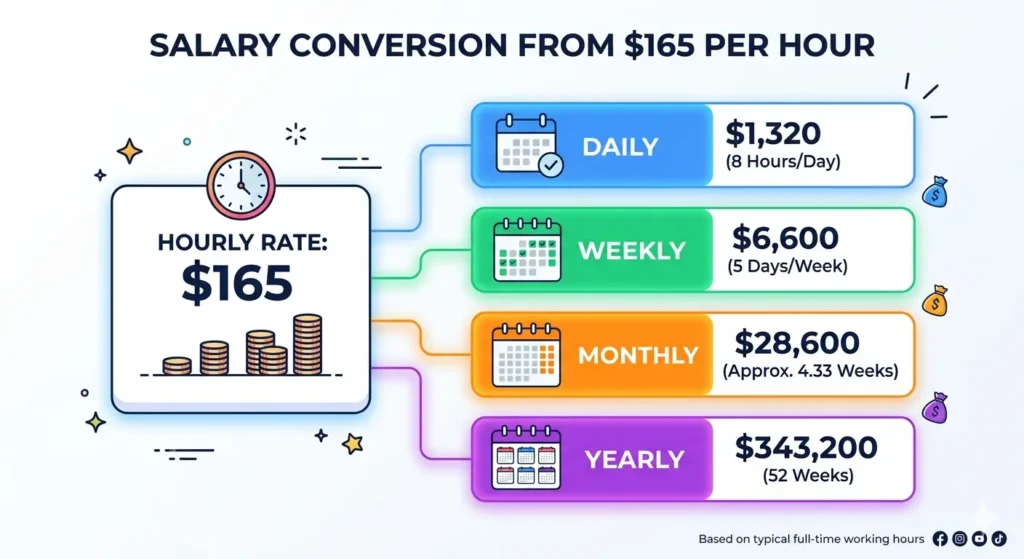
At $165/hr on a full-time schedule, your gross income breaks down across every pay period. Your daily rate at 8 hours is $1,320. Your weekly pay at 40 hours is $6,600. Your biweekly paycheck lands at $13,200. Semi-monthly pay comes to $14,300. Your monthly income reaches $28,600. And your annual figure at 2,080 hours is $343,200.
Most salary calculators show slightly different annual totals. Sites like Talent.com use 2,080 hours (52 weeks x 40 hours), while others use 2,000 hours (50 weeks). The $13,200 gap comes entirely from how each site handles paid vacation. Knowing which assumption fits your actual schedule matters before you build any financial plan around this rate.
How Hours Worked Changes Your Annual Total
Your actual annual salary depends entirely on how many hours and weeks you put in. The standard 2,080-hour assumption does not fit everyone. Part-timers, contractors, and workers with unpaid leave all land at different numbers.
Full-Time Employee: 52 Weeks vs. 50 Weeks
At 2,080 hours (52 weeks, 40 hours per week), you earn $343,200 gross. At 2,000 hours (50 weeks), you earn $330,000. The difference is $13,200, which equals two weeks of lost hourly wage. If your employer offers paid time off, you still collect your full $343,200. If you take two weeks unpaid, your actual gross drops to $330,000. Check your employment contract and know exactly which scenario applies to you before making any financial projections.
Part-Time at $165/Hour
Working part-time at $165/hr still puts you well above most full-time salaries in the United States. Here is what your gross income looks like at reduced hours, assuming 52 paid weeks:
- 20 hours per week: $171,600 per year
- 25 hours per week: $214,500 per year
- 30 hours per week: $257,400 per year
These figures assume 52 paid weeks. Adjust them downward for any unpaid time off you take throughout the year.
165 an Hour Is How Much a Year After Holidays?
The U.S. has 11 federal holidays. If your employer gives you those days unpaid, you work roughly 2,008 hours per year instead of 2,080. At $165/hr, that produces $331,320 in gross income, not $343,200. Paid holidays keep you at the full $343,200. Most salaried employees get paid holidays. Most hourly contractors do not. Verify your contract terms before assuming either number applies to you.
What Is $165 an Hour After Taxes? Your Real Take-Home Pay
Gross income tells you what you earn. Net income tells you what you actually keep. At $343,200, you sit in a high federal tax bracket, and your take-home pay drops considerably depending on your filing status and the state you live in.
Federal Income Tax on $343,200
The IRS taxes income in brackets, not at one flat rate. For a single filer in 2025, $343,200 pushes you into the 35% marginal tax rate bracket on income above $243,725 (IRS Revenue Procedure 2024-61). Your effective tax rate across all income lands around 28 to 30%, meaning you do not pay 35% on every dollar earned.
- Estimated federal tax owed: $90,000 to $97,000
- After federal tax alone: approximately $246,000 to $253,000
Married filing jointly lowers your tax burden noticeably. Pre-tax deductions like 401(k) contributions (up to $23,500 in 2025 per IRS limits) and HSA deposits (up to $4,300 for individuals in 2025) directly reduce your taxable income before the IRS calculates what you owe. Use both to protect more of your earnings.
FICA: Social Security and Medicare
FICA taxes stack on top of federal income tax. As a W-2 employee, your employer splits these costs with you.
- Social Security: 6.2% on the first $176,100 of wages (2025 wage base) = $10,918
- Medicare: 1.45% on all earnings = $4,976
- Additional Medicare Tax: 0.9% on income above $200,000 for single filers = $1,278
- Total FICA burden (employee share): approximately $17,172
Your employer matches your Social Security and Medicare contributions, which adds value to your total compensation package. As a 1099 contractor, you cover both sides yourself.
State Income Tax: Where You Live Changes Everything
Your state of residence shapes your take-home pay more than most people expect. Here is how $343,200 gross plays out across major states. Texas and Florida carry no state income tax, leaving you with an estimated $228,000 to $233,000. California taxes top earners at 13.3%, cutting your take-home to around $182,000 to $188,000. New York tops out near 10.9%, landing you at roughly $191,000 to $197,000. Illinois applies a flat 4.95% rate, bringing your take-home to approximately $211,000 to $217,000.
These are estimates for single filers. Your final number shifts based on local taxes (New York City adds its own layer on top of state tax), filing status, and any deductions you claim. Use the IRS Withholding Estimator at irs.gov or a licensed CPA for a precise figure.
Total Estimated Take-Home Pay at $165/Hour
Here is a clean summary of estimated annual take-home by scenario: net income calculator
- Single filer, no state income tax (Texas, Florida): $228,000 to $233,000
- Single filer in California: $182,000 to $188,000
- Single filer in New York: $191,000 to $197,000
- Married filing jointly (Texas): up to $248,000 depending on deductions
Maximizing pre-tax deductions is the single most effective way to reduce your tax liability at this income level. A 401(k), HSA, and dependent care FSA together can push tens of thousands of dollars out of your taxable bracket.
$165/Hour as a Freelancer or Independent Contractor: What Changes?
This section is what most salary breakdown articles skip entirely. The freelancer and contractor reality at $165/hr looks completely different from a W-2 paycheck, and the gap catches many new contractors off guard.
Self-Employment Tax: The Cost Most Calculators Ignore
As a W-2 employee, your employer covers half of your FICA taxes. As a 1099 contractor, you pay the full 15.3% self-employment tax yourself on net earnings up to $176,100, then 2.9% on everything above that.
On $343,200 gross, self-employment tax runs approximately $27,000 before deductions. The IRS lets you deduct half of SE tax from gross income before calculating federal income tax, which reduces your taxable income slightly. Even with that deduction, your total tax burden as a contractor far exceeds what a W-2 employee pays at the same gross income.
Billable vs. Non-Billable Hours: The Reality Check
Most freelancers do not bill 2,080 hours per year. The real-world average for independent workers runs between 1,200 and 1,400 billable hours annually, according to the Freelancers Union 2023 Freelancing in America report. The rest goes to admin tasks, client outreach, proposals, revisions, and downtime between projects.
At 1,300 billable hours, your actual gross income at $165/hr drops to $214,500, not $343,200. That is a $128,700 difference in annual earnings. Plan your financial life around realistic billable hours, not a theoretical maximum that assumes zero downtime.
Quarterly Estimated Taxes: What Freelancers Must Know
The IRS expects independent contractors to pay taxes four times per year. Miss a payment and penalties stack on top of your tax bill. The 2025 due dates are April 15, June 16, September 15, and January 15, 2026 (IRS Publication 505).
At $214,500 gross (realistic billable hours scenario), set aside 30 to 35% of every client payment for taxes. That means reserving $65,000 to $75,000 per year before you allocate the rest. Keep this money in a separate savings account and treat it as untouchable until each quarterly estimated tax payment comes due.
True Salary Equivalent: Contractor vs. Employee at $165/Hour
A $165 an hour salary for a W-2 employee includes benefits that contractors must fund themselves. Here is the true cost comparison:
- Employer-sponsored health insurance: $7,000 to $15,000 per year in value
- 401(k) employer match at 3 to 6% of salary: $6,500 to $13,000 per year
- Paid time off (10 to 15 days): $13,200 to $19,800 in unpaid income for contractors
- Employer’s share of FICA: $17,172 per year
Add those up and a $165/hr contractor needs to earn $185 to $200/hr just to match the total compensation a W-2 employee at the same rate receives. Factor this into every contract negotiation.
Is $165 an Hour a Good Wage? What This Salary Actually Gets You
Income Percentile: Where Does $343,200 Rank?
The U.S. Bureau of Labor Statistics reports the median hourly wage for all workers at $23.10 in 2024. Any rate above $53/hr places you in the top 10% of U.S. earners. At $165/hr, you sit above the 95th income percentile. This is not a common wage. Most U.S. workers never reach this level at any point in their career.
Monthly Budget at $165/Hour Take-Home
Using a take-home estimate of $19,000 per month (single filer, moderate-tax state), here is what your monthly budget realistically looks like:
- Housing at 30%: $5,700 per month covers a strong mortgage or quality rental in most U.S. cities
- Transportation: $1,500 per month covers a car payment, insurance, gas, or rideshare costs
- Food: $1,200 per month covers groceries and regular dining out
- Savings and investments: $4,000 or more per month toward long-term wealth
- Discretionary spending: $3,000 or more for travel, entertainment, and lifestyle expenses
This monthly income level lets you save hard, live well, and build real wealth in nearly every U.S. metro outside of San Francisco or Manhattan.
Cost of Living Comparison: Where Does $165/Hour Stretch Furthest?
In low cost-of-living states like Texas, Tennessee, Ohio, and Florida, $19,000 per month in take-home creates exceptional financial security. You can buy a home, max out retirement accounts, build an emergency fund, and still carry significant spending money every month.
In high-cost metros like San Francisco, New York City, and Los Angeles, the same take-home still provides a comfortable life, but the margin between income and expenses tightens fast. Housing alone eats 40 to 50% of monthly take-home in those markets. Your living wage advantage shrinks quickly the further west and north you move on the coast.
What Jobs Pay $165 an Hour?
$165/hr belongs to specialized, high-demand fields where expertise commands a serious premium. Here is where this rate appears in the real job market.
In medicine, anesthesiologists, orthopedic surgeons, and specialist physicians regularly bill at or above this rate. The Bureau of Labor Statistics reports median annual pay for anesthesiologists above $239,000, well above $100/hr even at standard hours.
In technology, senior software architects, principal engineers, and AI/ML engineers at top-tier companies earn hourly contract rates in this range. Specialized freelance AI engineers and data scientists with niche skills command $150 to $250/hr in the current market, according to the Toptal 2024 Developer Rate Report.
In law and finance, M&A attorneys at major firms, senior financial advisors managing high-net-worth portfolios, and fractional CFOs working with growth-stage companies all operate in the $150 to $250/hr range.
In consulting, partners at McKinsey, BCG, and Bain bill client rates well above $165/hr. Independent management consultants with 10 or more years of industry-specific experience reach this range regularly.
In design and creative fields, senior UX designers and brand strategists with deep specialized portfolios command $100 to $200/hr on platforms like Toptal and Gun.io.
How to Calculate If 165 an Hour Is How Much a Year for Your Situation
The formula takes 30 seconds and works for any schedule. Multiply your hourly rate by your weekly hours, then by the number of weeks you work per year.
Hourly Rate x Hours Per Week x Weeks Per Year = Annual Gross Income
- 165 x 40 x 52 = $343,200 (standard full-time, paid vacation)
- 165 x 40 x 50 = $330,000 (full-time, two weeks unpaid)
- 165 x 30 x 52 = $257,400 (30 hours per week, full year)
- 165 x 20 x 52 = $171,600 (20 hours per week, full year)
Adjust the week’s number for any unpaid time off you plan to take. This gives you an accurate gross income figure to work from before factoring in federal tax, state tax, and FICA. hourly pay calculator
Conclusion
Whether $165 an hour is how much a year lands at $343,200 or $214,500 depends on one key variable: how many hours you actually bill and get paid for. Your gross figure changes with hours, weeks, and holiday policies. Your net income changes with your state, filing status, and how aggressively you use pre-tax deductions. A no-tax-state W-2 employee keeps $233,000. A California freelancer working 1,300 billable hours might keep closer to $130,000 to $145,000 after all taxes and business costs.
At this income level, every financial decision carries weight. Max out your 401(k) and HSA, understand your state tax impact, and if you work as an independent contractor, price self-employment taxes and missing benefits into every rate you quote. $165/hr is an exceptional rate by any standard. Your goal is to structure your finances to actually keep as much of it as possible.